The North West of Iran is the most ethnically diverse region of the country. Whereas the Persian or Fars people are the largest ethnic group within the 86 million Iranian population as a whole with 51%, the majority of people in the North West are Azeri people. The North West of Iran has been a passageway and a residential region from the age of primitive humans and the Azeri people are among the oldest of the Aryan race. Other people in the North West are Kurds, Arabs, as well as the Persians of course.
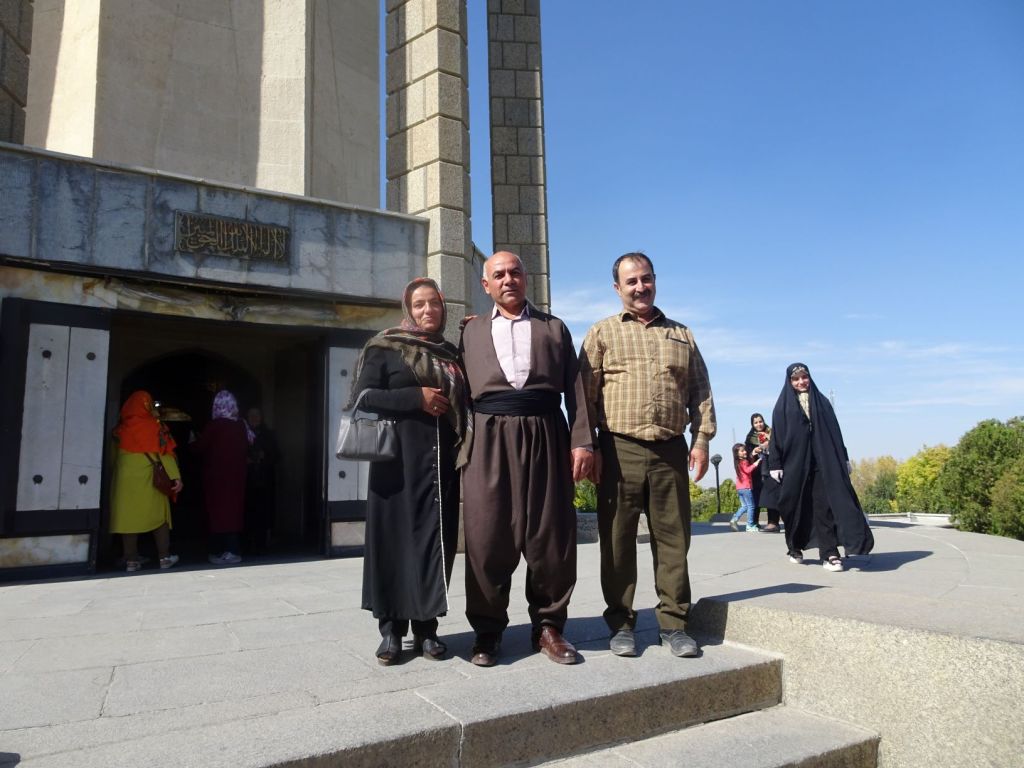
The region was much affected by the Iran-Iraq war which started when Saddam Hussein invaded the Iranian prince of Khuzestan in search of a corridor to the Persian Gulf. The war lasted for almost eight years between 1980 and 1988.
The province of Azerbaijan in the far North West borders with the republic of Azerbaijan, Armenia, Turkey and Iraq. The original province included the whole of the Republic of Azerbaijan, and areas now in Turkey, but territory was lost during the Qajar dynasty to Russia during the Iranian – Russian wars in the 19th century.
Hamadan is an ancient city in the North West, and is one of the oldest in Iran. It was the summer capital of the Achaemenid Empire between 520 and 330 BC.
October 8
We set off early because we have received messages to say we must hand in our passports in Hamadan for a visa extension before 2 pm. No time to visit the castle in Khorammabad we pass. This, we hear later, is a very old structure that has been continuously extended and still is. A kind of ‘living monument’. The road is good and the views amazing. There are mountains on both sides and now and again we cross a range over a pass. The potato harvest is in full swing.
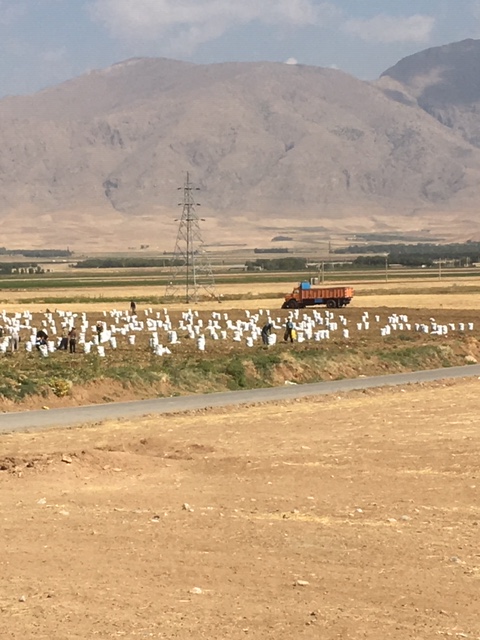
We drive without stop until we get to Bisotun. We have to persuade a guard to let us through the gates (does he want money?) to get to the Caravanserai Hotel where the others are parked up.
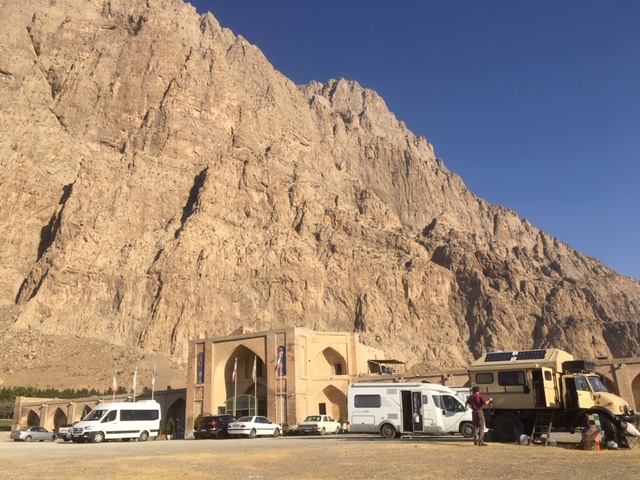
The rocky outcrops of Bisotun had to be passed by every trader on the Silk Road who travelled towards the passageway in the North West. King Darius passed there when he moved his residency every year from his spring palace in Persepolis after the Nowruz celebrations to his summer palace in Hamadan, and passed again in the Autumn when he moved south from Hamadan to Susa.
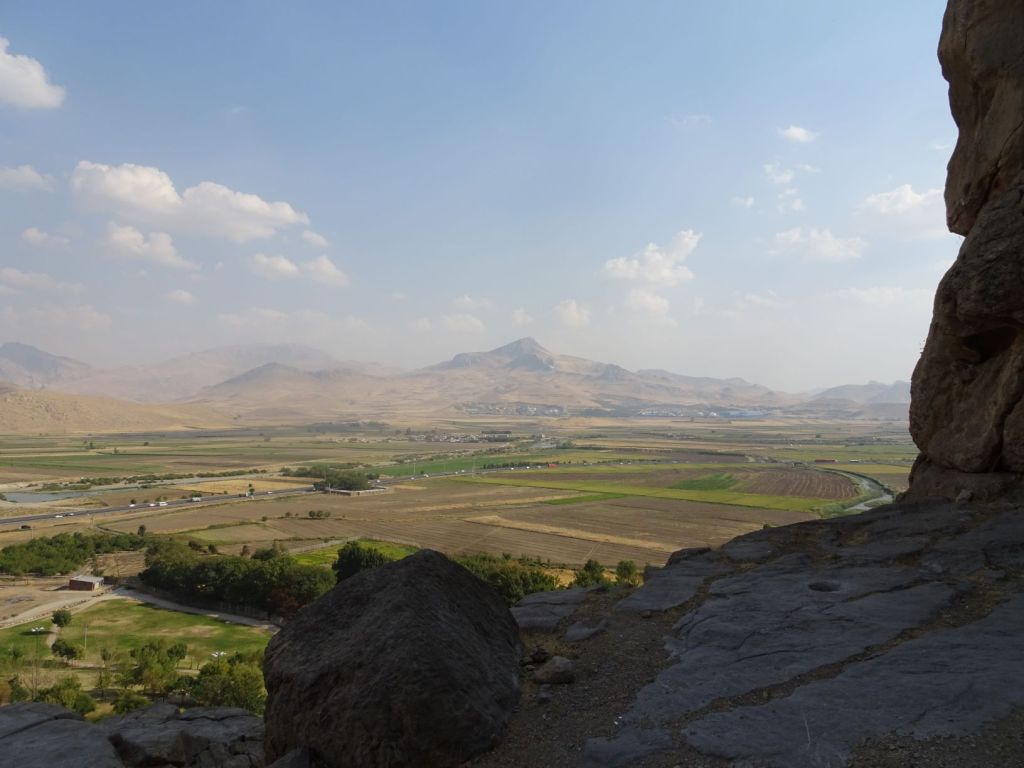
Bisotun has an extraordinary rock relief which was not accessible close up at the time of our visit and we therefore do not have a photograph. However, it is worth describing what the relief is about. The following is taken from the book ‘Iran; Empire of the mind’ by Michael Axworthy which we would warmly recommend to anybody who wants to understand Iran culturally and politically:
” Cyrus was succeeded by his son Cambyses, who extended the empire by conquering Egypt, but in a short time gained a reputation for harshness. He died unexpectedly in 522 BCE, according to one source by suicide, after he had been given news of a revolt in the Persian heartlands of the empire.
An account of what happened next appears on a extraordinary rock relief carving at Bisotun, in western Iran, about twenty miles from Kermanshah, above the main road to Hamadan. According to the text of the carving (executed in old Persian, Elamite and Babylonian) the revolt was led by a Magian priest, Gaumata, who claimed falsely to be Cambyses’s younger brother Bardiya. Herodotus gives a similar version, saying that Cambyses had murdered the true Bardiya some years earlier. The revolt led by Gaumata seems to have drawn force from social and fiscal grievances, because one of his measures to gain popularity was to order a three-year remission of taxes, and another to end military conscription. Pressure had built up over the decades of costly foreign wars under Cyrus and Cambyses. But Gaumata also showed strong religious enthusiasm or intolerance, because he destroyed the temples of sects he did not approve of.
An Iranian revolution, led by a charismatic cleric, seizing power from an oppressive monarch, asserting religious orthodoxy, attacking false believers, and drawing support from economic grievances – in the sixth century BCE.
How modern that sounds.”
The rock carving depicts Darius standing on his opponent Gautama. In front of Darius is a line of eight vanquished rulers paying homage. The winged symbol of Ahura-Mazda hovers above the figures and is surrounded by 1200 lines of text in three languages. The text was copied and distributed to all the provinces in the Achaemenid Empire.
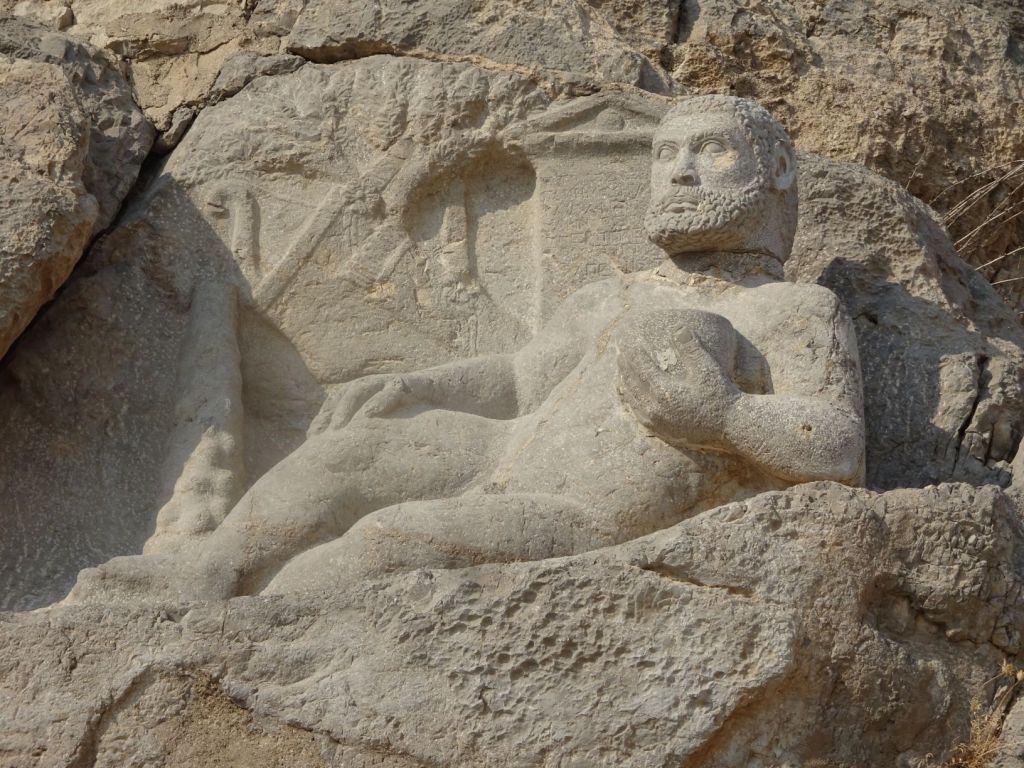
Underneath this magnificent relief is a statue of Hercules. It dates from 153 BC late in the Seleucid period around the time of the Parthian uprising. When you think of Hercules as a giant strong man, the statue comes over as rather dwarf-like, and looks rather pathetic. Hercules lying down, only 1.47 metres long, his head a copy and glued on ( the original was stolen but recovered and is now in a museum), and he has been robbed of his penis after the revolution of 1979….
When we arrive at the Caravansarai the group has just finished a guided tour and are having tea with the guide in another building behind. We are unsure whether we can join and how our decision to go to Susa against advice has gone down. But we have no choice, we must hand in our passports. There is little small talk with us, things are still a little frosty it seems, but Paul kindly takes us back to the sculptures and reliefs on the rock face. They are not as impressive as the ones we saw earlier, but this is just a sign of how spoiled we have been on this trip. Surely the relief of Darius and Gautama would have been of the same quality if only we could have seen it close up.
Then it is time for a nice shower in the hotel room we have at our disposal and we have dinner with the group outside from a ‘take away’. We are surprised nobody is asking us about our experiences in Susa. But dinner is good, we engage in conversation and we do feel part of the group again.
October 9
We are off to Hamadan today, the summer capital of the Achaemenid Empire. There is a temple to visit on the way, but just as we are parking up we get a message that we need to hurry up to get to the visa office in Hamadan where we all have to sign our documents. What a shame, just when we thought we could take it a little easier. A mad dash drive to get to the visa office in time is the result and we cannot park there and worry about our start problem so we have to find a downward sloping streets. One of us stays in the car, double parked, with foot on brake and then we change over. All this stress for one day extra in Iran. It is a shame, because in the end it has taken our guides Hannie and Theo a full day to get the extension. But we are all done, just in time before the office closes and off to our camping spot we go.
But this is even stranger. We thought we would be camping near a hotel and indeed we do, but the hotel is at a crazily busy and complex intersection of roads and has no proper parking place. So we are camping a little further along on a public parking space with picnic places. It all sounds good, but we do not understand why this park is so busy. Police is directing traffic and there are people everywhere in cars and on foot carrying a lot of luggage and setting up camp.
They are pilgrims. It is the time of Arba’een Pilgrimage. Buses depart from this very spot continuously to take people to Karbala, south west of Baghdad in Iraq some 725km away. The Arba’een is the largest annual gathering in the world, and is held at the end of the 40 day morning period following Ashura, the religious ritual for he commemoration of martyrdom of the grandson of Prophet Mohammad and the third Shia Muslim Imam, Husein Ibn Ali’s in 680.
The Mog is surrounded by old and young who want to see inside. A young woman and her husband want to know all about it. It is a strnage experience to see such a brilliant smile with beautiful eyes and perfect white teeth radiating out of a figure in black clothing, head covered in black chador. Very confusing…
How on earth are we going to manage to sleep here? Something to worry about later as first we go on our guided tour. The female guide has helped all morning getting our visa extensions sorted and now she is showing us some of the sights of the city. Unfortunately we have to stay close to the visa office as not all documents have been returned to us and we go back twice to get them! So the tour is a bit restricted. We see yet another shrine for a poet (we should not be complacent, these are highly revered figures in Iran, but as we do not know their works and cannot read Farsi we don’t fully understand their significance). We visit the Jewish synagogue and learn there are only some 25 Jewish people living in Hamadan now. The rabbi is in charge of the tomb of Esther and Mordecai which is on the same site, but he cannot let us see inside as it is a Friday. There are special moments when one of the group asks the rabbi questions that reveal her knowledge of Jewish customs and they immediately strike up a rapport. A big hug results on our departure.
Then we go to see what we are most interested in in Hamadan: the shrine for a scientist and medic!
Ibn Sina, known in the west as Avicenna, was a Persian polymath and is considered the father of modern medicine. He was born 980 AD In Uzbekistan but moved to Hamadān where he practiced until he died in 1037 AD.
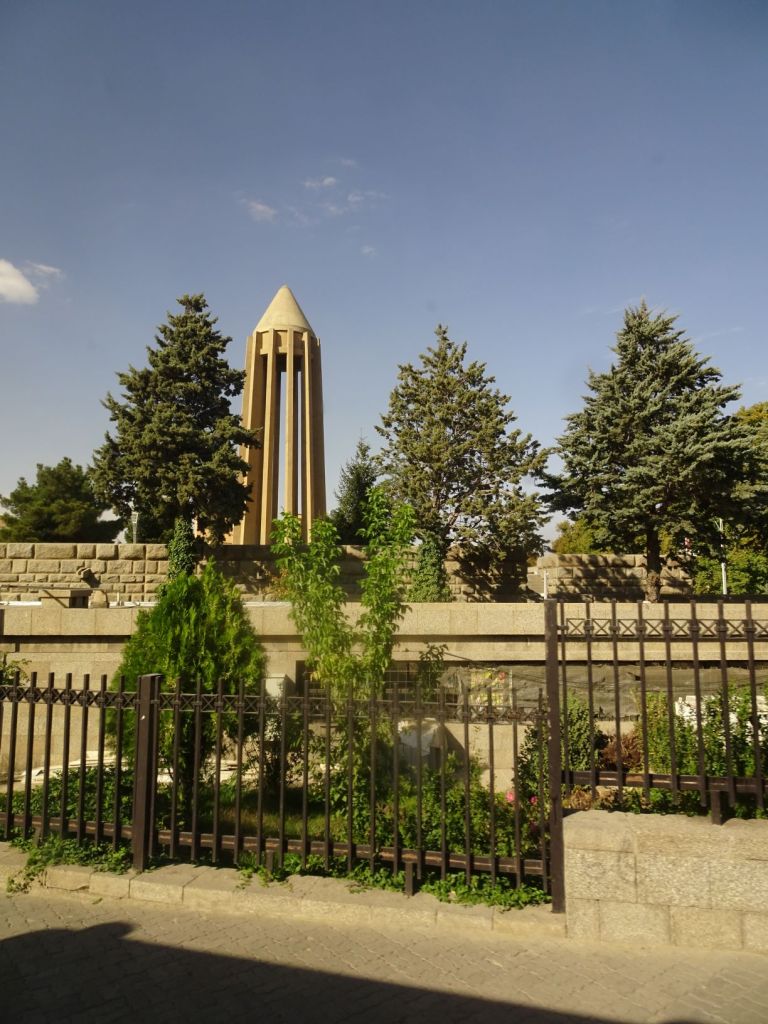
The small museum attached to the shrine shows some of his writings about plants, but the translations are very poor and it is a little disappointing given his enormous influence. His book The Canon of Medicine had five volumes and was translated in Latin and Hebrew. It functioned as the encyclopedia of medicine throughout the islamic and western world until the middle of the 17th century. Written in 1025 AD, it introduced the notion of inductive logic in to the diagnosis of diseases; that is that diseases present with a consistent set of symptoms and signs, called a syndrome. The book also gives an extensive introduction in to pharmaco-therapy mainly based on herbal medicines, some 750 in total. Even today, herbal clinics in China use the texts of Avicenna to provide a rationale for their herbal treatments.
The knowledge of anything, since all things have causes, is not acquired or complete unless it is known by its causes. (quote from Avicenna)
Then we do something unexpected: we visit the house where our guide lives together with her aunt and extended family. This is a private visit and we do not know what to expect. It turns out the house is an apartment over 2 floors in a wealthy area of town. The owner has a building company and it shows in the quality of the building. A huge living area with open plan kitchen is there to receive all 20 odd of us. We are entertained in the traditional way: first fruit, then tea with sweets and then another serving of tea. Conversation is a little difficult with the owner and his wife, but the guide herself and the nephew and niece speak English and we manage some conversation, even about politics. But on the whole this remains a difficult topic and it quickly reverts to family and looking at photographs of our families. But what an interesting end to the afternoon.
The guide gives us some advice on where to go for dinner and get a proper Iranian meal. This turns out to be spot on: we go there with the four of us and end up in a place where the guests sit in small cubicles, just on the floor, and are served a variety of sauces (soups) with bread. They are delicious and we finally feel we have tasted the Persian kitchen. Together with a beer (alcohol free of course) and tea after the mail for four persons the whole thing sets us back one million, or better said 10 euros, 2.5 euro each! Super advice from our guide who makes a quick appearance, most likely to see whether we have taken her suggestion to heart.
Then back to the camping spot by taxi and hoping we can sleep. It is incredibly noisy but we manage a bit of sleep and get up early for the final stretch in the NortWest.
October 10
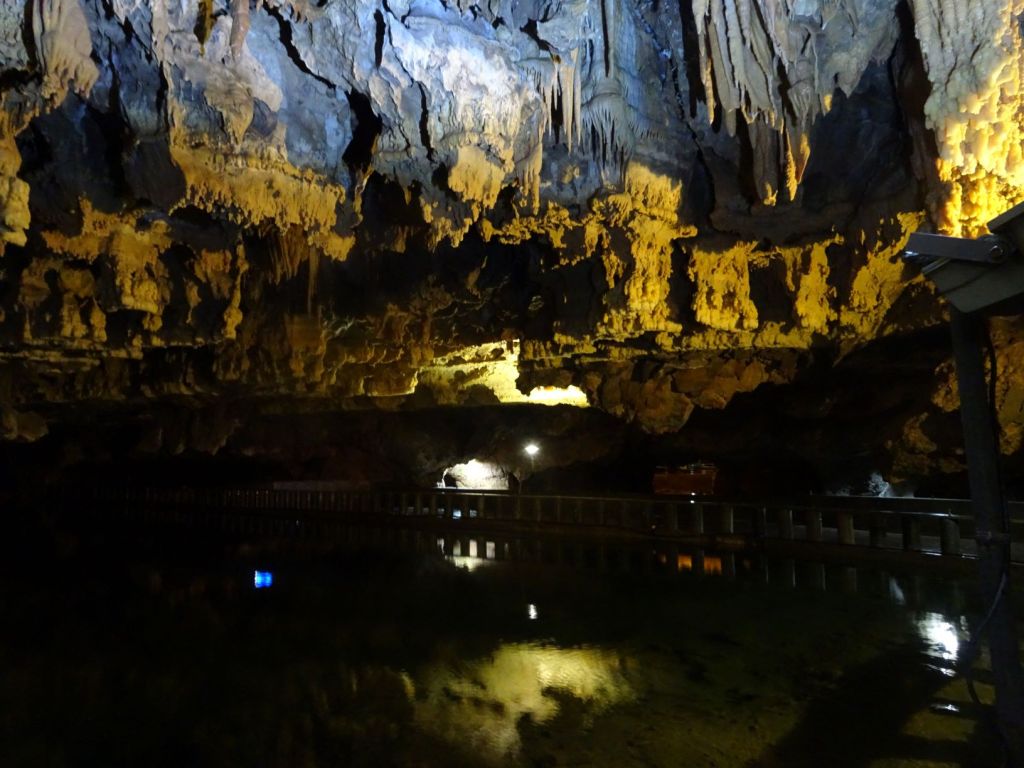
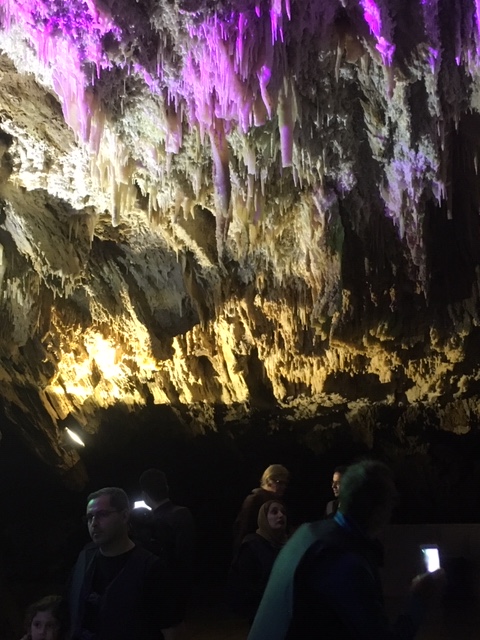
We drive from Hamadan to Zanjan today. The first part over a super new road to a cave complex, called Alisadr Cave. The cave complex was discovered in 1963 and is filled with water up to 14 metres deep. It is absolutely massive, and we go through it on beautifully constructed walkways and also by peddle boat. We have seen many caves but nothing quite like this! How lucky we are to have made this choice: while looking for a place to buy tickets we meet an Iranian couple who offer to walk us to the, rather hidden, place where we should be. We start talking and their English is perfect. They are academics and happy to be our translators/guides for the tour in the cave. Such a stroke of good fortune.
After the visit, we sit down for an alcohol free drink and have a very interesting conversation. They tell us how the boycott by the West is strengthening the regime of the mullahs. It provides them with perfect ammunition to argue that America is bad and the Western model of democracy is cruel and against Islam. The poverty that results from the sanctions hinders peoples’ education and their ignorance makes them believe that the mullahs are right. Iranians who oppose the regime are asking the West to stop the boycott, and help the people to develop their intellectual potential so that they themselves can make a judgement and ditch the Islamic State model.
We could have talked for days, they are such an interesting couple. We promise to stay in touch. Time to move on, as always, and we say goodbye after a final drink in a small café. This is low season and things are closing down. The rows and rows of benches at the entrance and inside the cave indicate how busy it must be here in the tourist season and how lucky we are to be here with just a small group of local Iranians.
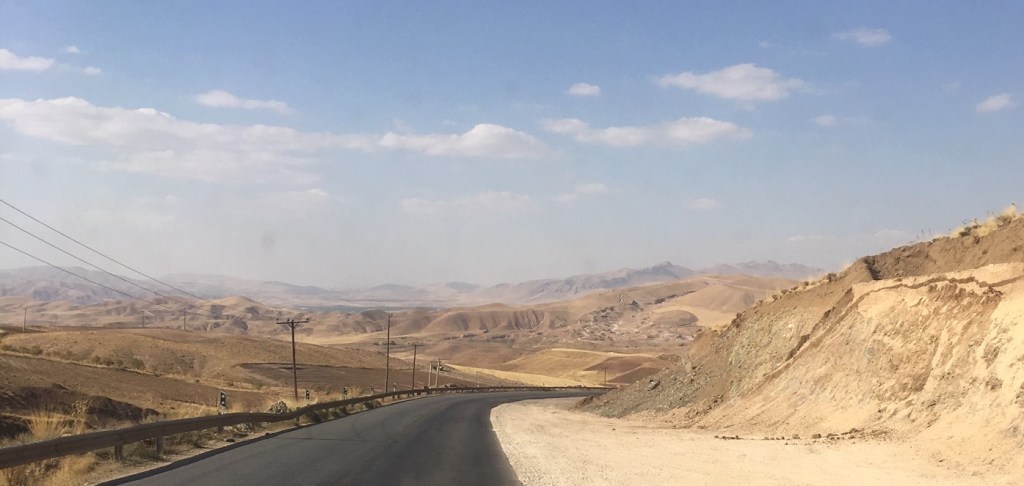
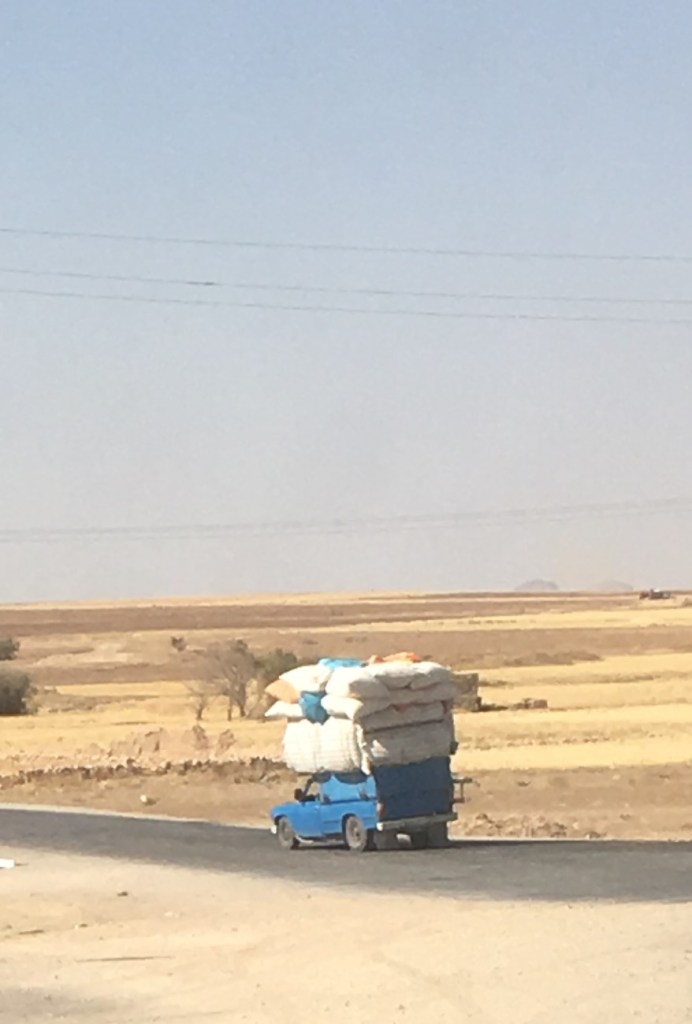
We drive further north towards Zanjan. The landscape is interesting: we keep crossing mountain ranges with rather flat agricultural land inbetween. Still harvest time and we keep seeing nomads working away at the site of a brand new road. It must be so strange for them to have to cross with their animals over pristine tarmac while they live under sheets hearing the traffic roar past.
We have a final place to visit today and we are excited to go. We are visiting Sultaniyeh, the former summer capital of the Ilkhanids, the descendants of Hulago, a Mongol leader. Just a few buildings of the 14th century remain amongst the ‘modern’ city, which is a collection of old and new buildings, chaotically arranged and with many unfinished buildings or open areas where animals and children play. These stand in huge contrast to the domed structure that dominates the city and can be seen from miles away. It was originally built as a mausoleum for the first Shia Imams, but in the end became the resting place for Sultan Oljaitu. who died in 1316. Sultaniyeh was a thriving rich city in its day where caravans following the silk route would trade their wares. Clearly many influences of different places and cultures are visible. We see the beautiful brickwork first seen in Uzbekistan, some of the earliest tile work in Central Asia.
The inside of the main space is full of scaffolding, restauration work is underway, but clearly the money has run out or is running low as not much is happening. But this is an UNESCO World Heritage site and it will be protected from further decay. While the decorations are not quite what they must once have been (enough remains to get a good sense of the splendor), the building itself seems to be in a reasonable state. We are allowed to go all the way up to the balustrades that give views inside the main space and show the magnificent size of the dome, and also give good views over the lands beyond.
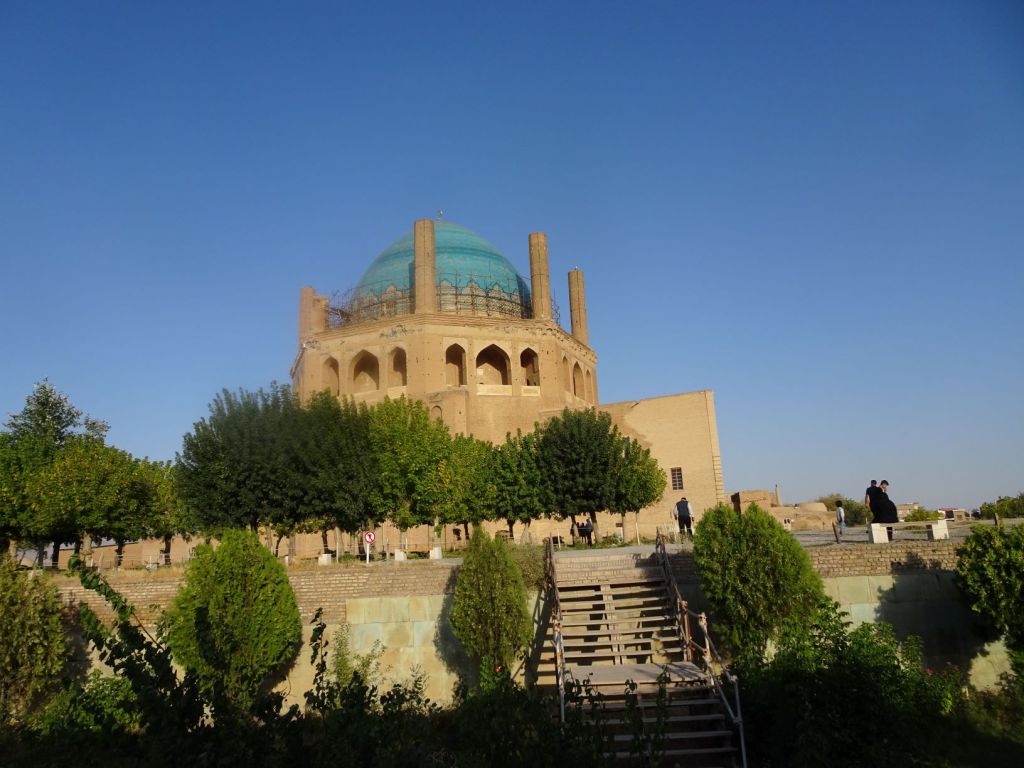
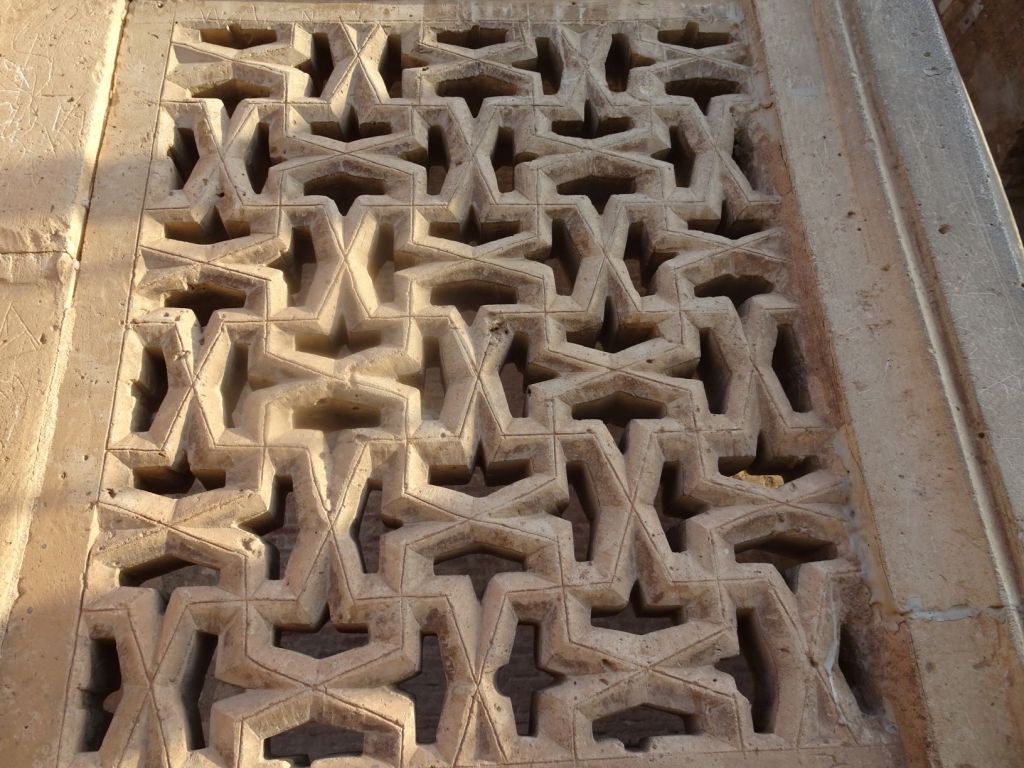
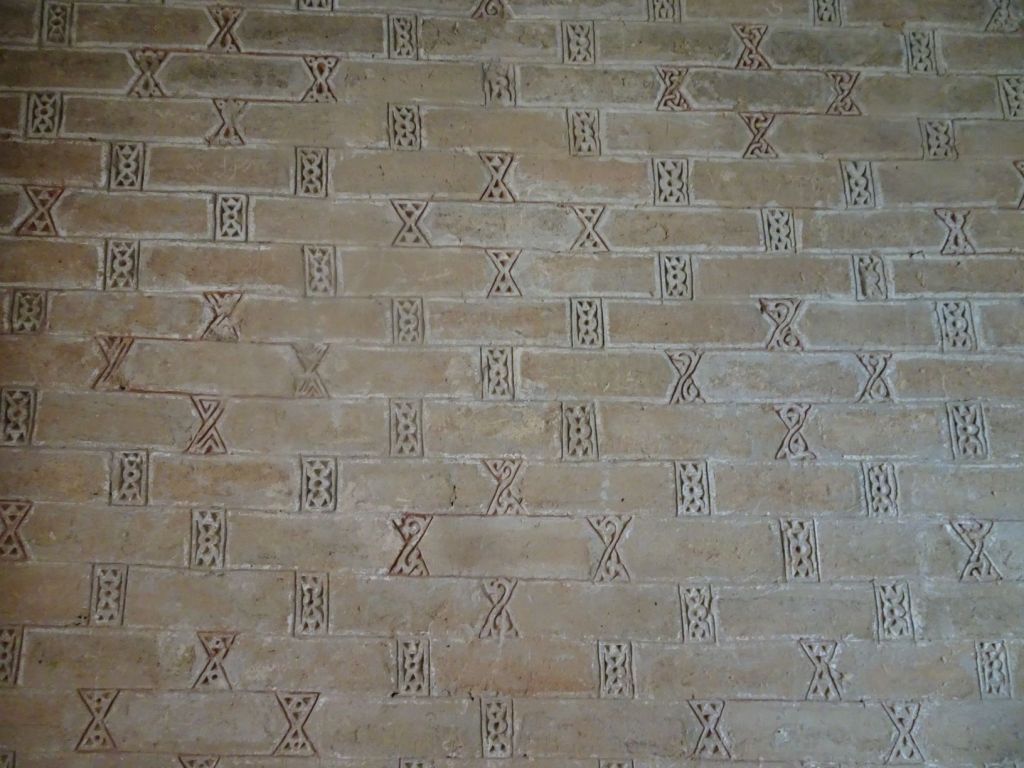
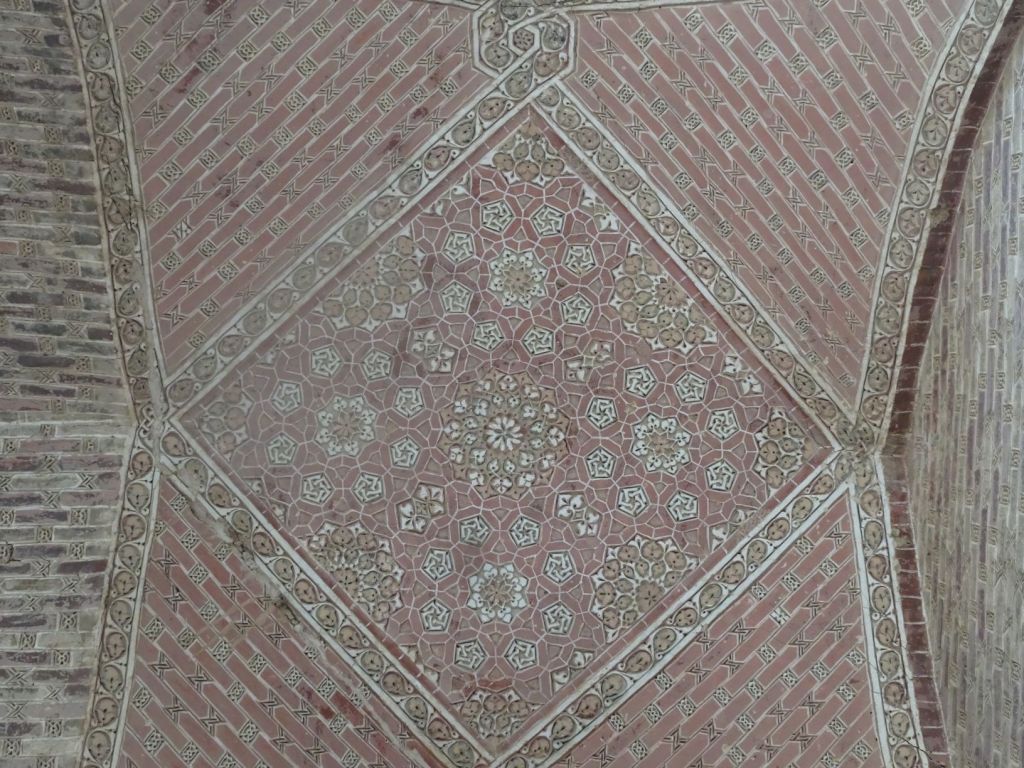
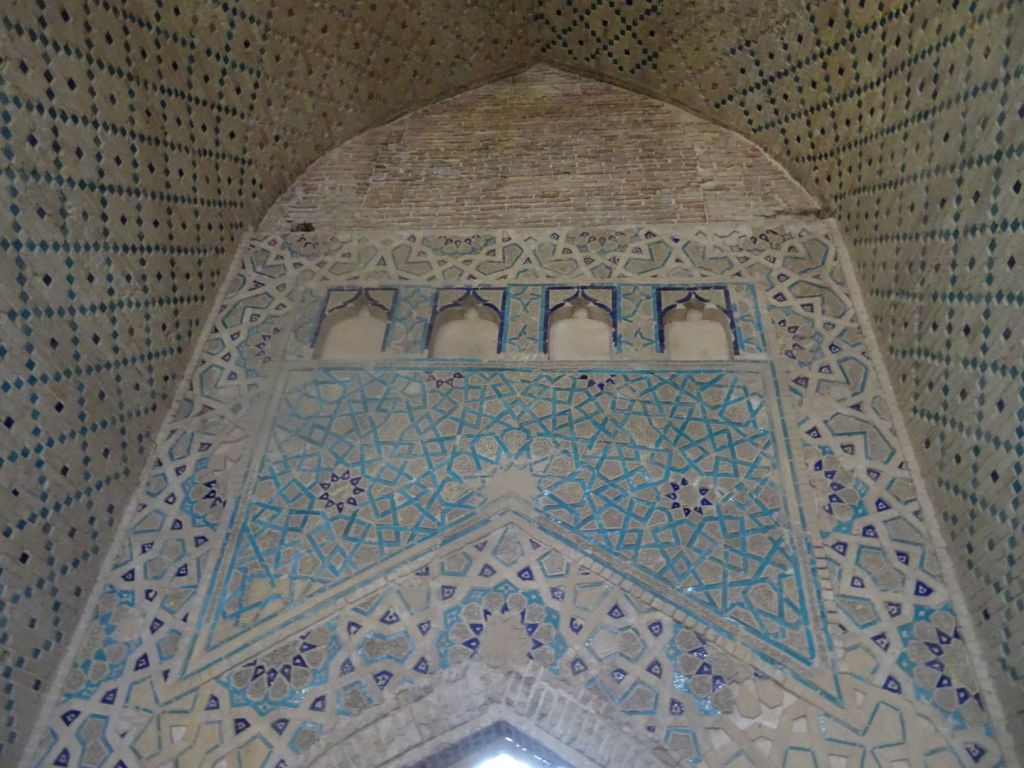
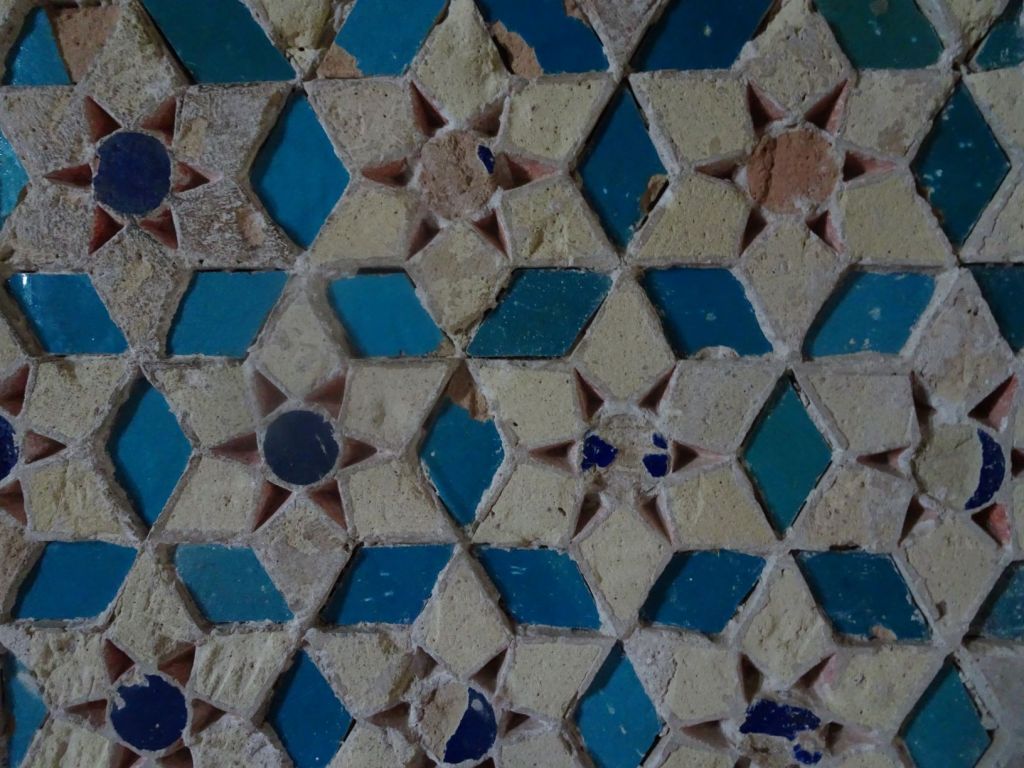
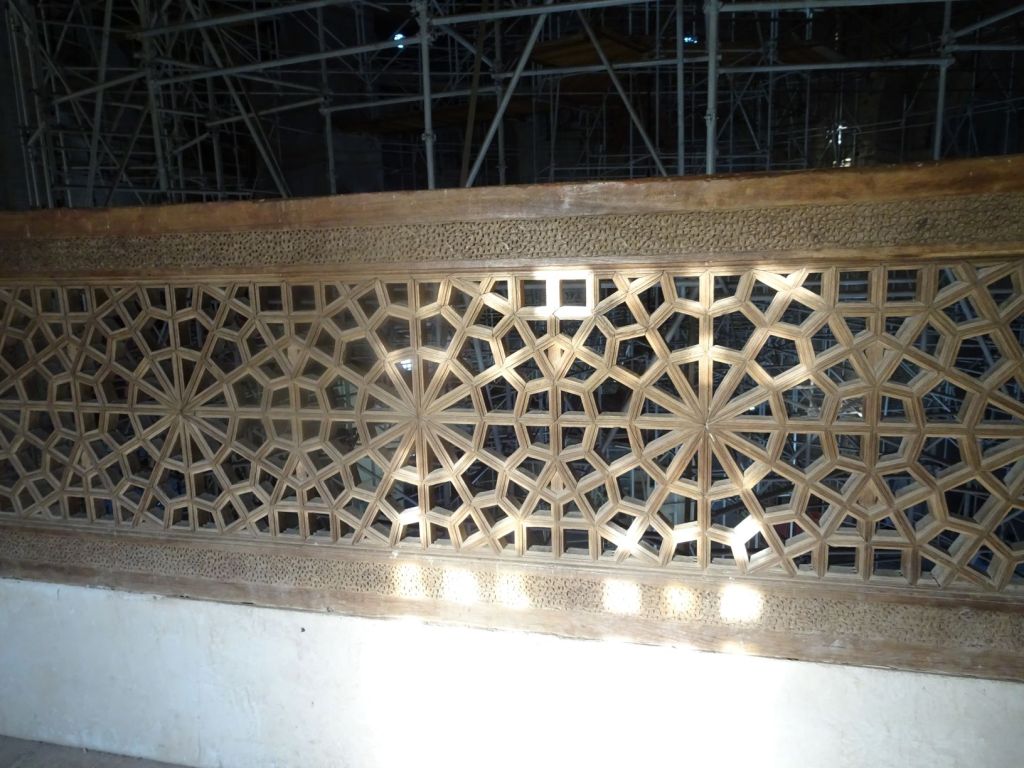
We are totally taken aback by this building. Although so much of it is covered in scaffolding, what we have seen combines the best of the architecture and decorations we have seen on this trip. Yes, some of the buildings from the later times were very inpressive, but there was also a lot of ‘showing off’ with glass and unnecessary gloss. Here, the structure of the building take centre stage, and some of the decorative elements are in the stucture itself with the stone work and the bricks. We hope that in time more of the internal decorations can be restored so that visitors can see the building in its full former glory.
We are told by the ticket office guy we should also visit another old building in town. It takes a little time to find it, but again, fantastic brickwork. This is the monastery and mausoleum of sultan Chalabi Ughlu, again built in the 14th century. The signs tell us that the mausoleum was probably built first and then the monastery added to show devotion. The monastery is unique in that it is of similar construction to those of similar age seen in Turkey and built around Sufi principles. It is unique in present day Iran and illustrates how boundaries for countries and religions are ever changing. The mausoleum is again an octagonal structure in brickwork. The complex is in even more need of restauration, but at least it is also protected and some of the brickwork remains to show how beautiful this must have been when new. Interestingly the patterns are not clear when you are closeby, but step back and suddenly a pattern emerges from the bricks. These are again ready for use as knitting or weaving patters.
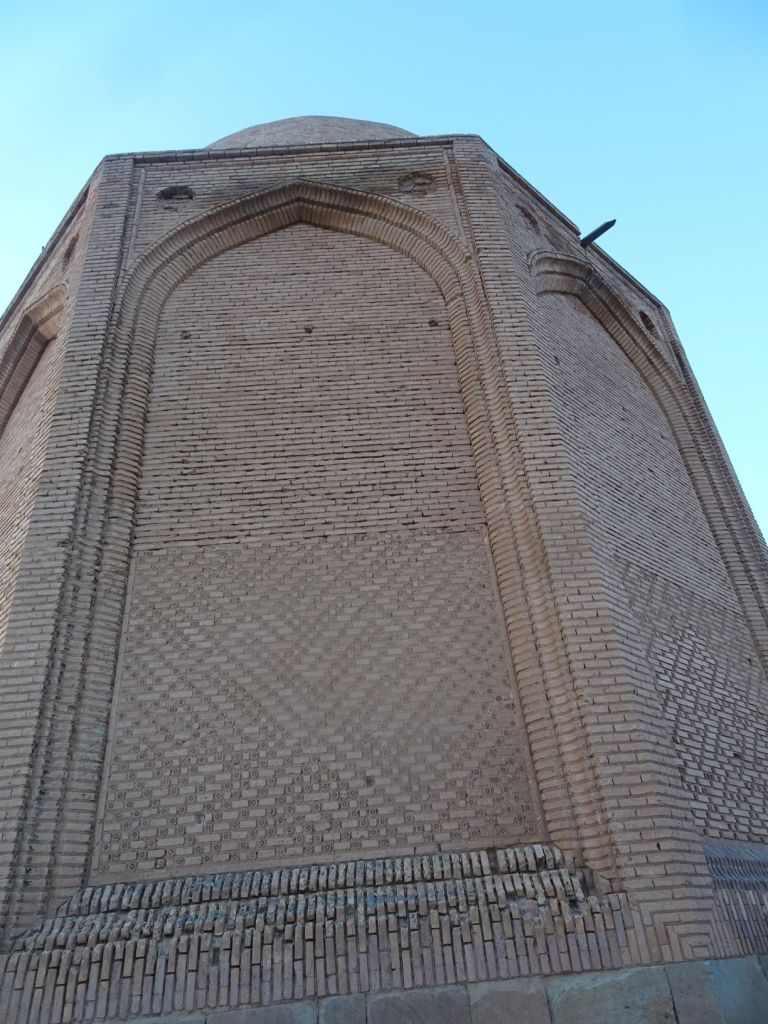
With our minds and hearts full of these wonderful buildings we drive the last hour against a red setting sun to Zanjan.
We had hoped to spend some of our last Tomans at the bazar knowing that the bazar in Tabriz, our final stop in Iran, will be closed on Friday (tomorrow). But we are late. A quick taxi ride into town and we can just about make the bazar for fruit and spices. We get some dates, a rather big box in fact, as we have been told that dates from the South of Iran are the best and this will be our last opportunity to get them. Our first item for Xmas dinner!
Then some metal work presents as Zanjan is the capital of steel and copper work. The bazar, and shops around it, is full of shops selling knives, many with beautiful ornate wooden handles, copper pots and dishes and ornaments made from various metals. Not all to our liking, but probably all very good quality. The quality of the shops and the general infrastructure in the centre of Zanjan is striking. This, like Hamadan, is clearly a more prosperous part of Iran.
Miep wants to spend some more time in a shop selling head scarfs hoping to get a few nice ones to give away at home. Are they real silk? Perhaps not, but they are nice and they are from Iran and the shops are closing so these must be bought. Then suddenly we hear someone saying: ‘Hebben jullie hulp nodig?’. It is the owner of the shop next door. He speaks perfect Dutch. He has lived in Amersfoort working for an insurance company, but came back when his father died and then decided to stay (at least for a while). We have heard this type of story before. The family ties in Iran are very strong and once someone has come back they get back into their former family lives with extended family and may never leave. We understand, but we also contemplate how someone like him must feel seeing his country going backwards in economic terms and having seen and experienced the wealth and life style in Western Europe. We do some windowshopping until everything is closed and when we finish up buying some fruit for breakfast we hear him again: ‘Veel plezier op de rest van je reis door Iran!’
October 11
Saturday morning and this is the day off here. We wake up to loud music and Miep goes to see what it is. Wow: this is bootcamp Iranian style. A man with microphone is instructing a group of at least 100 men and women in exercises. Some wear pink bibs. It turn out this is a charity working with people who have or have had cancer. The ones with the bibs are the charity volunteers, the others are the (former) patients. Wonderful to see men and women exercizing together, this is unusual in Iran where usually there is strict separation of the sexes. Women adhere to the dress code though, covered completely including head scarf. Miep tries to join in but is surrounded by people who want to be photographed with her. In the end she gets 15 minutes of exercise. At last: some of the exercises we had planned to do every morning. It feels good, but with the sun up already, it is a sweaty business in full dress!
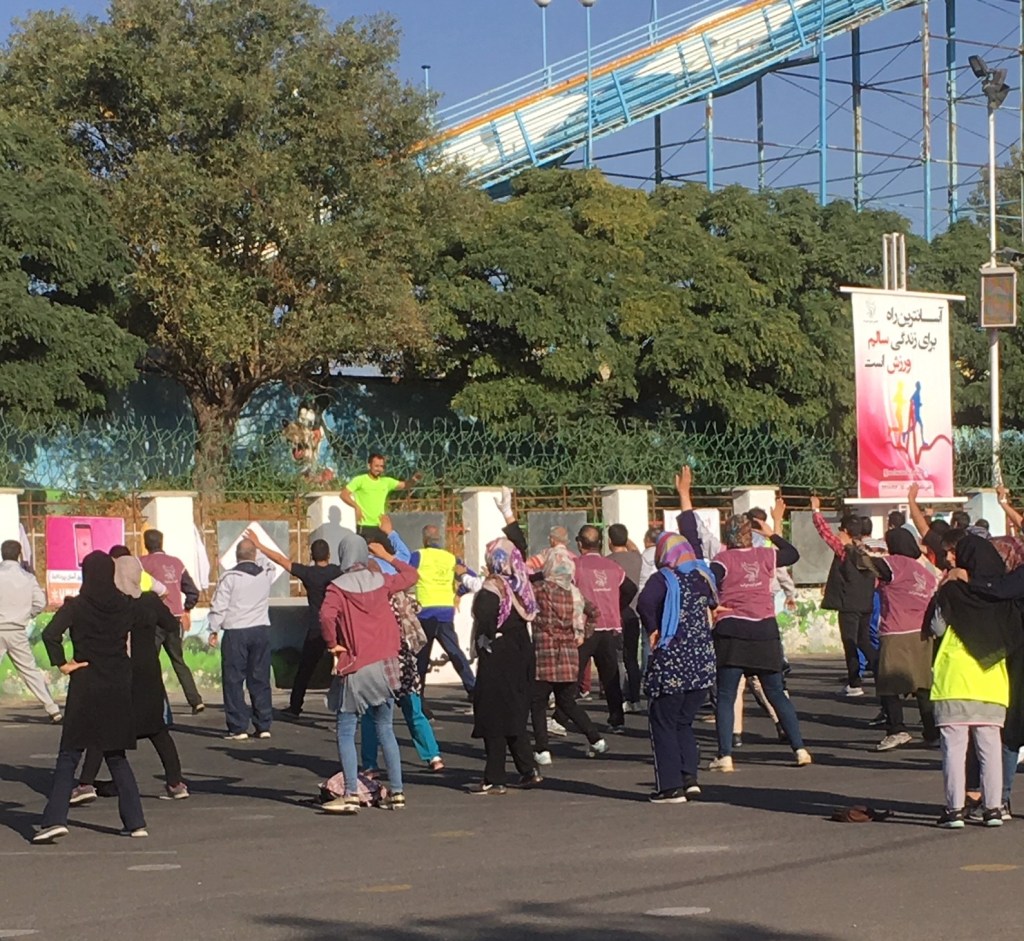
At the end she makes a donation and now she has to have her photograph taken with the leader of the charity. My goodness, just for turning up! But then a picture is taken of the whole group all one hundred of them and apparently this is done every Saturday for their newsletter. What a wonderful idea to do this. It brings the charity workers and those they aim to help together doing something really useful. This has been a very good start to the last full day in Iran.
The group drives to Tabriz today, but already we have worked out that we are unlikely to make the time set for the border crossing the day after as much of the journey goes through mountainous terrain. So we drive on till dark and are a little ahead of the group that way. We miss the bbq they have arranged on their park camping ground, but we are happy in the knowledge we will make the rendezvous tomorrow without stress.
October 12
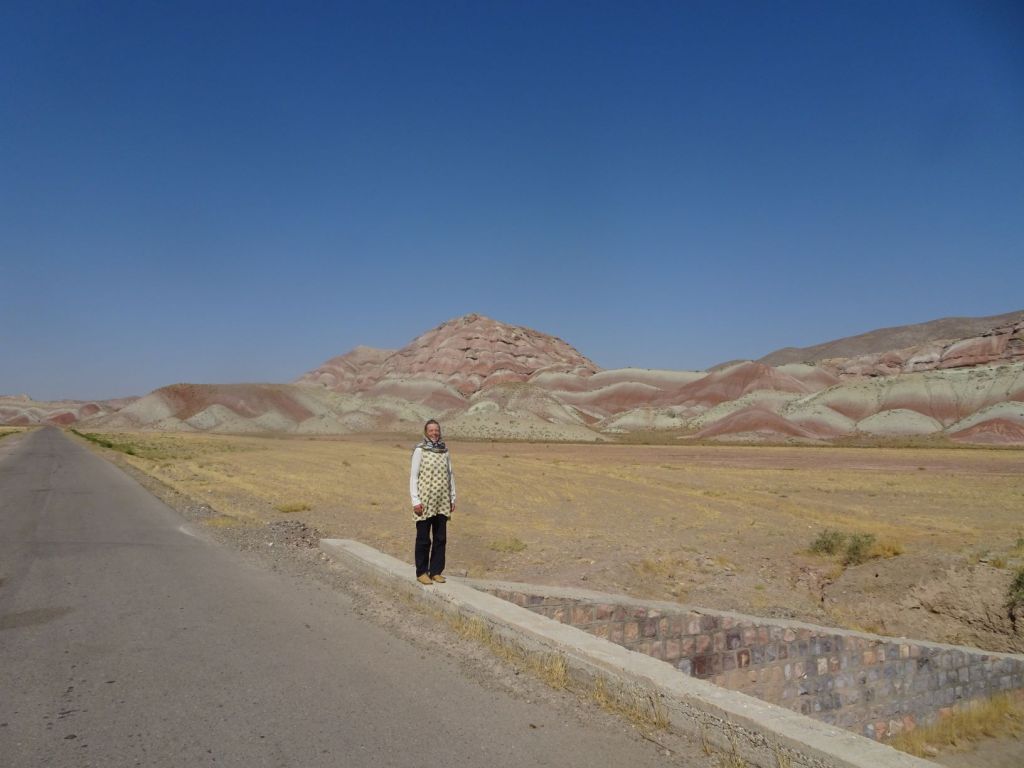
On the way to the border we stop to take in the wonderful landscape with red mountains. They have stripes and zigzags and are just like another knitting pattern. So much inspiration for colour schemes and for patterning we have got on this trip. We have coffee and take our time in the sun. Just a little sideroad and we could have camped there with all eleven campers. Why do we end up so often on a parking place? If ever we come back here we must seek out such quiet spots where the views calm you down and sunsets and rises are spectacular.
But it is not to be today, we must get ahead of the group and north of Tabriz. We drive on up and down the long inclines and declines in the road and park up just beside the road on a picnic place Iranian style. People have just started to leave so we hope it will not be too noisy and we will leave as early as we can anyway. Our job for tonight is to write enough postcards to use up all the stamps we have left after our encounter with the postoffice lady in Isfahan. Remember how we were told to put 10 times as many stamps on a card in an envelope than on a normal card? We ended up just sending the cards without envelopes and now have 20 stamps left. And, we have a lot of Iranian cards too. It is fun going through them all and thinking of which card to send to whom. We get it all done and will post them tomorrow.
October 12
We get up just before sunrise and get going as it gets light. The road is much easier than we were led to believe so we make good progress. We arrive in Jolfa at 7.30 and find the postoffice which is just opening. Miep wants to make sure she has put the right amount of stamps on the cards and the nice postman checks and then carefully writes the country to which each card is sent in Farsi on the card and then highlights it. Surely they should all find the right destination now?
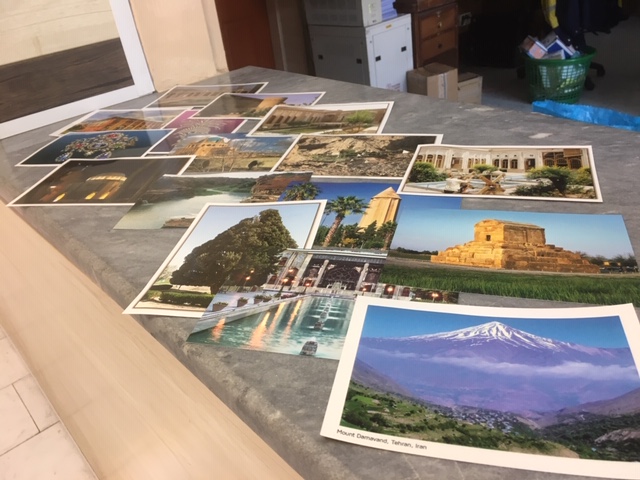
But then he turn each card over and looks at the image. His colleagues join in and start naming the places and items (such as jewellery from the Shah) shown on the cards. This is a wonderful moment. The pride when they recognise a place or when Miep tells them what it is. We have most likely seen a lot more of Iran than they have and ever will. We are now in the far NorthWest of the country, close to the border with Turkey and Azarbaijan and closer to Armenia than to Isfahan, let along Shiraz or Mashhad. The size of Iran is enormous, 40 times the size of Holland and seven times the size of the UK.
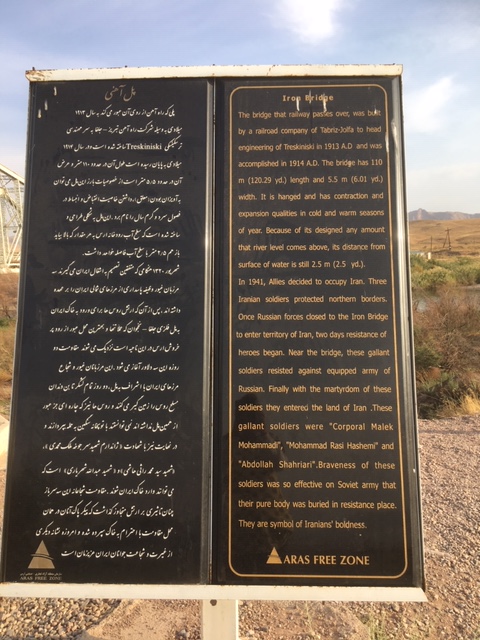
When we leave Jolfa we see the bridge that connects it with Azarbaijan. This border is not open and there is an armed guard on a watch tower. Miep does take a covert picture and also goes to see what the statues are of three men close to this bridge. The plaque tells the story of 3 men who were guarding this border post during the second world war. But they were overrun in 1941 by the Russian army and killed. This area was invaded by the Ottoman Turks during the First World War, and by the Russians during the Second World War. On both occasions the country had been formally neutral. We add a picture of the description of this story which illustrates how difficult it can be to make sense of English translations of Iranian texts.
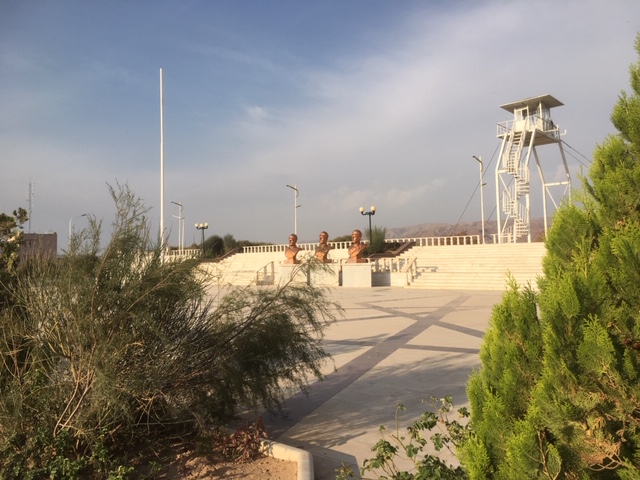
We drive the beautiful road that runs along the border. Iran and Azarbadjan are separated by a river here and the mountains to the North look ominous. We cannot see a road into a valley. Most likely we will have to climb right up.
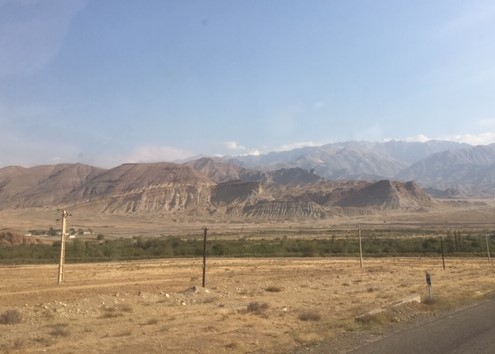
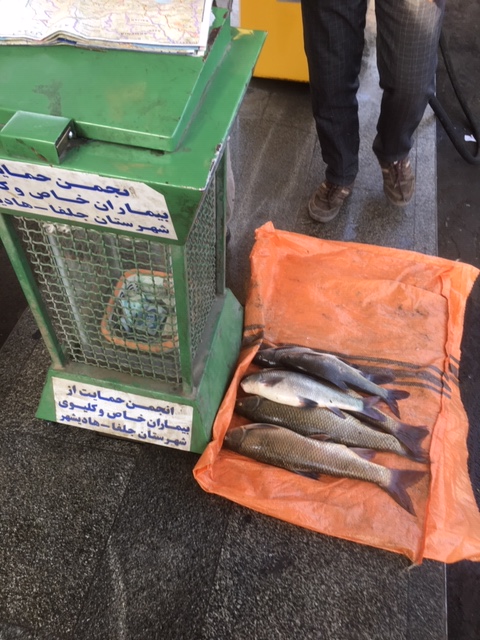
We fill up one last time in Iran. We will miss the ridiculously low prices for fuel. And this time it is even weirder. A guy is selling fish and offers us some at the pump, just on the floor. Here is water at last and apparently fish! It makes our mouths water and Roelf is keen to get his fishing gear out, but it will have to wait until we have crossed the border.
We are early and have time for breakfast in a small café. Eggs fried with lots of oil and bread and tea. Just what we need. It tastes delicious and while we eat the owner and a friend of his ask us whether we are man and wife, where we are from, whether we have children, how old they are, how old we are and so on. All the questions we have become accustomed to during this trip. And then they want to see pictures. They scroll through the pictures on Miep’s phone and start looking at the places we visited in Iran. Just like in the postoffice there is a ‘can you name the place’ game going on. But this time the café owner tells us he has been around Iran a lot and has visited many of the places on the pictures. He runs this small café in a totally out of the way place, but has been to Yazd and Isfahan! We are happy to once again see how proud this Iranian is of his country.
This is a lasting memory of Iran for us: the pride of the Iranians in their country, their wish for their lives to be easier and for the country to be accepted by the world. It is not the choice of many to be an Islamic state.


 Central Asia Roadtrip
Interessant om te zien en te lezen. Ik hoop dat jullie er een boekje van kunnen laten maken met natuurlijk de foto’s erbij. Mooi om te lezen over de onbefoelde gevolgen can de boycot. Een goede les voor ons!
LikeLike
Hi Lida
Ja we hopen het te kunnen downloaden. Roelf is nu aan het lezen over de Caucasus. Zoveel geschiedenis….
LikeLike