Mashhad is the capital of the region Khorasan in North East Iran. The name Khorasan means ‘land of the rising sun’ and was given during the the Sassanian period (third Persian empire 224-651 AD). It is the western half of the old Persian province of Khorasan, which included parts that are today in Iran, Afghanistan, Tajikistan, Turkmenistan, and Uzbekistan.
Mashhad was a small village when the Silk Road passed it to the south, but it gained significance when it became the resting place of Imam Reza, the Eight Imam during the second half of the eight century AD. Mashhad means ‘place of martyrdom’. Imam Reza’s shrine became a centre of pilgrimage for Shia muslims, and the Mosque of Gohar Shad is the holiest site in Iran.
Mashhad was the capital of Iran for a short period in the first half of the eighteenth century during the reign of Nader Shah. After the death of Nader Shah in 1749, it remained the capital of an independent Khorasan until Khorasan was reunited with Iran by the Zand dynasty some 30 years later.
Today, Nader Shah is a controversial figure, revered by most Iranians because he lifted Iran to great power for the last time in history. However he is despised by many, in particular the Shia clerical elite, because he reverted the state religion from Shi-ism to Sunni-ism to improve relations with other muslim countries within his Empire.
Nader grow up during the final years of the Safavid dynasty which had ruled Iran for almost two centuries. He was of Turkmen origin from a semi-nomadic tribe in the northern valley of Khorasan.
Nader Shah restored Safavid rule after they had been deposed by an Afghan revolt which had led to the destruction of the Safavid capital Isfahan. However, dissatisfied with the weak Safavid leadership, he declared himself Shah in 1736.
An admirer of Ghengis Khan and Timur, Nader Shah undertook many military campaigns and for a short period of time became the most powerful emperor in Western Asia. He has been described as the last great Asian conquerer. His last years were marred by increasing emotional instability and cruelty when he blinded his son who he mistakenly suspected of plotting against him. The military campaigns bankrupted the country and his regime became increasingly repressive. In 1749 he was assassinated by his own bodyguard. Many people in Iran today believe that his murder was commissioned by Britain who were concerned about Nader Shah’s military successes and feared he became too powerful. If this is true it would be one of the first but not last inappropriate interference of Great Britain in Iran’s internal affairs.
Sept. 15
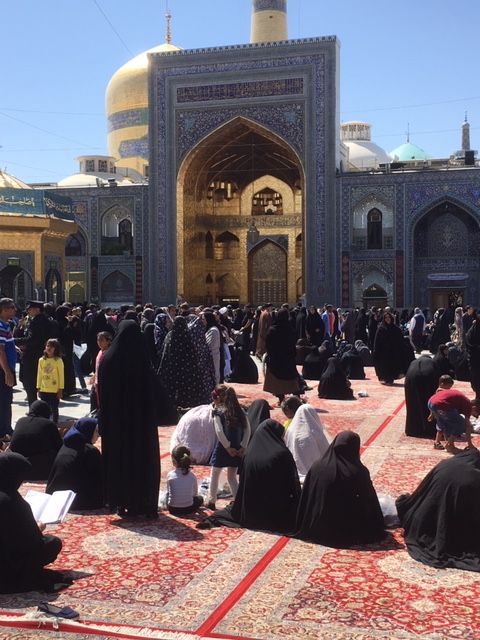
We had a good night’s sleep despite again a very noise camping spot. We stay at the place where people camp when in Mashhad. It is absolutely packed with small tents and pilgrims who come to visit the shrine of the 8th Iman, Iman Reza. This is the only Iman (of the 12 Imams that are important for the Shi’ite Muslims) who is buried in Iran. We go to this site today with the help of our lovely guide, who speaks fluid English and French (and of course Farsi). She tells us the shrine is only second in importance to Mecca and that 27 million people visit Mashhad every year. It shows: the roads are absolutely packed and a 4-lane highway takes us right to the shrine and then underneath the complex where there are massive parking spots and more roads. These underground passages have only been built since the revolution. Every woman in the group is issued with a colourful chador (imagine NHS nighty); these are probably used to distinguish those who are not Muslim and hence did not bring their own black chador. Miep struggles with hers as it has no arms and no tailored head opening, it is just a large piece of cloth that won’t stay on her head and that she and others trip on. It gives a good idea of the trials and tribulations Iranian women face every day with the dress code.
There is a body search before we can enter the complex, women and men (who can wear what they like) separate and off we go. The ‘police’ is walking round with colourful dusters to give all that do not comply with the rules (such as women who do not cover their hair completely) a gentle ticking off. The site is absolutely massive with numerous connected squares, all surrounded by walls with decorative tiles and mirrors. We are given an introduction by a video and we are allowed to ask questions about Islam. Some typical Dutch questions come up, pretty straight to the point, but they are smoothly dealth with, or circumvented. Then we are released. ‘Stay with us’ we hear as the guides walk us round pretty quickly. We wish we had more time to see things close up.
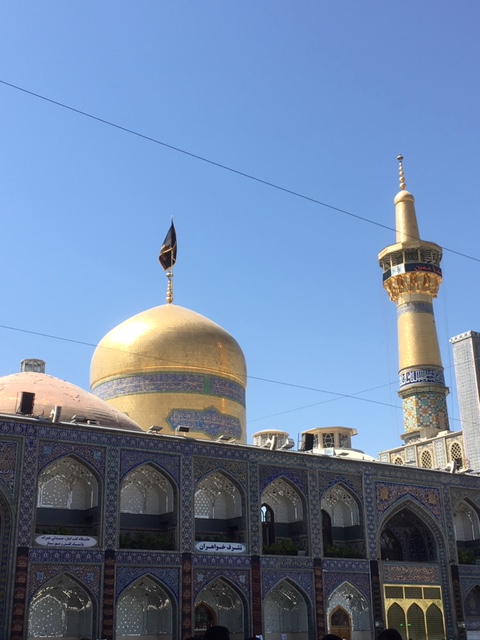
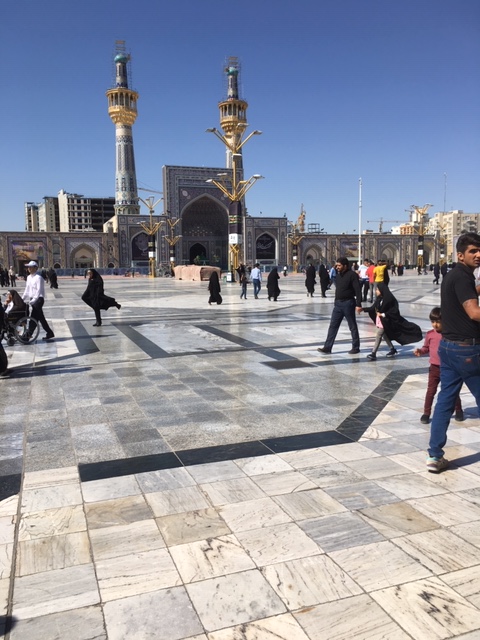
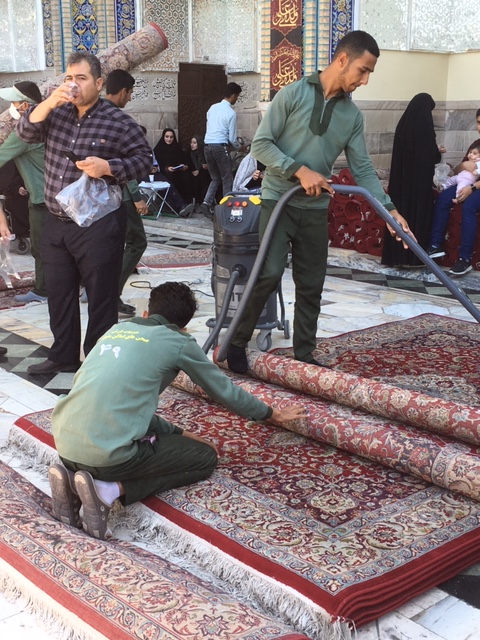
We thankfully get some time in the impressive carpet museum where the pictorial carpets and a ‘hunting carpet’ are our favourites.
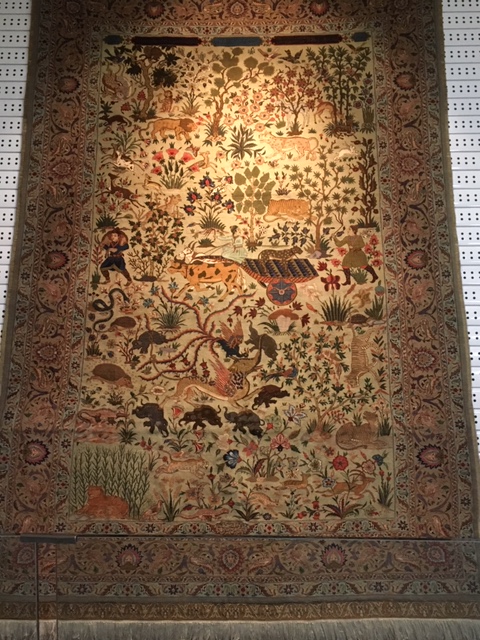
Then on we go, too slow for the guides who get more and more nervous, but what are we supposed to do: this is a monumental site and it is so colourful and masterful. Now it’s noon and prayers get underway. Carpets are rolled out. Men in front, women behind. Children are with their mothers. One toddler screams every time his mum bends forward in prayer and he cannot see her anymore through the black chador. The Imam leading prayers can be heard throughout the whole complex.
We learn that the site is staffed by some paid staff assisted by an army of volunteers, usually professional people, who give up one day per week to help run the place. There is a university, library, various museums, a health centre and huge kitchens that supply food for free to those six thousand people a day who are selected to eat there, some who have applied to do so and others who are chosen because they are poor. This is the largest not for profit organisation in the world. The clergy that run the shrine own large areas of land in and around Mashhad and they are powerful in the region but also nationally and probably internationally as well.
Our visit comes to an end, too soon for Miep who was keen to see more of the architecture. We get in the bus and go to the modern area to eat and do some shopping in a mall. Consumerism triumphs religion.
Then back to see an old governor’s house in town and then on to the bazaar. This is the place we want to spend some more time and we let the bus go back to our campsite without us so we can walk the kilometre long rows of shops. There are the local items that pilgrims and tourists take home: saffron, leather goods and turquoise stones set in rings. Tens of shops selling the same wares and many, many workshops for the jewellery from turquoise. But there is much more. Clothes, shoes, spices, fabrics, clocks, embroidered tableware, and then the tailors that can make your personalised chador. The latter are mobbed as women prepare to go to the shrine dressed appropriately.
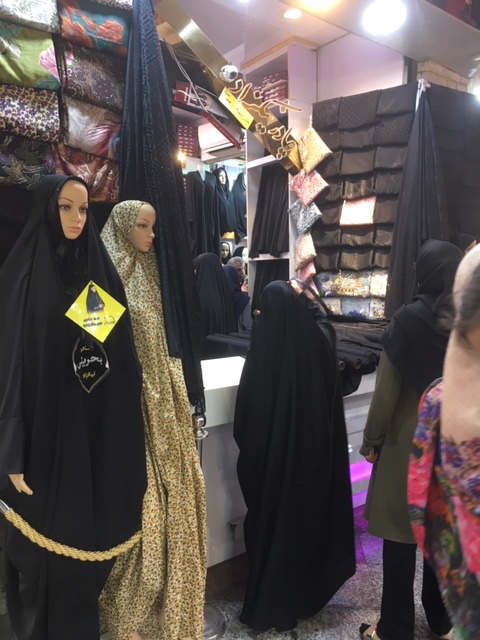
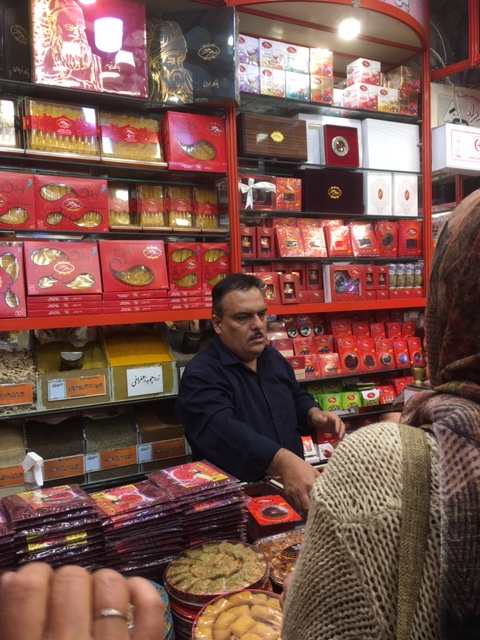
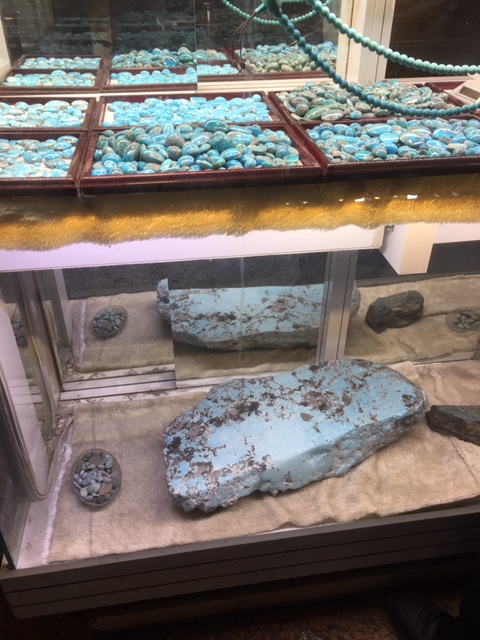
We find a shop for sim cards and purchase two so we can use the computer, ipad and one phone without having the change cards. They do not cost much. Most things are cheap here for us, who have western currency. The exchange rate has changed dramatically in our favour in the past year to the detriment of locals. We eat for one dollar per head. Bread, meat, salad, water and doogh, a yogurt drink. It is remarkable how many people we see, even in the restaurant, who have had surgery nose jobs, hair implants, or even chin surgery. We learn later that cosmetic surgery is very popular in Iran. Women in particular want to have a slightly upturned nose. Why on earth: the young women we see are all so beautiful….. We take a taxi back to the Mog, a thirty minute ride, sets us back another 2 dollars. It has been a very full day and we dream and dream with all these new impressions in our head.
September 16
Another good sleep. There is a big difference between the temperature during the night and the day. Some 25 degrees. You want to put on something warm as soon as the sun sets, but in the afternoon the temperature can be quite high, still close to 30C (and more in the car), so you really need two sets of clothes here. But it makes for good sleeping. We have a relatively easy drive today heading west on our way to the Caspian Sea. We pass through the same agricultural land we saw on our way to Mashhad as we retrace our steps part of the way.
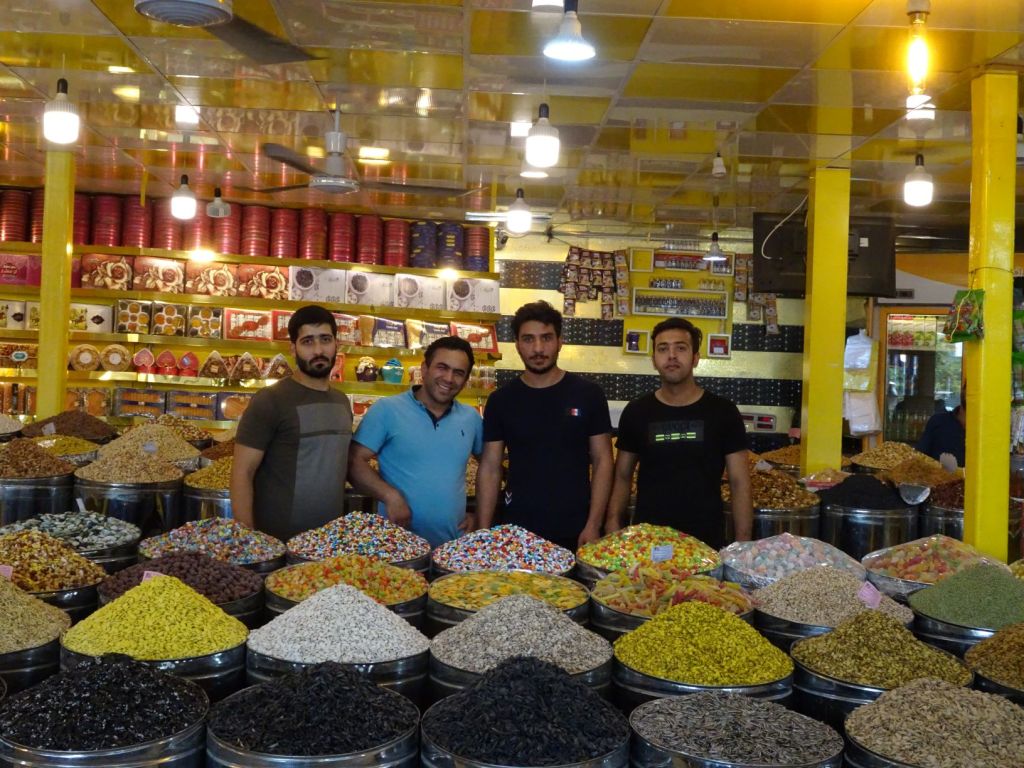
Short stop in Quran for some food. Immediately we are attracting a crowd. ‘Why did we come here?. They do not mean Iran, they mean their city. Well, it is true, there are no architectural masterpieces here, but this is an ordinary place. A town where people work and study and we want to see how people live. We are not sure they are satisfied with this, but friendly smiles and help to find public toilets (in a mosque) and a simple restaurant, just what we wanted. Then onwards to find another interesting place en route, Shirvan. Here there are tens of stalls along the road that sell dried produce. Nuts, spices, teas and sweets. Amazing displays. We can try out everything and end up buying some salted nuts, salted roasted chickpeas, dried rosebuds (for tea) and several spices. We meet nice English speaking people there who buy immense amounts of spices. They tell us that this place is famous for this type of produce and that people use spices for treatment of various illnesses, such as using turmeric for diabetes. Of course pictures all round.
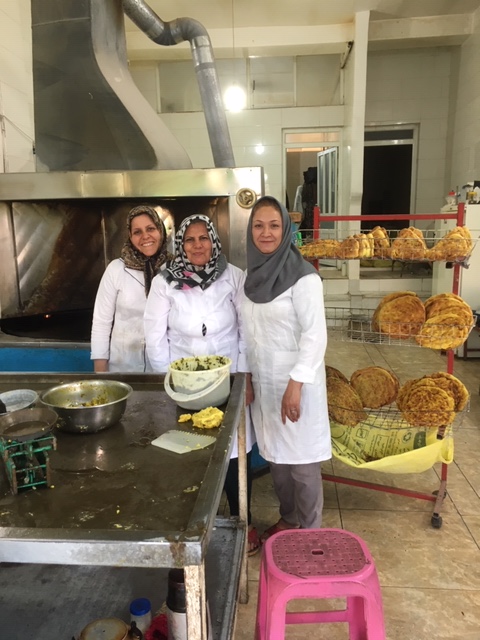
We drive through more mountainous terrain now and get to Bojnurd late afternoon. Just some bread and a cold drink required before we park up for the night. But nothing is quick here. The ladies at the bakery need to talk to us, so a daughter is phoned to act as translator. Then more photos. Buying a bread takes time, but delicious it is!
We camp in a recreational area just outside town. It is full of small tents again and families sleeping on carpets inside and in front on the tarmac. We don’t quite get the attraction of being in this place. Is there some entertainment? Or is it just the being together out of town that attracts? We will see in the morning when it gets light.
September 17
We walk round the park one more time and see the swimming pool (for men only) and then walk up a small hill. There are not that many attractions in the park but it must be the opportunity for families to camp and eat together that attracts, together with the swimming pool.
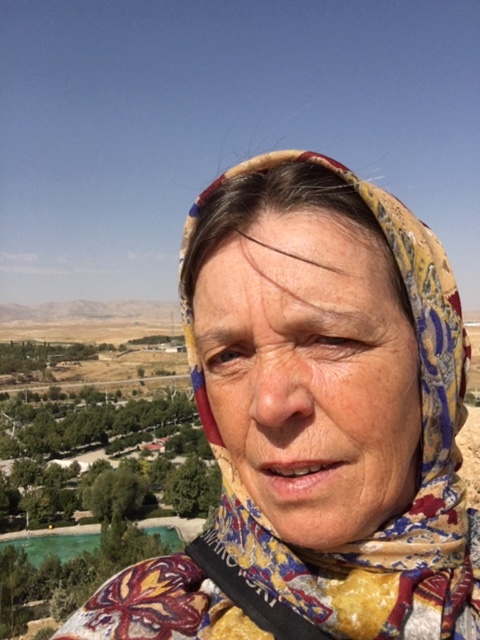
People are leaving and so do we. We have a relatively short drive (170 km) through the mountains, over a plateau and then down again to Golestan Nature Reserve. It is bone dry everywhere. The mountains are beautiful. When we descend into the nature reserve there are hundreds of cars parked along the road. This is apparently how people enjoy nature here. Just 10 metres off their car, right on the side of the road, they set up the picnic in the woods. We find our camping spot within earshot of the road next to a modern new built house.
This is an ecolodge, designed by a female architect who with her husband (both Iranian and both with US passports too) has started this project. Initially somewhere else and now in Golestan national park. They host groups or individuals who come to explore nature in the park and they involve locals in the whole venture. Some work in the house to help with cooking and cleaning, some are invited to give workshops in making of felt rugs or weaving and others are involved in walks in the park. They are keen to retain the old traditional crafts in the region and have established a good relationship with craft men and women locally. They are all Turkmen, we are very close to Turkmenistan here and there is still a sizeable population of a few million Turkmen in this northern part of Iran.
We are warmly welcomed and then have a super dinner in the house with the whole group.
September 18
A third of the group set out for a walk in the park while the others enjoy a cultural day, seeing crafts, making food and so on. We first drive back 50 km on the road we came from and then turn left into the park proper. We walk in the arid region, our host and guide Cameron calls it the ‘steppe’. There is not much to see, there is a black vulture when we first get out of the minibus, but then we don’t see any birds anymore. Strange, perhaps again the problem with heat during the day, although today is not an especially hot day. We do see two groups of wild sheep and numerous signs of the presence of predators. We see the poo of the famous Persian Leopard, full of hair and teeth and turning completely white after some weeks. Also poo of foxes, porcupines, the wild sheep and brown bears. But we see none of them in the flesh unfortunately.
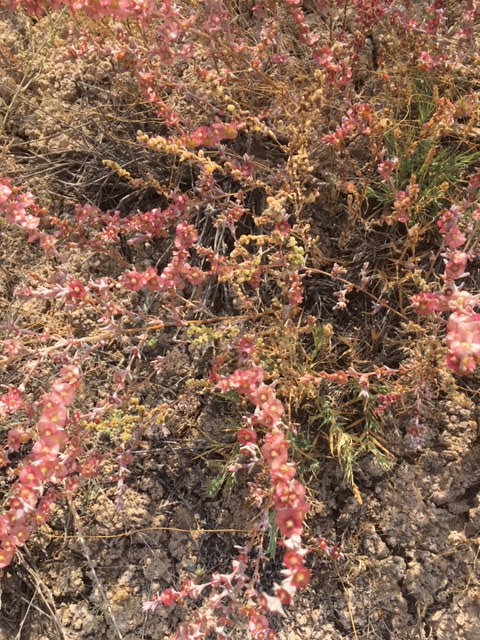
The vegetation is interesting. A lot of artemisia which is the winter food for the grazers. Then numerous other plants, mainly flowering in pink and dark red that I have never seen before. Pretty small flowers.
We walk for 4.5 hours and have a nice lunchbreak in the middle. It was interesting to see such a dry area not far away from a much lusher green forest further down the plateau.
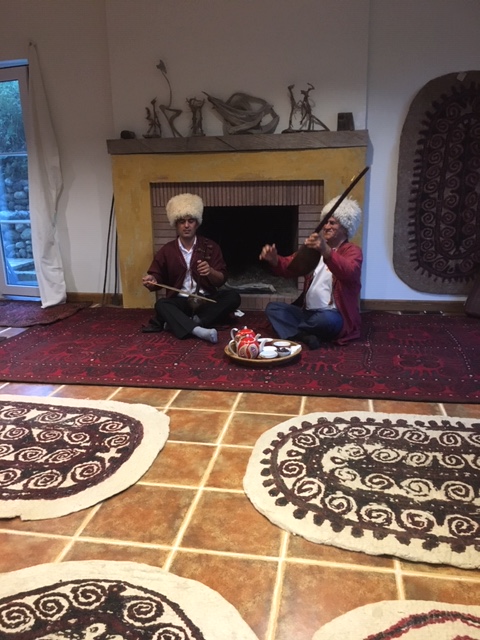
When we get back we are just in time for a music performance of a father and son; Turkmen musicians. The sounds are unfamiliar to us, the instruments we have seen, or at least similar ones, in Kyrgyzstan, and they sound slightly unharmoneous to our western ears. But the strangest thing now is the singing. This includes loud shouts and sounds of horses, hi-hi-hi, and clapping sounds. Very energetic and fascinating to watch, but not quite music to our ears.
We retire to the Mog and have a lovely call with daughter Roos. All is good, the jackals call in the night and we prepare to move on tomorrow.
September 19
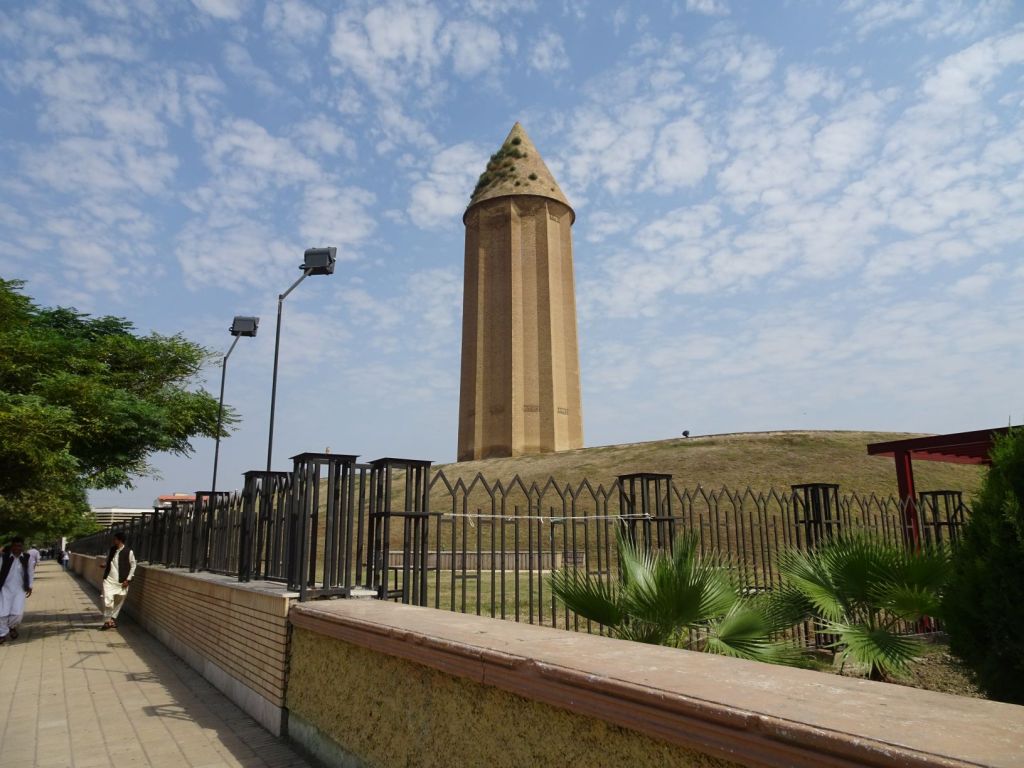
We have a long drive ahead of us to get to the Caspian Sea coast. We drive first to Gonbad-e Kavus, where there is an ancient tower, built in the Sassanid period in the 10th century. The Mongols did not destroy it because they saw it as a religious monument. It has the most astonishing acoustics. You can whisper, even when standing outside, and hear it very clearly a long way away. When you talk standing in the middle of the tower it feels as if you are shouting. Such amazing architecture. The highest brick tower in the world!
Then we move on, first trying to find remnants of an ancient wall, second only to the Chinese wall in length, that was built in the 3rd century BC to protect Iran from invasions from the north. But we cannot find it and the GPS systems fail again close to the target. When the Mog nearly falls into a deep irrigation channel we give up and decide to go to our final camping place. We think we have got it all right this time, but when we arrive just before the sun sets over the Caspian Sea, we realise we have not put in the correct coordinates. An update has been circulated last night. We read it, but did not understand these were new coordinates. So we are 25 miles away from where we need to be, but the sun is now under and we need to get there over poor roads and in the dark.
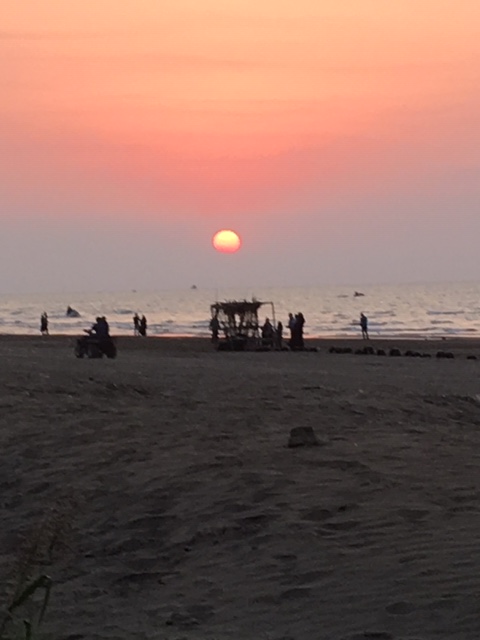
When we set off from the beach our roof hatch falls off AGAIN. Thankfully nobody hurt and we heard it this time! It must have been the hundreds of speedbumps we drove over today. We are glad to move on. We were surrounded by people the minute we stopped and the beach is one big carnival. Fun to see for a short time, but so noisy and women are not even allowed to swim in the sea!
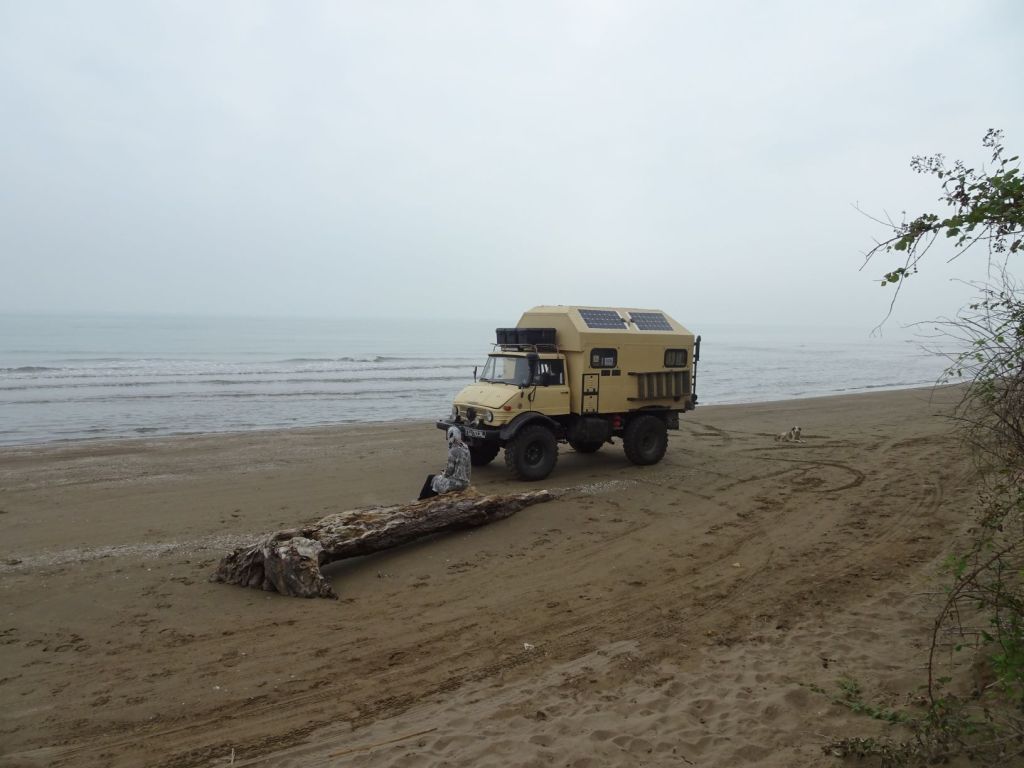
It takes us nearly 1.5 hours, but we do make it to the correct destination, a beach near the nature reserve Meyankalea. The guard kindly opens the gate and we drive to a very quiet beach where we park for the night. Hardly time to eat, but the location is superb. Right on the sand close to the sea and perhaps Miep can steal a swim before the locals come past. Women are only allowed to swim in the dark we are told, when they cannot be seen…… Nobody here but our group tonight. What a privilege.
Unfortunately there are no birds here now. They come in winter, overwintering from Siberia. I ask the guard, surely there must be some birds, but he is adamant: no birds here now.
September 20
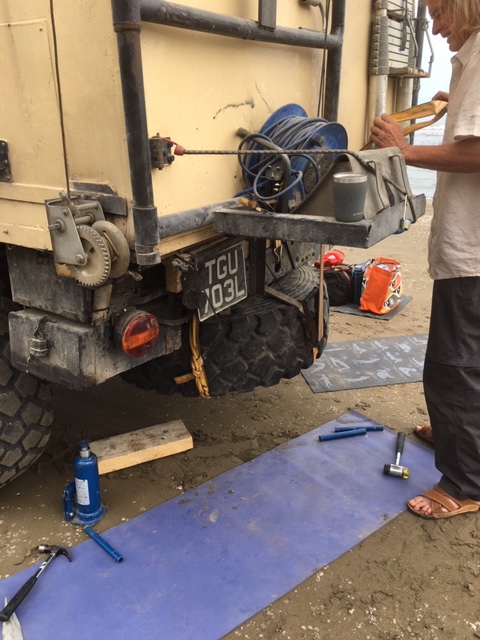
A quick swim in the morning and then the reality of the day. The spare wheel under the Mog needs attention as it has moved hanging on bands underneath the car. Roelf works on it with help from Paul, one of our group members.
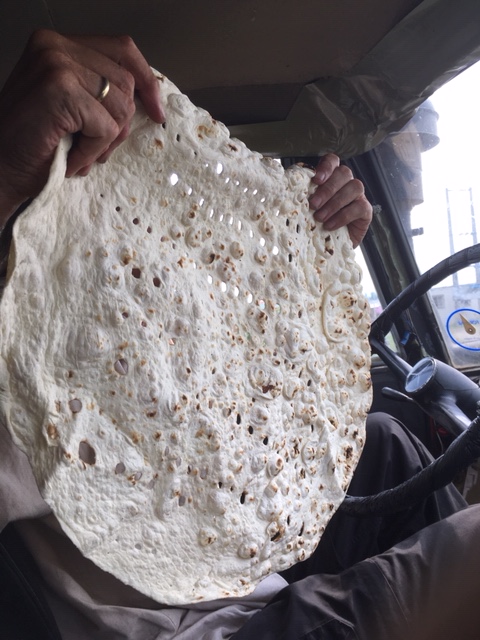
Then it is time to go. We drive into the Alborz Mountains today, quite a steep drive. We buy some nice bread to keep us going over lunchtime. This is the typical Iranian bread, big flat breads that you carry over your arm, or in this case, in a plastic bag to stop it from going stale right away.
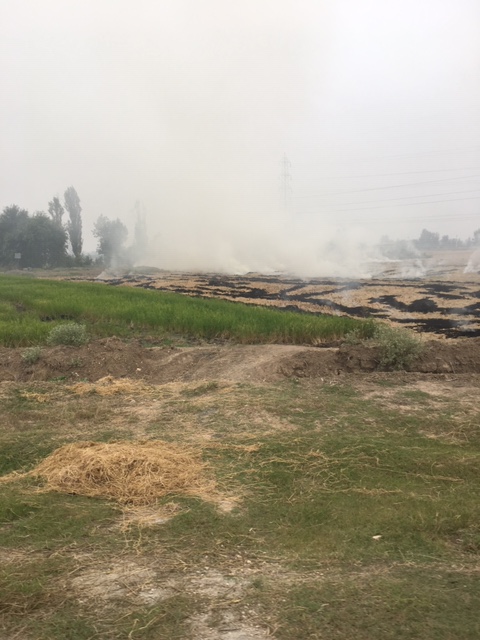
For a long time we drive through the smell of burning. Farmers have harvested their grain crop and have brought in the straw. They now burn the remaining stubbles before ploughing it under.
From Amol the road goes straight into the mountains and it is not long before we crawl in second gear. It gets tight when 3 lanes merge into one to go into the first of several tunnels. This is a serious mountain road. We have to stop twice to let the Mog cool down, but thankfully no overheating. There are villages and small town hanging precariously onto the mountain walls. We wonder why they are there, what do people do in these towns? There seems little agriculture, the rocks are bone dry. It must be nearly impossible to get up to these places in winter. The roads are so very steep.
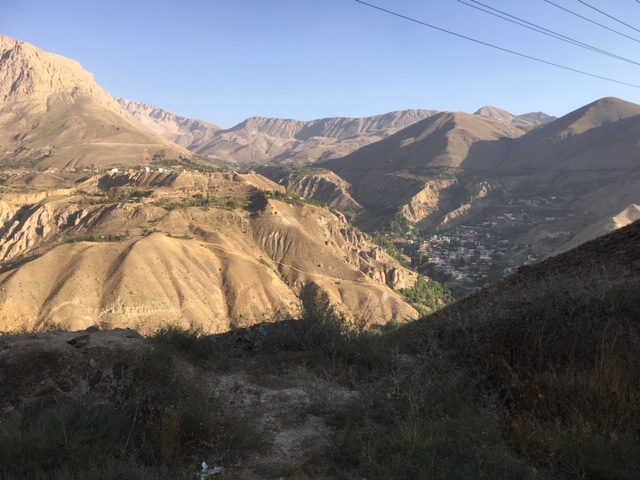
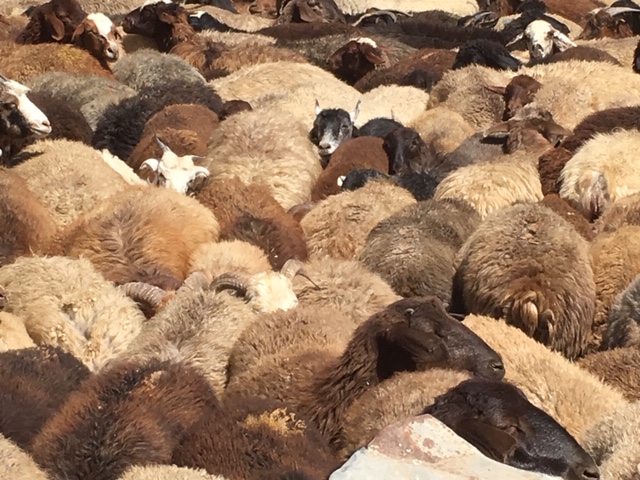
Then it is time to turn off the main 77 road and go up even higher to the Lar National Park where we will camp right underneath the volcano Damavand. This mountain of 5610 metres, is the highest in Iran and the highest volcano in Asia. We get there and we love the place. We are camped on a flat piece of land; everyone can get privacy and we can see the mountain from our van. Then flocks after flock of sheep and goats come past on their way to enclosures further up the hill. There are always a couple with bells so the shepherd can hear them in the dark. The sound is lovely, and then the stars come out and we start seeing lights high up the Damavand. There must be climbers up there and campsites. We will explore more in the morning. This was a good day!!
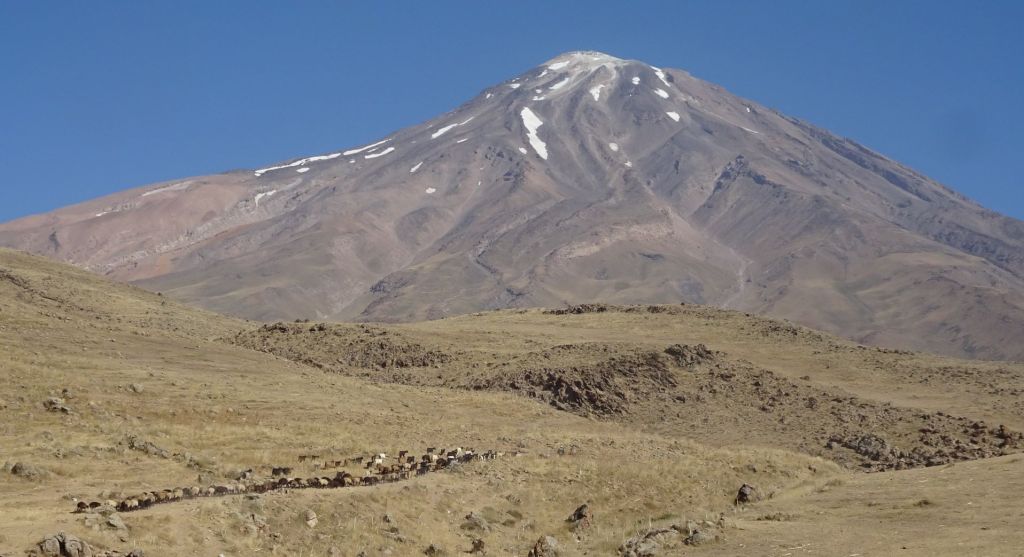
September 21
We wake to the sounds of the sheep bells and the shepherd calling them. This is so nice. We are only 60 km from a large metropolis (Teheran) but here we are amongst shepherds and mountain peoples. We take it easy in the morning celebrating the birthday of Hannie our tour leader and then we go for a walk (just when it gets hot). First past the place where the sheep are herded to be sorted and to allow them to drink. Water is brought up by small lorry and is also pumped up we hear. That is why there are so many herds up here.
Then further up to the ridge where we can see the whole Damavand. There is indeed a camp halfway up from where we are and perhaps a tower even higher. There is also a mosque lower down and there are roads and cars. We cannot quite make out how far up these cars can go, but some way. No doubt you will require a permit of sorts to walk up this mountain and it does not look an easy stroll at all. It is very steep near the top and it looks like ashes and moraines for the largest part.
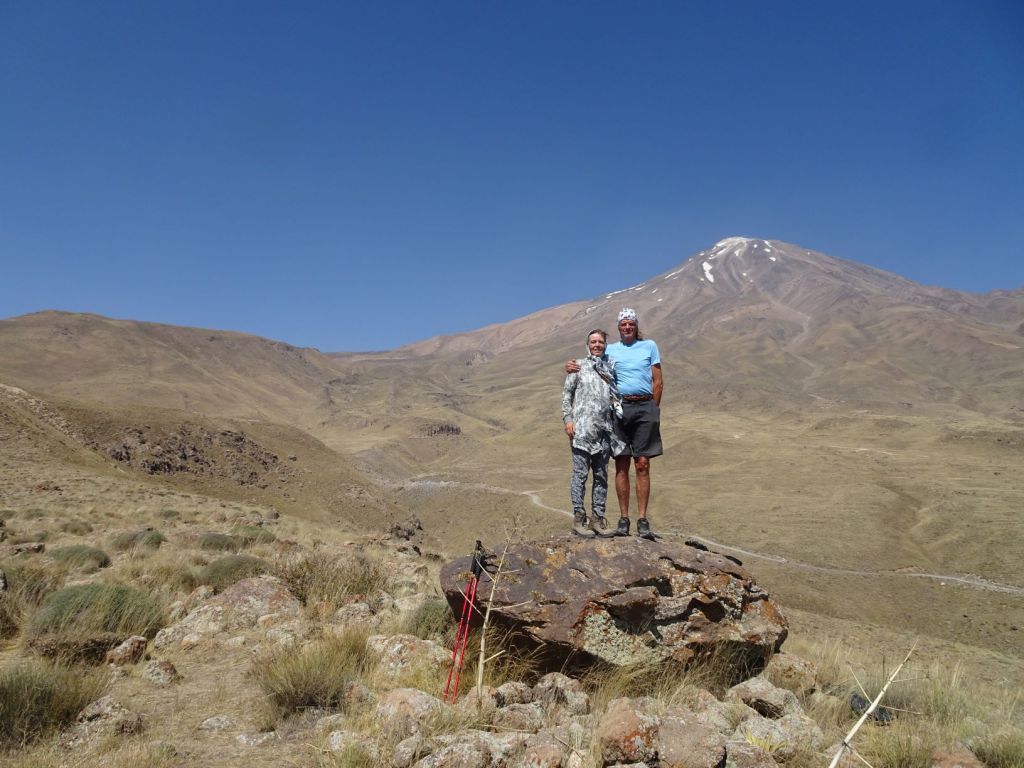
We decide to do a circular walk and we love this terrain. There are new views every time you come over a ridge. The view into the valley beyond changes all the while. Steep mountains with small villages scattered about, a stark blue sky above and several birds of prey, eagles, a merlin and perhaps a vulture, we are not sure, fly above. It is warm but not too hot and we manage to walk for nearly 4 hours. We are at 2500 metres where we camp and nearly 3000 during the walk. It is surprising how we find it all very easy going.
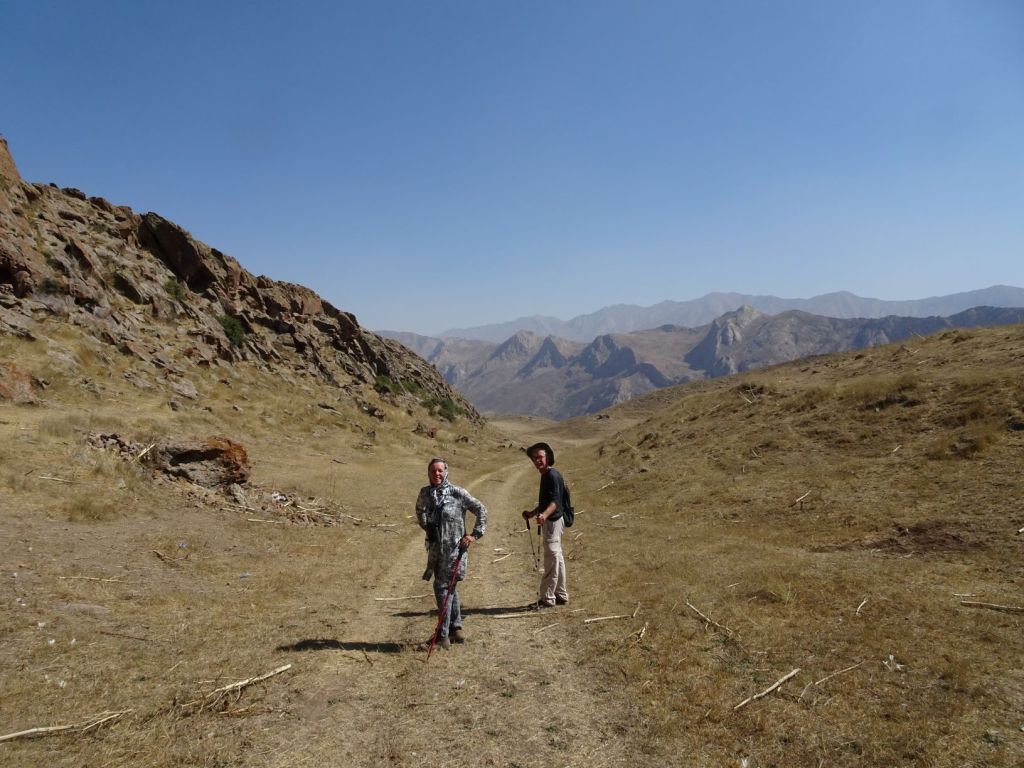
At night the same stars and lights up the mountain. This terrain has really been a shot in the rose for us. A memorable camping spot. Tomorrow we descend from the mountains into Teheran. We have to get up early to make the most of it.
September 22
We are up early and leave as we have planned at 8.30. But what we did not know is that the clocks go back one hour here, we are in wintertime now and it is actually 7.30. The road goes up for just a short while and then it is going down all the while. We drive past the ski-resorts just north of Teheran and then into the suburbs of Teheran. The hills are barren but still there are road stalls everywhere selling the spoils of a good harvest: pumpkins, fruits, nuts and honey.
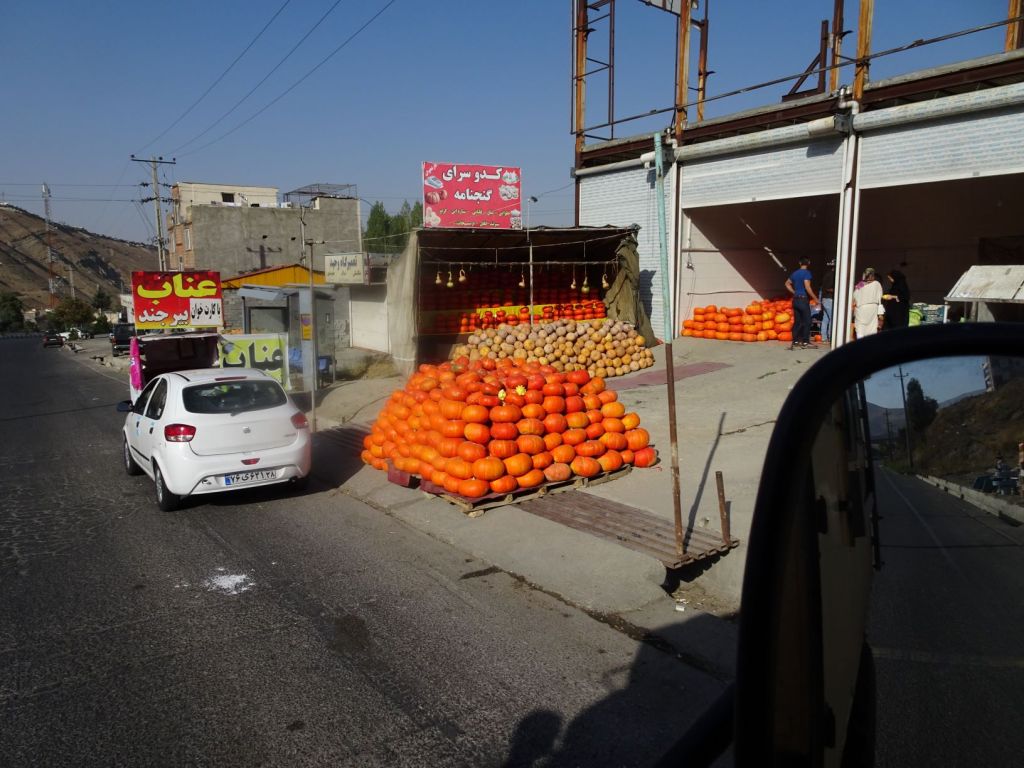
And further down we go. Wide roads lead us into this huge city. From afar we can see the pollution Teheran is infamous for hanging as a brown fog over the lower parts of the city.
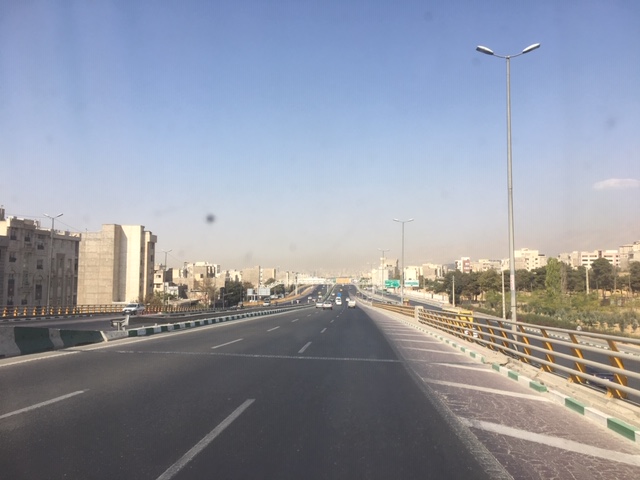
It is another 20 km once we have reached the boundaries of the city. The park where we are supposed to camp in the shade won’t let us in and we are resigned to spending another two nights on a concrete car park next to a busy highway. But it is walking distance to the metro, so we will spend all our time in the city and just come there to sleep. We have finally reached Teheran and cannot wait to explore more.
Teheran
Teheran is the capital of Iran but only since the last 200 years after the Qajar dynasty overthrew the Zand dynasty in 1794 and Teheran took over from Isfahan as the capital of the kingdom. With a population of 8.7 million people in the city and 15 million in the greater Teheran region, Teheran is the most populous city in Western Asia.
Agha Mohammad Khan defeated and brutally murdered the last Zand ruler, Lotf Ali Khan which marked the beginning of the Qajar dynasty which would last until 1925. The capital was moved from Isfahan to Teheran to ensure good links with the Caucasus where the Russian threat was growing.
The Qajar dynasty is looked upon by the Iranian people today with shame and disapproval. It turned out to be an era of slow decline with territories lost to Russia during a series of Russian wars, and Iran becoming a pawn in the colonial interests of Russia and the United Kingdom during ‘The Great Game’ in the 19th century. The Qajar Dynasty proved to be weak and decadent taking bribes and not standing up to the colonial powers manipulating them.
Armenia and Georgia and further territory south of Caucasus was lost during the Russian wars and the regime was unable to prevent encroachment of Russian and British forces in the North and the East. During the Anglo-Persian war in 1853, Britain prevented the Persians to reassert control over Herat and took control of areas near the Persian Gulf. During the second half of the century Russia completed the annexation of Turkmenistan and Uzbekistan severing the ancient ties between Persia and cities like Bukhara and Samarkand.
Repeated trade concessions, loans and donations to the Persian rulers by Britain and Russia resulted in loss of control of economic affairs and towards the end of the 19th century many Persians believed that their rulers were beholden to foreign interests.
Popular demand to curb arbitrary authority in favour of rule of law increased as concern regarding foreign penetration and influence heightened.
In 1906 protests broke out everywhere and the Shah was forced to promise the formulation of a constitution to restrict royal powers and to organise elections to open a parliament, the Majles.
However, the regime rescinded on its promises and with Russian help the Majles was closed down in 1908. This resulted in the constitutional revolution in 1909 when the Shah was deposed and had to go in exile in Russia. His 11 year old son was put on the throne. A turbulent time followed; Russian troops landed in 1910 in an attempt to reinstate the ex-Shah.
The constitutional developments were undermined when incredibly, under the Anglo-Russian Entente of 1907, Persia was carved up in to spheres of influence between the two colonial powers.
Although Persia remained neutral when the First World War broke out, the Ottoman Empire invaded their territory. Between 1914 and 1918, Ottoman troops massacred many thousands of Iran’s Assyrian and Armenian population.
Iran was occupied by Ottoman, Russian, and British troops for the duration of the war and was effectively left without a government of its own.
In February 2021, Reza Khan, a commander in the Persian Cossack Brigade organised a Coup d’etat becoming the effective ruler of Iran. He was formally crowned Shah in 1925, establishing the Pahlavi dynasty which would rule Iran until the Revolution of 1979.
The name Pahlavi recalls the Middle Persian of the Sassanian Empire and Reza Khan forced all foreign nations to address the state as the Iranian Empire. He established a strictly secular political set up and was very assertive towards foreign meddling in Iranian affairs. The former upset the clergy in Iran and the latter did not go down well with the foreign nations, Britain, and increasingly, the United States.
Britain already controlled all Iran’s oil production through the concession obtained from the Qajar dynasty in the early 1900s, and the Shah was reluctant to have further British control over the economy turning to other countries such as Germany and France. When as a neutral country, he refused the British demand to expel all German citizens after the outbreak of World War II, he was accused of being a Nazi sympathiser and Britain engineered his departure from the throne in 1941 to be followed up by his son Mohammad Reza Pahlavi.
In 1951 the Majles appointed Mohammed Mossadegh as Prime Minister. He nationalised the oil industry. The Shah was opposed to this fearing sanctions from Britain and the United States and temporarily fled the country. The United Kingdom and the United States organised a Coup d’etat, deposed Mossadegh, and the Shah returned from exile.
Now the Iranians found themselves in a similar situation to fifty years ago under the Qajar regime with the difference that the present puppet of foreign powers ran a secular regime and the country was not bankrupt but profited (to a point that the foreign powers would allow) from revenues resulting from the oil boom.
The Shah’s Government oppressed their opponents with the help of Iran’s security and intelligence secret police the SAVAK which was much feared. The SAVAK arrested and murdered the Shah’s opponents, mainly leftists and islamists.
During the sixties, the Shah embarked on bold and ambitious plans to develop the country based on Western economic models and philosophy which created more enemies, in particular amongst the clergy.
When a charismatic and intelligent Islamic leader came to the fore the unrest coalesced in to the Islamic revolution in 1979. The Shah fled the country and died of cancer shortly after.
September 22
Exploring Teheran
First stop: getting some more local currency. We walk from the metro stop and find ourselves in an area that sells wool (honestly! It must get cooler here in winter…..) and then streets of shops selling machine tools, drills, compressors, anything a joiner may want and overalls and gloves, just what Roelf needs.
Perfect as we need to fit a new attach mechanism to our roof hatch, and Roelf finds a key for his drill and new working gloves. Then we get some more local currency, have some lunch, and head for the National Museum, looking for air conditioning. It is 36 degrees on the streets.
The museum has some wonderful exhibits and explanations in English. We particularly like the pottery, the huge vases and vessels made in the time Susa was a large city on the West side of current Iran. These items were made an astonishing 7000 years ago!! Not all vases were so large, some were small but could have been made in our time; the decorations were so stylish, depicting animals and geometric figures.
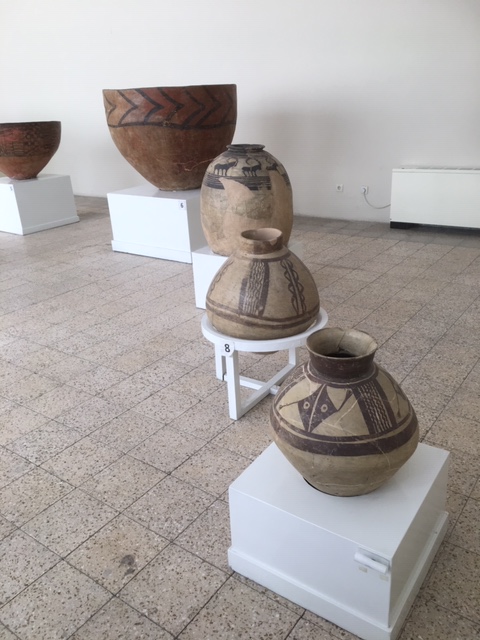
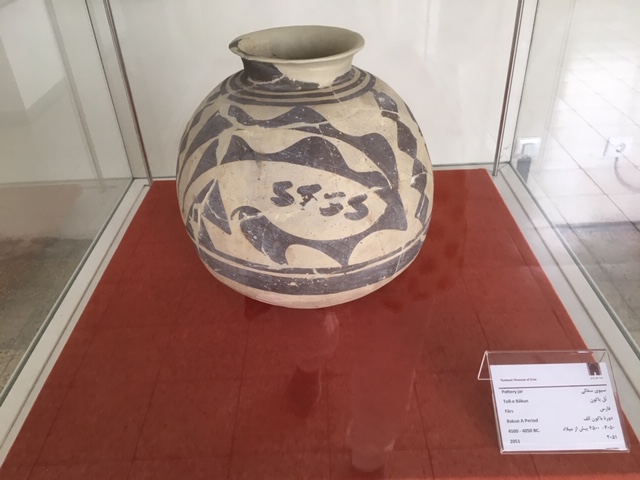
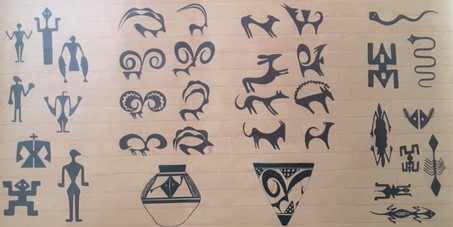
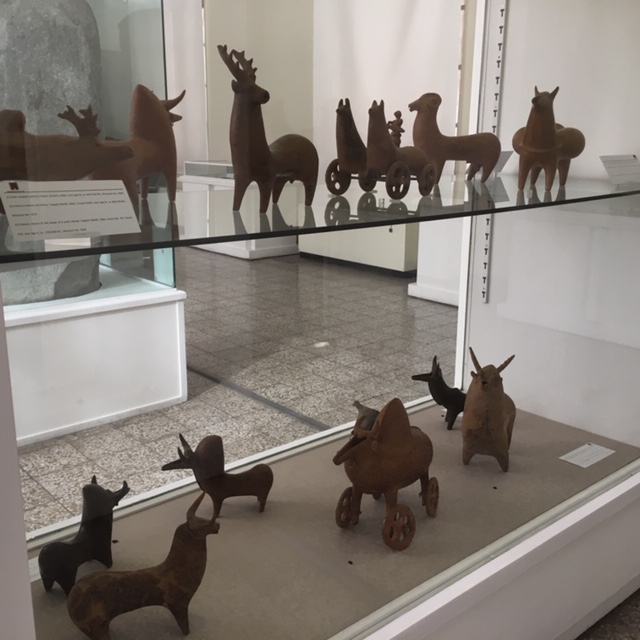
There were also small clay and bronze figures found in graves even earlier, 7000 BC.
And then we were shown original statues and friezes from Persepolis. Quite astonishing sculptures in granite and in slate. And intricate writing on stone tablets.
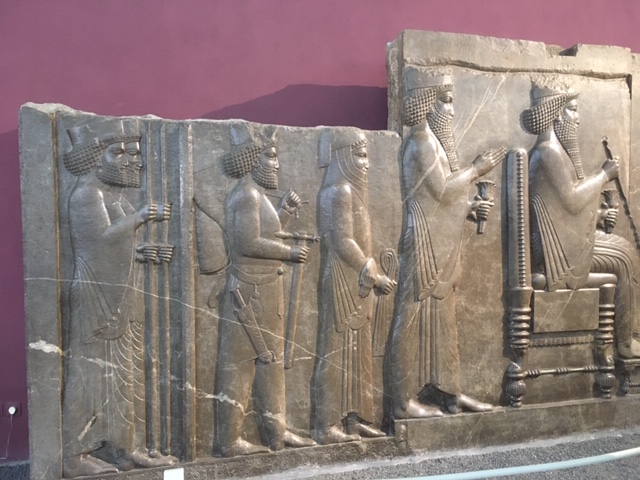
We are already looking forward to seeing more of this later during the trip when we will visit Persepolis itself.
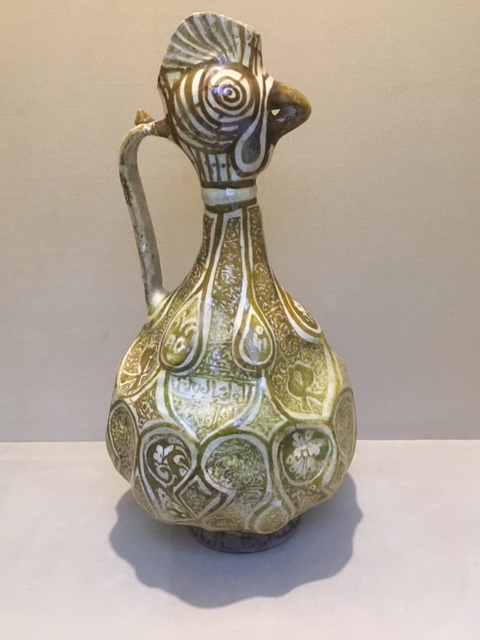
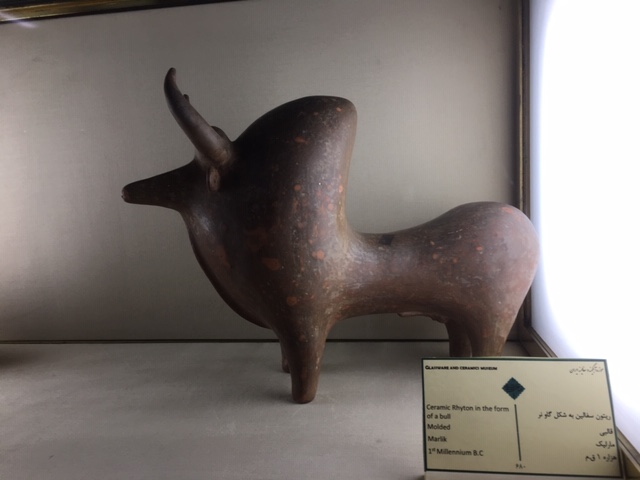
Then we head to the nearby museum of glass and pottery, housed in the beautiful former Egyptian embassy. What a grand building just off the street with a lovely garden in front and walls all round. You can feel completely removed from the noise and hustle and bustle of the city around. Wooden parquet floors, glass mosaics on the walls and grand chandeliers over the circular staircase. This is some building for a museum!
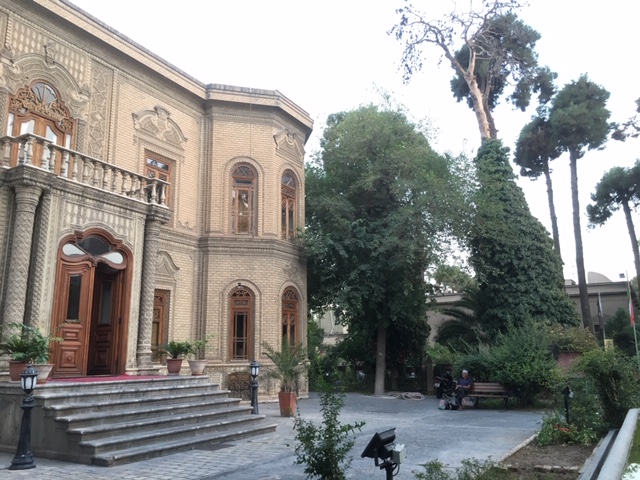
The glass is intricate, shiny and amazing. Mostly made in the northeast of Iran, the places we did not see and must remember to visit if we ever are to return. Just south of Mashhad, in Neyshabor, and in Gorgan, the city we passed but did not enter and even in Gonbad where we visited the brick tower. Aparently there is glass making still in these cities.
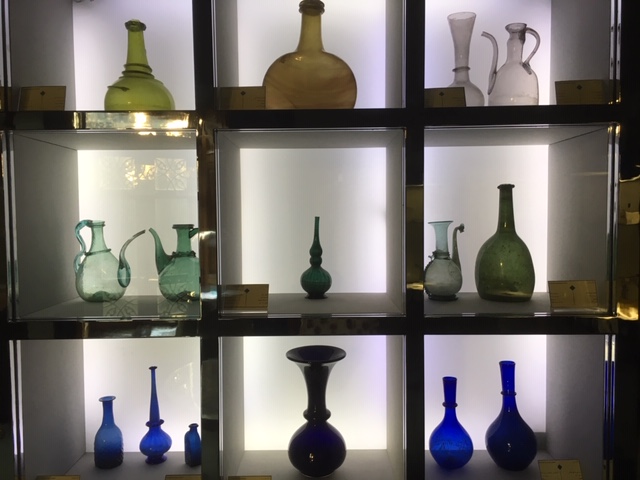
But even more beautiful are the examples of pottery, mainly from Kashian, a city we are still to see. Again, the decorations are stylistic and artful. And the shapes of some of the decorative pieces are magical.
Then off to café Godo Yas to sample the café culture in Teheran. We end up in a place at the end of a backstreet. An open courtyard with a huge sail over it and pond in the centre as is customary in Iranian gardens. It has also nice seating inside where we spend some time writing and reading. We have been drinking fruit juices all day and it is nice to know there are good toilets nearby! It is after 9 before we set off back to our Mog for a good night’s sleep. It is very dark when we finally exit the Metro on what may have been the last train. We walk through a dark park and are accompanied by locals with dogs who want to protect us. We have not felt in any way unsafe, but perhaps this dark park is one step too far. We arrive safely at the car and are looking forward to seeing more of this city tomorrow.
September 23
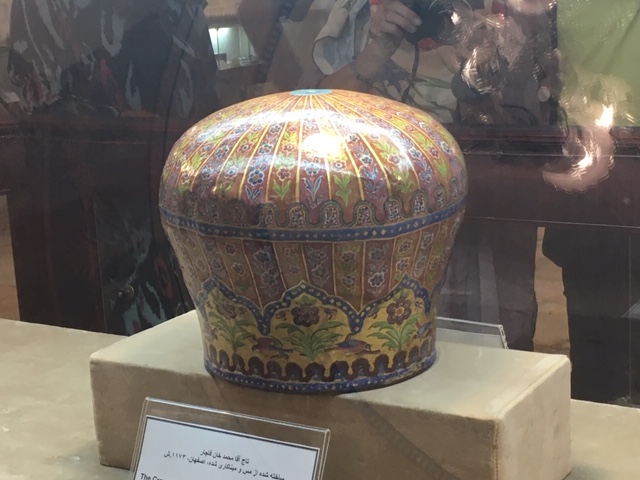
We make a guided tour through Teheran by bus. First we go to the Golestan palace, built by the royal Qajar families that ruled Iran for 200 years (1794-1925) until the Pahlavi era of the last two sjahs in the 20st century. These buildings were built at a time when Tehran was not a major city yet and they were used by the royal family as a stop in between Isfahan and the north of Iran. The palace was used for coronations and a replica of the peacock coronation throne is on display. There is also a huge white marble throne that could be taken apart and travel with the kings as they moved round the country. Some of the extensive collections of paintings, art objects, ceramics and various gifts to the kings, are also on display. The rooms are decorated with glass mosaics and large carpets. It is all very ornate and not especially to our taste, but the craft in making the objects and decorating the building is impressive. The styles were copied from the French court in particular. While we are not so sure about the interior, the outer tilework is spectacular.
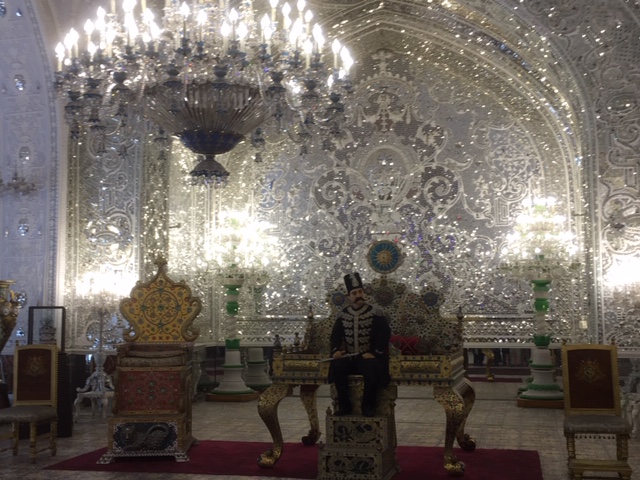
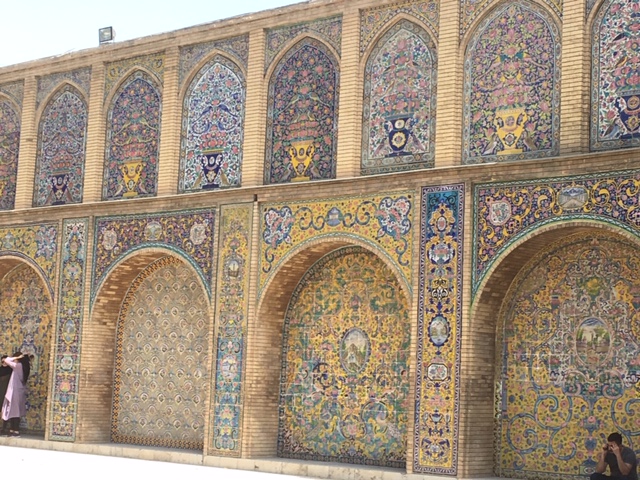
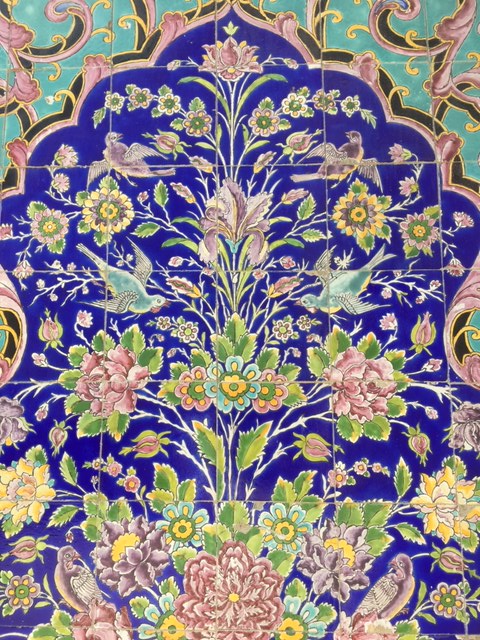
In the last century during the reign of the Pahlavis the building was no longer in use as residence, but was still used for official visits of state guests. During that time, before the revolution, several buildings were constructed in ‘modern utilitarian style’ directly beside the palace. This looks crazy now. Behind the beautifully tiles facades concrete blocks rise up and dominate the site that once was a peaceful garden surrounded by low rise buildings. Town planning was not much in force clearly.
In the afternoon we visit the crown jewels that are kept in the Central Bank in Teheran. When the last shah was deposed, Khomeini confiscated all his possessions and these can now be viewed on certain days only and only during a short time slot. Strict security, we are not allowed to bring anything not even phones so there are no pictures we can show here. We buy some postcards to remind us.
In a darkened room are display cabinets with the most extensive jewel collection you can imagine. Organised by the type of precious stones used we see rubies, emeralds, diamonds (white, yellow and even black), turquoise and pearls, set in gold, silver and decorating objects such as swords, parts of water pipes, drinking vessels and just ornate objects. There are brooches, bracelets, necklaces and of course tiaras, and crowns. We see beautifully embroidered clothes with precious jewels, a globe in which the continents are indicated with rubies and the seas with emeralds, and the original peacock throne. It is just a sea of immensely precious stones, most not from Iran but sourced by the shahs over the centuries from other countries in central Asia and from South Africa. We are guided at lightning speed round the collection as people are waiting to be allowed in. We have a time slot of only some 30 minutes, but what a special visit. The value of this collection? ‘It is of course highly valuable’ says our guide, ‘but nothing compared to the value of all our oil and gas’.
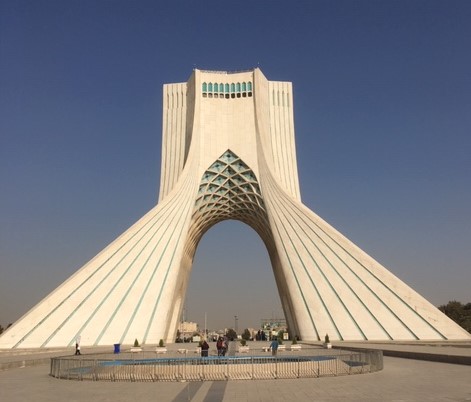
We finish with a visit to the famous arch that is always shown on TV when an item about Iran comes up. The Azadi tower was built by the last Shah in 1971 in commemoration of the 2500th year of the foundation of the state of Iran and was named Sahyad (Shah’s memorial). After the revolution it was renamed Azadi, or freedom memorial. On TV we always imagined this to be a concrete block without grace, but how wrong we were: this is a very stylish monument that makes reference to Iranian architecture with its shape and has turquoise mosaic lines and a beautiful tiled internal ceiling. It is set in a park and is oozes class. Another wrong impression we had about this country is put right!
We take the Metro back into town to find another café. This time it is 65 yard café just off Ferdowsi square.
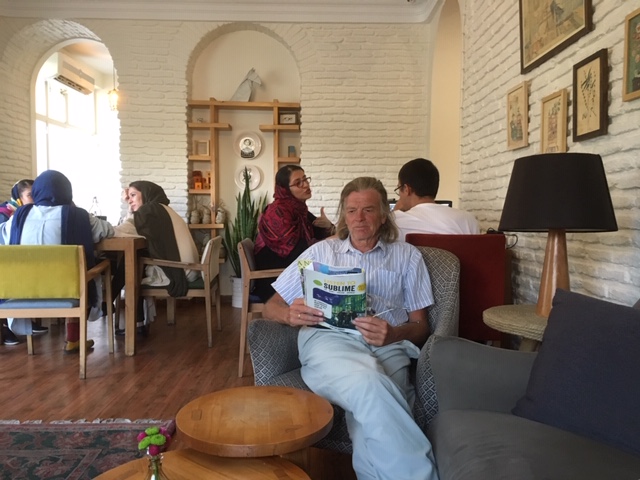
A young clientele in a lovely building with a countyard outside and sitting rooms upstairs furnished with retro looking furniture. We find some comfortable seats to spend a little time reflecting on our time in Iran so far. What a country this is and how these peoples deserve to be respected in the world. Tomorrow we leave the capital and move further south. We are looking forward to seeing more. May the Mog take us there!


 Central Asia Roadtrip
Hey Miep & Soene, bijna aan het eind van jullie reis. Via de polarsteps van Lida begrijp ik dat jullie naast alle gastvrijheid ook een andere kant van Iran hebben gezien. Armoede en rellen; het is en blijft een land met een totalitair regiem, ook al zijn er zo nu en dan verkiezingen. Helaas, als je leest wat jullie allemaal meegemaakt hebben aan gastvrijheid en bijzondere ontmoetingen. Vooral bij de Iraniërs thuis. Het moet met name voor jonge vrouwen erg knellend en deprimerend zijn om buitenshuis te moeten voldoen aan de reli-kledingvoorschriften. Word je daar niet een beetje triest van als je beseft hoe vrij je zelf bent ( ook al moeten Miep & Lida zich elke dag weer in een doek om het hoofd en armen wurmen). Wat een raar voorrecht voor de mannen, die zich helemaal niet hoeven aan te passen in hun kleding (hooguit een lange broek? )
Benieuwd om later te horen hoe zo’n lange reis bevallen is. Het valt mij op dat jullie op vrijwel elke locatie met gidsen op pad gaan. Zijn die gidsen van te voren geregeld door de organisatoren van de groepsreis? Op die manier leer je veel van het land en kom je via gidsen in contact met families. Wel een groot voordeel van een groepsreis. Als je alleen reist, zul je minder gauw zo vaak met een gids op pad gaan.
Veel plezier de laatste dagen van de reis, nu al meer dan 20.000 km! Superprestatie van de Mog & bemanning, na eerdere mechanische en fysieke problemen.
Groeten
Gerard & Aukje
LikeLike
Hoi Gerard
We zijn weer achter met onze blog omdat de website weer geblokkeerd is. Hopelijk kunnen we het up to date maken als we in Armenië zijn over twee dagen.
Onze interpretatie van Iran is anders dan Lida’s hoewel we het eens zijn met het gebrek aan vrijheid, vooral voor vrouwen.
Wij zijn een heel sterke Iraanse identiteit tegen gekomen en een enorme trots op het land. De mensen hier zijn ambivalent over het ‘vrije westen’. Het vrije westen heeft Iran al tweehonderd jaar misbruikt en uitgebuit, en de huidige boycott wordt door de ontwikkelde bevolking hier in dat verband gezien.
Men maakt zich hier veel meer zorgen over de krappe economische situatie en het isolement dat wij hen hebben opgelegd, dan ze zich zorgen maken over hoofddoekjes en dergelijke.
De rellen die we mee hebben gemaakt werden veroorzaakt door een specifieke kwestie die te maken had met HIV en het gebrek aan ondersteuning van de bevolking door de gezondheidsorganisatie.
De meeste mensen distantieren zich van de mullahs en zouden graag zien dat de godsdienst uit het overheidsbeleid verdwijnt. Maar ze zijn sympathiek ten opzichte van hun regering als je het hebt over de relatie met Amerika en Groot Brittannië. Niemand hier gelooft dat Iran de dingen doet waar het Westen hen van beschuldigd!. En we hebben al verschillende malen te horen gekregen hoe kwaad men hier nog steeds is over de speech van George W Bush toen hij Iran indeelde in de ‘Axis of Evil’. Dit was kort nadat Iran Amerika enorm had geholpen met het bestrijden van de Taliban in Afghanistan. De Iraniërs zijn het eens met hun regering dat ze dit soort onzin niet pikken.
Wat de mensen hier vragen is of we ze kunnen helpen met het ontwikkelen van het land, vooral het onderwijs van de bevolking zodat mensen zelf de flauwekul van de mullahs kunnen doorprikken een andere regering aan de macht brengen.
Wat we doen met de boycot en het verspreiden van negatieve verhalen over Iran is preciesheid tegenovergestelde.
Tot spoedig horens
De groeten aan de Auk.
Soene
LikeLike
Dank voor je reactie, genoeg stof om over na te denken. De geschiedenis van Iran leert inderdaad dat Iraniërs niet veel van het Westen te verwachten hebben. Dat is natuurlijk verrekte jammer en stom van onze eigen regeringen. Lida gaf in één van haar polarsteps ook aan dat zij de Iraanse regering/overheid wantrouwt vanwege de opstelling richting Israel (geen erkenning staat Israël). Benieuwd hoe Iraniërs op straat/thuis bij de thee daar over denken. Zijn er nog Iraniërs die terug willen naar de tijd van de Sjah? Kan ik me haast niet voorstellen, was een wrede dictatuur, maar bood voor de rijkere bovenlaag en middenklasse wel de mogelijkheid om een westerse levensstijl te leiden.
Hoe lang zijn jullie nog onderweg? Na Armenië rechtstreeks naar Turkije? Of nog een ommmetje via Azerbejan en Georgië? Rijden jullie tzt nog via Nederland terug naar huis? Zo leuk zijn om jullie dan even te treffen.
Groeten aan Miep
LikeLike