July 30st
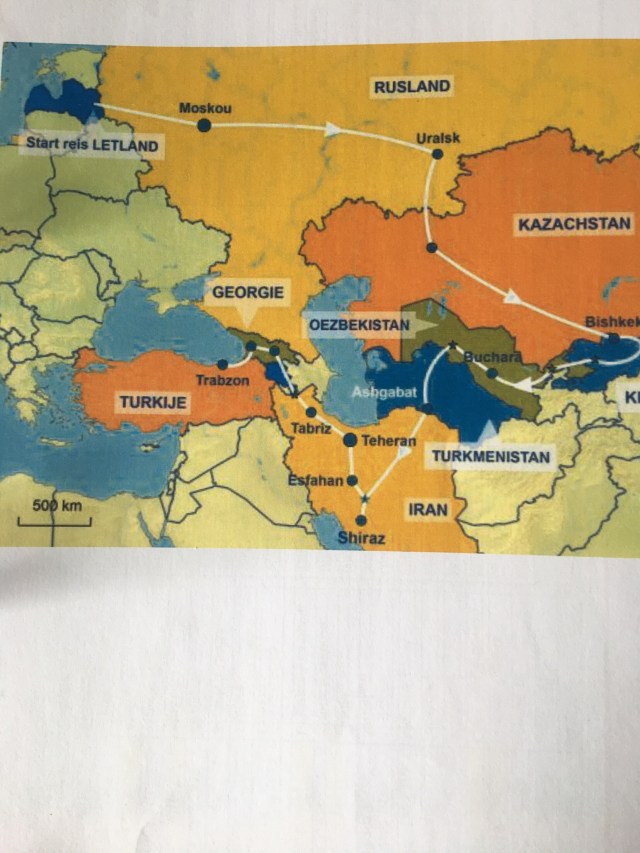
The border crossing between Russia and Kazakhstan is much more relaxed compared to the crossing between Russia and Latvia. Despite this we spend some hours there trying to get out of Russia and then waiting to be let into Kazakhstan and buy car insurance. The two young guys at the insurance booth make a lot of money for their boss this afternoon.
Maybe the more relaxed atmosphere is not such a surprise as the relationship between the two countries has always been positive. Still: the queues for the lorries trying to enter Russia is endless and we have visions of a post Brexit Dover border crossing. We have another priceless moment when the customs officer who has already stamped all the papers, finally sees the Mog: he bursts out laughing. We have been told to always keep a straight face when in the presence of officials, but he has so much fun seeing our crazy car that we end up laughing, all of us together. The Kazakh people have already endeared themselves to us!
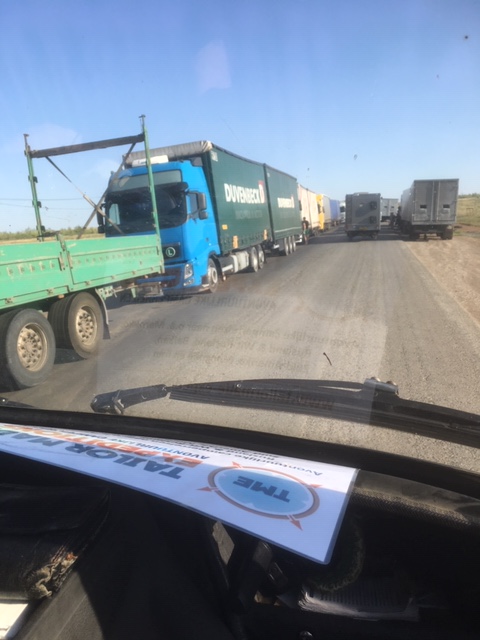
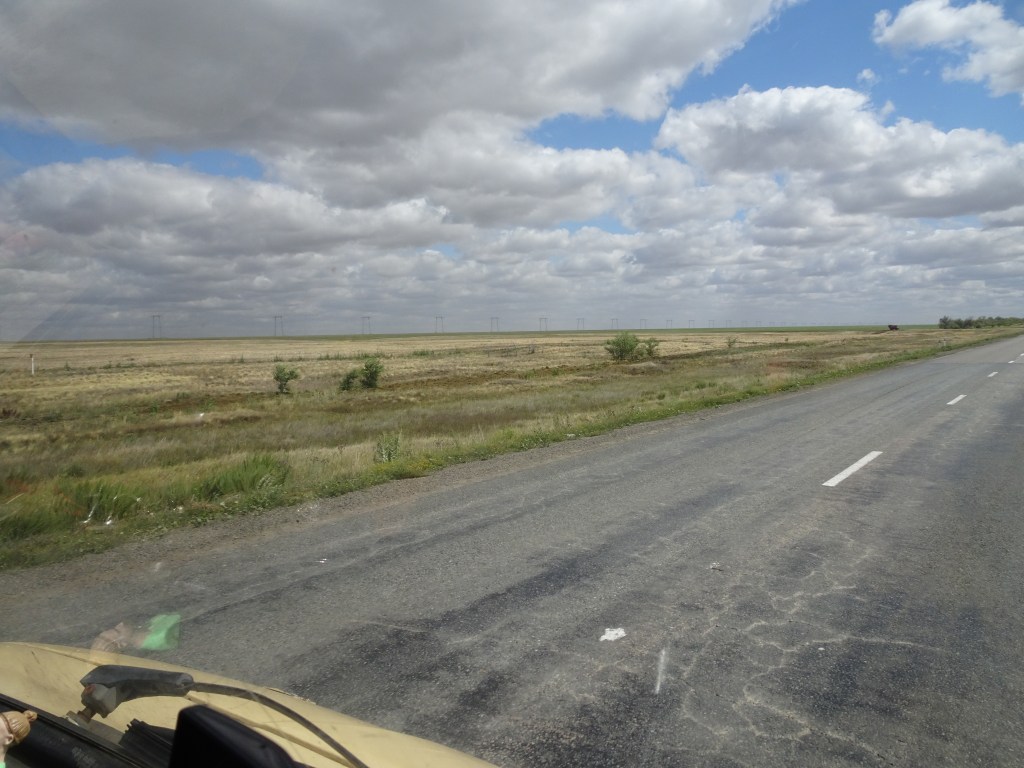
Immediately after crossing the border the landscape changes into steppe, an arid land with few trees or shrubs. Numerous nomadic tribes inhabited Kazakhstan since ancient times. They are known collectively as the Saga. They were in constant warfare with each other and unable to resist the Mongol-Tartar hordes lead by Genghis Khan when they swept the country in 1218. Kazakhstan was incorporated in the vast Mongol Empire known as the Golden Horde.
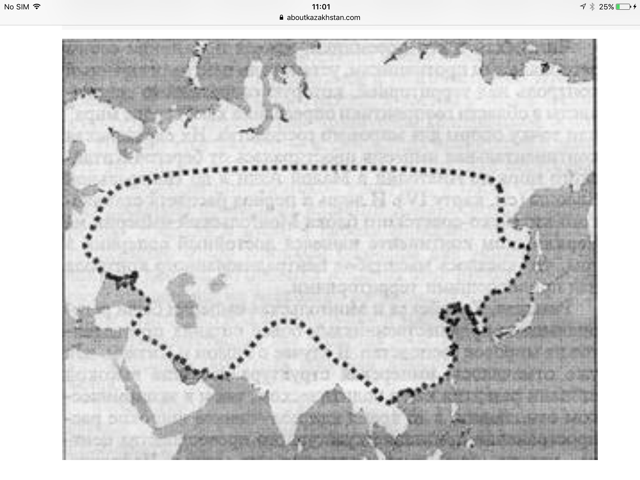
The Golden Horde fractured after the death of its last great leader, Mongke in 1360. Various Khanates ruled in Kazakhstan, and there was a return to almost continuing warfare with plundering and murder of the Kazakh population. The local warfare left the country vulnerable from invasions from all sides, leaving the Kazakh population on the brink of complete enslavement.
The most prominent leader during these years was Timur who was from Samarkand and formed alliances with neighbouring khanates. He was not a Chingissid but married the women of Chingissid khans he defeated in battle to give himself some royal legitimacy. He called himself ‘Emir’.
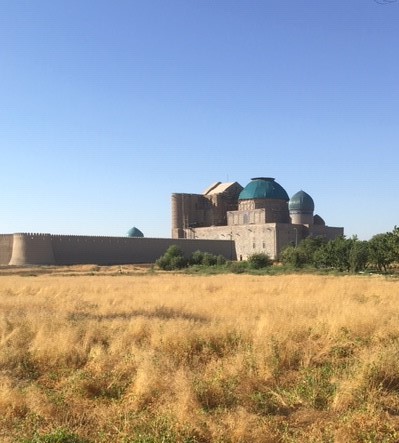
Timur reigned until his death in 1405 and gained incredible wealth by ransacking countries around his own homeland from Moscow to the North of India. The wealth was filtered back home and is visible until today in Samarkand but also in Turkestan where he erected this big mausoleum in remembrance of a 12th century poet and Sufi prophet. Timur is a folk hero in Kazakhstan and the mausoleum a symbol of Kazakh identity.
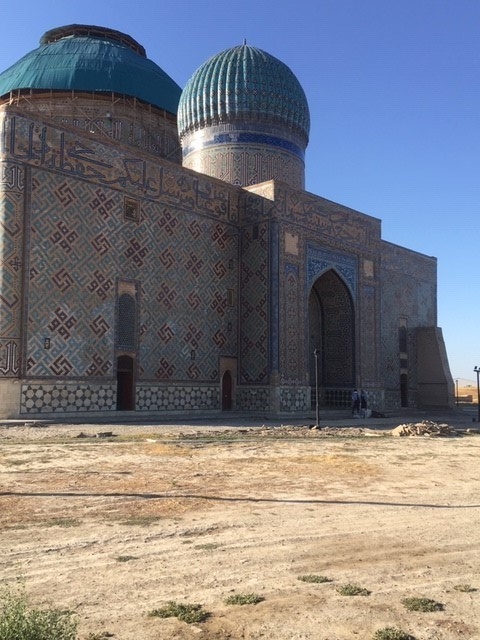
The whole site and even the whole city is under reconstruction with massive roadworks and new pavements being laid to allow pilgrims and tourists to visit.
After Timur’s death the Timurid regime lasted for another hundred years or so, but the bounty of warfare dried up and the rulers concentred on trade and art. Eventually the regime became unstable and the country reverted to local warfare. There was great instability when the country sought protection from the increasingly powerful Russian Empire leading to voluntary accession in 1731, during the time of Peter the Great (1682-1725).
After the Russian revolution in 1917, Kazakhstan became the show case for Soviet agricultural development, leading to the catastrophe of the shrinkage of the Aral Sea. Kazakhstan became an independent state after the fall of the Soviet Union in 1991.
July 31st
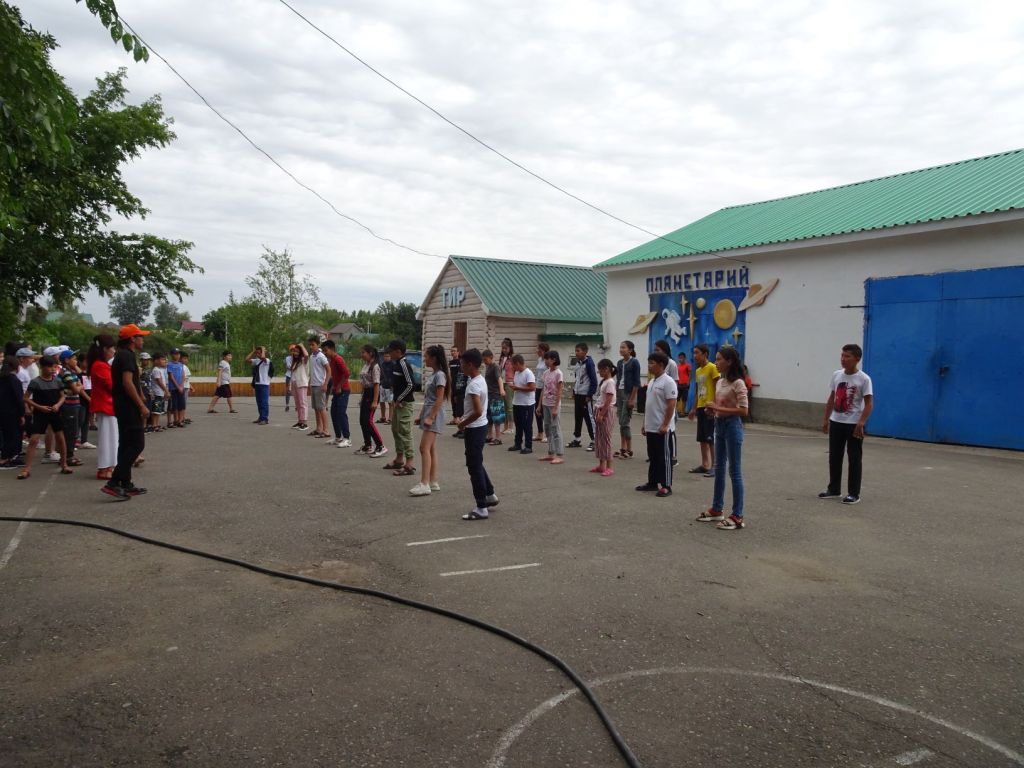
We have spent the night in Uralsk where we had a good camping spot near a river and near a holiday camp for children. It was peaceful and just what Roelf needed as he was increasingly feeling unwell and has developed a fever. We stay behind to allow him to sleep it off and leave late to join the group in a small village called Zhympity. Before we leave we hear the children sing quite beautifully. They also know a lot of dances and are very athletic in their movements.
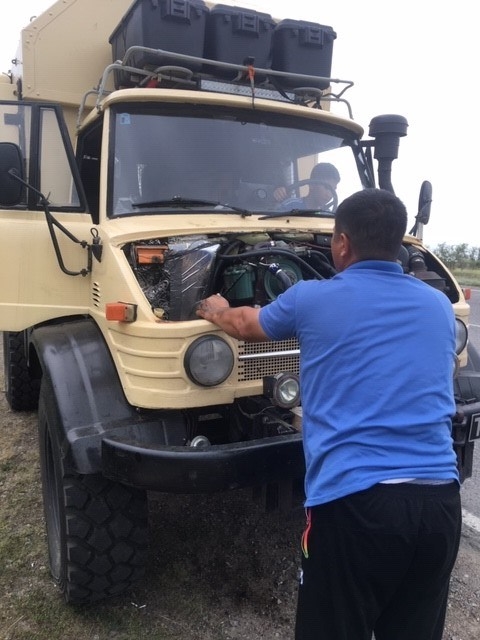
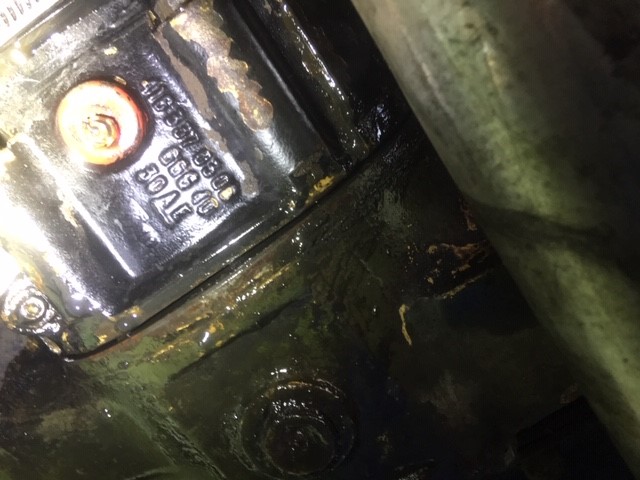
En route to Zhympity the Mog splutters and yet again our troublesome fueltank is giving up. We know there is water in it and have tried to drain this before. Roelf makes another attempt to do so, but with the engine running and now we have sucked air into the fuel system. Sucking out the air does no good and leaves Roelf coughing on the roadside. As always, people seem to appear out of nowhere when the Mog breaks down. A car travelling in the opposite direction turns around and before we know it the guy and his son have taken over. Fuel filters are removed and emptied and then he pumps them full again. A huge blister on his hand, but he just carries on. His son starts the engine and revs and again and we are ready to go.
The drive carries on being eventful. We end up in a major thunderstorm and huge amounts of water are blown over the road. Once again the Mog leaks in the cabin. We drive slower and slower and finally arrive way past 9 pm with everyone relieved we made it after all. Roelf is exhausted has a fever and needs to sleep. We hope for a better day tomorrow.
August 1st
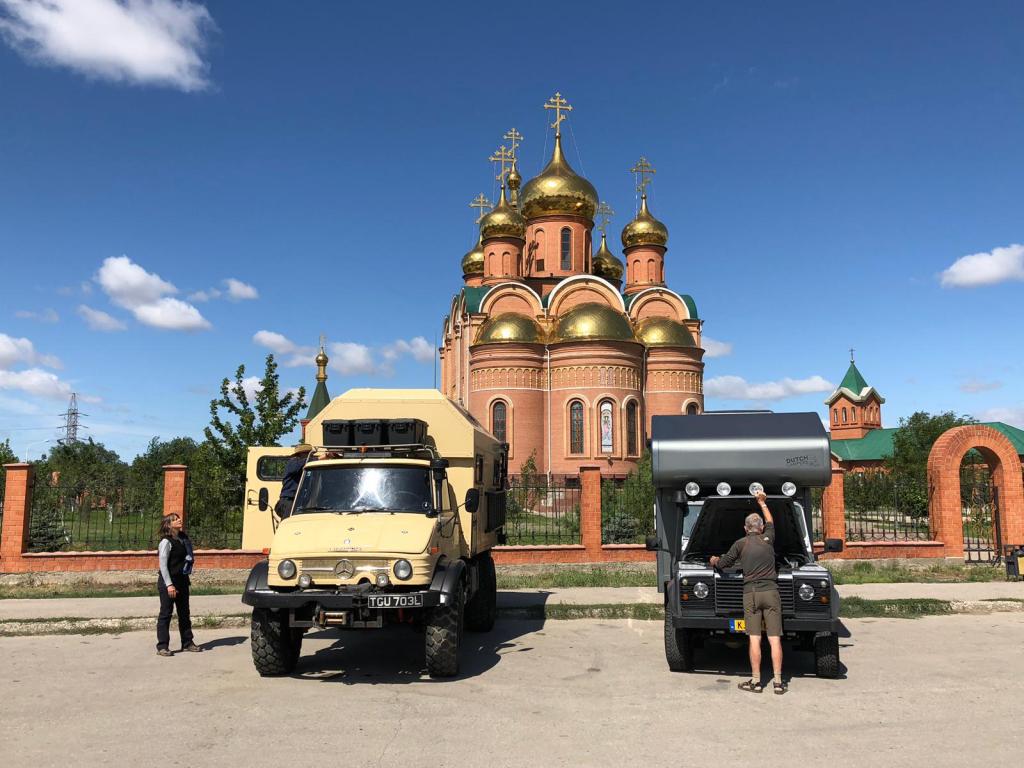
Roelf cannot remember very much about the drive to Aqtobe because he was so unwell. For the first time Miep gets to drive the car. After some initial instruction on how to operate the 4 gear levers Roelf retires to the back of the Mog to sleep and we are off. Lida and Kees in their landrover leading the way to Aqtobe. The road is steppe/desert, loads of birds of prey, eagles, falcons, hawks; it is quite amazing. Otherwise not much to see or do along the way. It is an easy drive and we arrive in Aqtobe (the last to arrive as is becoming customary for our slow camper), where all campers are already parked in front of a orthodox church and next to a MEGA shopping centre for the new rich Kazakhs. Aqtobe is a real frontier town where everything seems to go. Visions of Las Vegas and also of Dawson City where they said everything that money can buy was available. Roelf is oblivious to it all and is quite amazed when he sees the picture of the place where he had his high fever all night. He is even unaware of the constant harassing by police and other people who pretend to be officials and ask questions about us and the cars. In the end we just give up and stop answering. Campers are allowed to park on public car parks in Kazakhstan we were told and we are going to stay put.
August 2nd
Miep is enjoying driving the Mog. Roelf says she does it like a farmer drives a tractor; it is meant as a great compliment!.
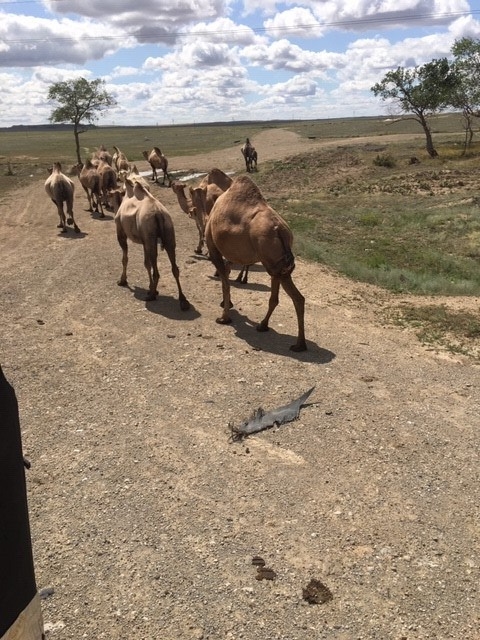
We drive on the next day to get to a small village where we will camp amongst the huts, houses and animal pens. We see camels along the way and some horses. Some herdsmen on horseback come along with their cows. Visions of the golden Chinggis Khan charging across the steppe. You see nothing for ages and then suddenly there is a group of camels or horses. You can imagine the fighters could have arrived out of nowhere although visible from afar if only you knew where to look in this endlessly empty landscape. Roelf can hardly keep his eyes open and misses all this; he has been on a double dose of Ciprofloxacin for a presumed cholecystitis because of fever, flank pains, and extreme nausea. We hope he will feel better soon. This is not the place to get into an acute situation.
When we arrive in the village there is a lot of commotion. Children appear from everywhere. As Miep puts out the ladder they all pile into the Mog where Roelf is unwell in bed. He has to put on his scariest face to chase them out.
August 3rd
It seemed inevitable that this was not going right. Under great confusion Roelf has been ambulanced to a small rural hospital. Our compatriots had tried to make enquiries as where we could get an ultrasound and some basic tests such as bloods and CXR, but it ended up with him being transported by ambulance for a 1.5 hour bumpy ride at great speed in the middle of the night. We were told that Kazakh police would be very tough on driving too fast, driving without seat belts and all kinds of other offences, but in this ambulance everything goes. The 3 male nurses are on their phones all the time and speak with Miep through an interpreter. Not much attention is paid to Roelf who is on a stretcher in the back. It is a great car with place for 3 stretchered patients, 4 people in the front and another 3 sitting in the back with the patient. We are all in the front and are being reassured constantly by the interpreter that the patient is taken somewhere where they can help him. When we arrive in Yrghyz there is a party waiting for us with male and female nurse, and 2 doctors. A quick and efficient clinical examination aided by interpreter on the phone seems to confirm the diagnosis of gall bladder infection. Roelf gets treatment and everyone disappears. We wonder how to get home and are told there are no taxis until the next morning.
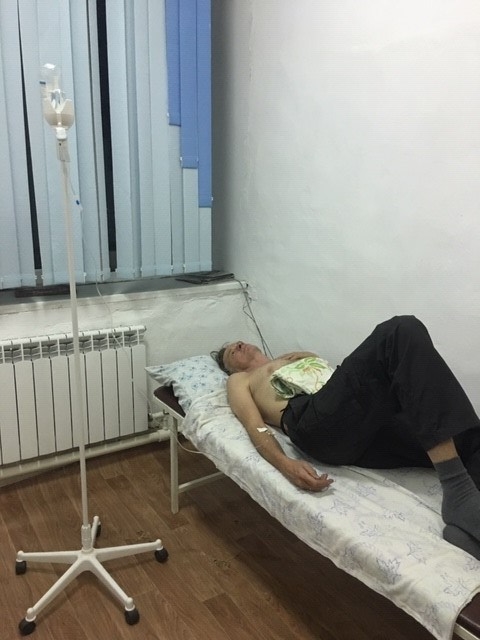
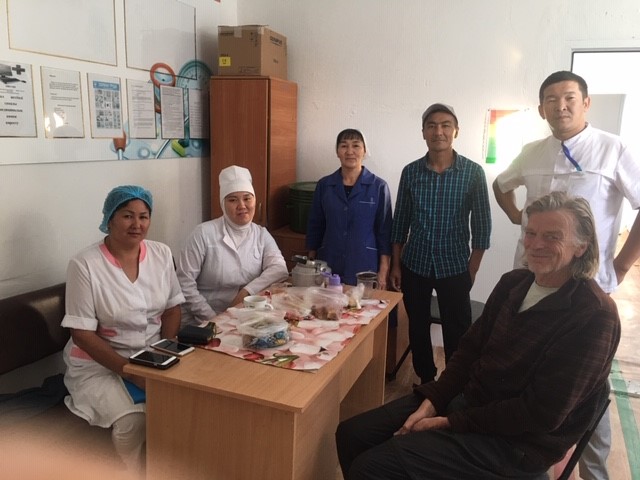
Lots of kindness, no effort to take any money, but no diagnostics, and an exhausting experience. We are offered a room to sleep in at 3 am and sleep until 7.
August 4th
We arrive back in Kzyl-Zhar Vtoroy at midday after a struggle to get a taxi and then, when we finally have one, to get the driver to take us the full 151 km back from the hospital in Yrghyz. We have to renegotiate the price 3 times! 3 other campers have kindly waited for us. After some quick checks on the Mog we can leave. Lida and Kees drive in front, Roelf in the back of the Mog and Miep drives the Mog. It is 3pm before we get back to the point on the main road (the M32 that runs all the way from the north border to Shymkent in the south east, some 2000 km!) where we were at 10 am. We have now travelled this 150 km stretch 3 times: first to the hospital, then back north to the village and now south again towards Aralsk. It is going to be a long day….
The journey continues to Aralsk, through the desert with not much to see. We have a good stop at a road cafe in a strange mining town where we see the mix of peoples that drive along this road properly for the first time. There are muslims and Christians, people with oriental features and blond people that may be Russian. People wearing all sorts of interesting headgear and for the first time we see the small rooms that will become commonplace where you can lie down round a table to eat. Roelf was really looking forward to a meal, but it does not sit well with him. He has to lie down in the Mog and misses the rest of the journey.
Aralsk is a truly, truly sad place. The city is totally run down, but boosts a railway station that connects north with south. Trains come and go all day and night. Mainly freight trains but also passenger trains with loud announcements. When we go to the station there is hardly anyone there, but on and on go these announcements all night long. The noise at our camping spot, a parking place in front of a hotel next to the railway station, is unrelenting. There was a wedding party when we arrived and the local custom is to keep driving round town for 2 days blowing horns and shouting. Then a disco and then car alarms. We hardly sleep and begin to resent the place. Roelf is still ill and the fevers have not stopped. We decide that he needs to be seen again, this time in a city with a hospital that can do some real tests. But before we can do that there is an excursion to the Aral Sea (or what remains of it). Miep goes and Roelf is trying to get some rest. One of our travel companions, Ada, is also staying behind and kindly offers to look after Roelf.
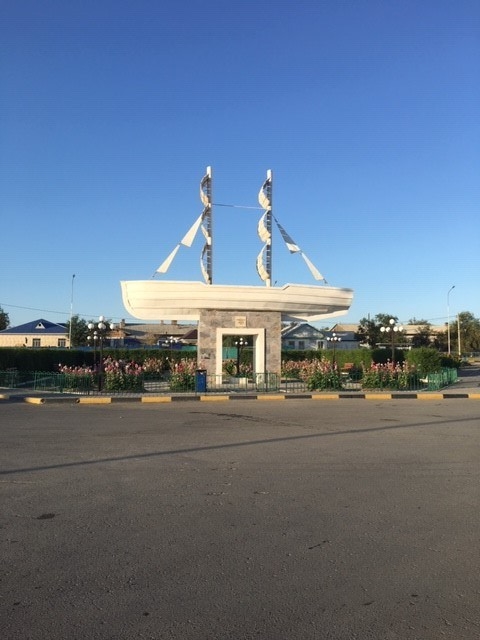
This monument, which we can see from the Mog, is in front of the station and refers to better times when Aralsk was a thriving fishing port on the edge of the Aral Sea.
The two rivers that fed the Aral Sea are the Amu Daria and the Syr Daria.
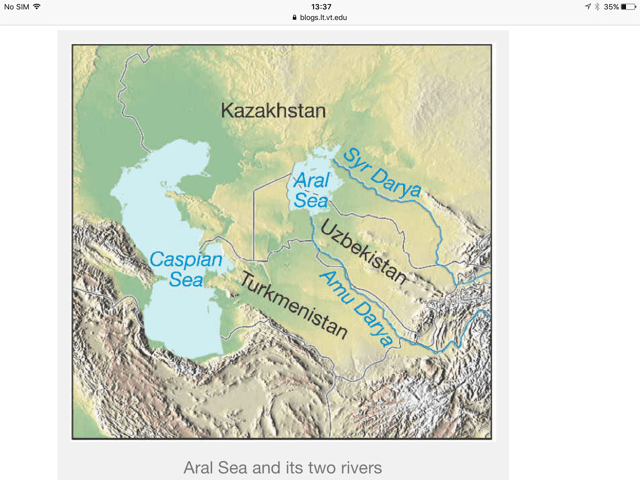
In the 1960s the Soviet Government decided to divert these two rivers to irrigate surrounding desert in order the grow food crops and cotton. The results were catastrophic.
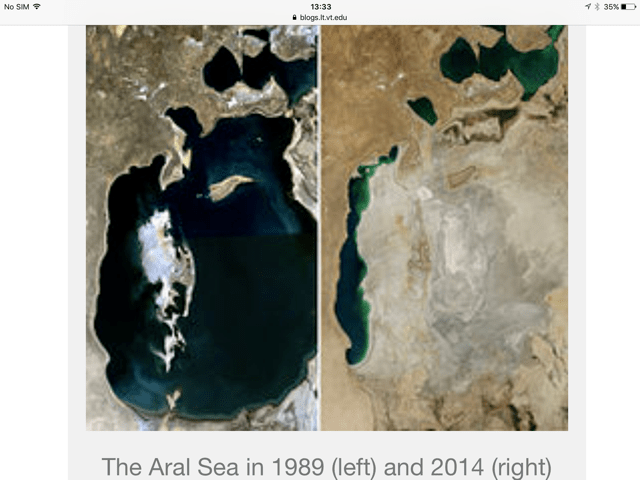
Roelf felt a bit like the picture on the right and was unable to join the excursion from town to the Aral Sea some 12km from town. This is much less then the 100km that was observed in 2005!. This regeneration of the North Aral Sea is made possible with a dam that was constructed to separate it from the South Aral Sea and allow the waters from the Syr Darya to slowly fill the shallow sea basin again. It appears to be successful and there is fishing again in the North Aral Sea. Plans are underway to increase the height of the dam to allow the Sea to expand further over the next decade. Interestingly the fish currently caught are fish such as flounder that can survive in the salty water. But as the waters return to fresh water over time different species are likely to return.
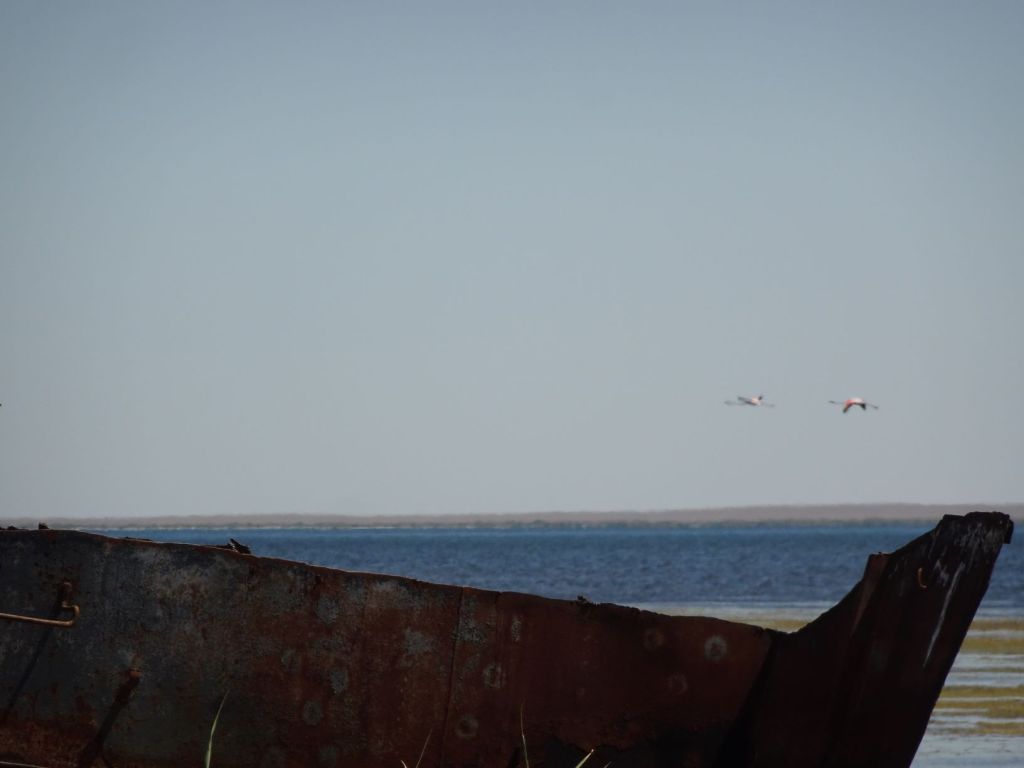
The excursion takes us over the former sea bed, past pinkish salt lakes, to spectacular sandstone formations, some small villages that used to be fishing villages but are now herding camels and horses and some villages where people are able to fish again. We also see the Aral Sea as it is now, in part regenerated. In fact, because we see a lot of water the devastating impact of the drying out of the Sea is not so obvious here. When approaching the former Aral Sea from Uzbekistan in the South, there is nothing but desert and the climate has changed and become a lot hotter in summer. This climatic impact is also the case for the city of Aralsk. But there is some hope and those in our party who have visited here some years ago sense there is some improvement in the state of the town.
August 5th
This is a good day, we leave Aralsk. It sounds harsh, but we really did not like it there and we look forward to moving on.The next stop on the trip is Kyzylorda. The city is rather modern and has 400.000 inhabitants; the first major city since Samara in Rusia, and the first opportunity to seek medical help for Roelf in a centre with diagnostic facilities. Roelf gets a ride there with a faster camper and Miep follows with the Mog. Once in the hospital Roelf’s journey starts with a Chest X-Ray which provides the diagnosis of Right Lower Zone Pneumonia. Ultrasound of the liver does not show any active gall bladder disease. Roelf gets a CD rom of the Chest X-ray to take for future reference.
Antibiotics are switched from Cipro to Azithromycin. Again, the hospital does not want to know of any payment although formally, foreigners are supposed to pay for their health care. The treatment is first class. Roelf even gets a bottle of Kazakh Cognac from the doctors to help with his recovery!
While Roelf is being seen to, Miep is driving the Mog at much slower pace (60km/hr) to Kyzylorda. To keep awake a few stops along the way are required, but there is not much to be seen. The road comes past the cosmodrome Baikonur from where the first man, Yuri Gagarin, was sent into space in 1961. It is impressive to see this in the desert. It is difficult to visit the place as it is still in Russian hands and requires a lot of permissions. The Russians pay handsomely for the right to keep this station open and all flights to the international space station depart from Baikonur.The other sight to see is the monument to the inventor of a local string instrument, the khorkhyt. It is a beautiful monument with a tower that catches wind and send this through organ pipes to make a haunting sound reaching far out into the emptiness. All that surrounded by coloured sand and flowers. Very tasteful and impressive.
We spend the night on a parking lot near a Mosque. Roelf and Paul and Kim who have taken him to the hospital are the first to arrive there. A young Imam asks what they are doing there, thinks about what they have to say, and then approves. Two minutes later he comes back with bags full of fruit and freshly backed buns. The prayers from the mosque sound absolutely beautiful to Roelf and he is so relieved his diagnosis has changed. Pneumonia rather than cholecystitis. When did we hear a hip hip hurray for pneumonia before? He may be able to continue this trip after all.
August 6th
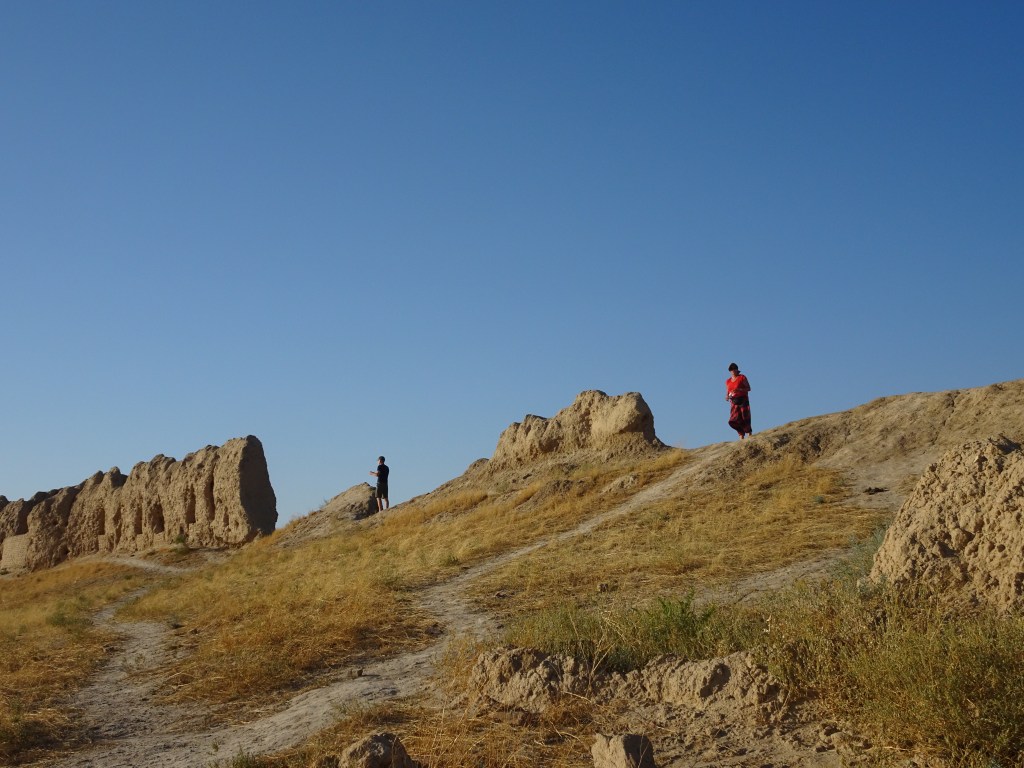
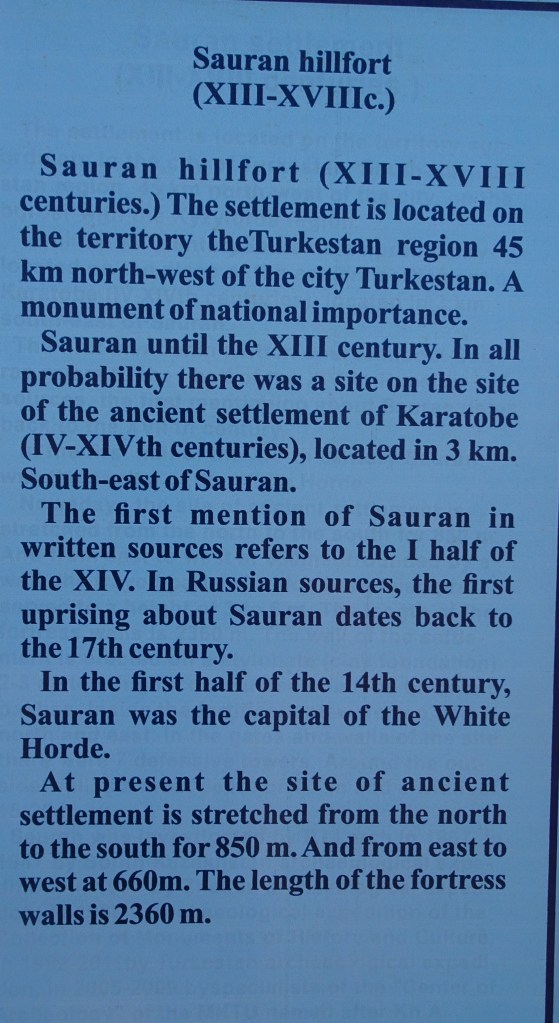
Roelf is fever free for the first time through the night. It is a hot morning but there is a small exercise place nearby and after so many days without any time to do anything but drive or be driven, Miep goes for some long overdue stretches. Today we drive to Turkestan and we hope to get a swim in the Syr Darya en route. Unfortunately we are unable to get close to the river which is separated from the road by a railway line with very low underpasses. Too low for the Mog. We have to abandon as it gets late and increasingly hot. We do stop to visit a ruin of a former hill fortress, Sauran, quite close to Turkistan. What a sight this is. The walls are partially intact and you can imagine how caravans would have appeared here from east and west and entered through the gates. It is 46 0C now and we cannot stay long, there is no shade anywhere. Roelf has stayed behind in the car but is uncomfortably hot and we are grateful for a quick cool down from the shower of Kim and Paul’s camper. Onwards to Turkestan where we find our camping spot along a busy, noisy dust road close to the city centre. Roelf is very uncomfortable but fever free. This time he is hot because of the unrelenting outside temperature.
August 7th
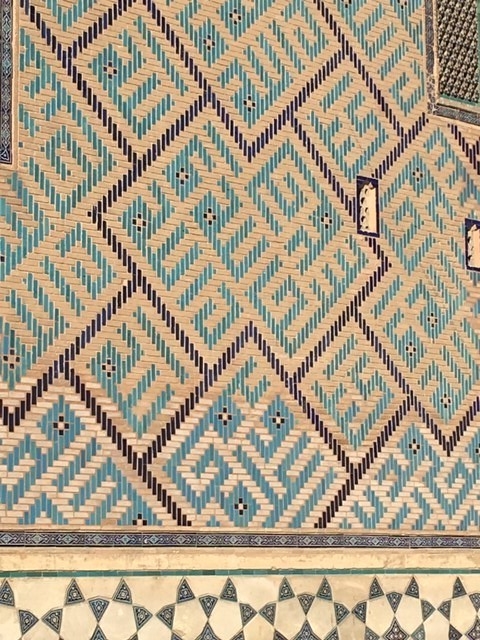
After a warm night where Roelf sleeps in a chair outside, we wake up in Turkestan. This is the place where Timur built the Mausoleum for the Sufi prophet Yassawy shown earlier above. Roelf is too weak to come on the excursion planned for today and we decide to leave after a short walk around the buildings. There is activity all round as Turkestan is working on making this an easily accessible place for pilgrims to visit. New pavements, new road surfaces, new walkways between the monuments. Because of this we were unable to camp just outside the monument as planned. What a place that would have been! The mausoleum is surrounded by walls that are largely intact. The outside of the Mausoleum is completely covered in tiles with exquisite patterns. Timur had converted to Islam and had it built to promote the religion. The building was on the north edge of his territory. Persian builders experimented with constructions that were later applied in the capital Samarkand. The dome above the central hall is the largest in Central Asia with 18.2 meters.
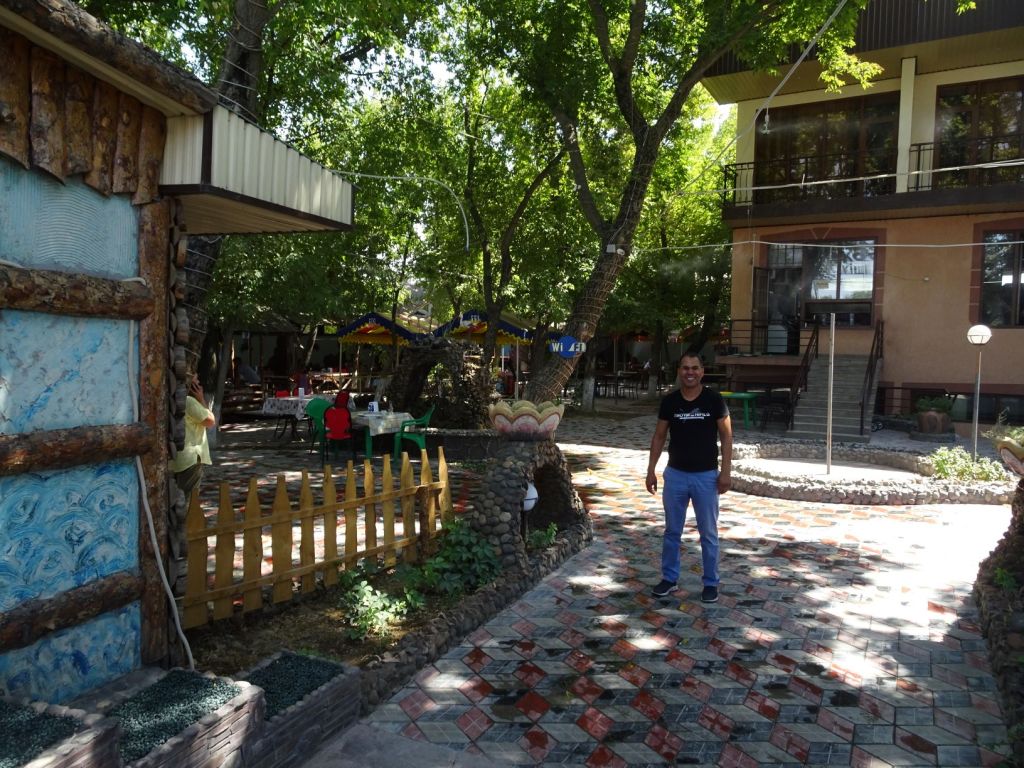
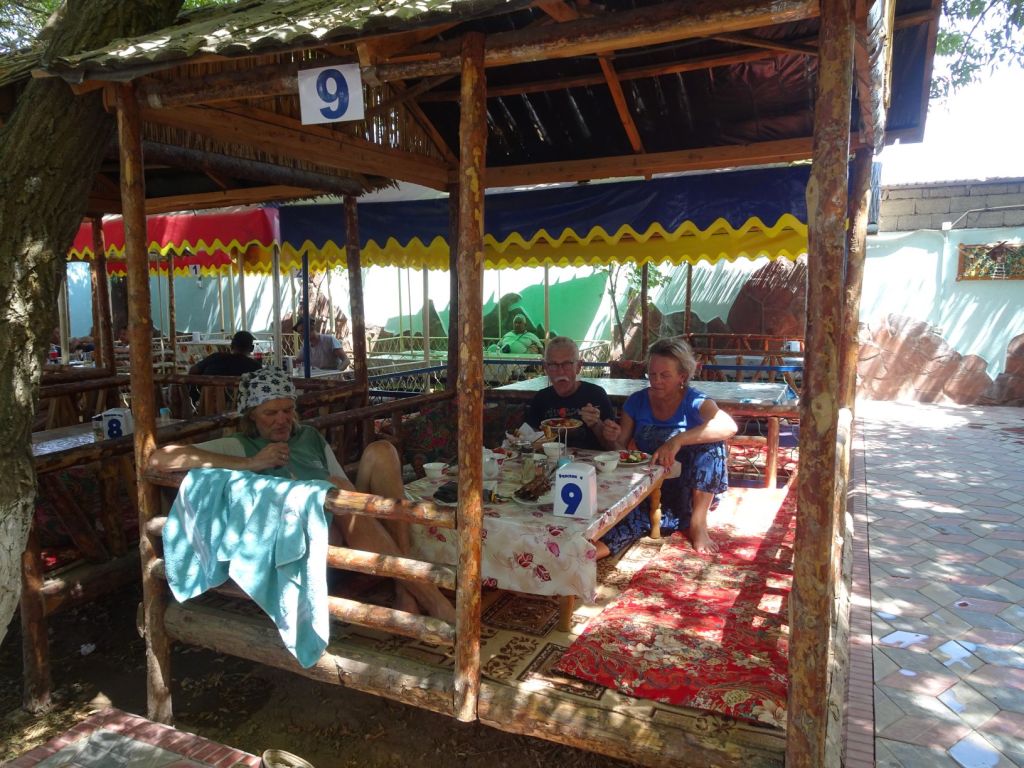
After the very hot cities we move to a beautiful place in the mountains. It is a camp site in a nature reserve called Aksu Zhabagly. We drive straight there, but with one stop over for lunch in a road café. We eat laying at tables and have BBQed chicken, salad, tea and bread. It is wonderful. Two British hitch hikers come to talk. One has spotted the Mog and tells us about the 3 (!) Mogs he has back home. They have come from Georgia where they worked. When we leave the restaurant owner comes to tell us the meal was on the house! Great surprise with us and thanks all round. Photos are taken and presents exchanged. The hospitality of the Kazakh people continues!
August 8
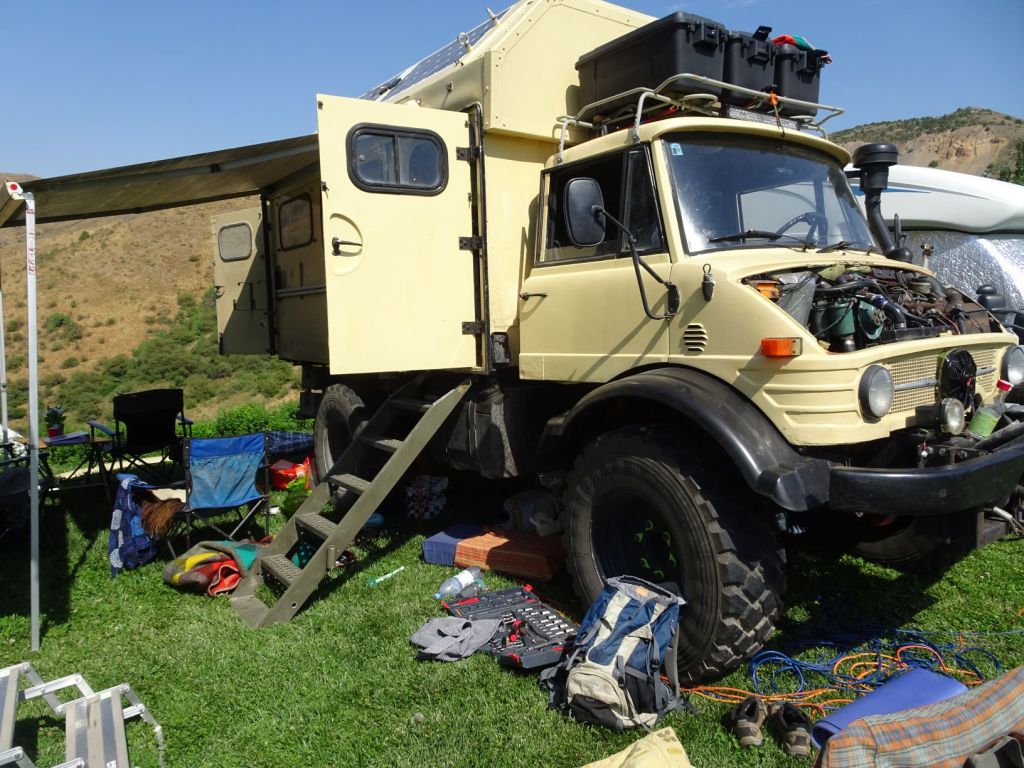
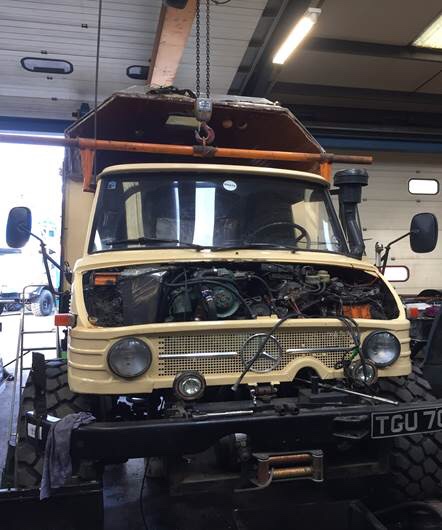
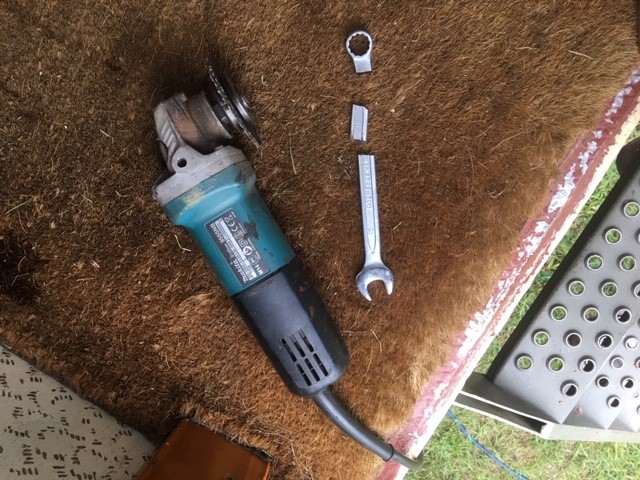
A wonderful day of relaxation. We organise the car, Roelf sleeps in the grass, the sun shines but it is not too hot. Miep walks up a hill side. It is not possible to enter the nature reserve without a ranger, but we will do so tomorrow. In the afternoon Roelf fits an external second fan to the Mog as we suffered twice with engine overheating in the drive up this hill and this is only the beginning of our mountain adventures. We have been driving without our bonnet, and now the Mog has a new nose as well!
August 9
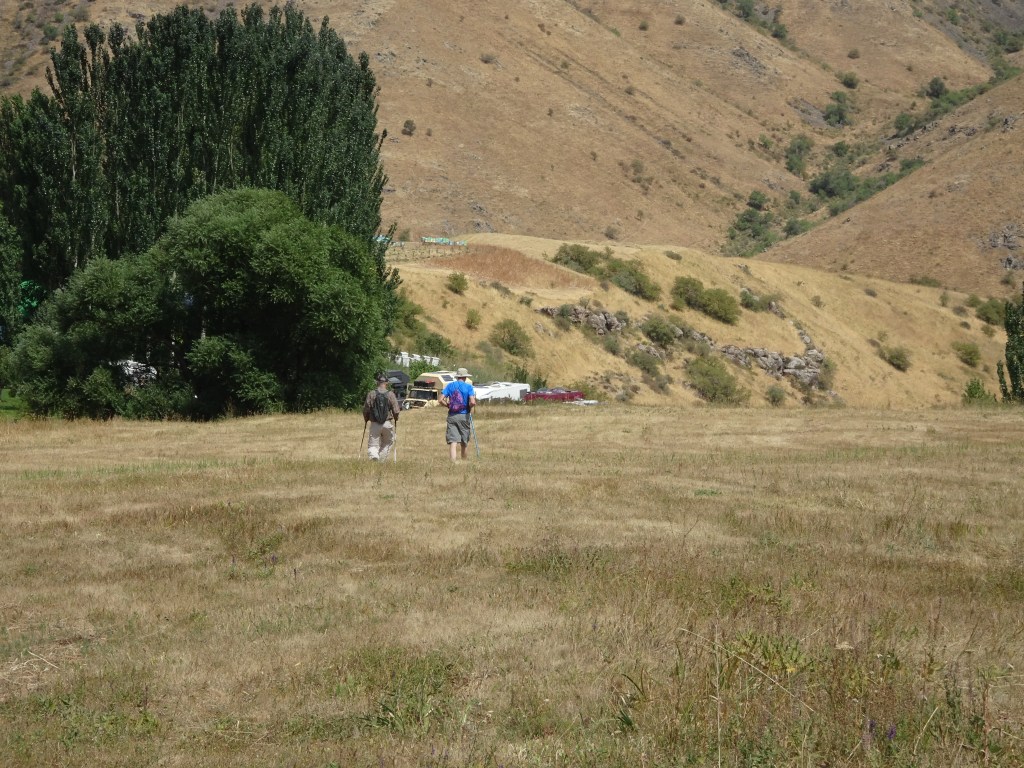
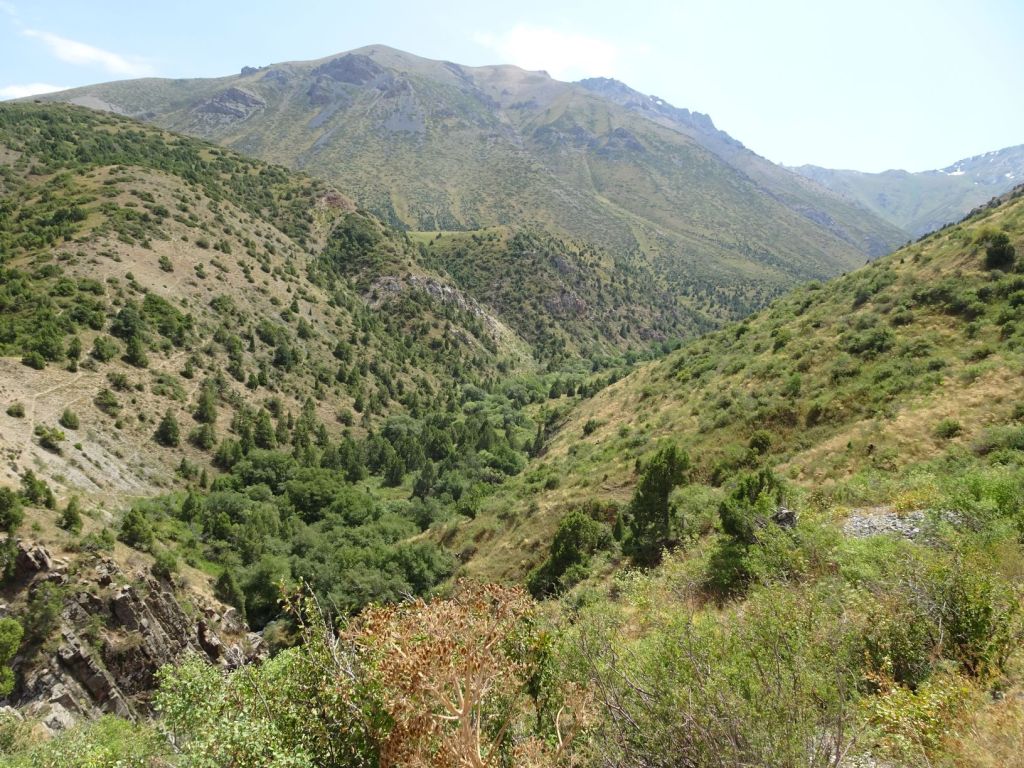
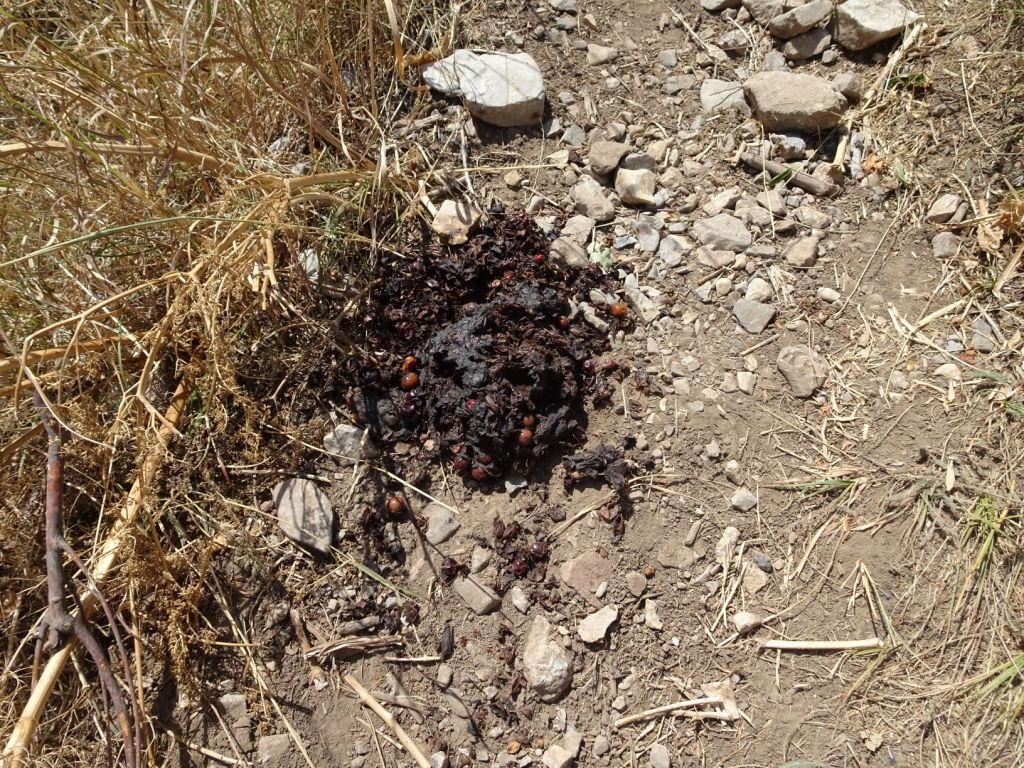
Miep goes on a day-long excursion with a ranger who speaks very little English. We walk up a path to a waterfall and hope to see some wildlife. It is a beautiful area but it is clear that for the best flower displays you have to visit just after the snows have melted. Everything is now in seed, but there is an abundance of it. We see few animals. Asking another group who have a ranger that does speak English we find out that there are loads of mammals in the park including predators such as wolfs (we hear them at night), several types of martins, jackal, wild boar, lynx, mountain sheep and mountain goats, porcupine, brown bear and loads of insects and birds. We spot one golden eagle and loads of bear poo. They eat the wild apples that are in abundance. It is too hot for the songbirds and they are in hiding.
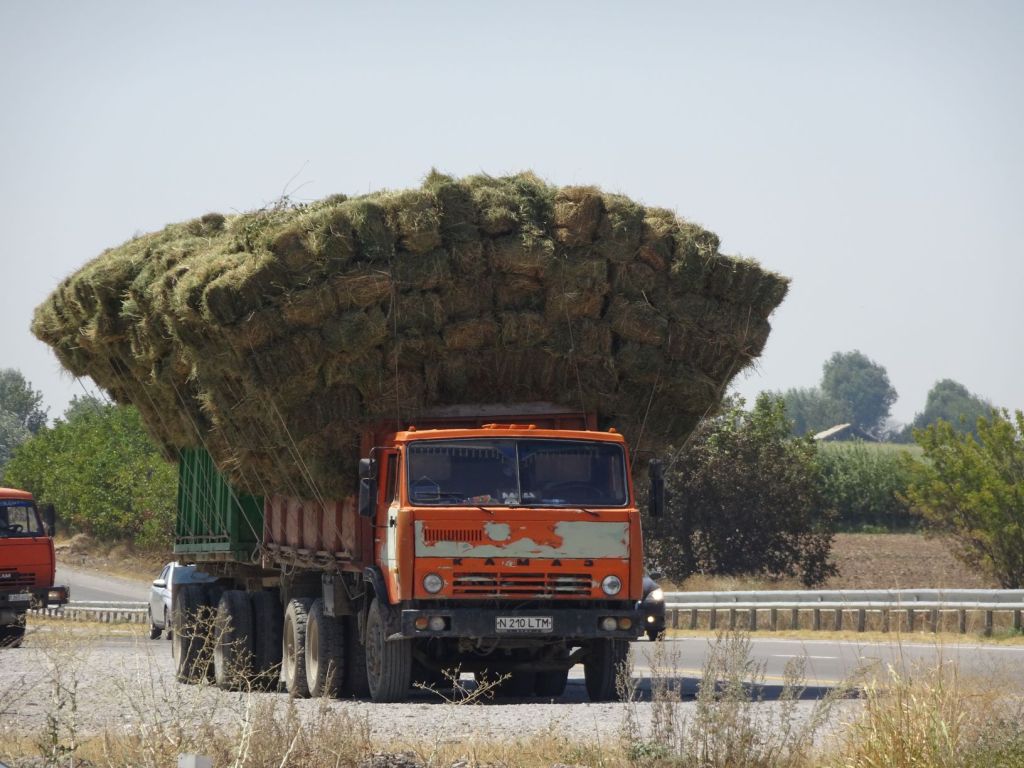
We start seeing Chinese lorries and also the evidence of the harvest season here. There is more green along the way, trees, irrigated fields, melon fields, but mainly grain. Straw is carried in the most wonderful way back to the farms.
August 10
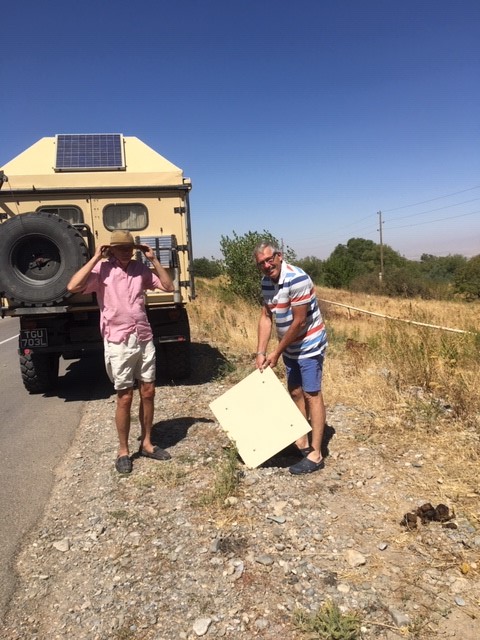
We drive towards Merke our stop en route to Almaty. We were relaxed and rested and so rested in fact we did not do a proper check before leaving. The lovely lady who runs the website comes running out to give us some of their honey, then we hurtle down the steep road towards the village and realise that the loud wind we hear blowing all round the car in fact comes from inside! The roof hatch is out!! We have left it on the roof when driving off. Driving back we do not see it and help arrives. Search parties all round and thankfully the hatch is found by Fransje and Ernest. It was easily 2 miles from where we left and with loads of bends and wind along the way. But we have it back. What a relief!
We are welcomed in Merke by the whole street. The hospitality of one family is fantastic We are invited in to their home and garden which is full of fruit trees. Their table is full of the most delicious foods.
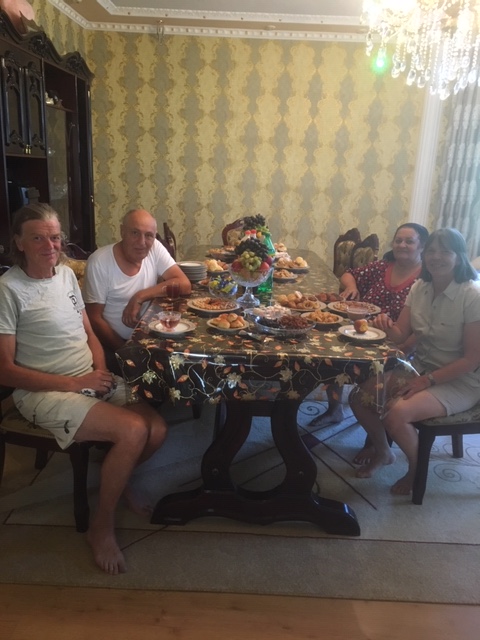
The family is of Turkish origin, from Anatolia, and moved to Merke during the times of Stalin to help with the development of Kazachstan as the show model of Soviet agricultural prowess. Google translate comes to the rescue as we do not speak Russian or Turkish and they do not speak English.
We leave with a sack full of fruit from their orchard, and a bag full of fresh eggs.
August 11
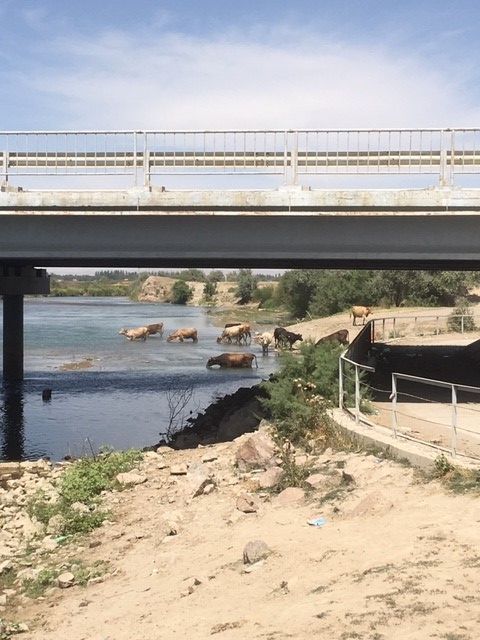
Another hot day. We stop for a swim on our way to Almaty, but we are relieved the Mog does not overheat and we get there without too much trouble.
It is the day of a Muslim festival and everyone is out on the streets to buy a ram or sheep to sacrifice. It reminds us a bit of the scramble to buy Xmas trees in Christian countries. The animals are in pens along the streets or on lorries and are dragged out on one leg to the boot of passenger cars to be carted off to meet their fate. 3 Days holiday here!
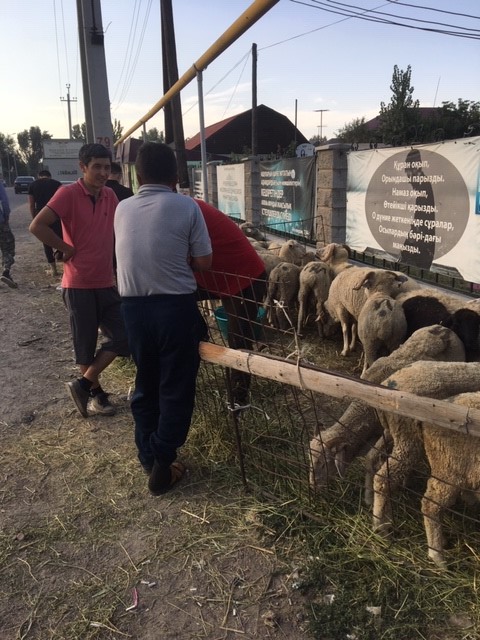
We arrive in Almaty where we camp on the parking lot of a hotel. It is right in the centre of town and it is an easy walk to shops and markets.
August 12
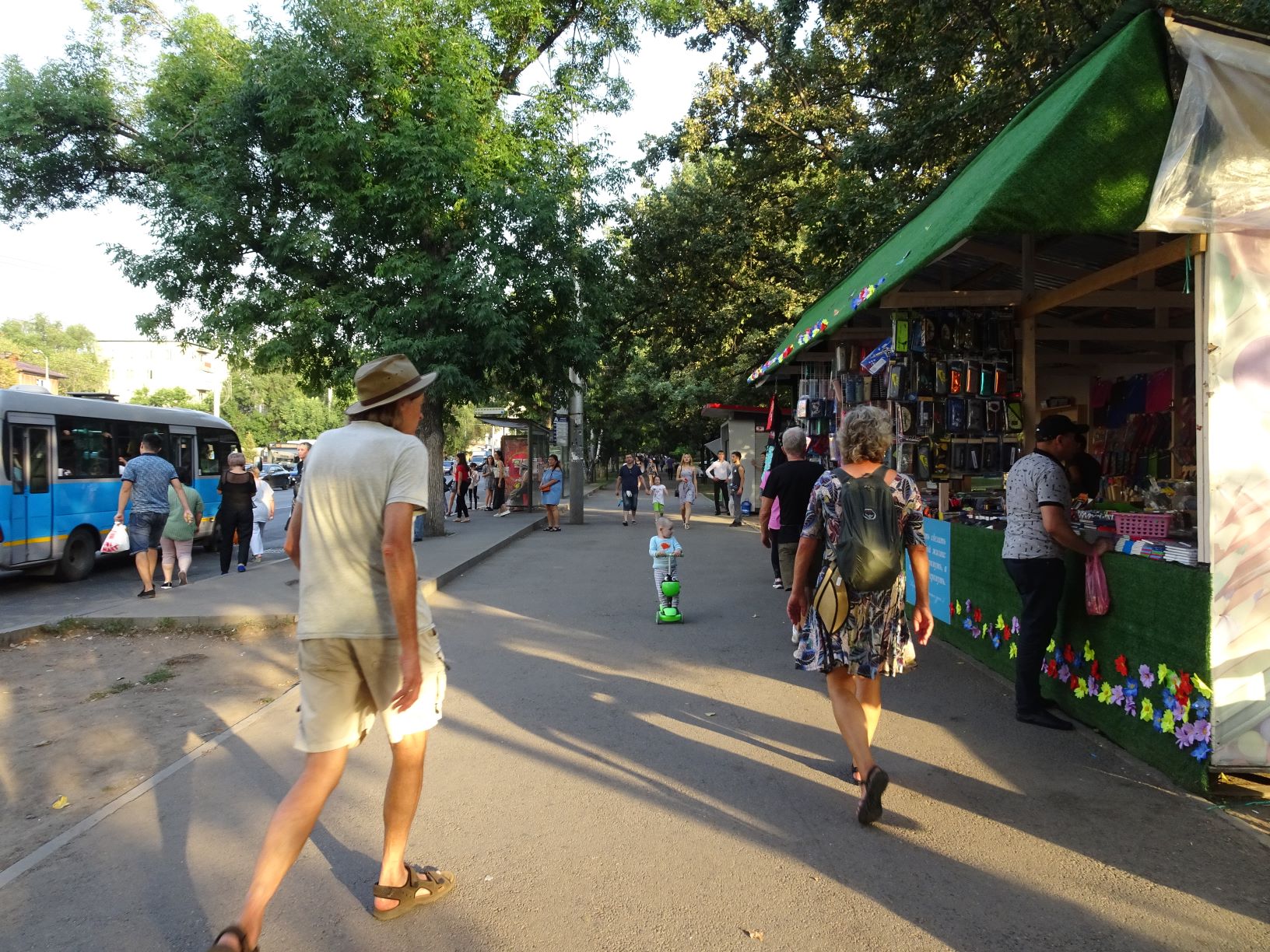
Almaty is the cultural heart of Kazakhstan. It was the country’s capital until 1997, and is still the largest city and central to all sorts of trade. With 1.5 million people, it is a real metropolis with all the positives and negatives related to that. Air pollution is stifling, and traffic comes to a standstill regularly.
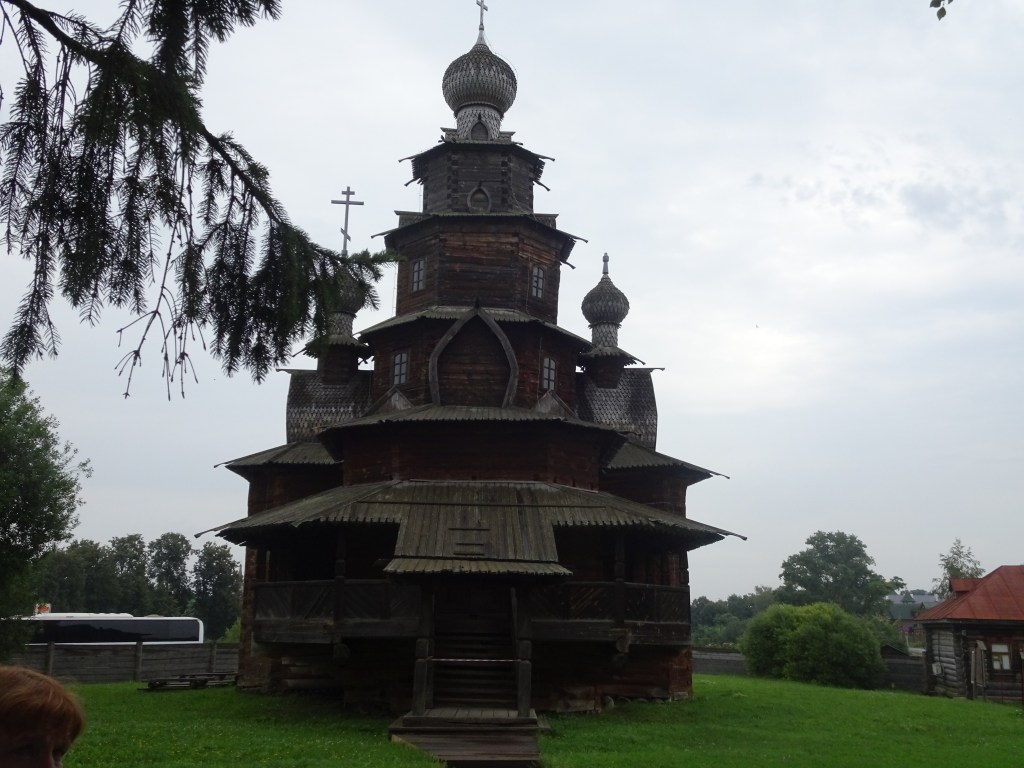
A major attraction is the Russian Orthodox church from tsarist times which is one of the tallest wooden buildings in the world. The paintwork is remarkable and uplifting.
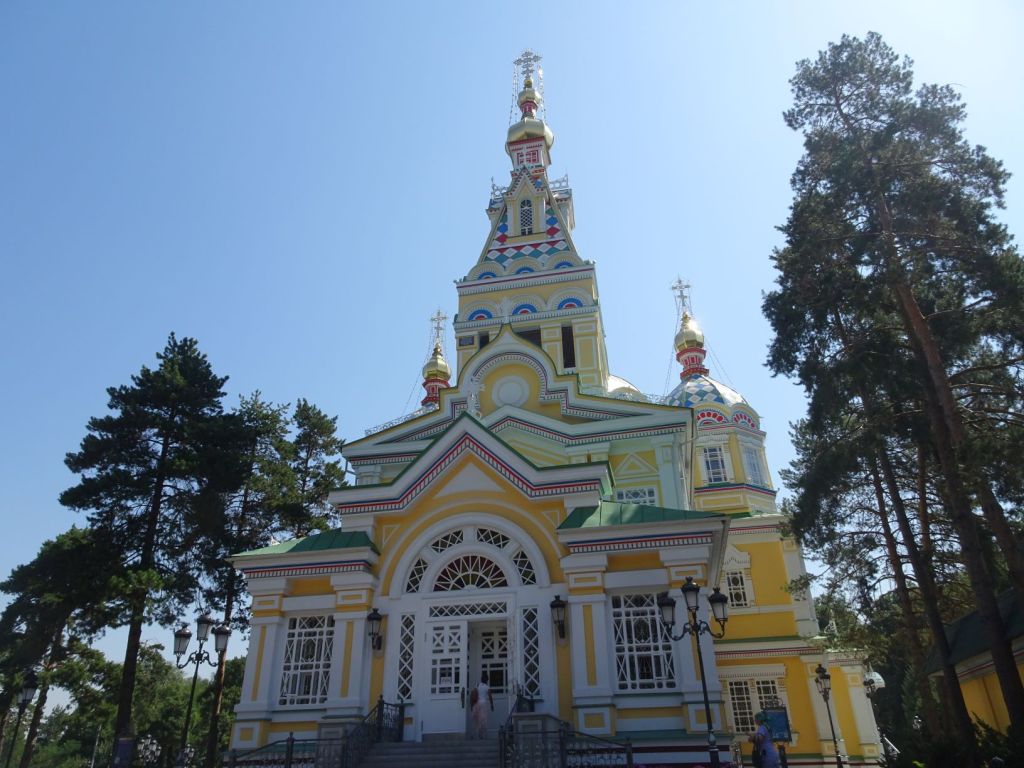
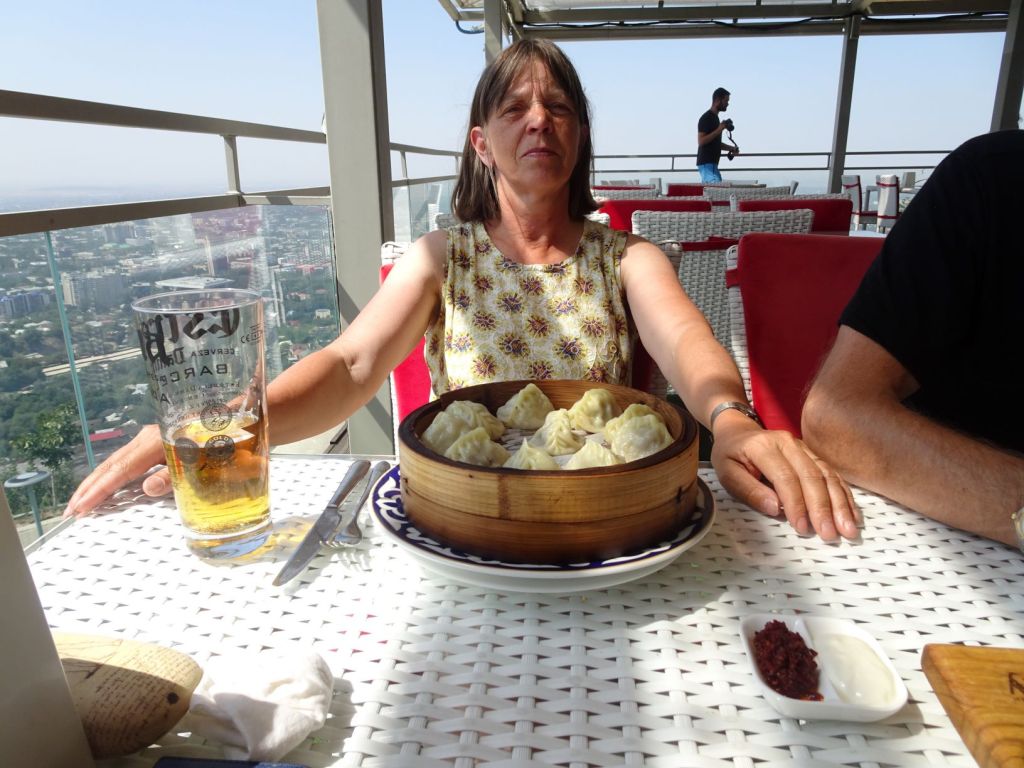
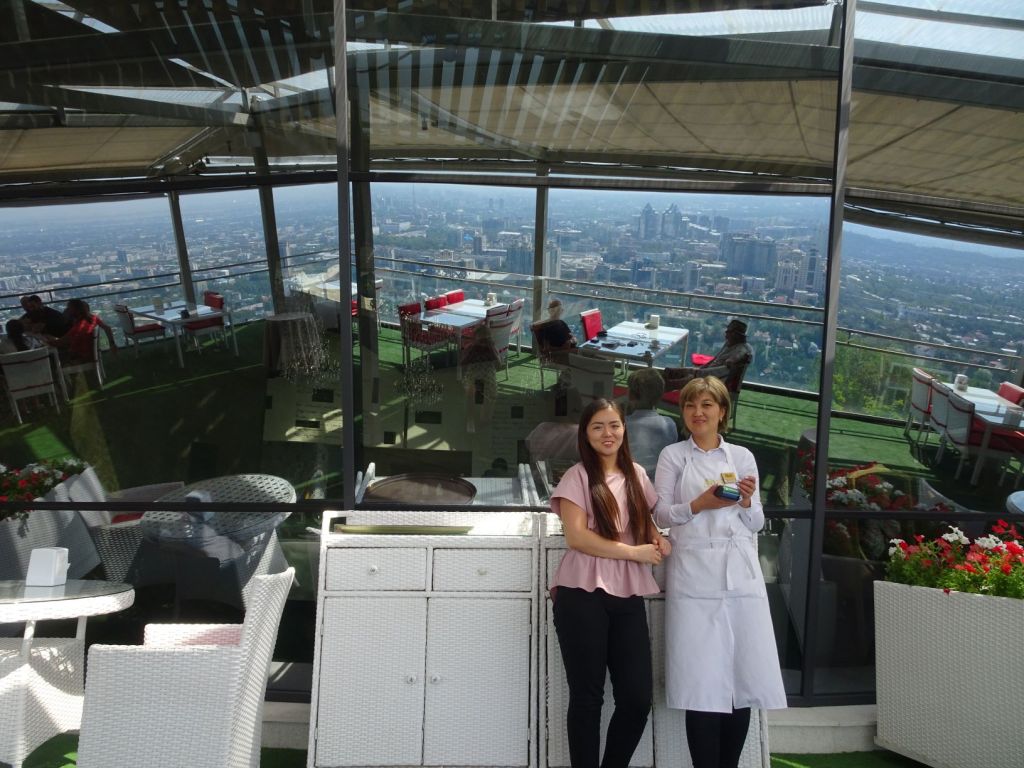
We take a taxi up the hill and a cable car back. Because Roelf wants to sit down all the time we have lunch in an expensive restaurant at the top.
There are magnificent irrigation channels throughout Almaty, supplied by water from the surrounding Zailyisky Alatau mountains. The highest point is 4979m.
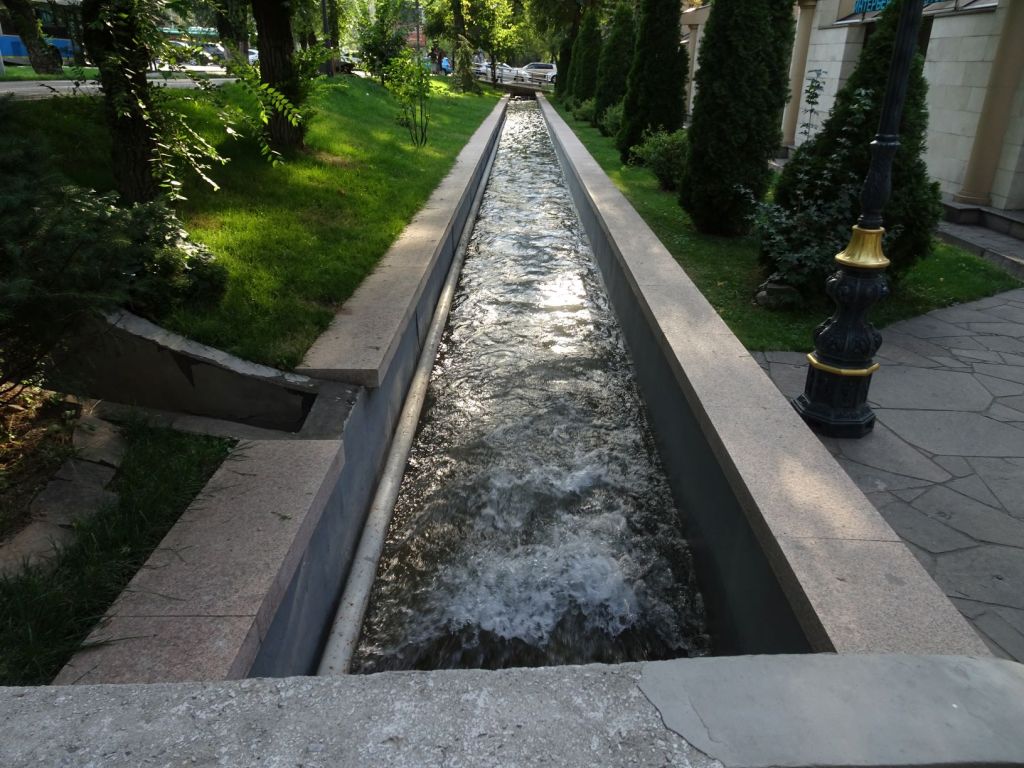
Streets have trees and lots of green; a very relaxing environment.
August 13
From Almaty we drive to our most easterly stop over; Sharyn Canyon. Truly beautiful, enhanced by lightning and thunder in the evening sky.
We arrive a bit late as en route we tried to see more of the Talgart Mountains, but found the skilifts were not operational in summer. The landscape from Almaty to the Canyon is quite empty but then changes quite suddenly again to orchards. We buy fruit at the last village before the Canyon at a wonderful market town. It is all fresh fruit and vegetables here and people come in droves from everywhere to stock up.
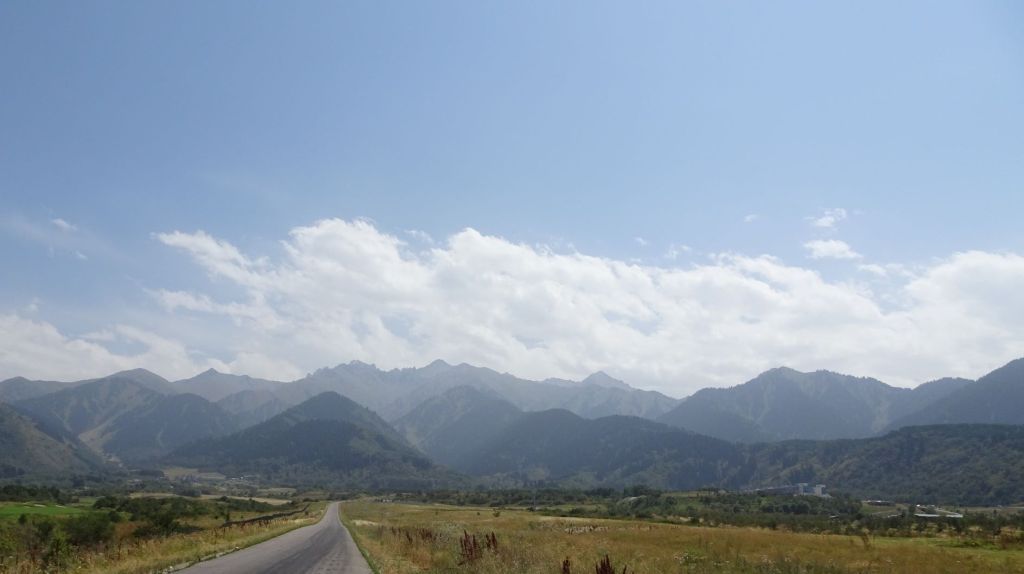
Then suddenly we are in a completely empty landscape again as the road rises up and the setting sun illuminates the rocks. The Sharyn Canyon appears and we get there just before 8. The Mog has coped well with all the altitude challenges as long as we drive slowly up hill. We park up and then the thunderstorm starts. It rains all night.
August 14
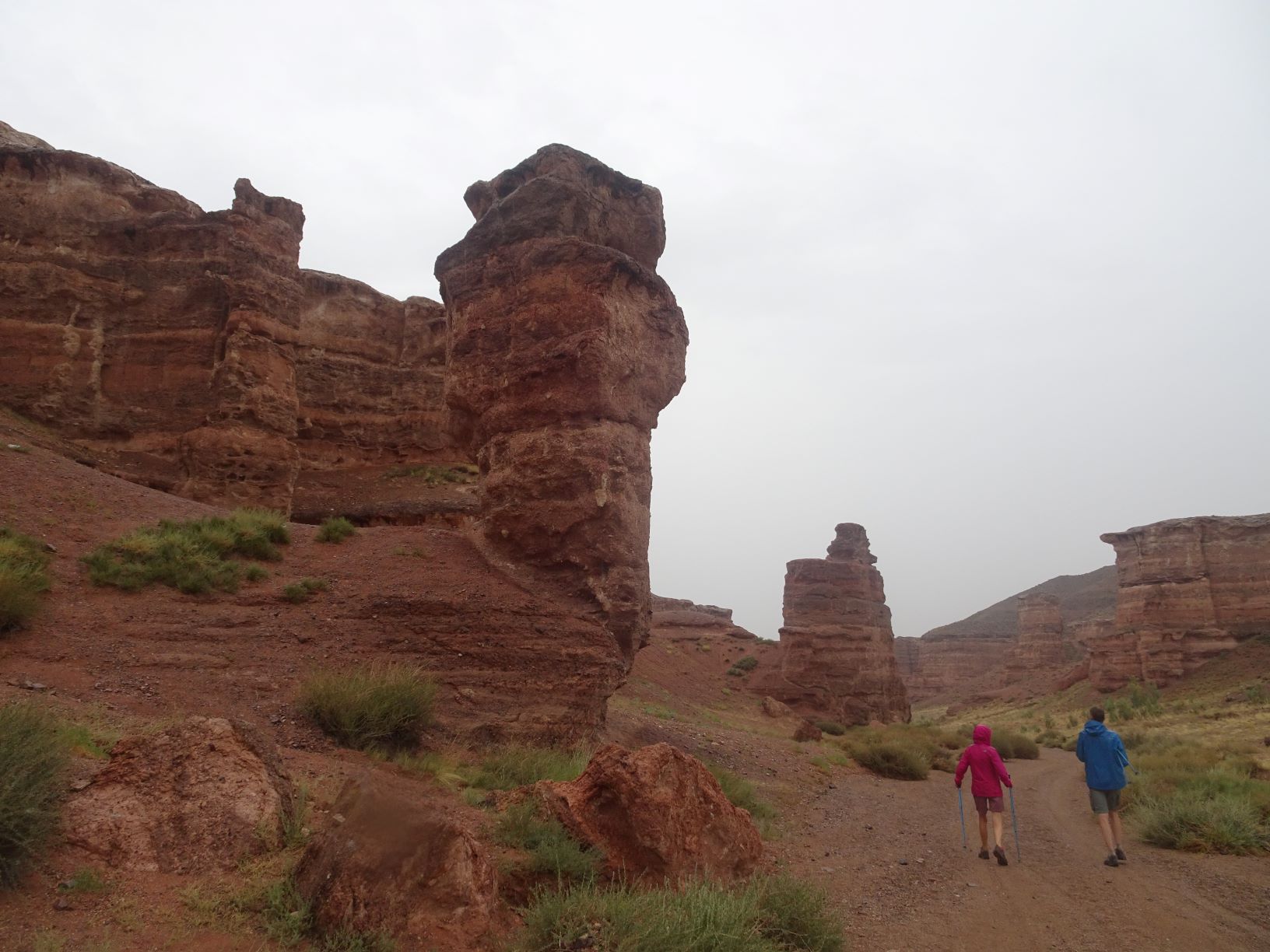
Miep walks the Canyon with 2 others from the group. It rains but it is making the stone formations even darker red in colour and the wind is much less down there. We walk all the way to the Sharyn River where an Eco Retreat has been set up for tourists. They are nowhere to be seen, perhaps still asleep. We enjoy the peace and quiet of the morning and having the Canyon all to ourselves, but time is pressing, even here: we have to head for the border crossing with Kyrgystan . So we say goodbye to Kazakhstan. It has been a surprise. Much more interesting than we had imagined. The different landscapes, the varied peoples, the cosmopolitan Almaty contrasted with traditional cities such as Aralsk and Turkestan and above all the friendliness of everyone we met.
The road to the border with Kyrgyzstan is very rough but the environment is magical. The Mog is totally in charge, overtaking the struggling white vans in the travelling group.
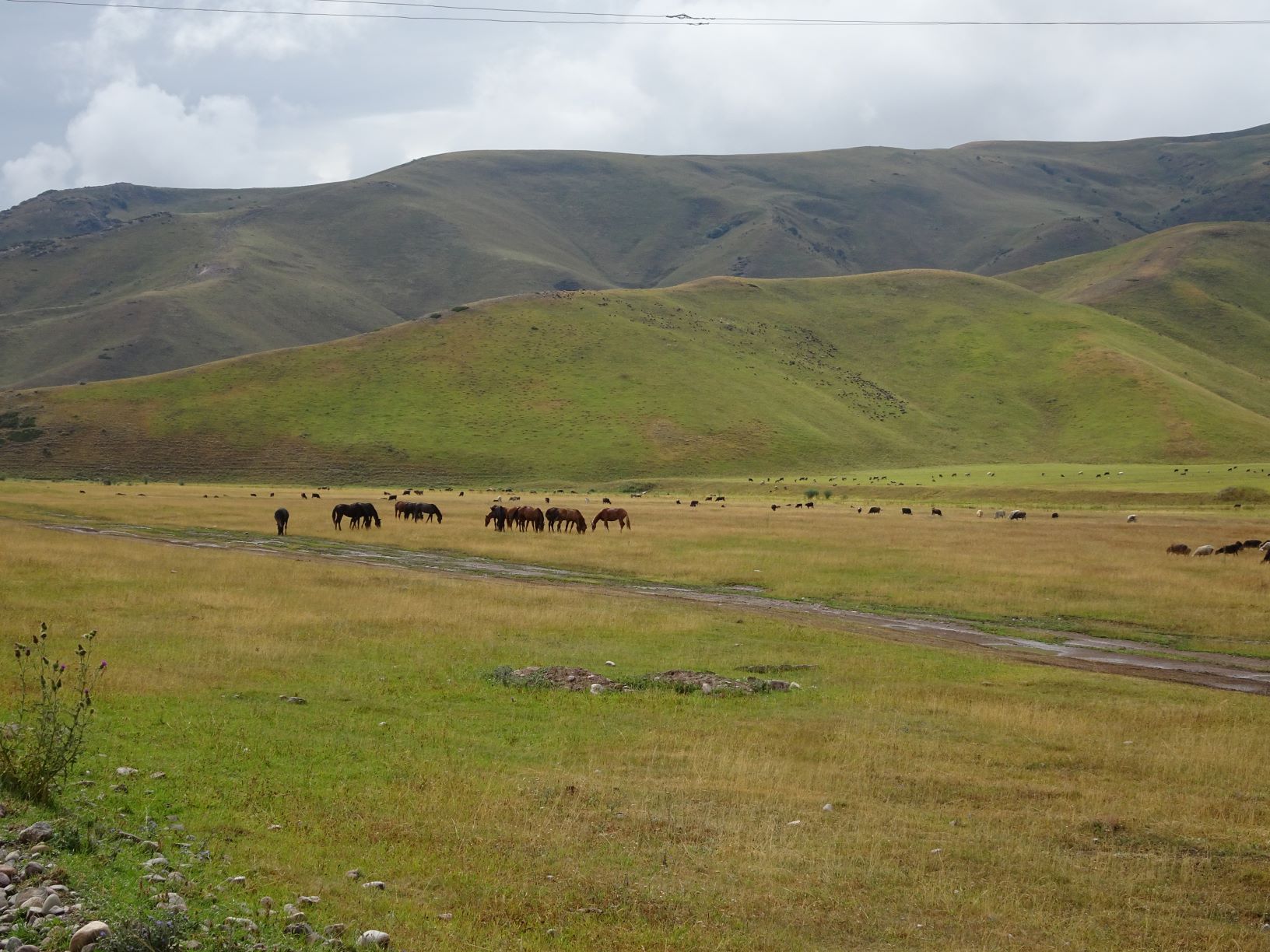
Goodbye Kazakhstan; welcome Kyrgyzstan!
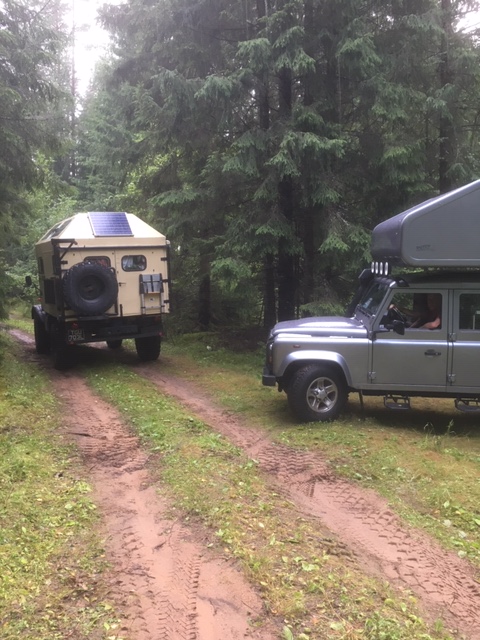
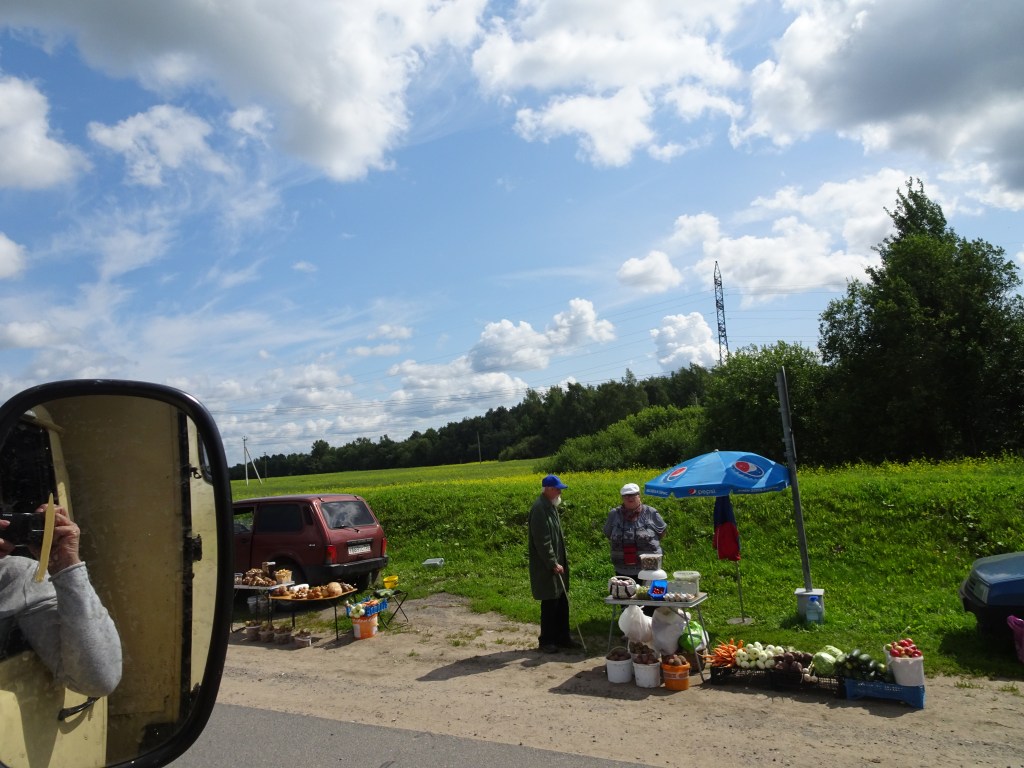
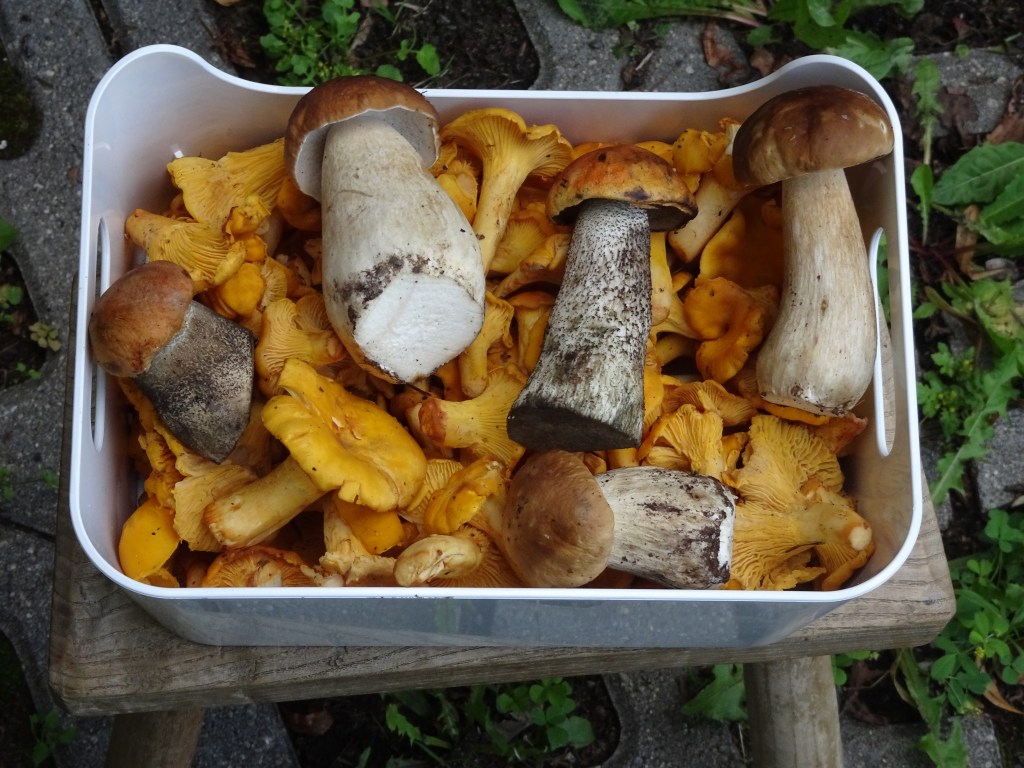
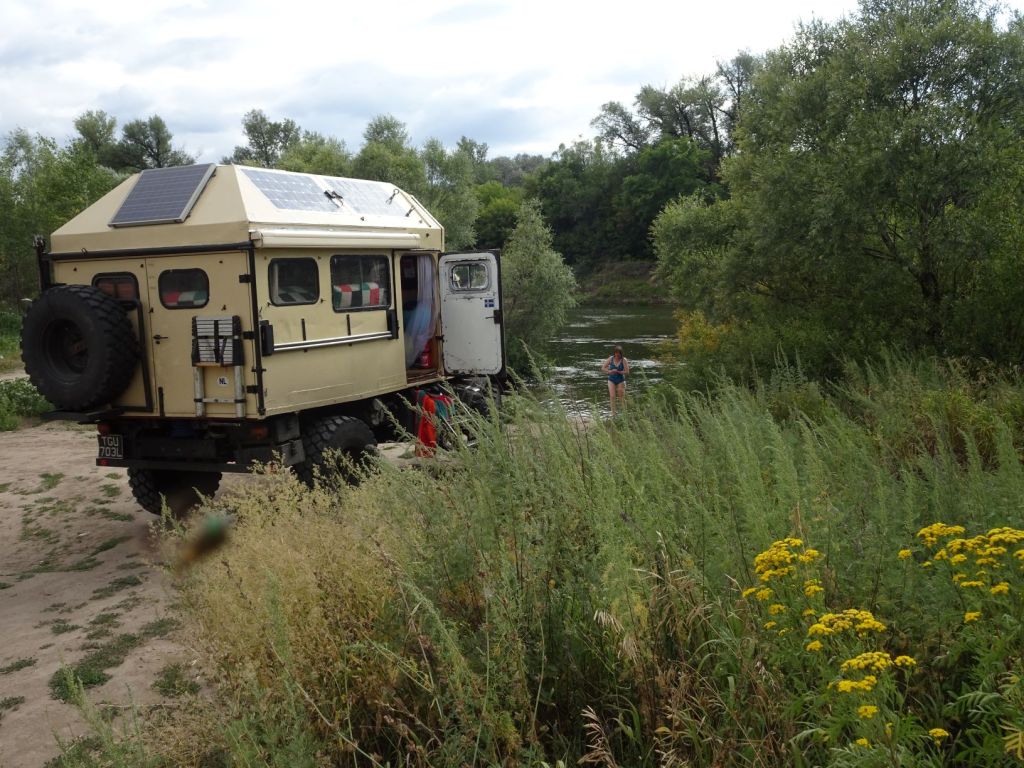
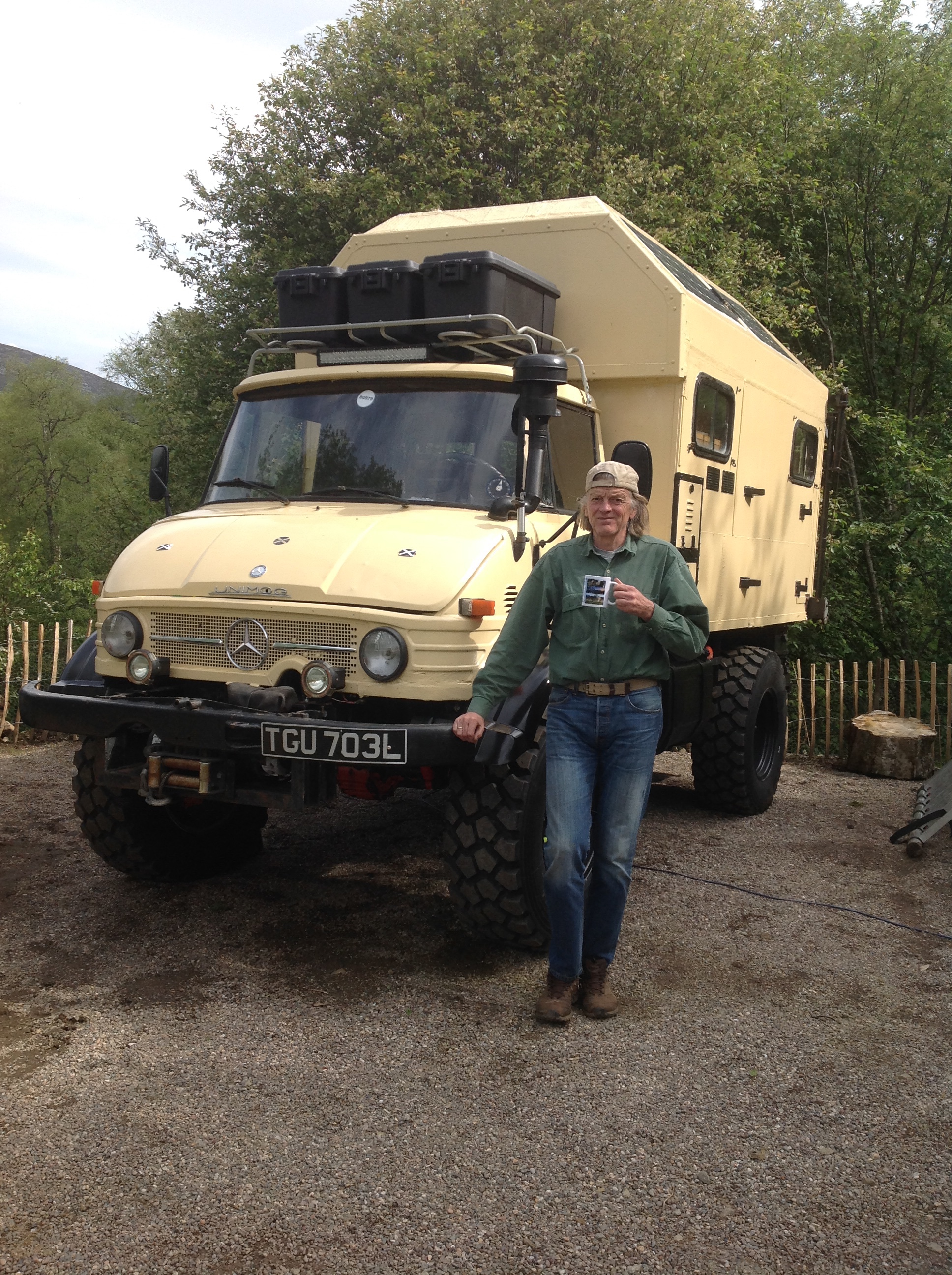
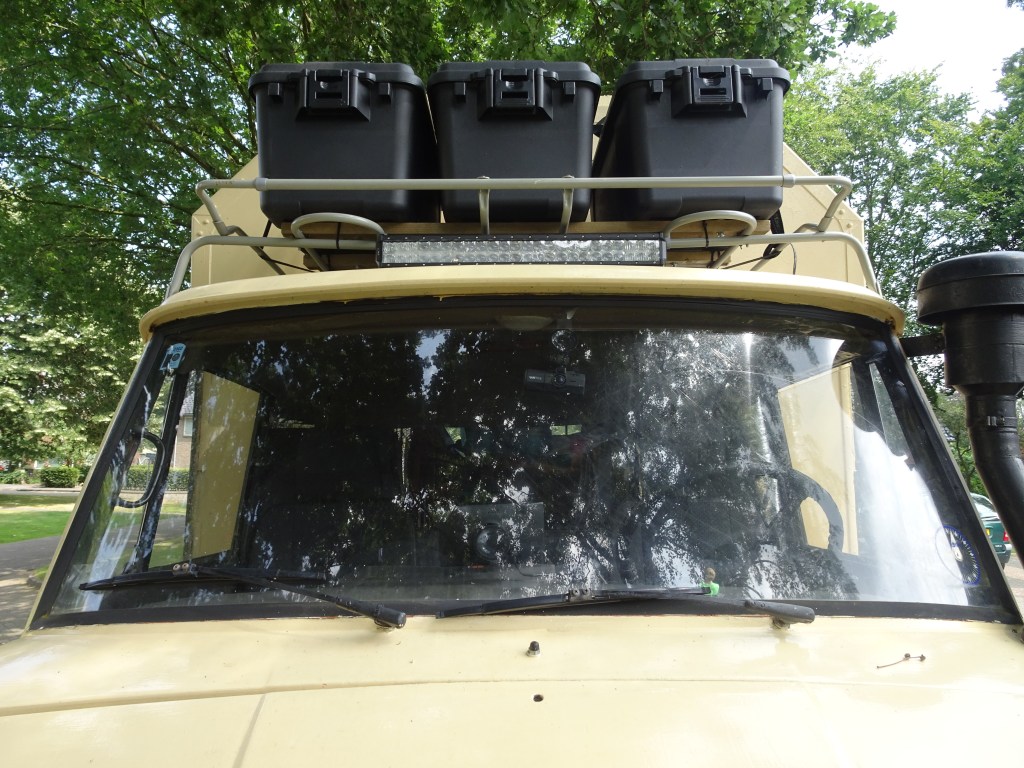
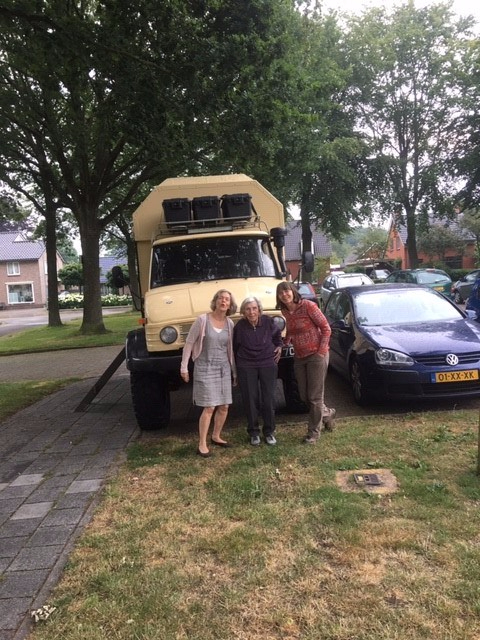
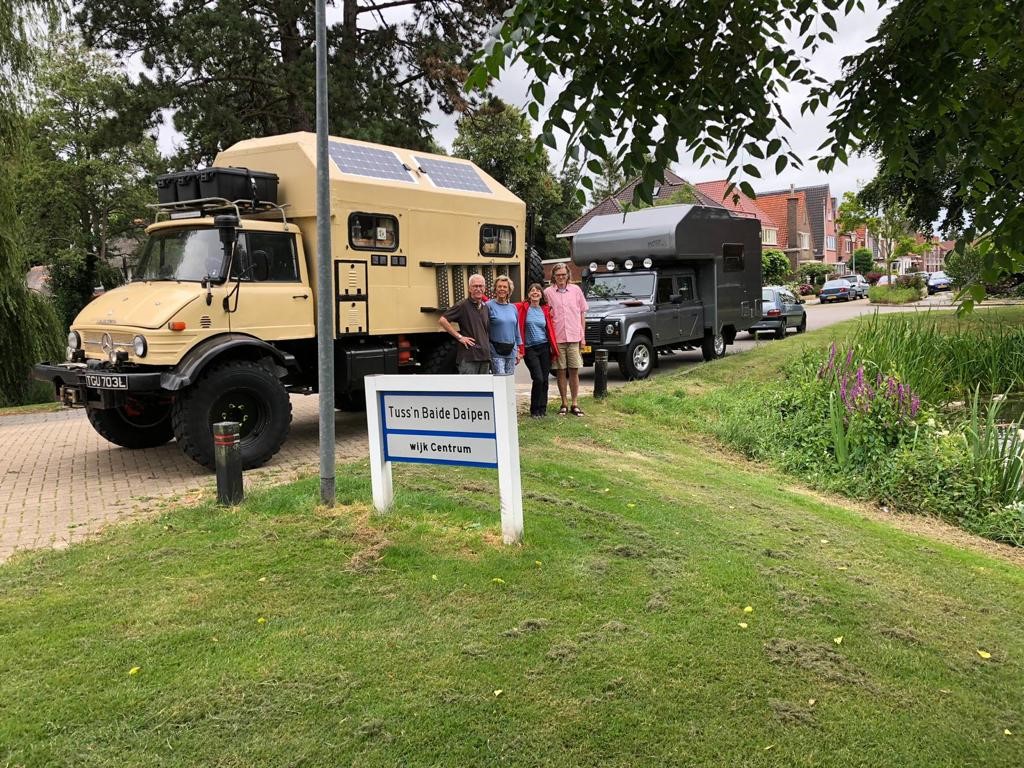
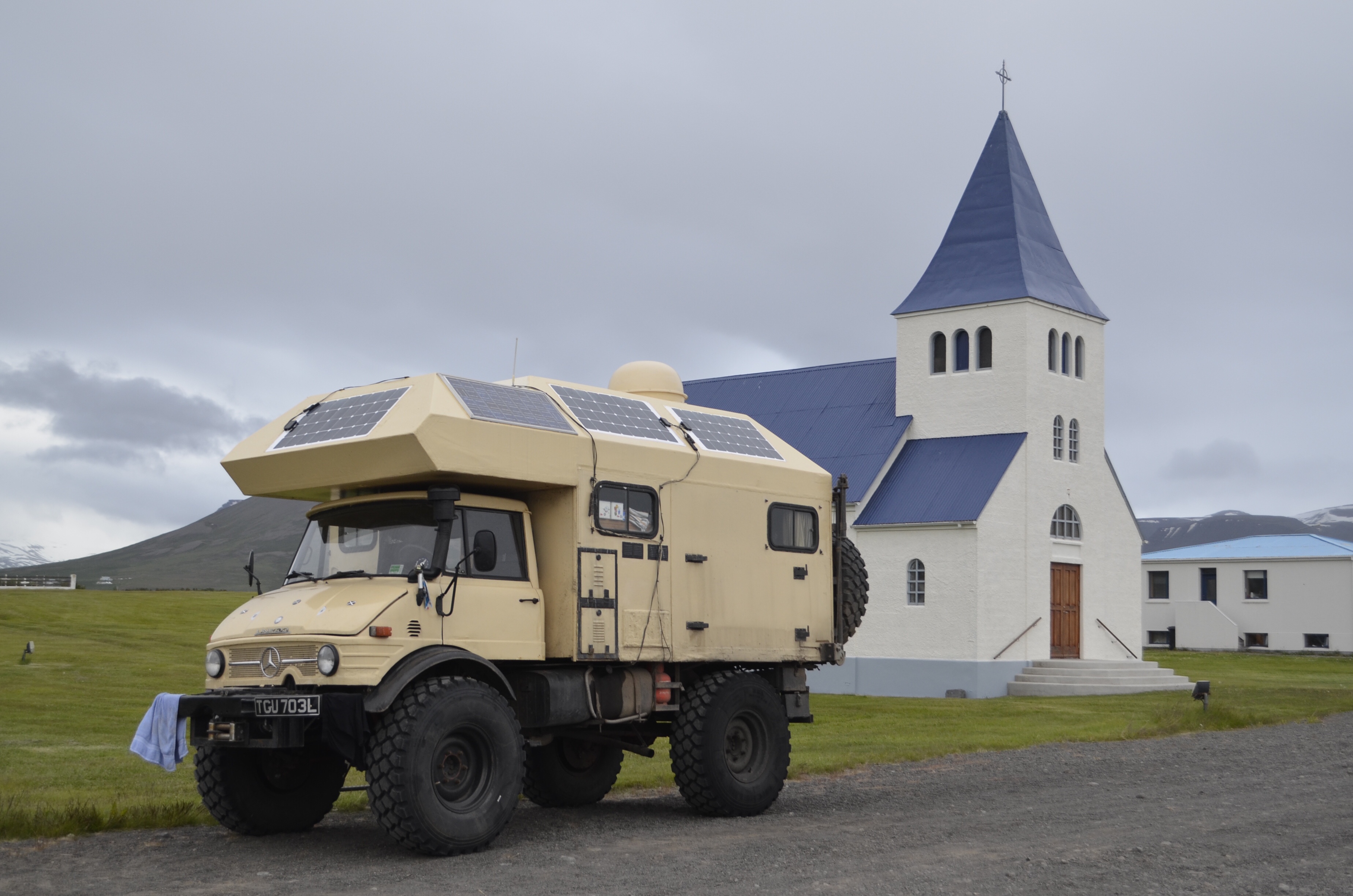 This is our Unimog 416 as it was.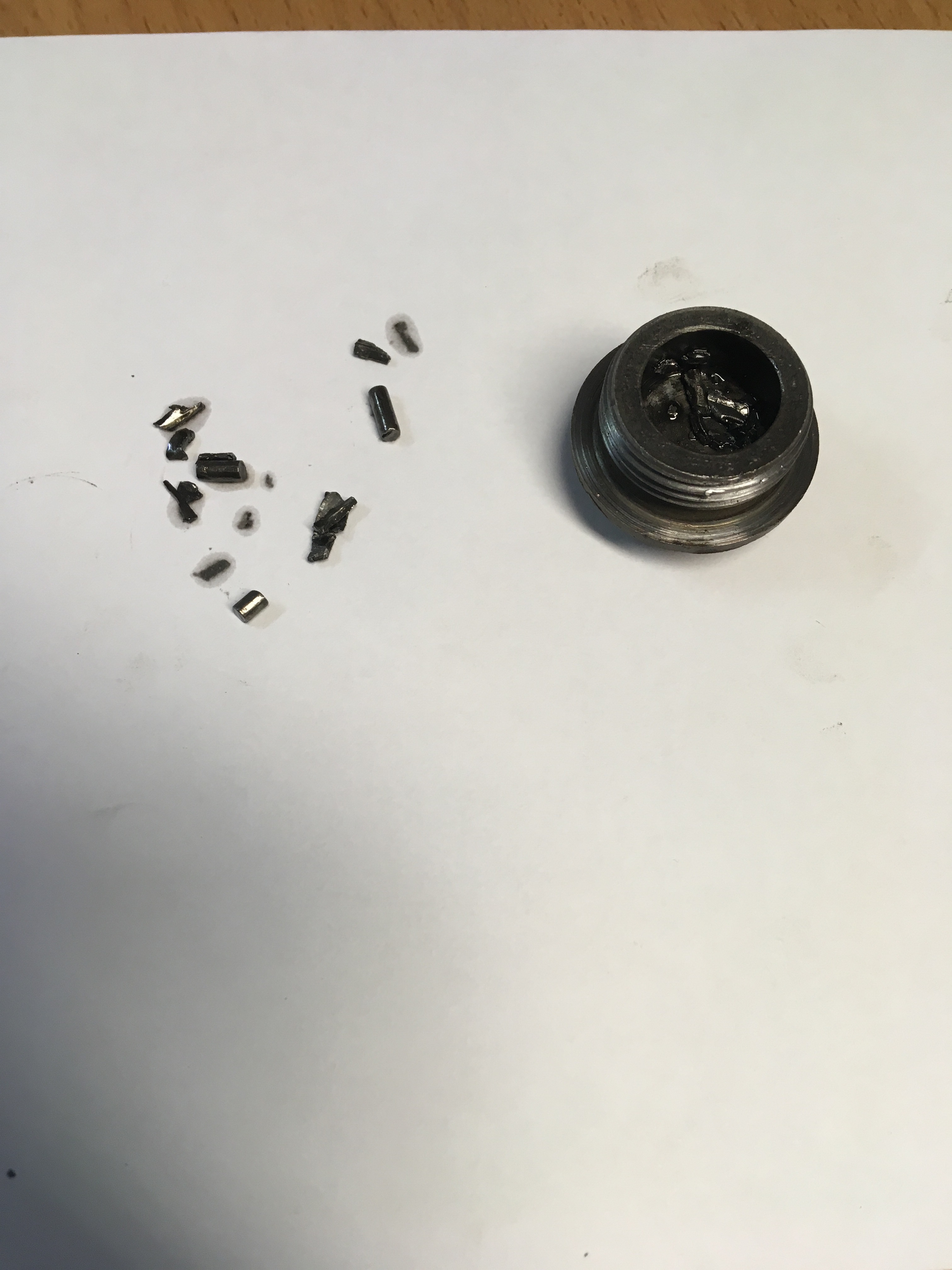
 Central Asia Roadtrip