October 22
The border crossing between Georgia and Turkey is relatively uneventful. We are the only team in the group that do not have Turkey as part of our standard car insurance cover and are taken aback at the amount of money we have to pay to get temporary insurance for 30 days (168 Euros).
The destination is Trabzon where the last communal stop of our group is at a large hotel; on the parking lot of course. The first we notice along the coastal road are major tea plantations on the hill side. Tea is big business in North Eastern Turkey; there are stalls along the road stacked with all sorts of tea. We stop along the way to buy some.
When we arrive at our destination, it is getting dark. We clean up in the fitness centre of the hotel. For the evening, TME has organised dinner with good food and lots of wine where each team presents their highlights of our 96 day journey together. We have lots of fun; a fitting farewell…
October 23
We say goodbye to the other teams, and embark on our journey through Turkey on our own schedule. Here is a bit about the country’s history which was largely unknown to us before we arrived here.
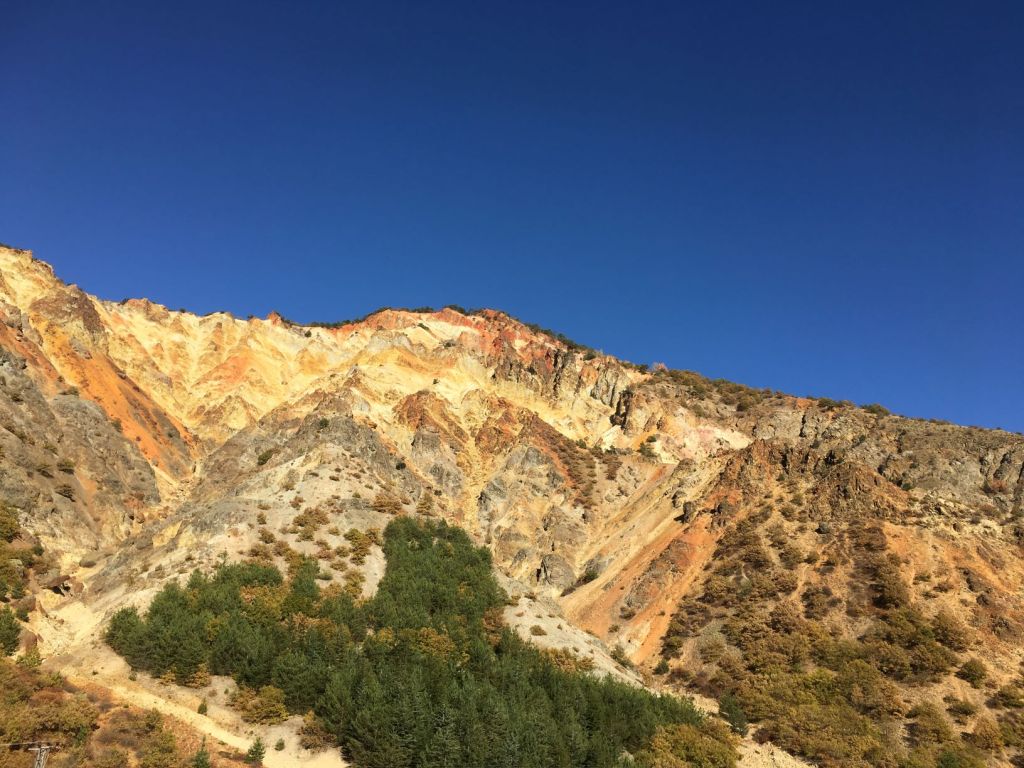
For times predating the Ottoman period, a distinction must be made between the history of the Turkish peoples, and the history of the territories now forming the Republic of Turkey, essentially the histories of ancient Anatolia and Trace.
From the time when parts of what is now Turkey was conquered by Turks, the history of Turkey spans the medieval history of the Seljuk Empire, the medieval to modern history of the Ottoman Empire, and the history of the Republic of Turkey since the 1920s.
The earliest organised state in the area which is now Turkey, was the Hittite Empire.
The Hittites were Anatolians who established an empire in north-central Anatolia around 1600 BC. This empire reached its height during the mid-14th century BC, when it included most of Anatolia as well as parts of the northern Levant and Upper Mesopotamia.
The Hittites had a very well developed administrative state using a particular cuneiform script for their bureaucracy. They were also considered masters in bronze and iron smelting, amongst the first peoples to use these advanced technologies.
After c. 1180 BC, the Hittites splintered into several independent city-states, some of which survived until the 8th century BC before succumbing to the Assyrian Empire.
After the fall of the Hittites, the new states of Phrygia and Lydia stood strong on the western coast as Greek civilization began to flourish. They, and all the rest of Anatolia were relatively soon after incorporated into the Achaemenid Persian Empire.
As Persia grew in strength, their system of local government in Anatolia allowed many port cities to grow and to become wealthy. Anatolia got divided into various satrapies, ruled by satraps (governors) appointed by the central Persian rulers. Some of the satraps revolted periodically but did not pose a serious threat. In the 5th century BC, Darius built the Royal Road, which linked the principal city of Susa in what is now western Iran, with the west Anatolian city of Sardis, close to the Mediterranean.
Alexander the Great finally wrested control of the region from Persia in successive battles, proving victorious over the Persian Darius III. After Alexander’s death, his conquests were split amongst several of his trusted generals, and Anatolia became part of the Seleucid Empire. The Empire became involved with wars with Rome which saw the loss of Anatolia to the Romans in 188 BC.
Roman control of Anatolia was strengthened by a ‘hands off’ approach by Rome, allowing local control to govern effectively and providing military protection.
West of Anatolia; a group of Indo-European tribes, the Thracians inhabited a large area in Central and Southeastern Europe. They were bordered by the Scythians to the north, the Celts to the west, the Ancient Greeks to the south and the Black Sea to the east.
All of Thrace, and the native Thracian peoples were conquered by Darius the Great in the late 6th century BC, but the area regained independence after the Persian defeat in Greece.
By the 5th century BC, the Thracian presence was pervasive enough to have made Herodotus call them the second-most numerous people in the part of the world known by him (after the Indians), and potentially the most powerful, if not for their lack of unity. The Thracians in classical times were broken up into a large number of groups and tribes.
Like Anatolia, Trace was overrun by Alexander the Great in the fourth century BC, and became part of the Seleucid Empire after his death. The Romans then took control in the second century BC.
In the early 4th century, Constantine the Great established a new administrative centre at Constantinople, and by the end of the 4th century AD the Roman empire split into two parts, the Eastern part became the Byzantine Empire named after the original name for Constantinople, Byzantium which had been founded by Greek colonists in 657 BC.
The Byzantine Empire ruled most of the territory of what is today Turkey until the mid fifteenth century while the other remaining territory remained in Sassanid Persian hands.
Neither the early Anatolian people, nor the Thracians were of Turkish origin. The first Turkic people lived in an area extending from Central Asia to Siberia. They were recognised as a separate ethnic group from the 6th century BC onwards. They are mentioned in a Chinese text relating to trade of Turk tribes with the Sogdians along the Silk Road.
The Hun hordes of Atilla, who invaded and conquered much of Europe in the 5th century, may have been Turkic; some scholars argue that the Huns were one of the earlier Turkic tribes, while others argue that they were of Mongolian origin.
In the 6th century, the leadership of the Turkic peoples was taken over by the Göktürks. From 552 to 745, Göktürk leadership united the nomadic Turkic tribes into a Turkic Empire. The name derives from gok, “blue” or “celestial”. The Göktürks were the first Turkic people to write in a runic script, the Orkhon script. The Khanate was also the first state known as “Turk”. The Göktürks eventually collapsed due to a series of dynastic conflicts, but the name “Turk” was later taken by many states and peoples.
Turkic peoples and related groups migrated west from Turkestan and Mongolia towards Eastern Europe, the Iranian plateau, and modern Turkey.
From their homelands near the Aral sea, the Seljuk Turkmen advanced first into Khorasan and then into mainland Persia before eventually conquering eastern Anatolia. They created a large medieval empire that from 1037 until 1194 controlled an area stretching from the Hindu Kush to eastern Anatolia and from Central Asia to the Persian Gulf.
The Sunni Seljuks played a key role in the crusades. Highly Persianised in culture and language, they exported Persian culture to Anatolia.
The Empire declined under the pressure of the emerging Georgian and Cilician empires in the late 12th and early 13th centuries, until the whole region was overrun by the Mongols in the 1260s. After the division of the Mongol Empire the area became part of the Golden Horde.
Another kingdom developed in 1326 with its capital in Bursa. The Ottoman’s first capital was replaced by Edirne after it was conquered in 1361. The empire expanded to Europe and Anatolia, and in 1453, the Ottomans sealed the fate of the Byzantine Empire by capturing its capital, Constantinople.
Constantinople was made the capital city of the Empire replacing Edirne. The Ottoman Empire would continue to expand into the Eastern Anatolia, Central Europe, the Caucasus, North and East Africa, the islands in the Mediterranean, Greater Syria, Mesopotamia, and the Arabian peninsula in the 15th, 16th and 17th centuries.
The Treaty of Karlowitz in 1699 marked the beginning of Ottoman territorial retreat; some territories were lost by the treaty: Austria received all of Hungary and Transylvania except the Banat; Venice obtained most of Dalmatia along with the Morea (the Peloponnesus peninsula in southern Greece); Poland recovered territories in the Ukraine.
Throughout the 19th and early 20th centuries, the Ottoman Empire continued losing territories, including Greece, Algeria, Tunisia, Libya, and finally the Balkans in the 1912–1913 Balkan Wars.
The Ottoman Empire entered WWI (1914–1918) on the side of the Central Powers and was ultimately defeated. During the war, major atrocities were committed such as genocide, mass murder and death marches intentionally denying food and water to the deportees by the Ottoman government against the Armenians, Assyrians, and Pontic Greeks causing millions of deaths mainly during the Armenian Genocide of 1915.
On October 30 1918, the Armistice of Mudros was signed, followed by the imposition of the Treaty of Sevres on August 10 1920. This treaty would have broken up the Ottoman Empire and force large concessions on territories of the Empire in favour of Greece, Italy, Britain and France.
The occupation of the country by the Allies in the aftermath of World War I prompted the establishment of the Turkish national movement. Under the leadership of Mustafa Kemal, a military commander who had distinguished himself during the battle of Gallipoli in WWI, the Turkish War of Independence was waged with the aim of revoking the terms of the Treaty of Sèvres.
By September 18 1922, the occupying armies were expelled. On November 1 the Sultanate was abolished, thus ending 623 years of Ottoman rule. The new Republic of Turkey was recognised internationally and officially proclaimed on October 29 1923. July 24 1923. A secular republic was founded. The fez was abolished, full political rights for women were established, and a new writing system for Turkish based upon the Latin alphabet was created.
The Turkish parliament presented Mustafa Kemal with the honorific surname “Atatürk” (Father of the Turks) in 1934.

The single party period was followed by a multiparty democracy after 1945. The Turkish democracy remained unstable with military coups in 1960, 1971, and 1980.
In 2002, the Justice and Development Party (AKP) under the leadership of Recep Tayyip Erdogan won the national elections and had two further victories in 2007 and 2015. There was another military coup in 2016 which failed and lead to major purges and restrictions in relation to press freedom.
But now back to our journey………
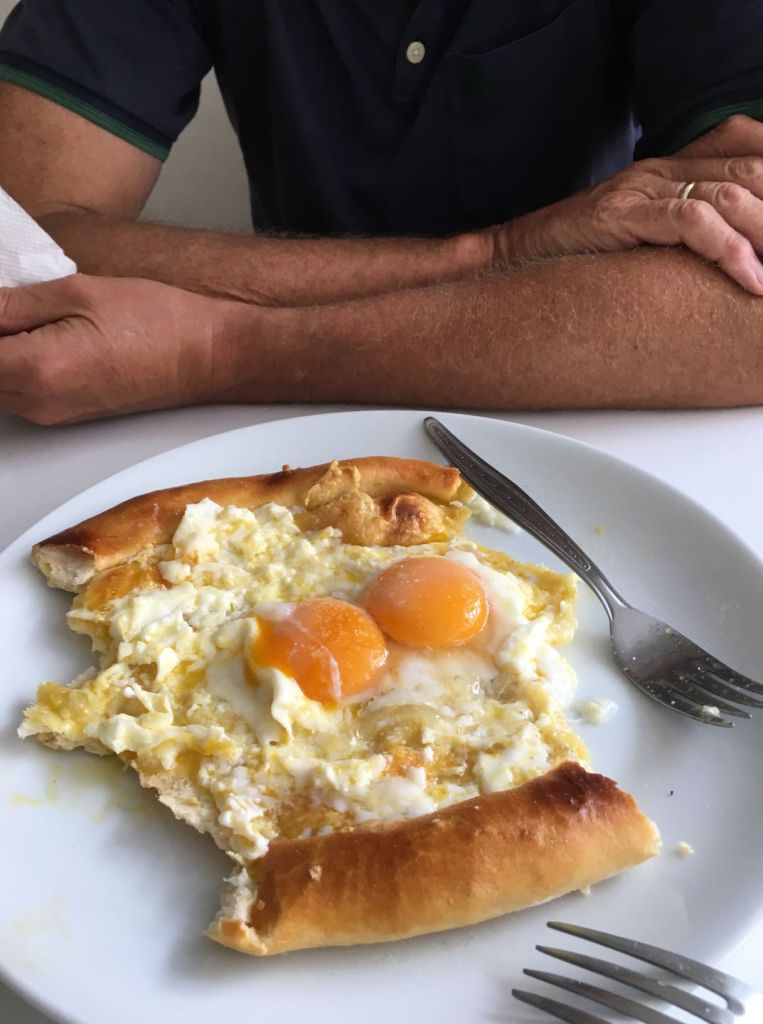
After saying our goodbyes to the other group members, we spend some time in Trabzon. This coastal tourist resort is in total upheaval; large multi-story apartments are rising up everywhere, there are road works to improve the main coastal road that runs right through the city and the old inner city is demolished. At the moment, it is a miserable place. There are few people on the street and we wonder how older people can even navigate the broken up roads. Only the tea houses are full (of men). We go into one and have our first cheese and egg ‘pide’, which is a speciality of Eastern Turkey and this makes up for the dreariness: delicious!
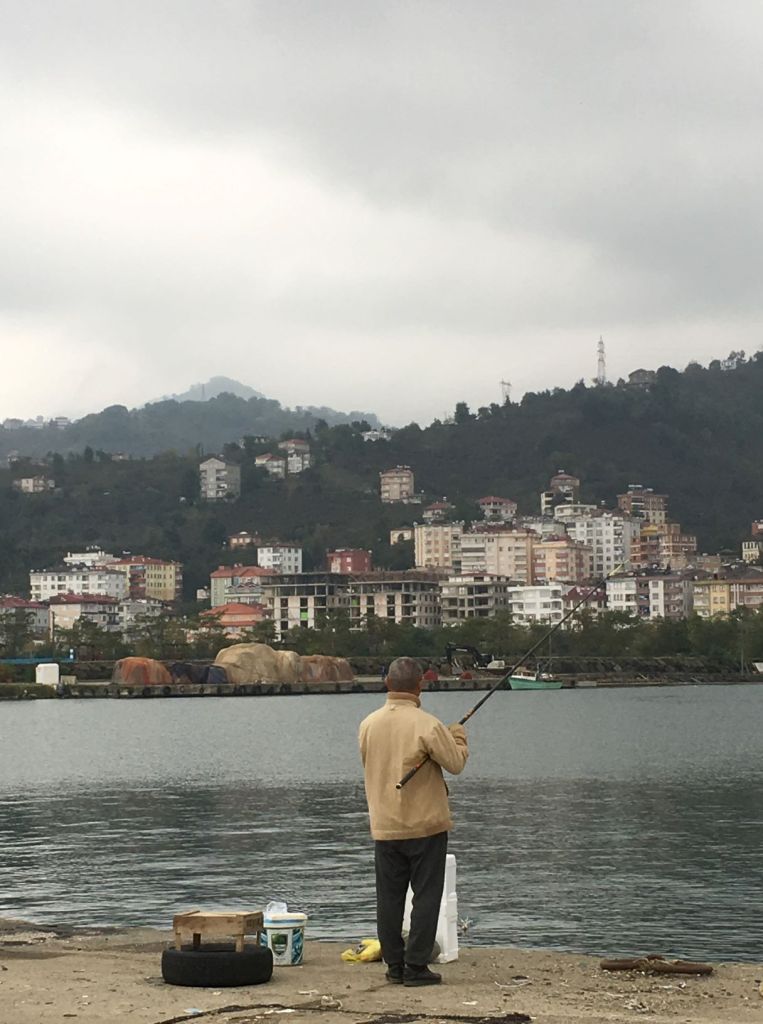
We leave Trabzon, and drive along the coast of the Black Sea. The weather is rather gloomy. We have a stop to try some fishing in a harbour but find out that although there are a lot of fishermen there, the catches are minimal. The fishermen keep some very small fish that in the North-Atlantic we would throw back because they are undersized.
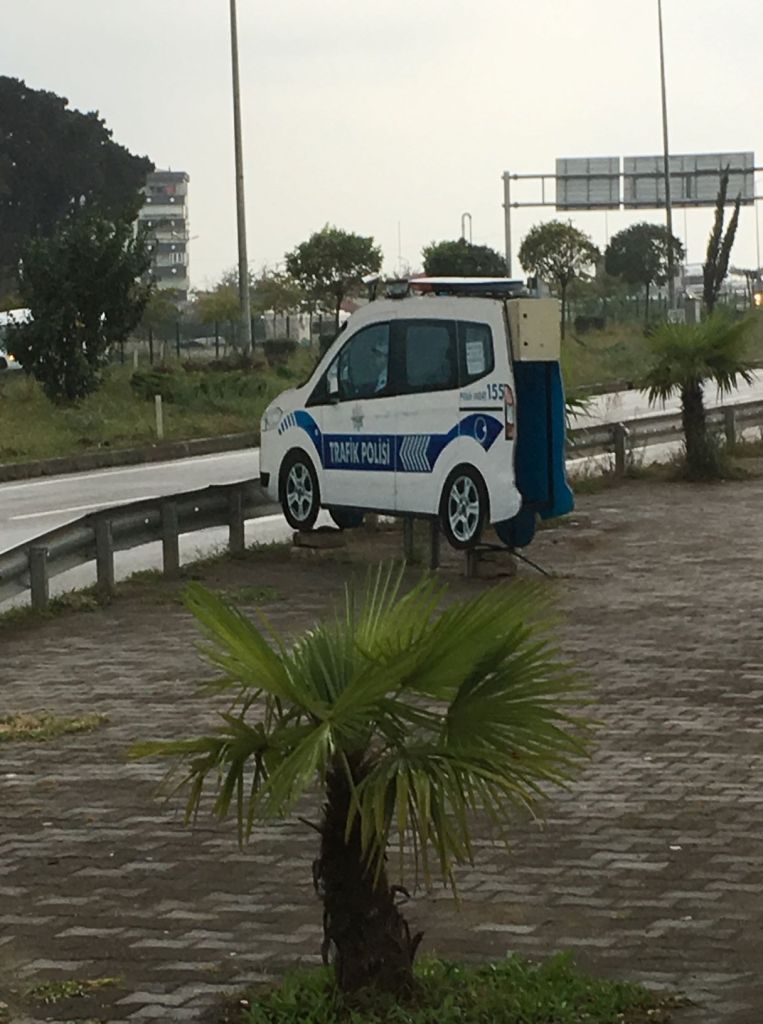
Travelling on, we come across the same deterrent we came across in Russia and the Stans, very realistic from a distance:
Towards the evening, the weather does improve a bit and we find a camping spot on an old part of the road which is made redundant by a tunnel. The spot is a bit messy with plastic bottles and the like, but the view is beautiful.
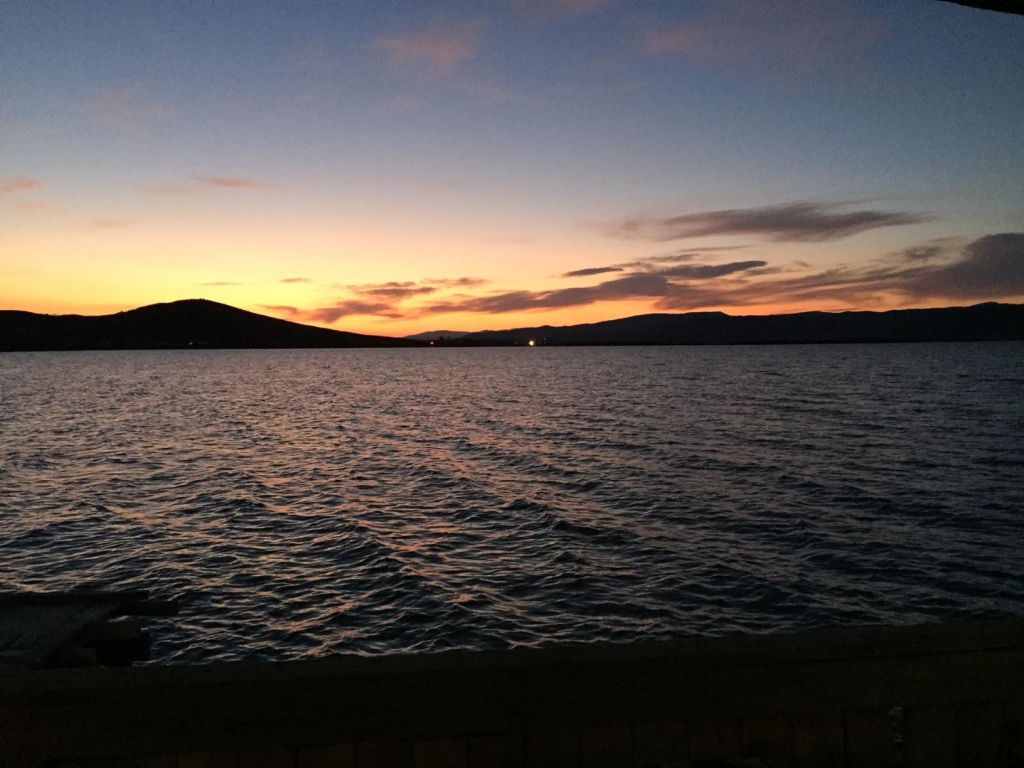
We have some wine, and listen to a podcast before we go to sleep.
October 24
We wake up and see a pod of dophins from the Mog! The coastal road along the Black Sea is busy and leads through many holiday resorts. In between, we find endless rows of hazelnut bushes amidst autumnal deciduous forests.
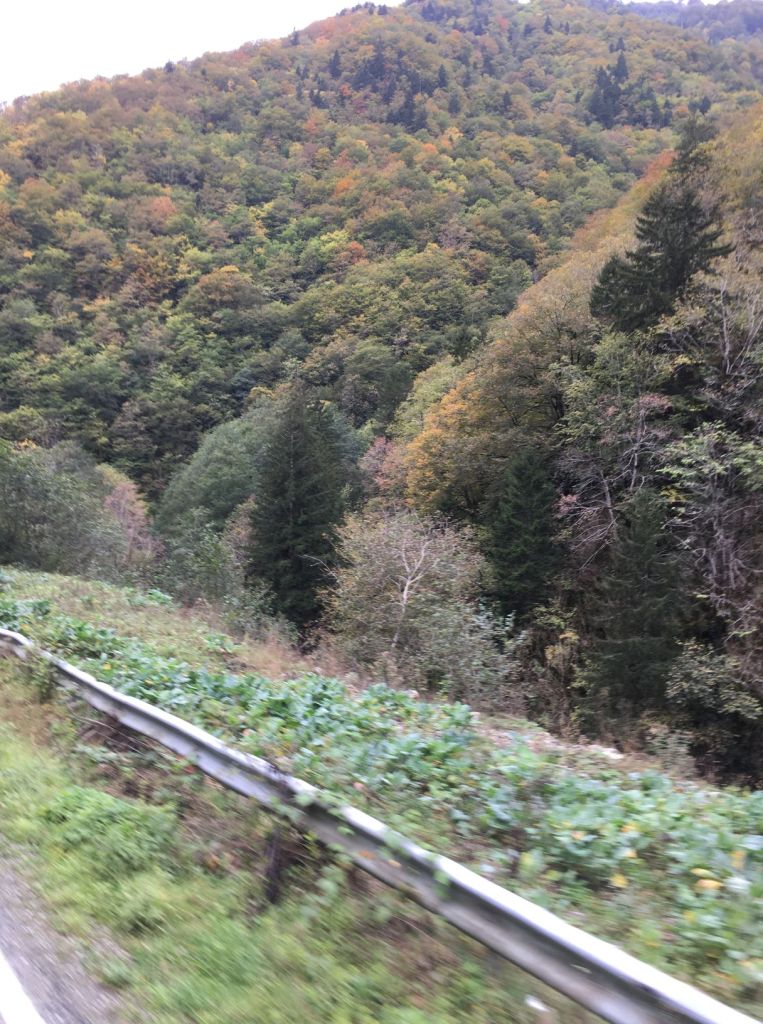
The mountains rise immediately from the coastline forming a trap for the weather with northerly winds accumulating clouds and moisture against the hillside. Not all that great so we decide to go inland in search of better weather and better views.
The weather clears promptly on the way up. The mountains are beautiful in their autumn colors.
We have another Pide with egg and cheese and buy some of these beautiful big, green tangerines in a small village.
Late afternoon, we park the Mog on a stretch of old abandoned road just behind the main one. It is wonderful to stay out in a quiet place without the constant barking of dogs.
October 25
We wake up to a beautiful day in a beautiful place. We had not realised that the highlands of Turkey were so magnificent.
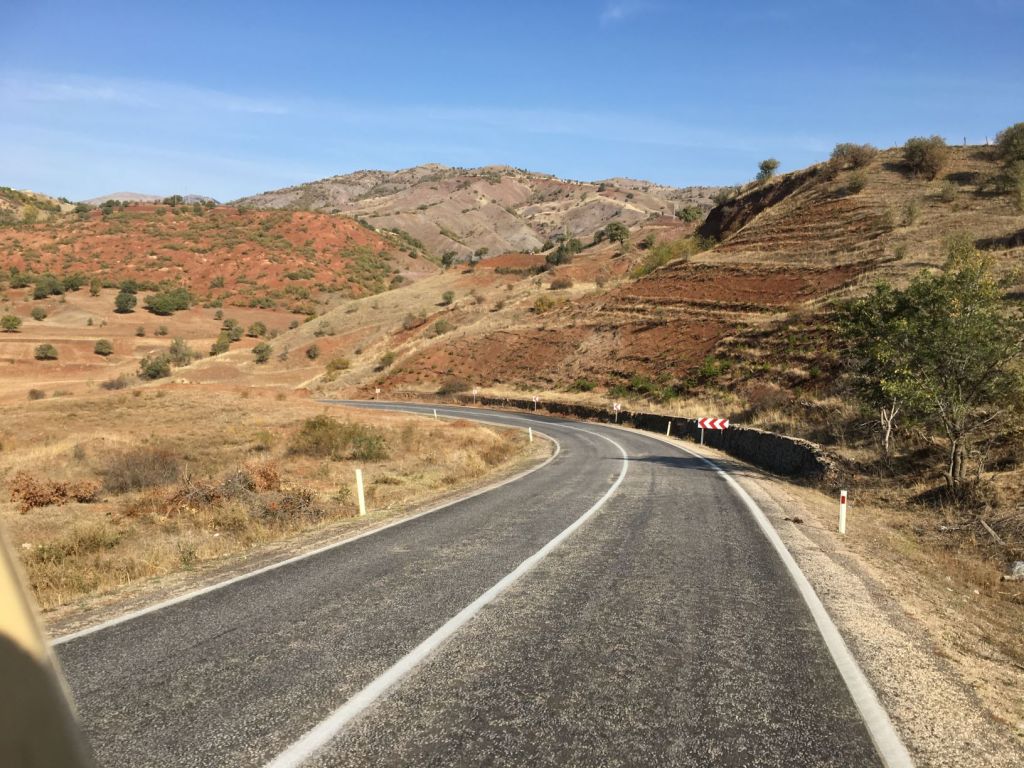
The farmers have prepared their fields for winter. The soil has lots of iron.
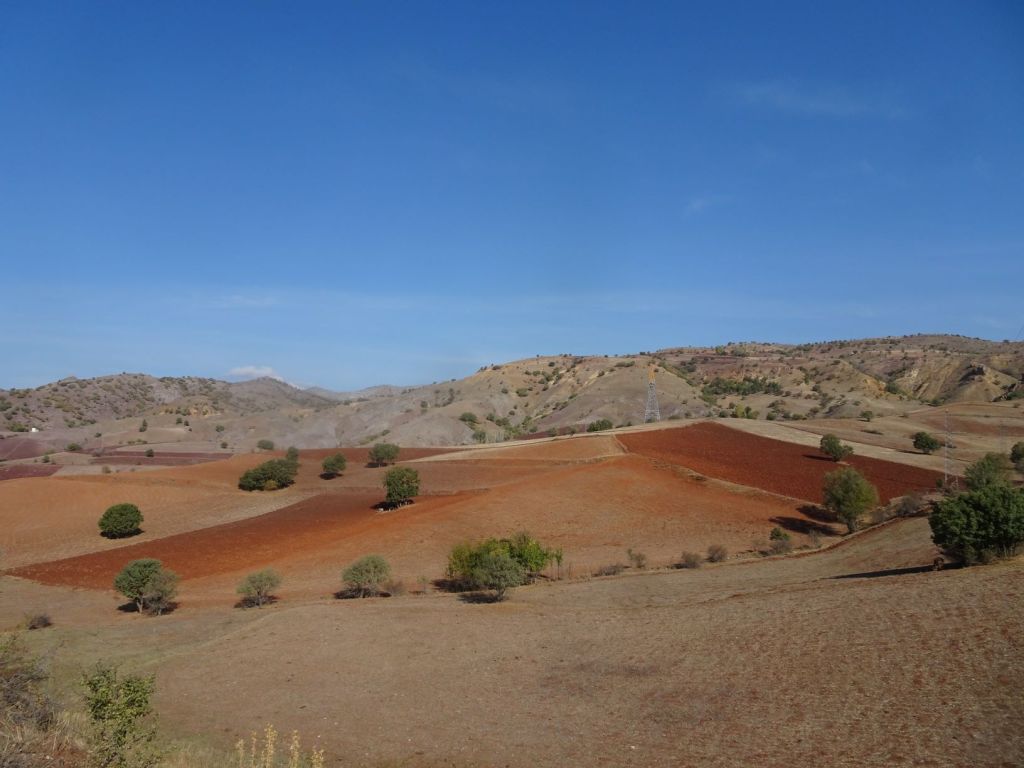
There is very little traffic.
Stalls along the roadside in small towns we pass though sell spices, pulses and loads of bread flour.
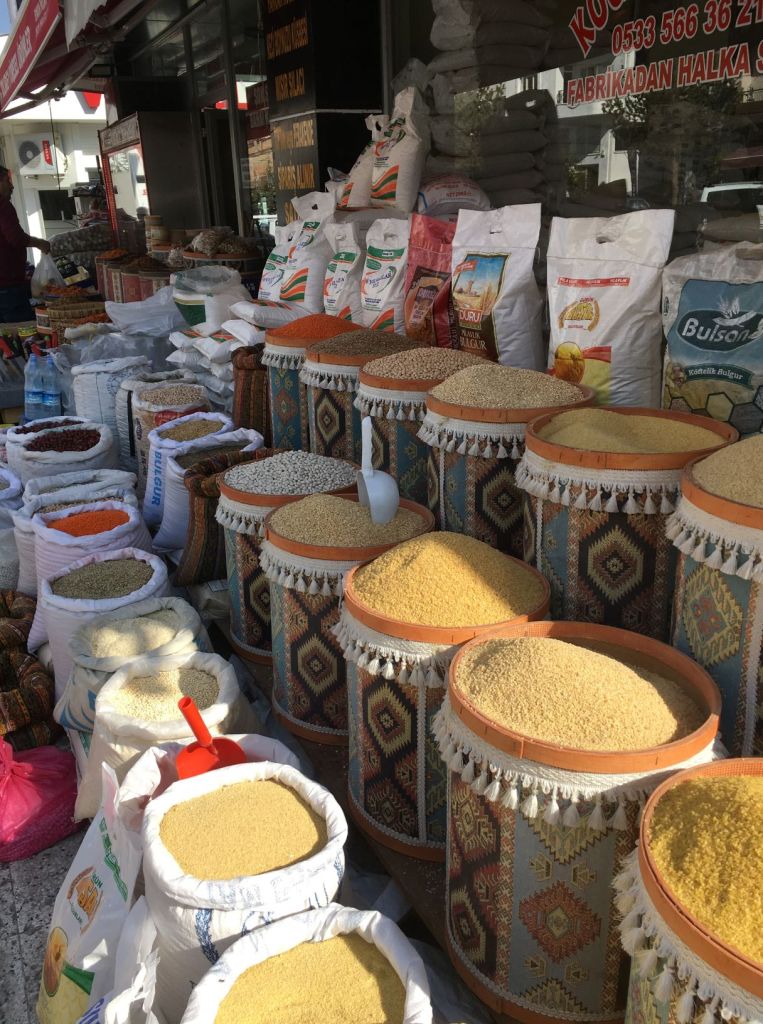
We have lunch in a traditional Turkish dining place where the locals eat also. It is a nice experience which needs no verbal communication. No choice of menu; you sit down and the food appears on the table in no time. Absolutely fabulous combination of grilled beef, salads, bread, little snacks and tea. Then you pay: 5 pounds each.
Back on the road, the pleasant scenery continues.
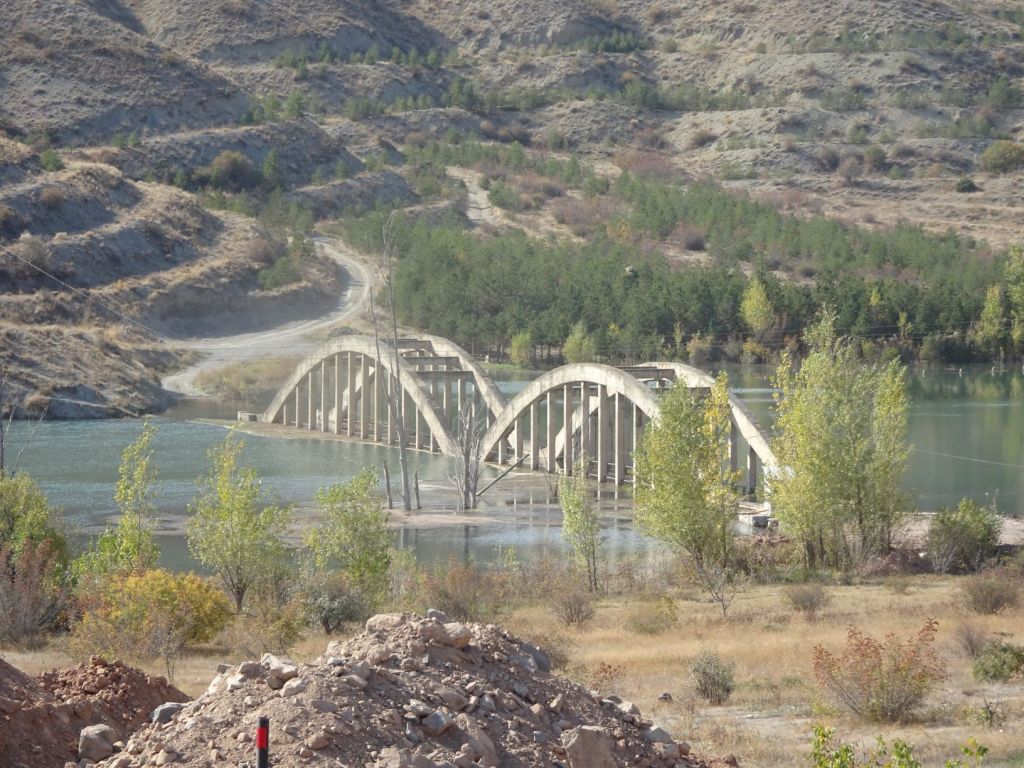
There are reservoirs
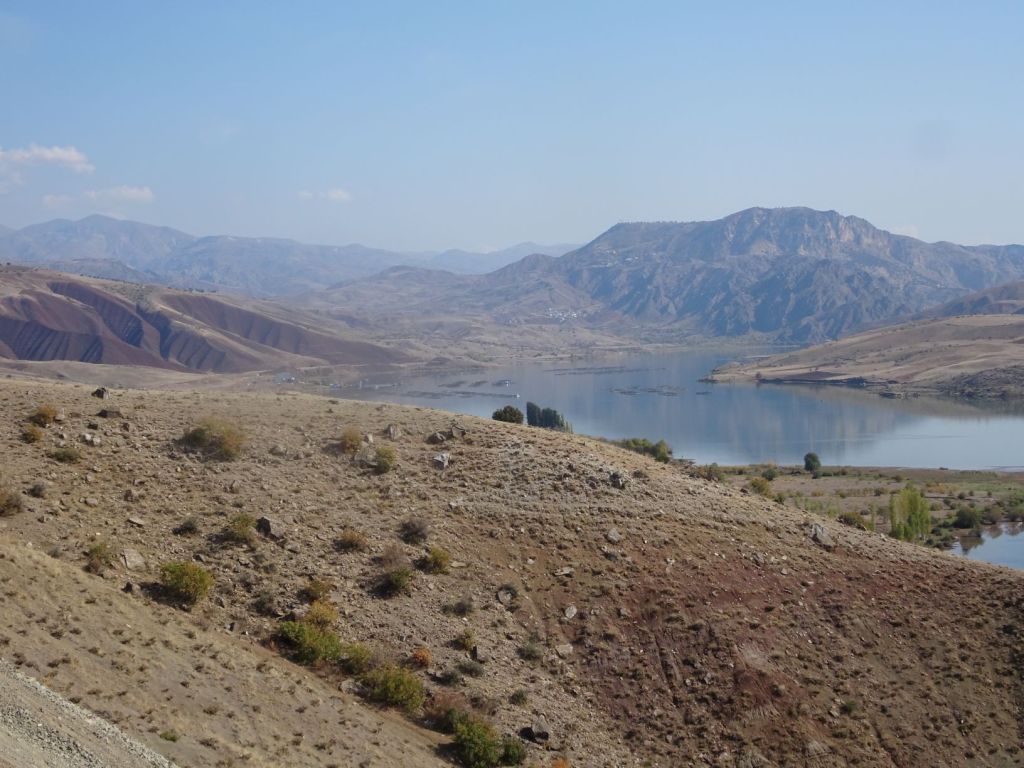
And their inevitable consequences.
We have an unexpected visitor when we settle down to camp. A herder comes to say hello and proudly show off his horse. Communicating with hands and feet we exchange a few pleasantries. Miep wants to know if it is alright to camp where we are and he manages to get across that he is delighted with that. We try but fail for him to take some of our food or drink, but the horse and donkey are happy to eat a big chunk of our bread.
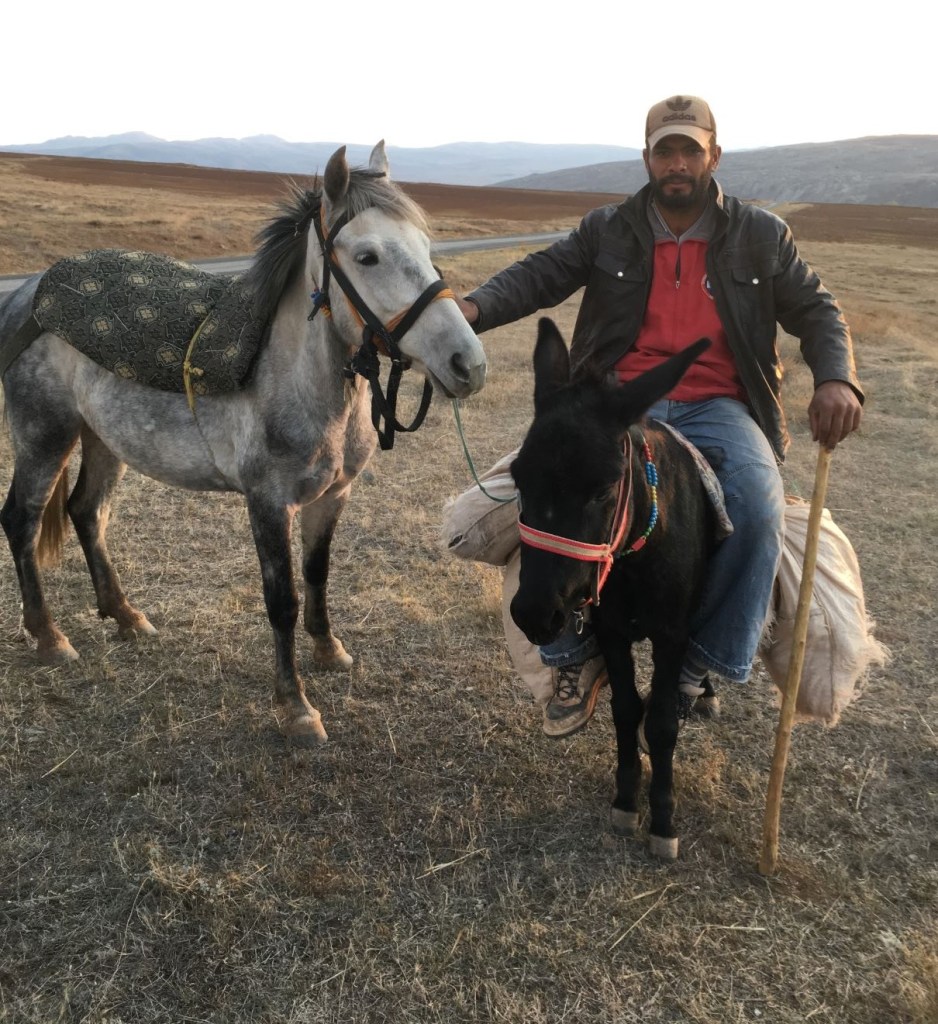
Finally he departs with his companions in to the evening sky. A lonely but beautiful existence it must be…
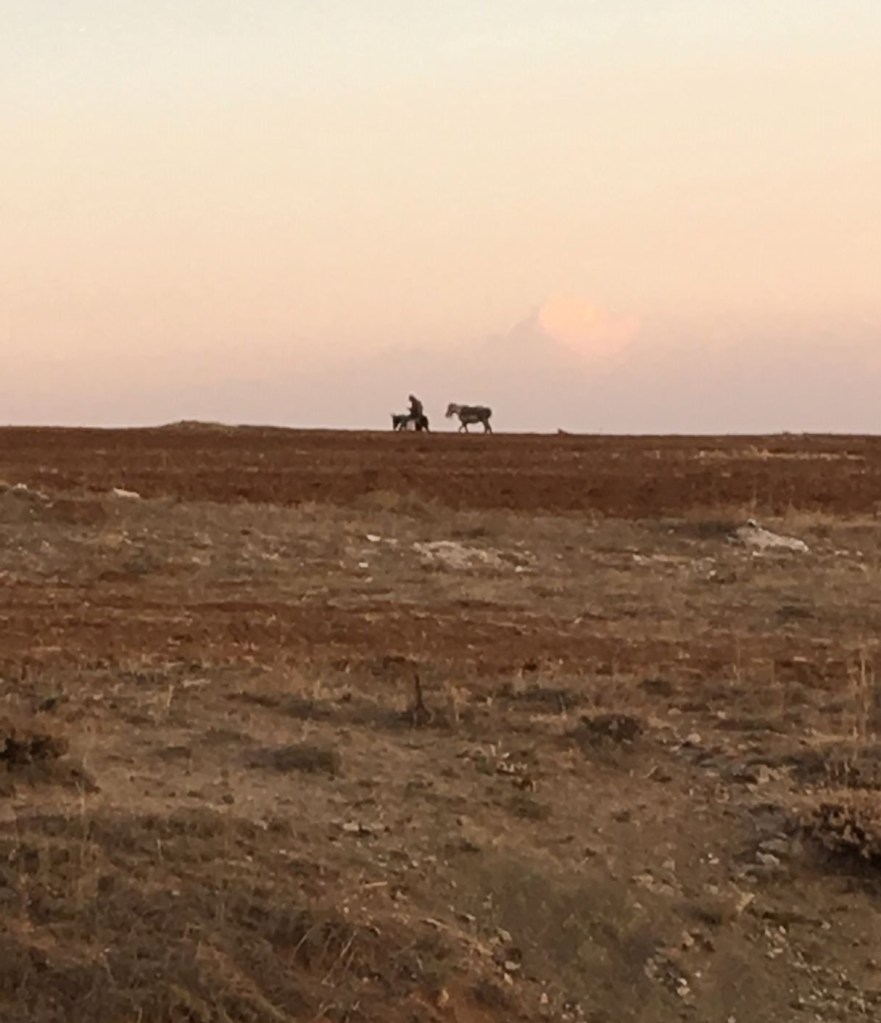
We are now the only ones here to enjoy the sunset.
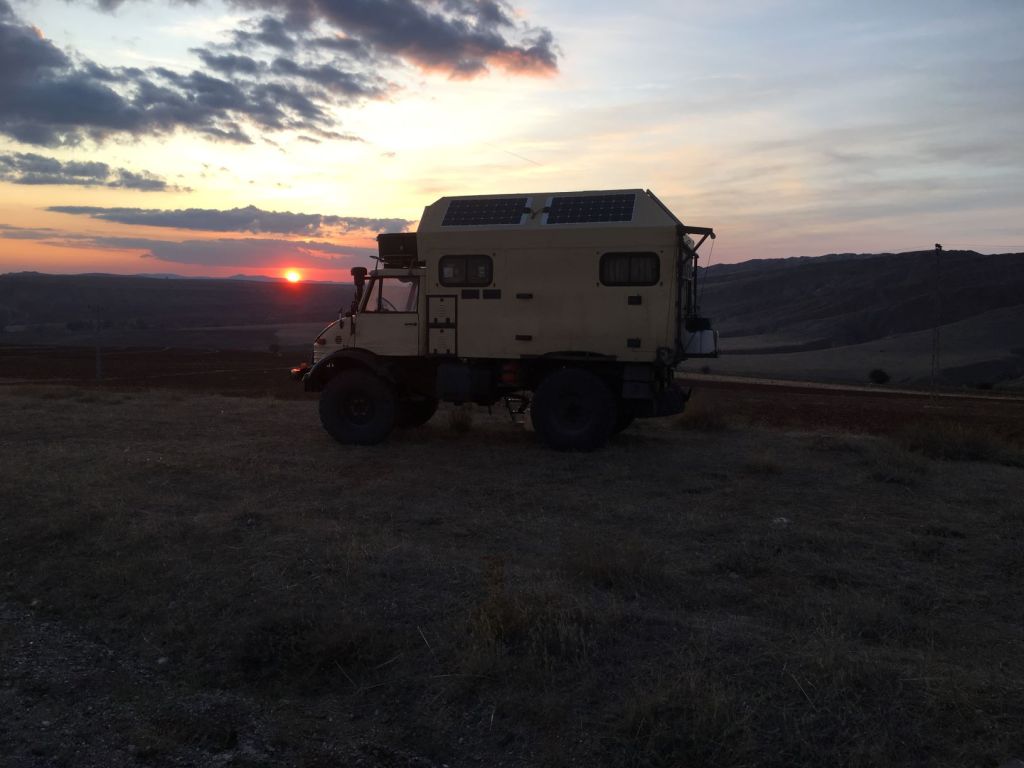
October 26
We drive to Kayseri. The city has rich heritage as a trading centre for the last 4000 years. It was the first organised commercial centre in the world and served as centre for Assyrian and Hittite trading routes for goods brought from Mesopotamia, and after the Royal Road was completed by Darius the Great in the 6th century BC, the city became an important cross road between the silk road from east to west, and the north-southt trading route between the Black Sea and the eastern Mediterranean.
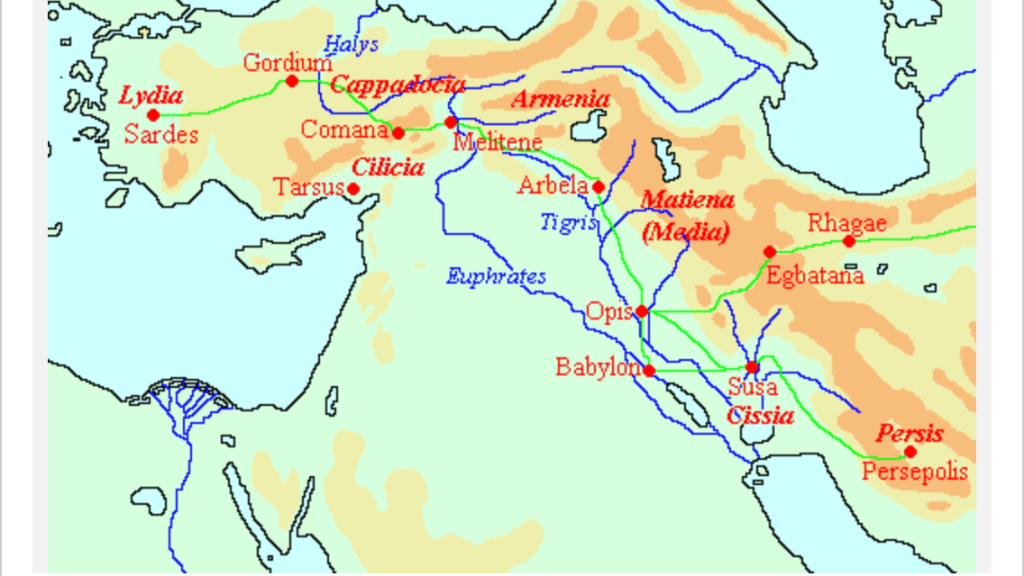
It is right in the middle of Anatolia and has historical artefacts from the Hittite, Persian, Hellenistic, Roman, Seljuk, and Ottoman times.
We park the Mog near the centre and have some nice wraps to eat on our way to the central square.
The Mahperi Hunat Hatun complex is on the central square of Kayseri and originates from the Seljuk period. Built in the 13th century it comprises a madrassa, now used as a café; a mosque (still in use), and a former bath house.
Just opposite the Hatun complex is a massive castle right in the middle of the city. The first walls were constructed 238-244 AD during the Roman period; it was reconstructed 300 years later in the Byzantine period and extended upon by a Seljuk Sultan in the 13th century, around the same time as the opposing Hatun complex. It is absolutely massive, and only just re-opened after extensive restauration.
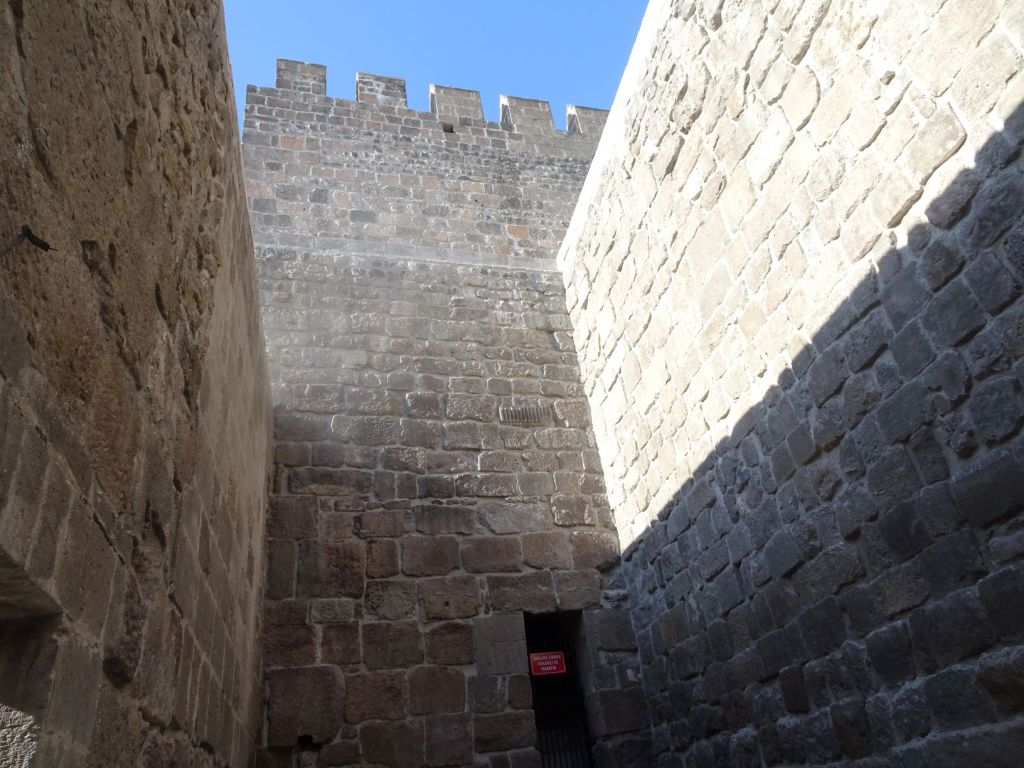
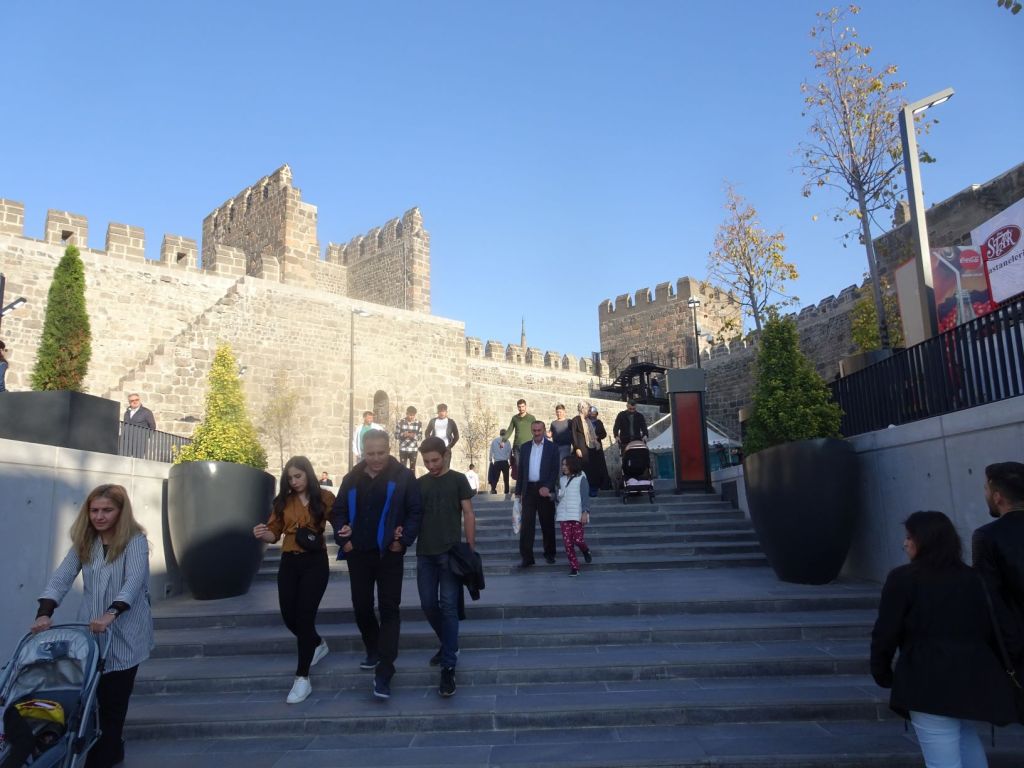
In the basement of the castle there is a history museum (entry fee 1 pound) that takes you chronologically through the history of Kayseri and the Cappadocia region:
2000 – 1700 BC Assyrian trading colony
1700 – 1200 BC Hittite Empire
1200 – 700 BC Phrygian Kingdom (the Phrygians were Thracians)
700 – 547 BC Lydian Kingdom (the Lydians were Anatolians closely related to the Hittites)
547 – 330 BC Persian Empire
300 BC – 17 AD Seleucid Empire
17 – 395 Roman Empire
395 – 1071 Byzantine Empire
1071 – 1243 Seljuk Empire
1243 – 1398 Mongol/Timurid Empires
1398 – 1920 Ottoman Empire
1920 – present Republic of Turkey
The Hittites formed the first organised state and had a cuneiform script
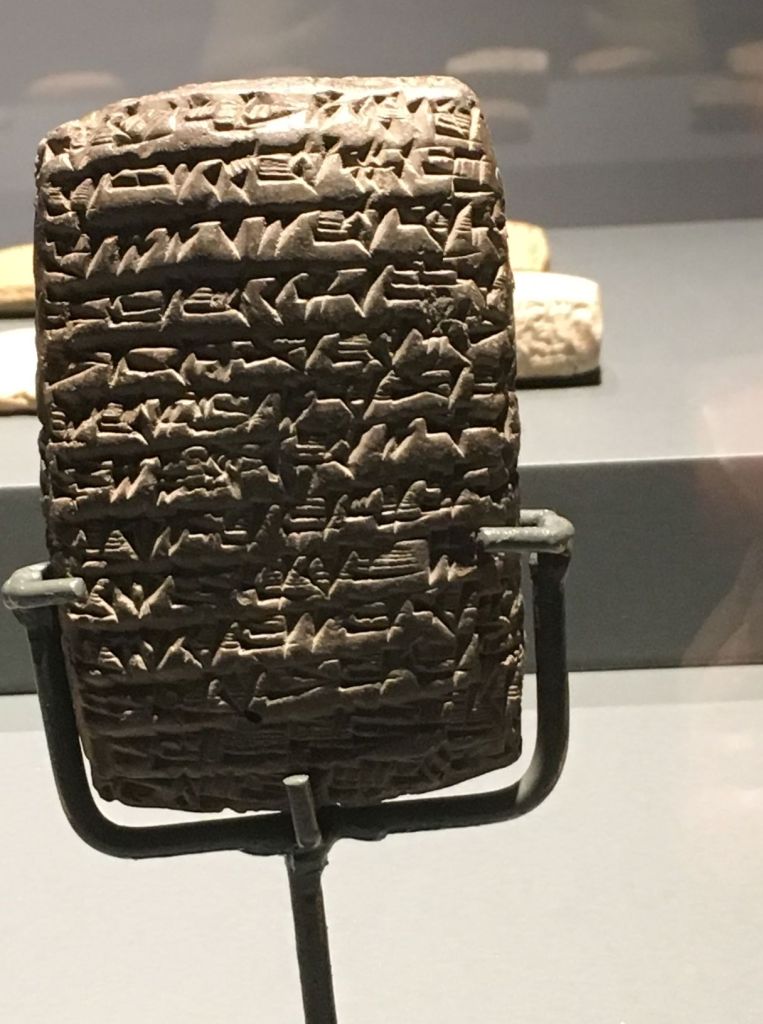
The Hittites were called the people of the 1000 Gods, whom they took over from the people they conquered.
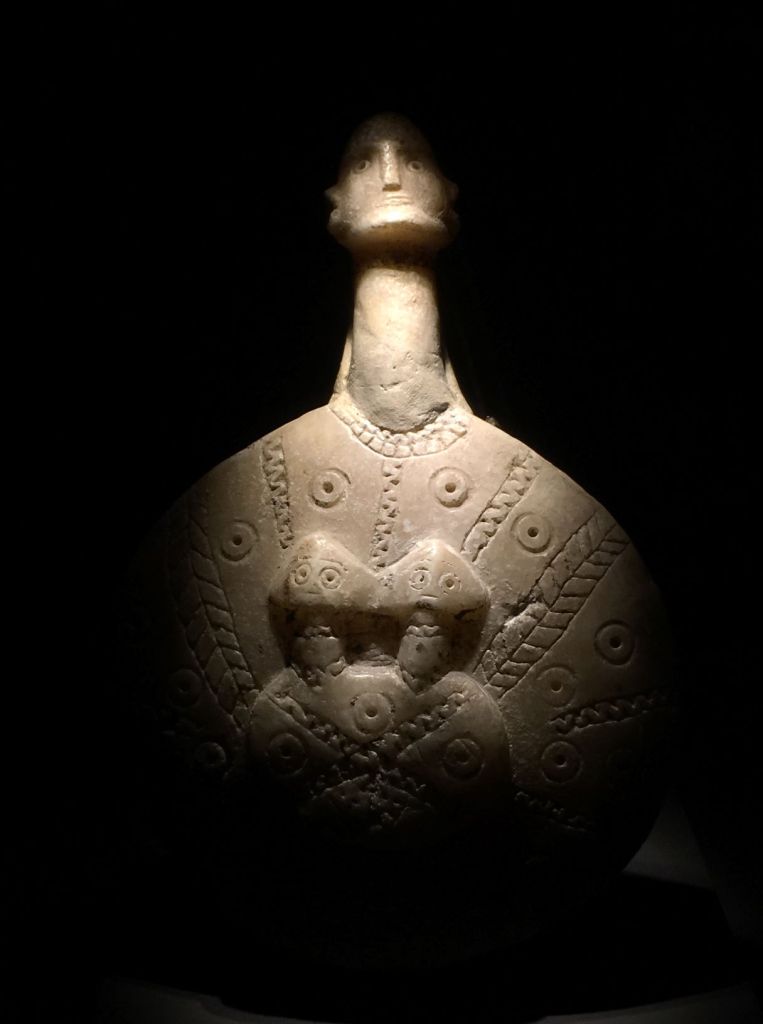
The Lydians were the first people in the world to mint coins to facilitate trade.
The last Seleucid king changed the name of the capital of the region from Eusebia to Kayseri during the first decennium AD in honour of the Roman Emperor Augustus.
The region became an important center for Christianity during the Roman period in the 3rd century AD. During the Byzantine period, there were frequent raids of the region by the Persian Sassanids and later by the Arabs leading to the building of underground cities and rock cut out churches throughout Cappadocia.
We are dutifully impressed by the excellent quality of the displays in the museum which contributes to the ease with which a carpet trader lures us in to his shop. The shop is in the old bazaar of Kayseri.
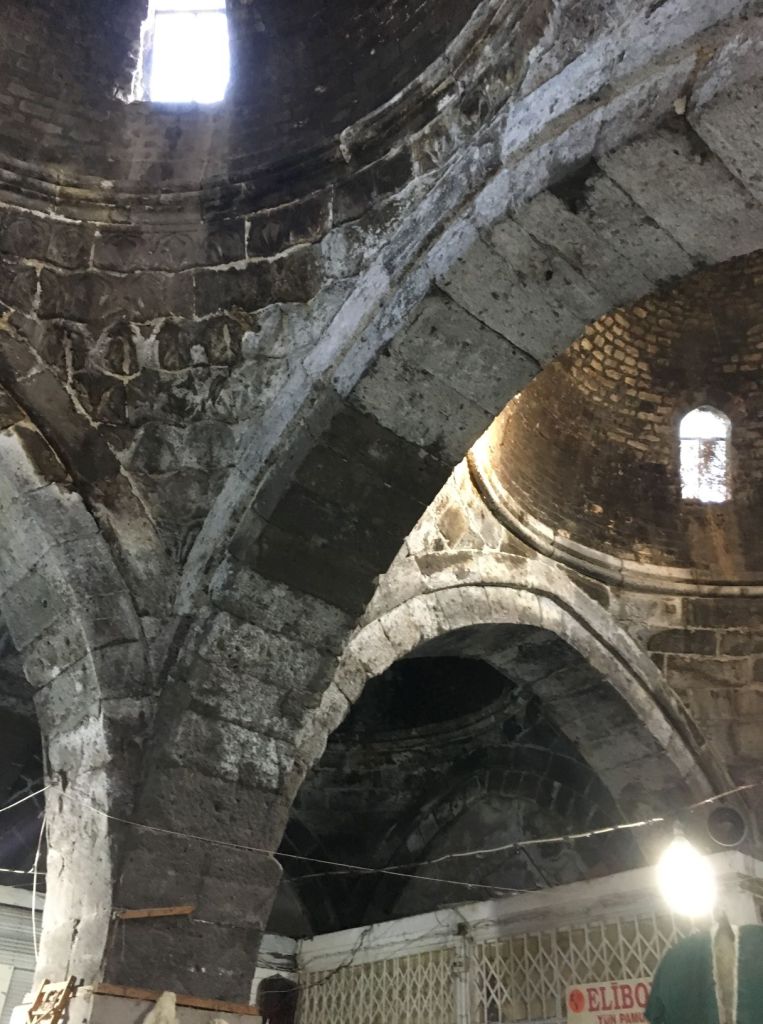
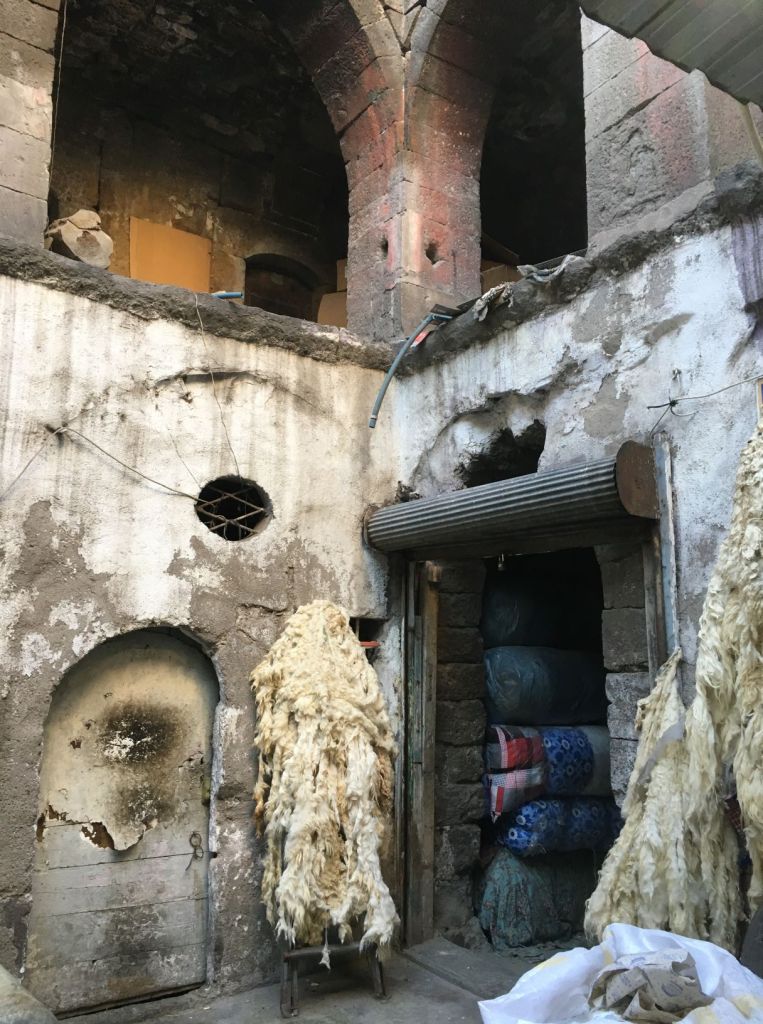
Once we are in, it is difficult to get out. We have complementary characters where Miep opens up new avenues, and Roelf tries to close them down. In a shop that means that the exploration of new products is closed down by buying them! A deadly combination as far as the wallet is concerned. It is good that both know what they like and purchases are rarely regretted.
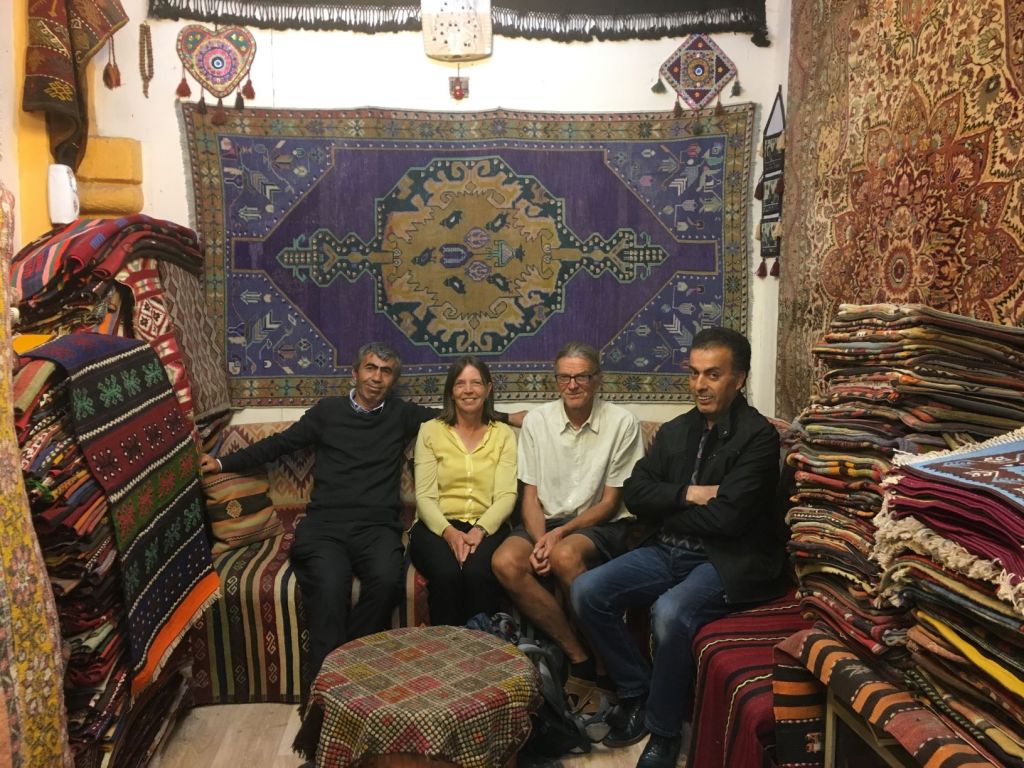
We buy three woollen pillow cases that are made from old carpets.
All these adventures means that we leave Kayseri after dark, and arrive late in the evening at the campsite in Goreme, the main tourist centre for Cappadocia.
October 27
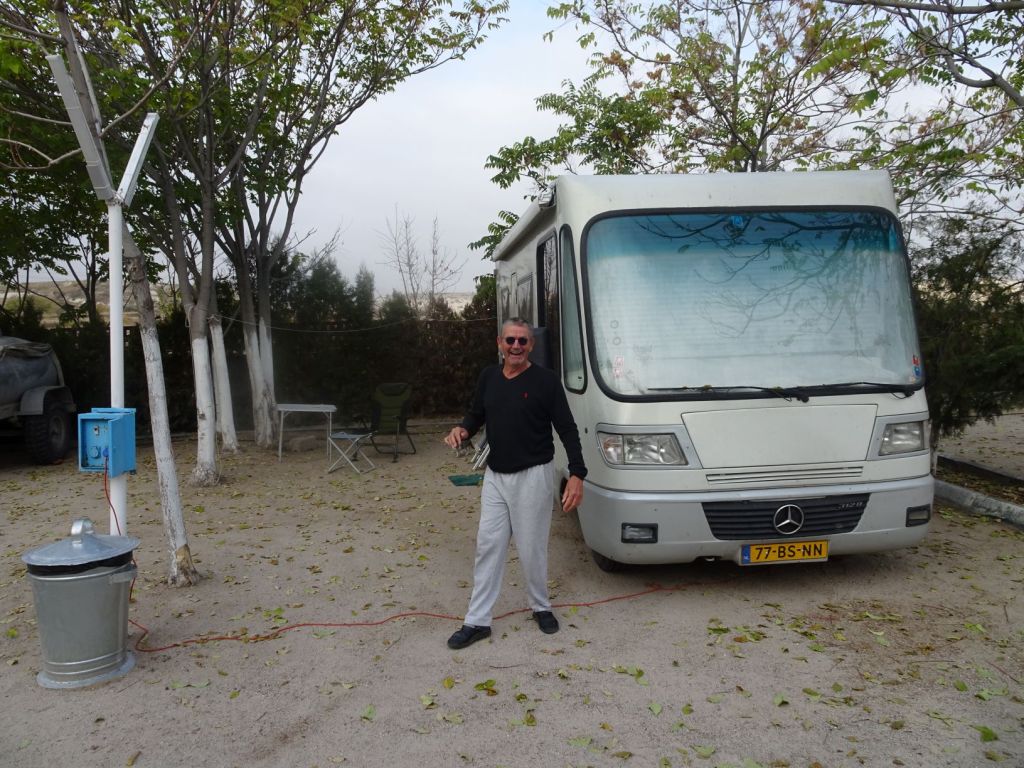
We wake up to a misty morning. There are four teams of our TME travelling group on the campsite!. It is nice to meet up again, and we gossip about the flood of tourists from the far East who seem to have travelled all the way to Cappadocia to have selfies taken; Jan tries to give an impression of a tourist posing for a selfie.
Roelf gets involved in a broken down Renault 4; the torsion spring on the right hand side is to relaxed and the car leans accordingly, causing the floor to hit the uneven roads.
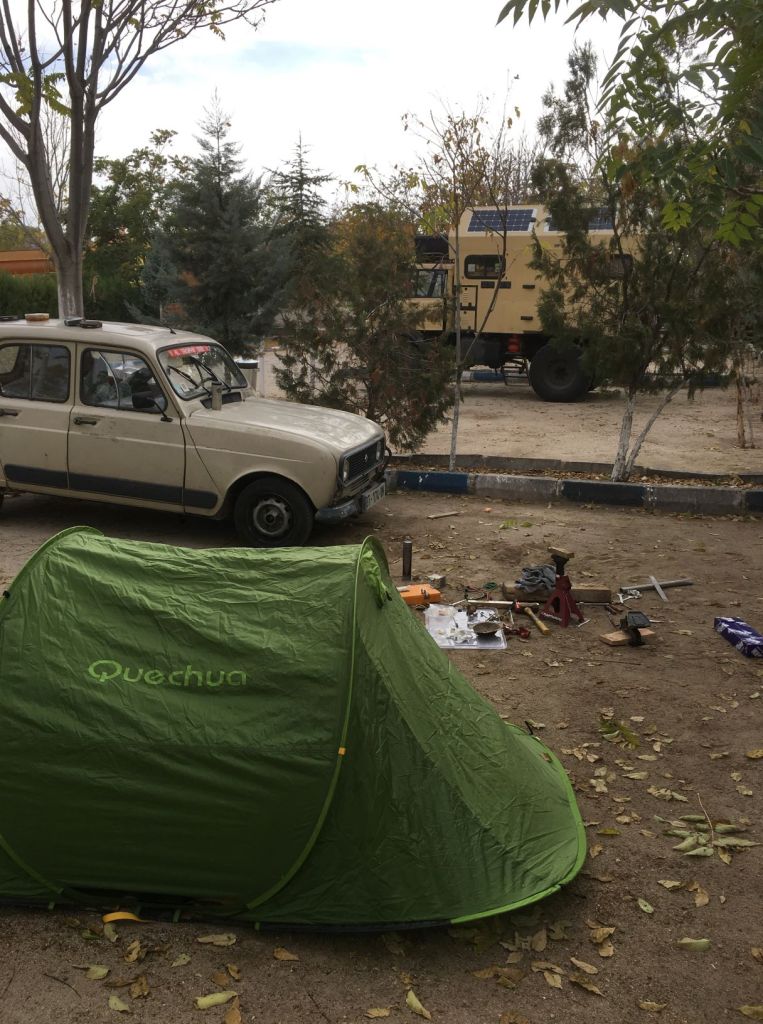
The car belongs to Sophie, a French graduate who is on her way to Mongolia. The R4 is from 1984, and she recently got it back on the road. Sophie has promised the car to her godson who is 2 years old. She is determined to present it to him in pristine condition when he turns 18.
Sophie is quite inspirational; she has a vast amount of tools and spare parts tucked away in her car, and she treats every bolt with loving tenderness. Most importantly, she knows the car very well. However, tensioning a torsion spring is not easy to carry out on your own, and Roelf is happy to help.
Miep sees it coming that Roelf will be working on the car all day, and goes out to Goreme on her own. The place is totally spoilt by tourism; every foreigner is besieged with people with want sell bus tours, balloon flights, and of course, carpets. The landscape is quite spectacular however.
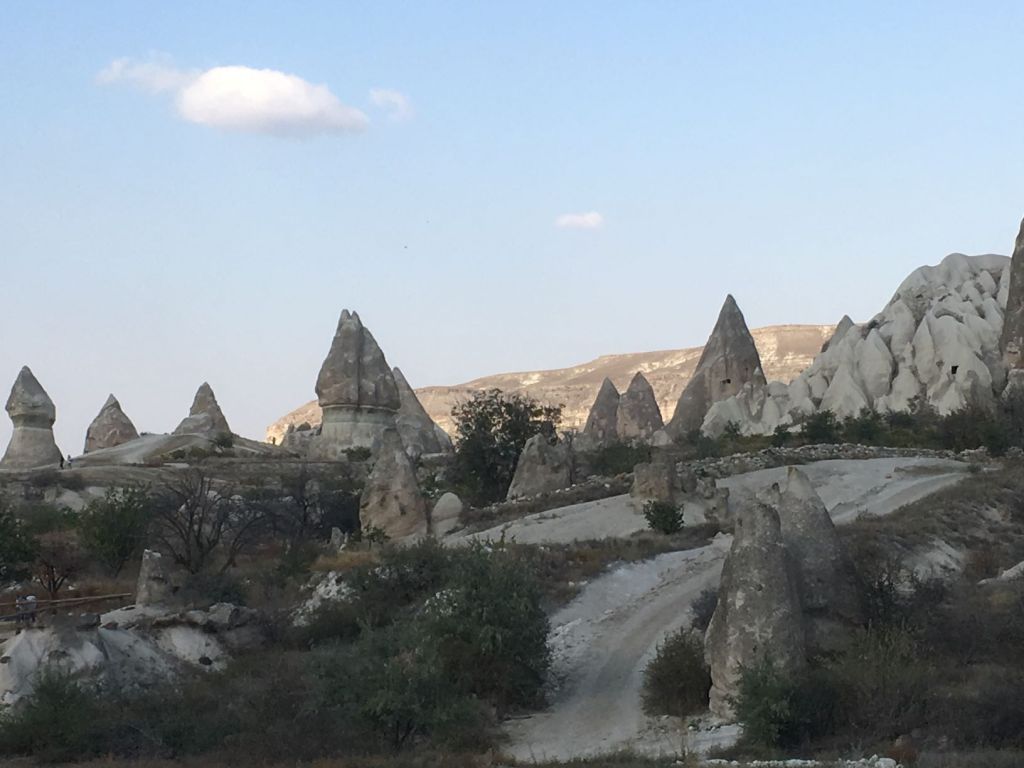
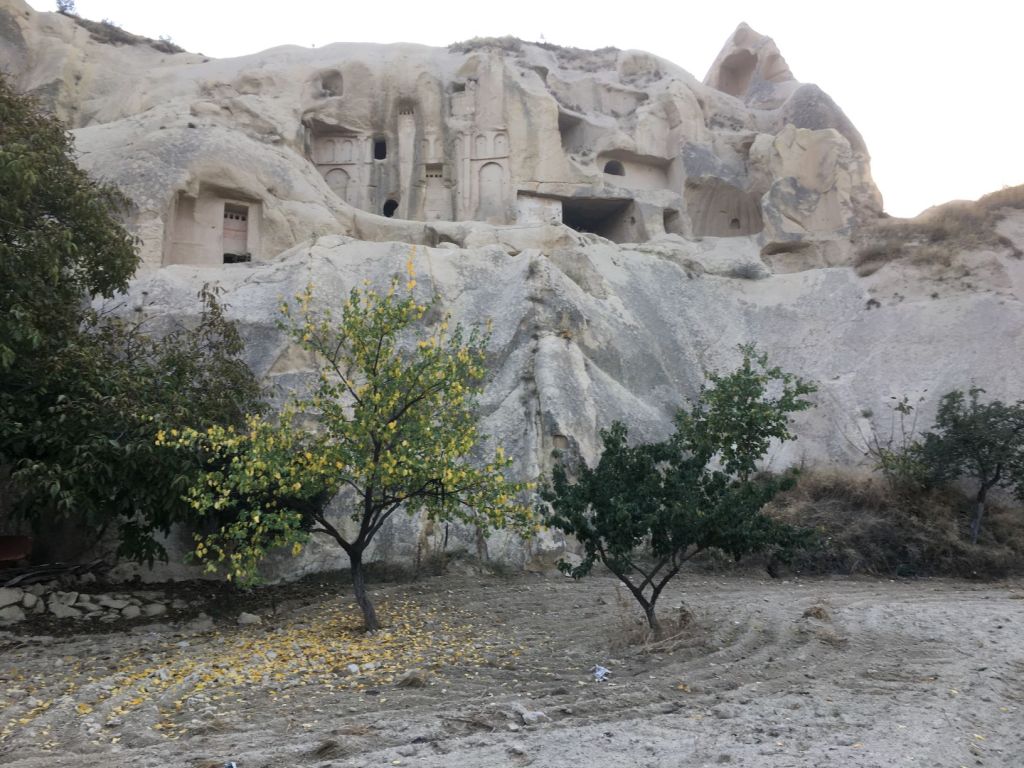
Rock cut out dwellings with towers and chimneys are everywhere.
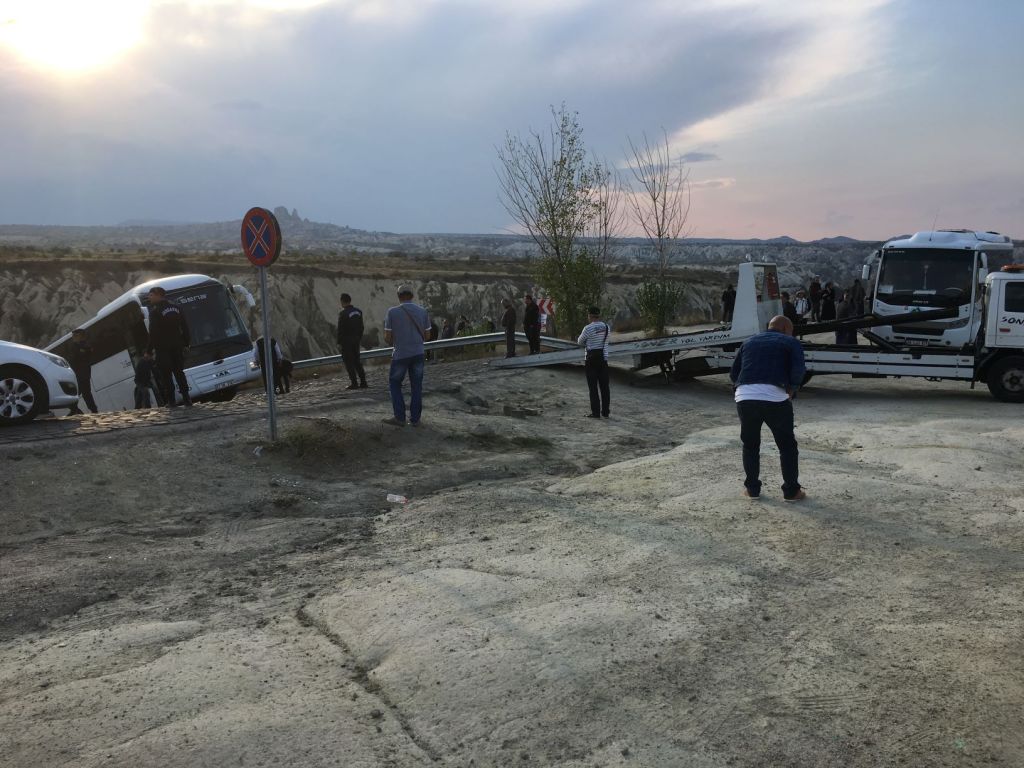
The narrow roads are busy with tourists in massive buses; for some the steep and narrow corners are a bit too tight. She finds one that has only two wheels left on the road. The driver has to stay in while it is being pulled up, looks very scary.
The day ends in a bit of disappointment because after a lot of deconstructing and putting back together again, Roelf and Sophie have left the torsion spring too slack. The whole thing has to be done all over again tomorrow. The good thing is that the finishing touches for the North West Iran section of the blog are completed and the post is published.
October 28
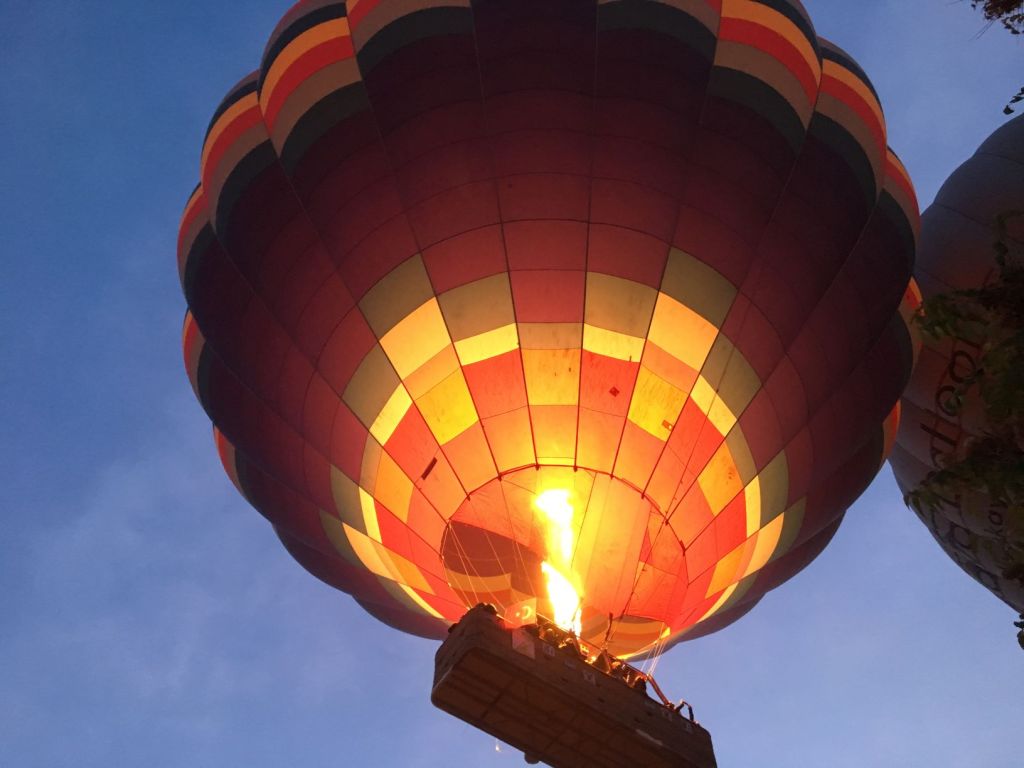
At sunrise, we are treated to a fantastic spectacle; hundreds of air balloons are filled up (with hot air and tourists) and released to the air to witness sunrise in Cappadocia.
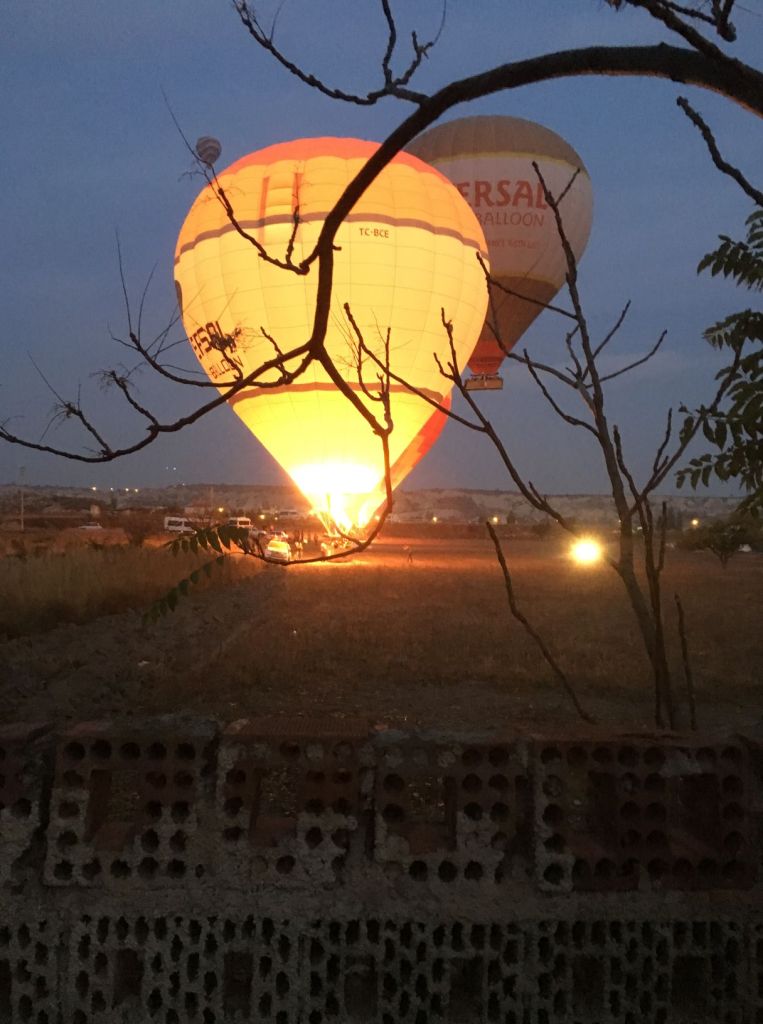
A ride sets you back £250
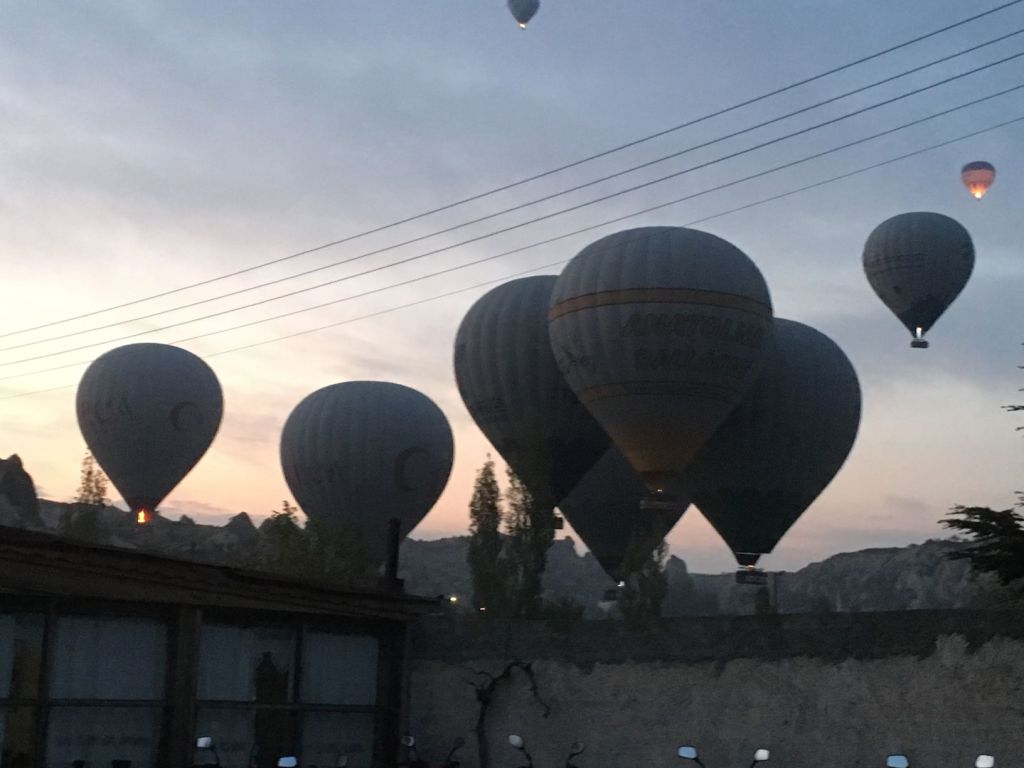
The experience lasts for about one hour.
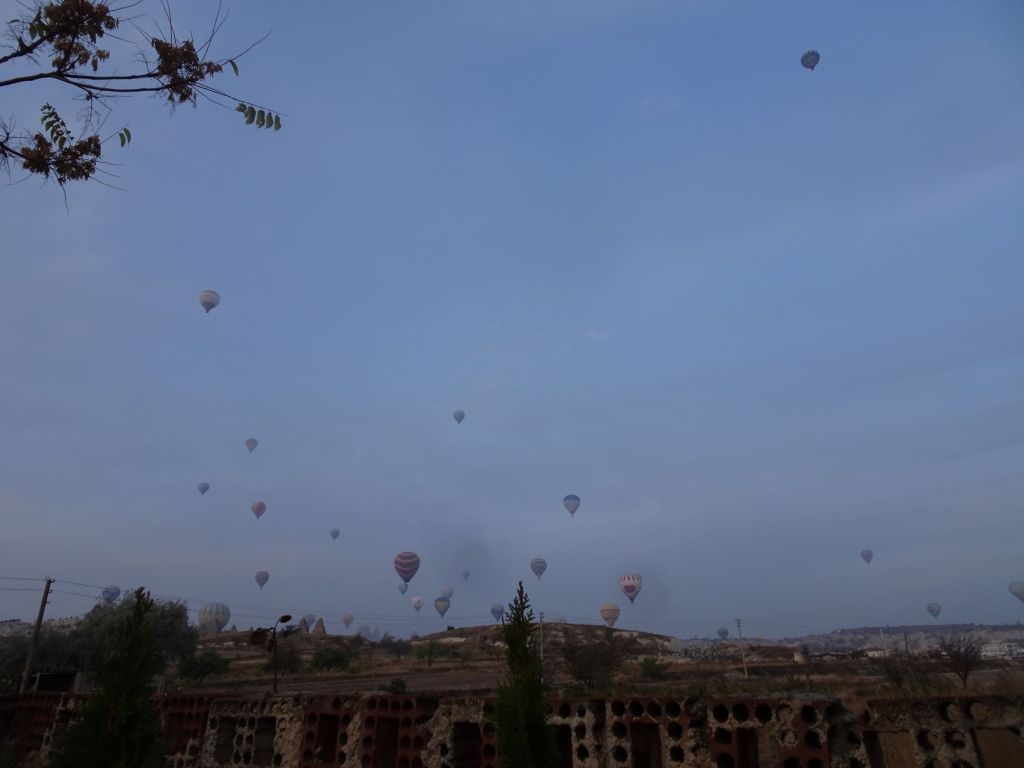
We somehow feel that we get the best of the spectacle for free.
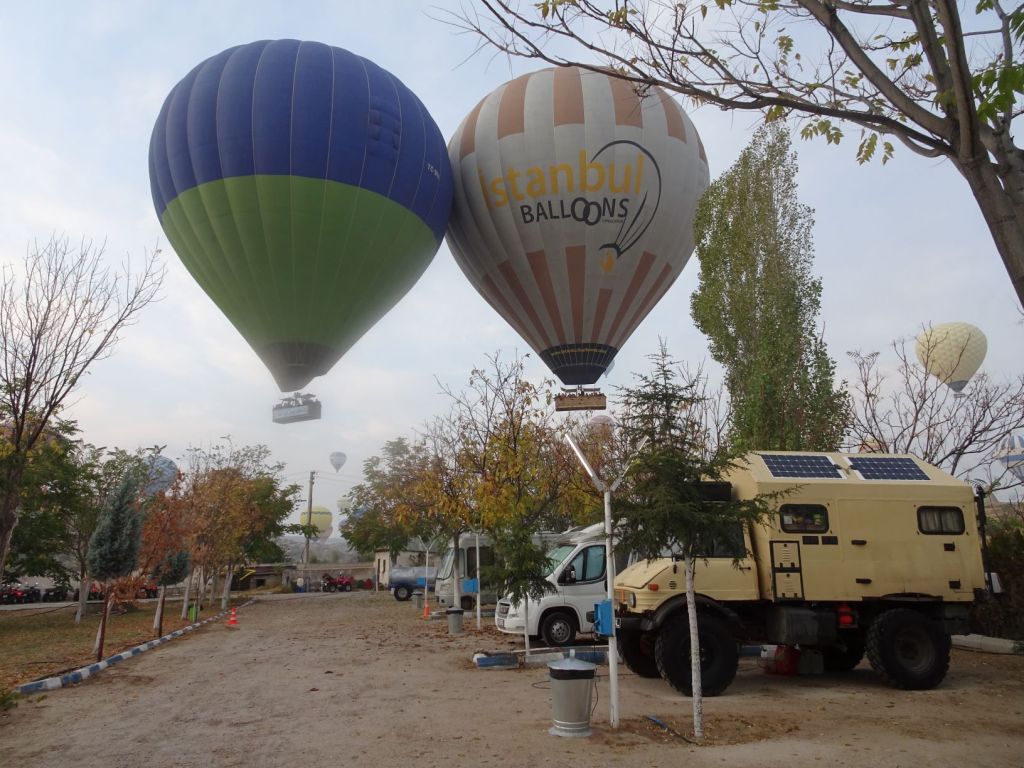
Some of the balloons go very close over the Mog.
After the practice of the previous day, Roelf and Sophie get the torsion spring fitted at the right tension.
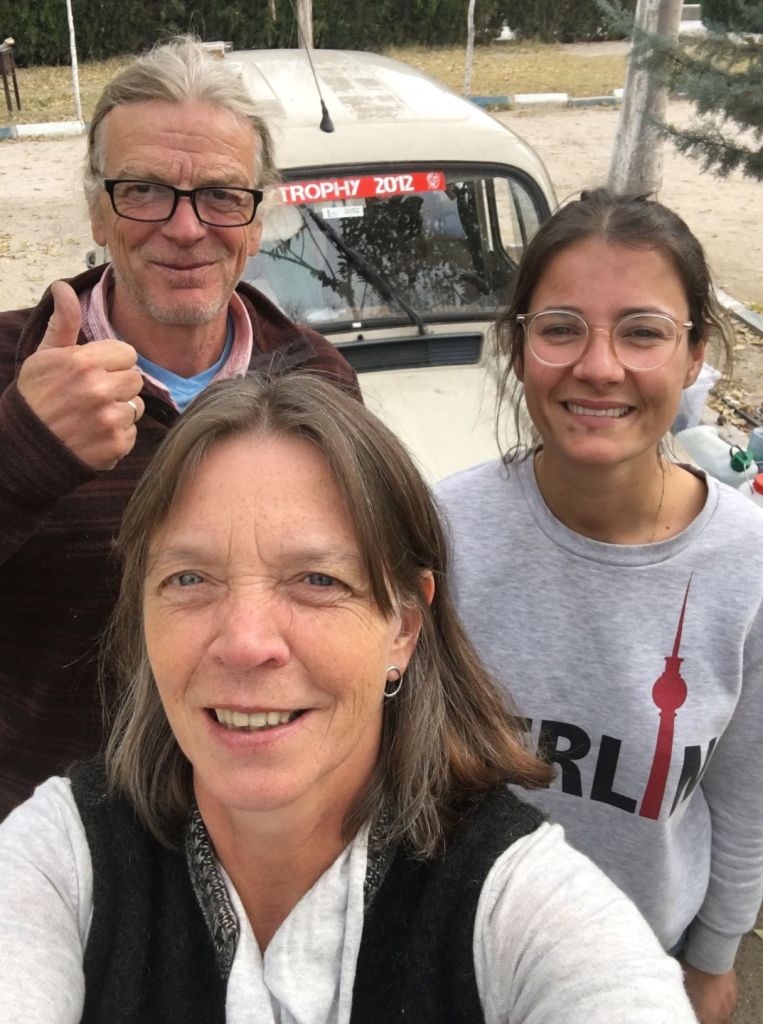
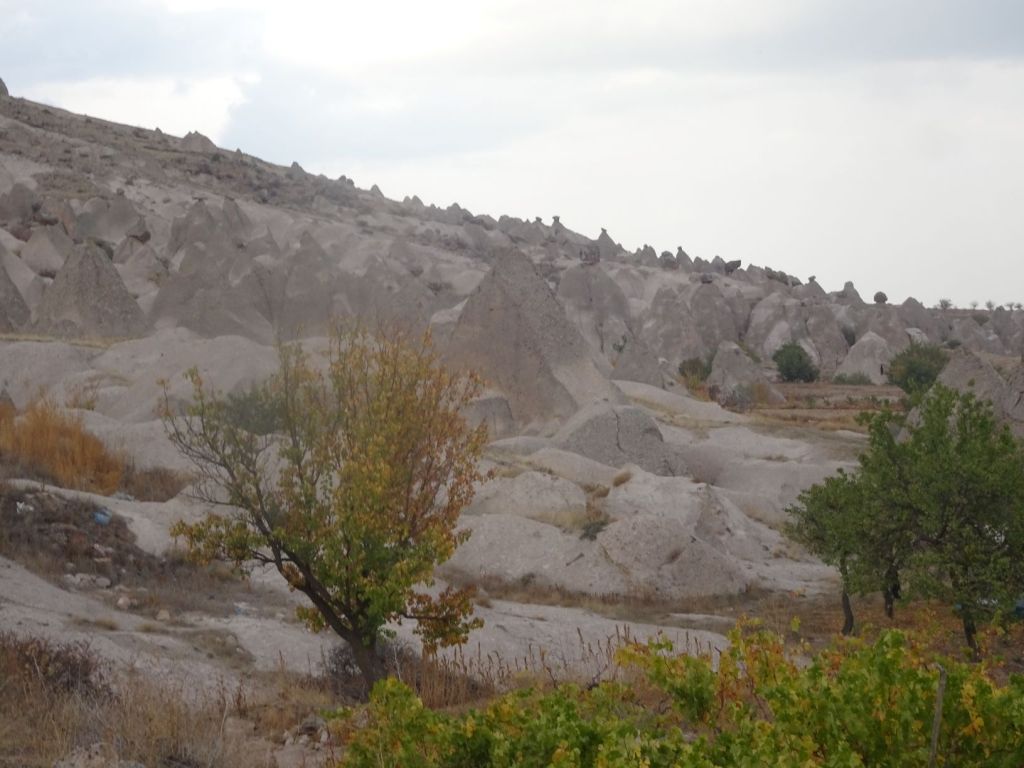
Way say goodbye and move on to other parts of Cappadocia. The landscape is dominated by the erosion of lime stone away from more hard forms of rock.
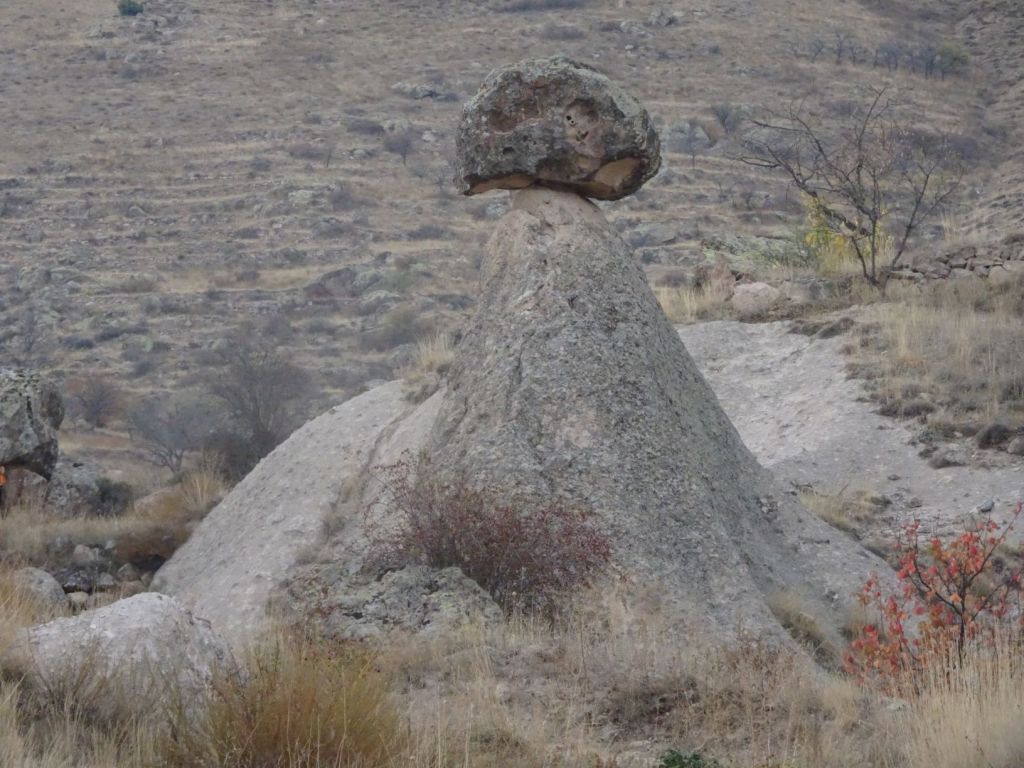
This can lead to exciting balancing acts.
Old rock cut out dwellings are intermixed with more modern buildings.
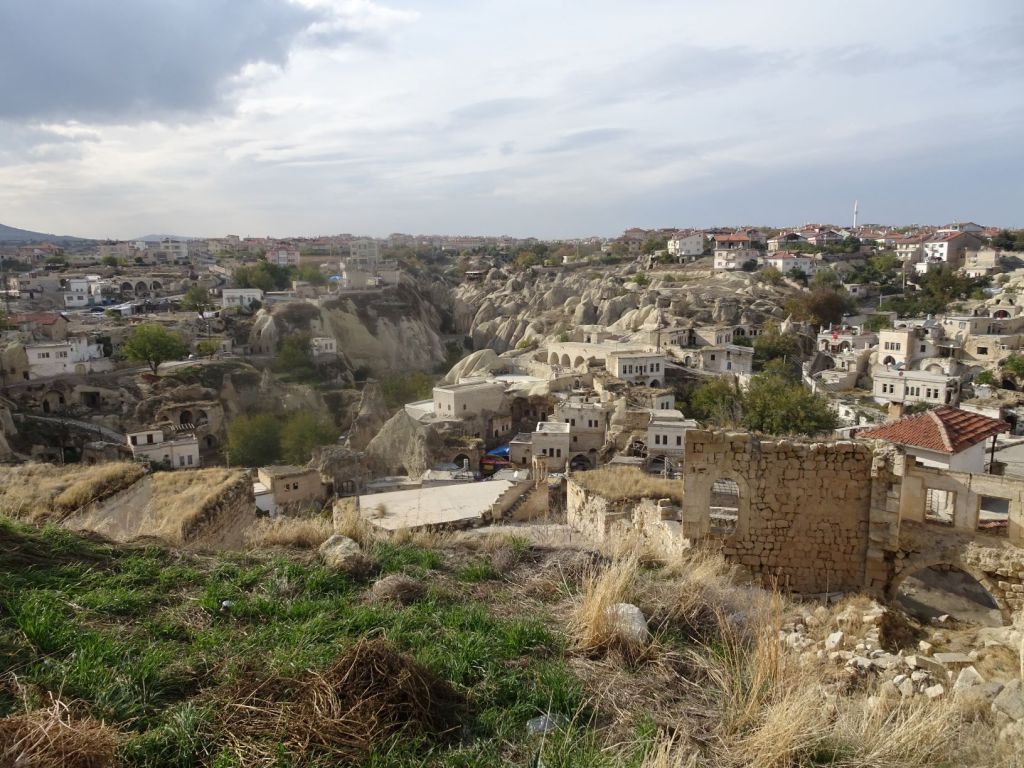
Clearly many of the cave houses are still in use. We see some cave houses with modern facades, and some still in their original shape.
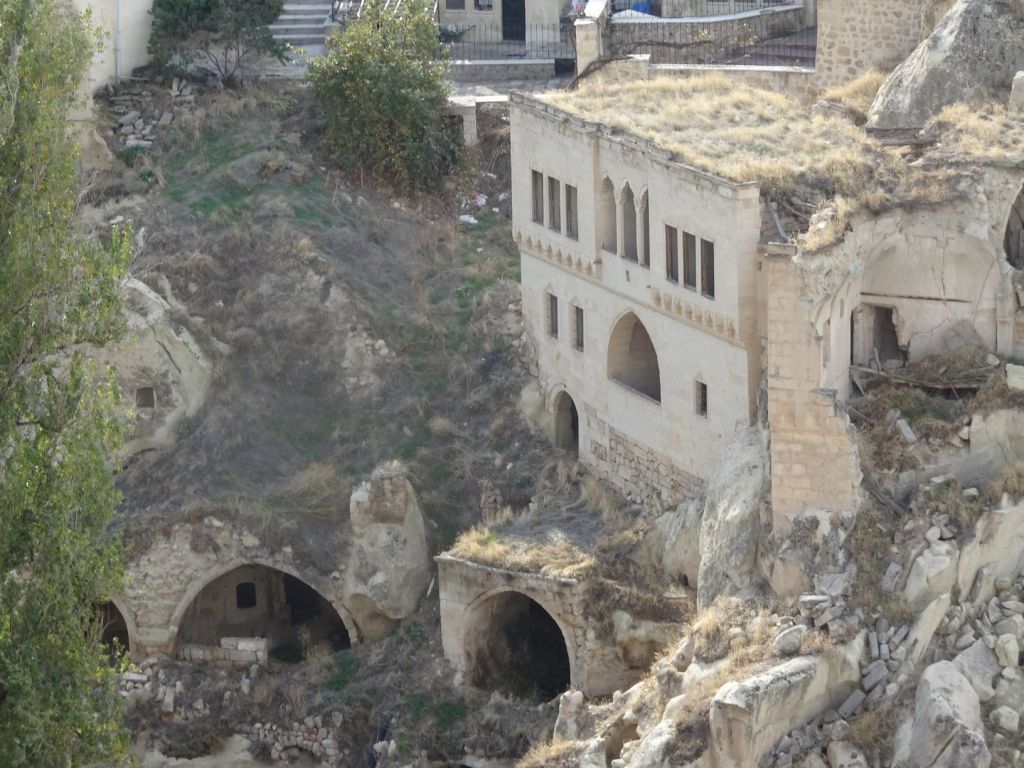
The bizarre effects of erosion have also been put to use in medieval times to create fortifications.
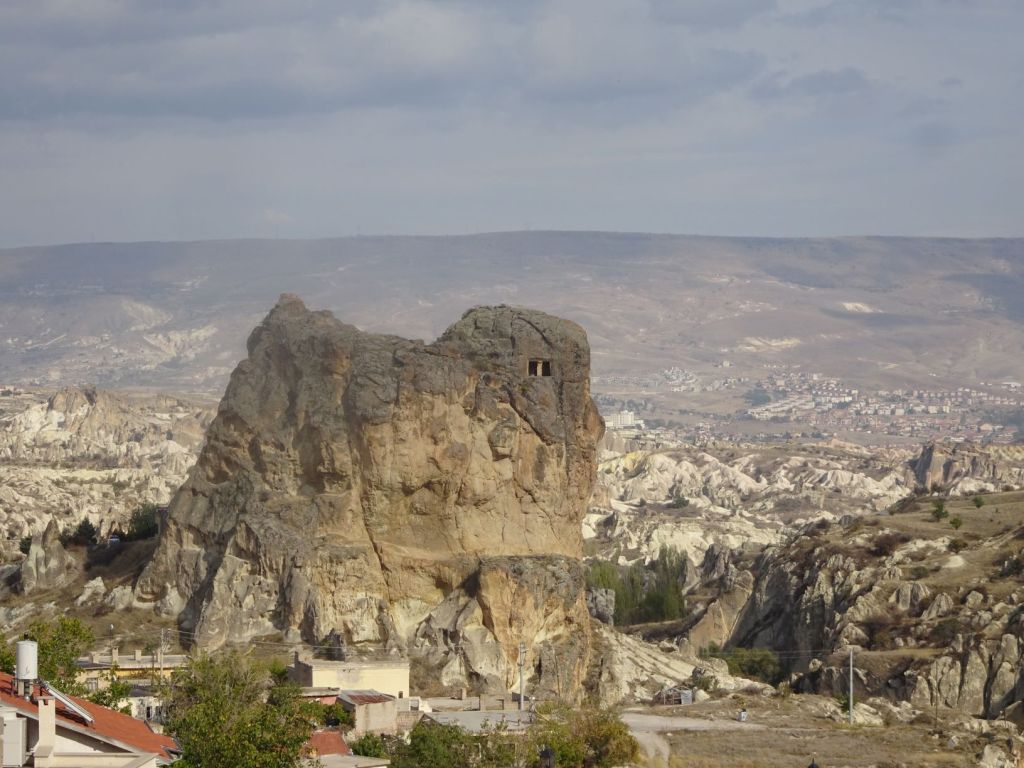
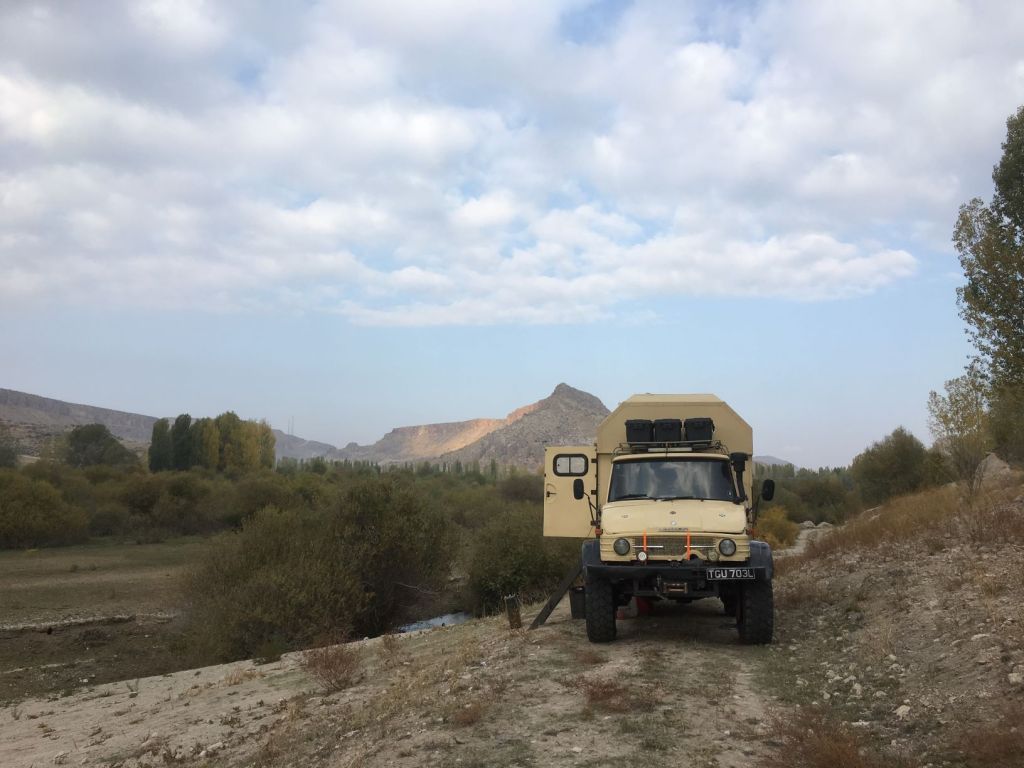
At some point in the early evening, we veer off the road and find a quiet camping spot near the village of Soganli. Miep makes a nice salad and dip for bread.
October 29
What a wonderful night; totally quiet. All we hear are the birds singing. We have missed our private wild camping so much during the TME journey.
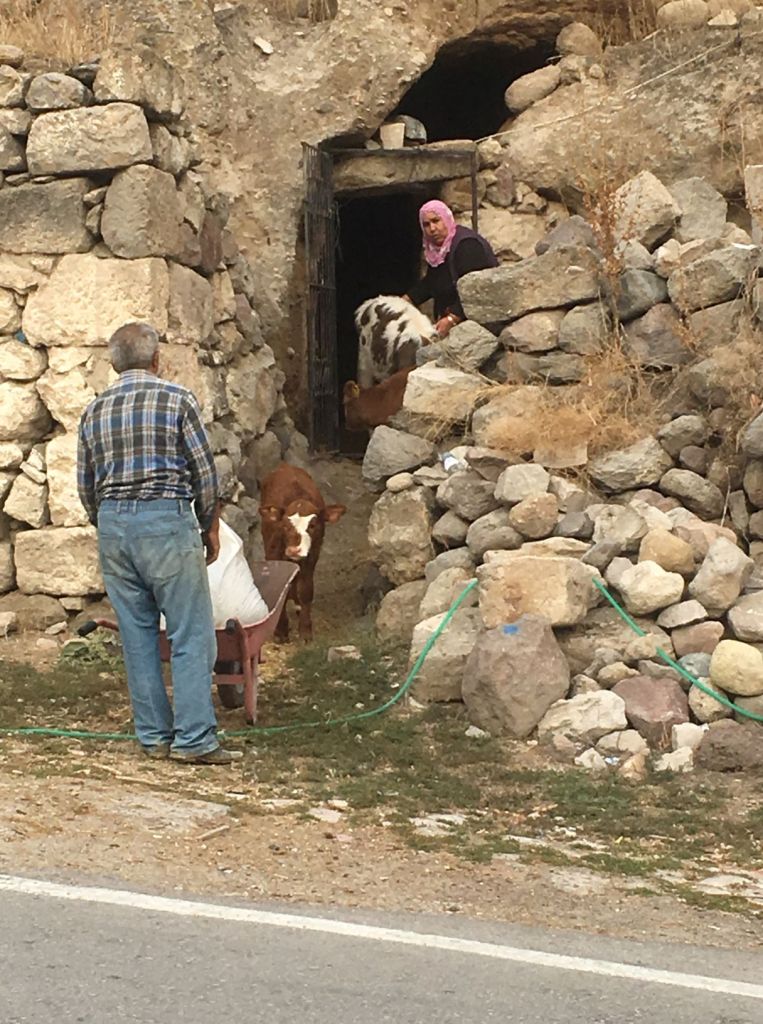
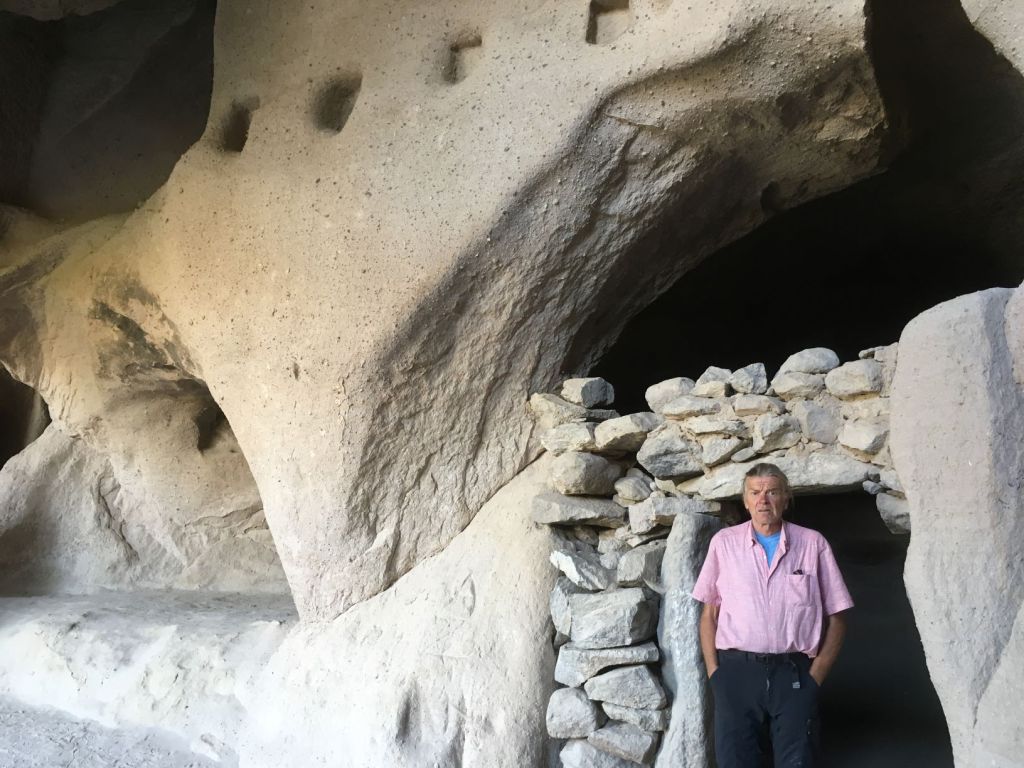
Just outside our camping spot we find a large cave with a stone balancing on top. The cave is used for storage by a farmer.
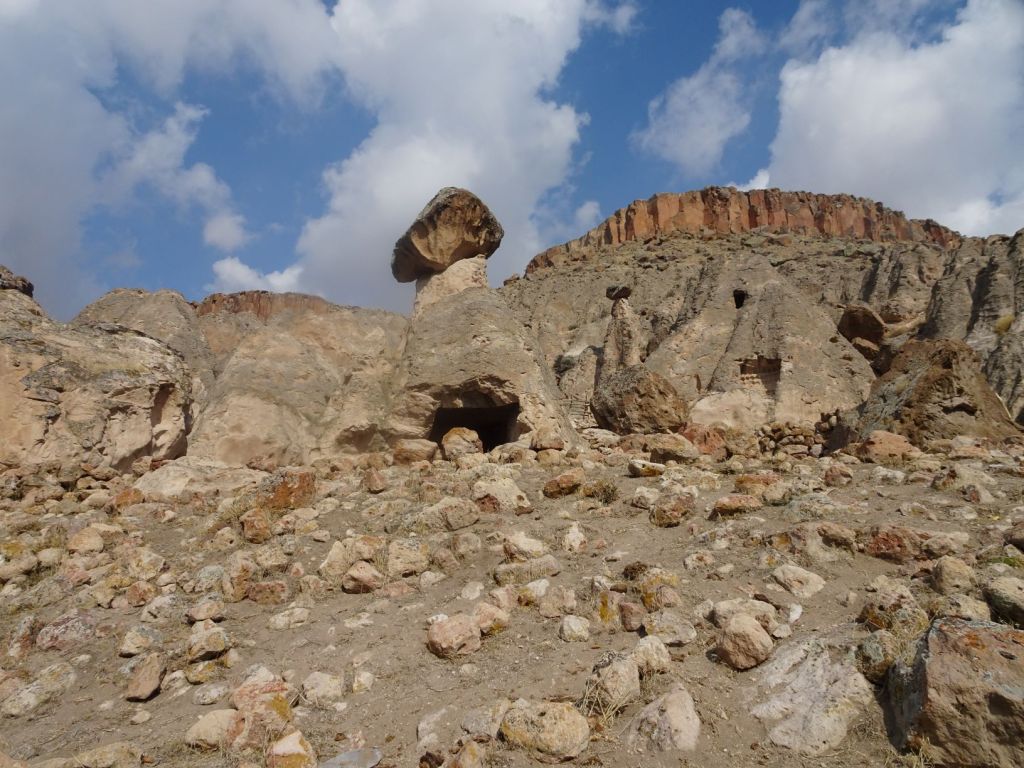
There is widespread use of the caves as storage space, or sometimes stables.
We visit one of the underground cities in the region. There are some 150 – 200 underground cities spread out over Cappadocia. They vary from what could better be named a village to true cities that could accommodate 30.000 people. These cities provided shelter from Persian and Arab raids during Roman and Byzantine times in the first millennium AD.
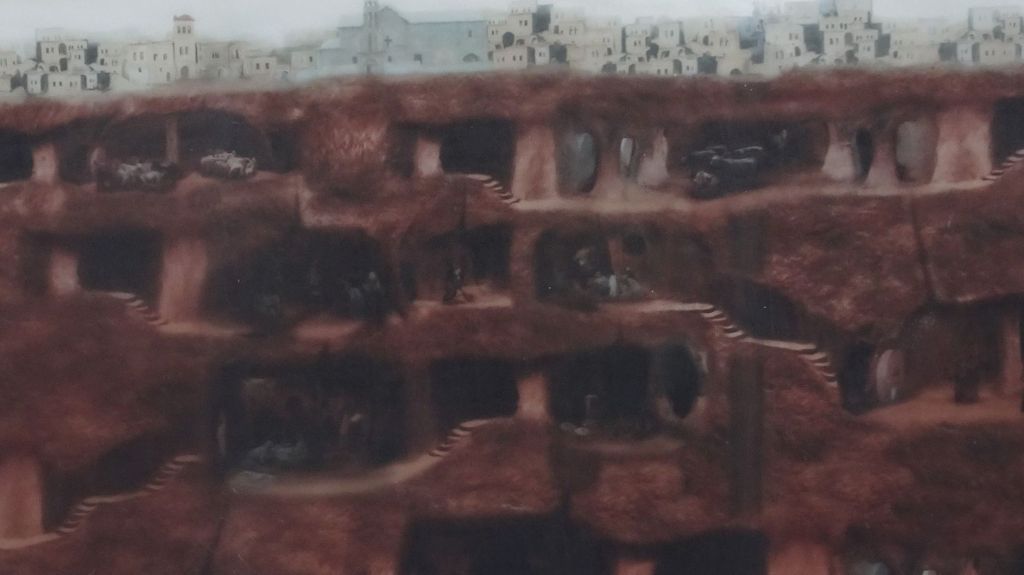
We visit one and wonder about how it would have been to live in these dark places with cattle and all during troublesome times.
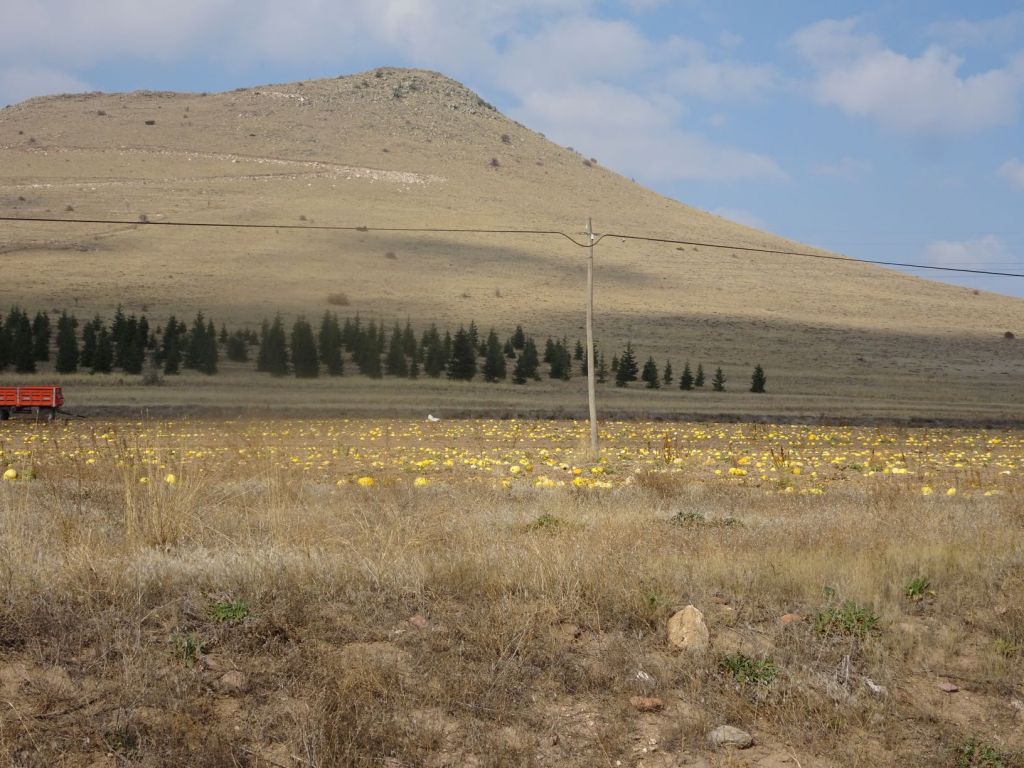
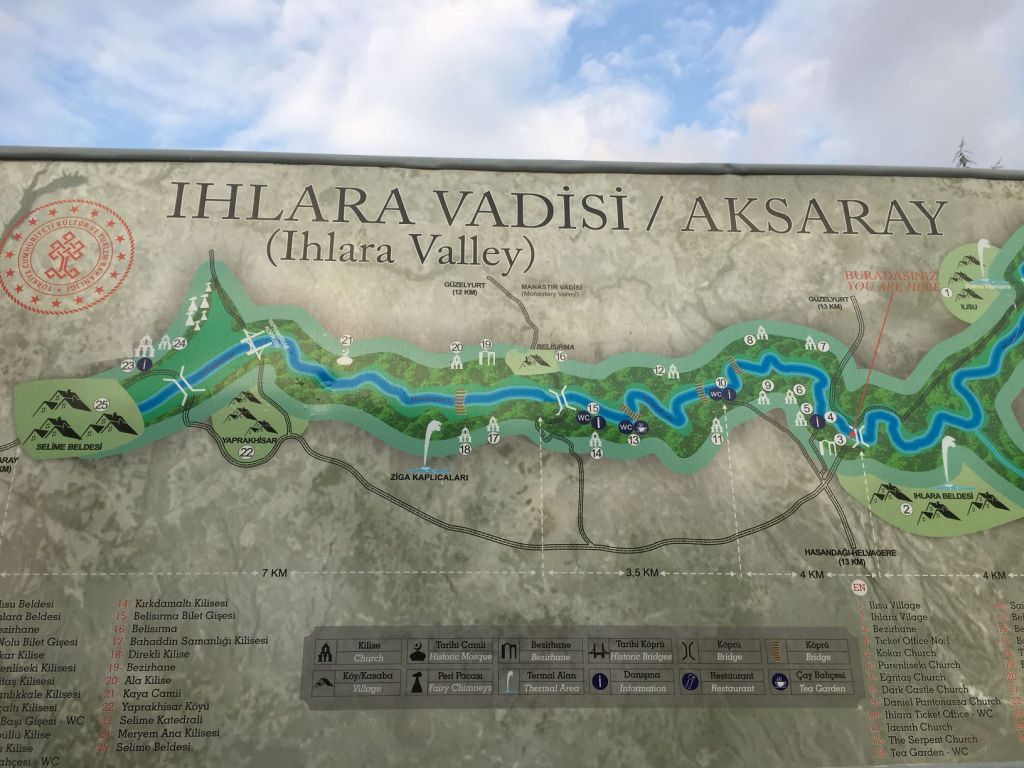
We travel over a plateau to the famous Ihlara Valley. There is still some farming activity with potato harvest and the harvest of melons.
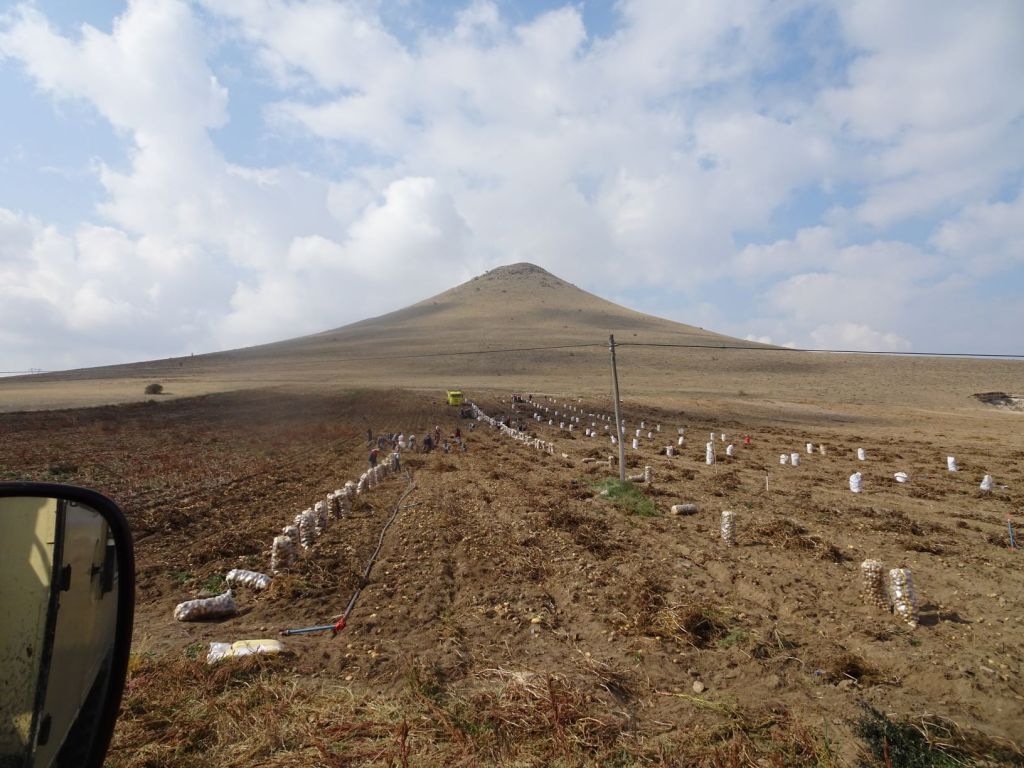
It continues to amaze us how these seemingly arid soils can produce so many goodies. Probably a lot of moisture comes down during winter and early spring, but we also see the endless irrigation pipes. They are now collected and stored for winter. Every village has a huge mountain of these black pipes.
We reach Ihlara Village late afternoon. It is dead quiet apart from some elderly men playing dominos. A short walk to sample the valley and then we move on to find a camping spot.
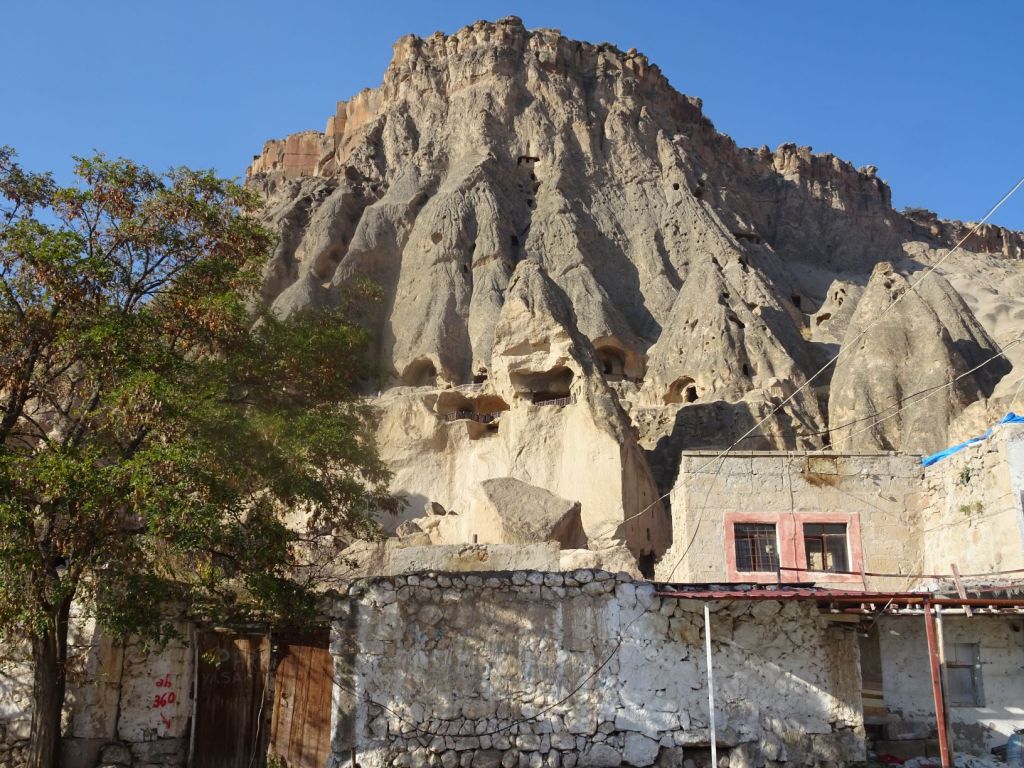
We find a really nice spot on a cliff edge overseeing the village of Belhisma.
October 30
Another quiet night we wake up to the noises of the village down below; cow bells and a cockerel. We are going to do a walk today. Hopefully 10k plus. The valley is famous for its flora and rock cut out churches.
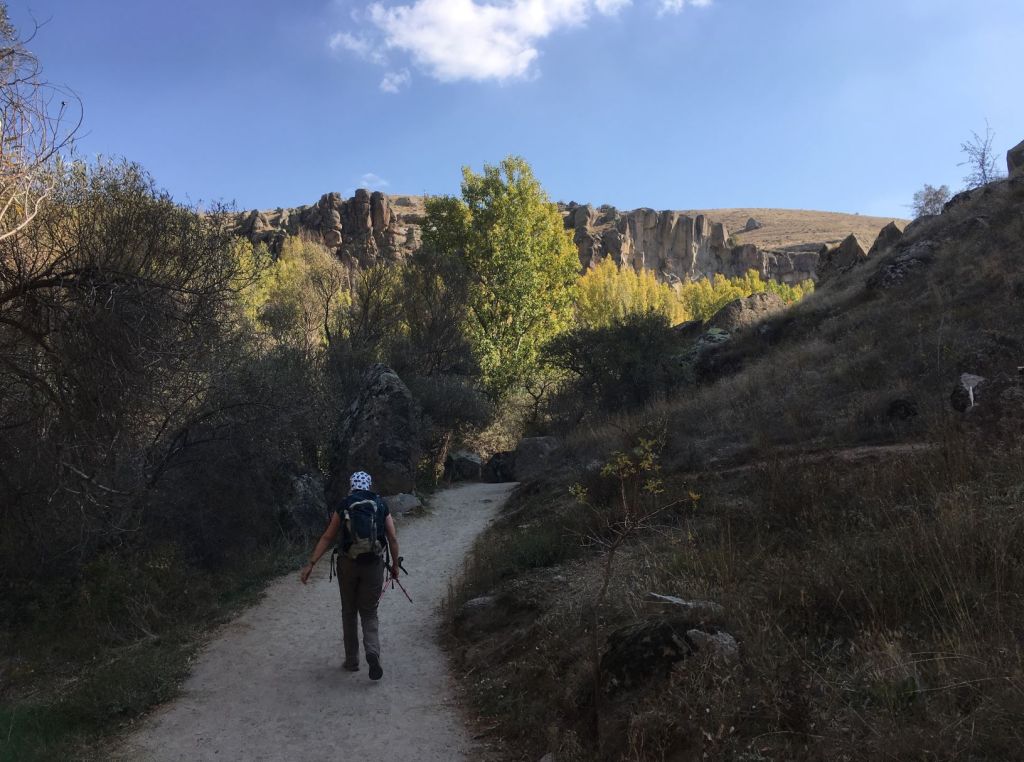
Autumn colours below, blue sky above.
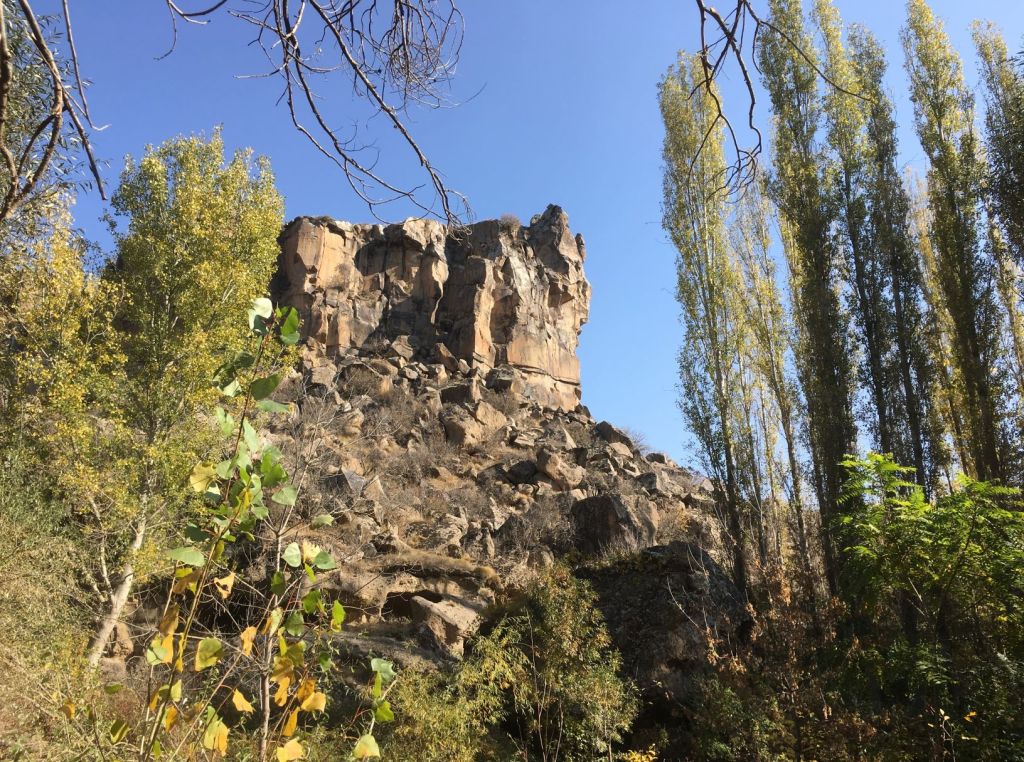
The churches are everywhere.
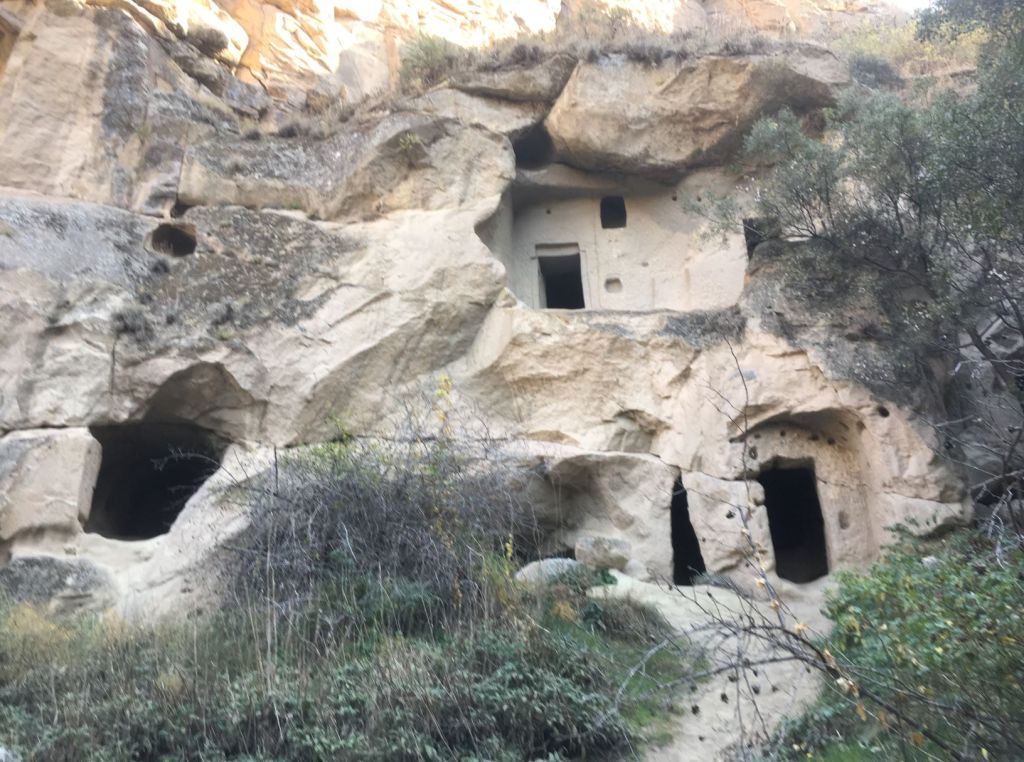
Some of the entrances are quite grand.
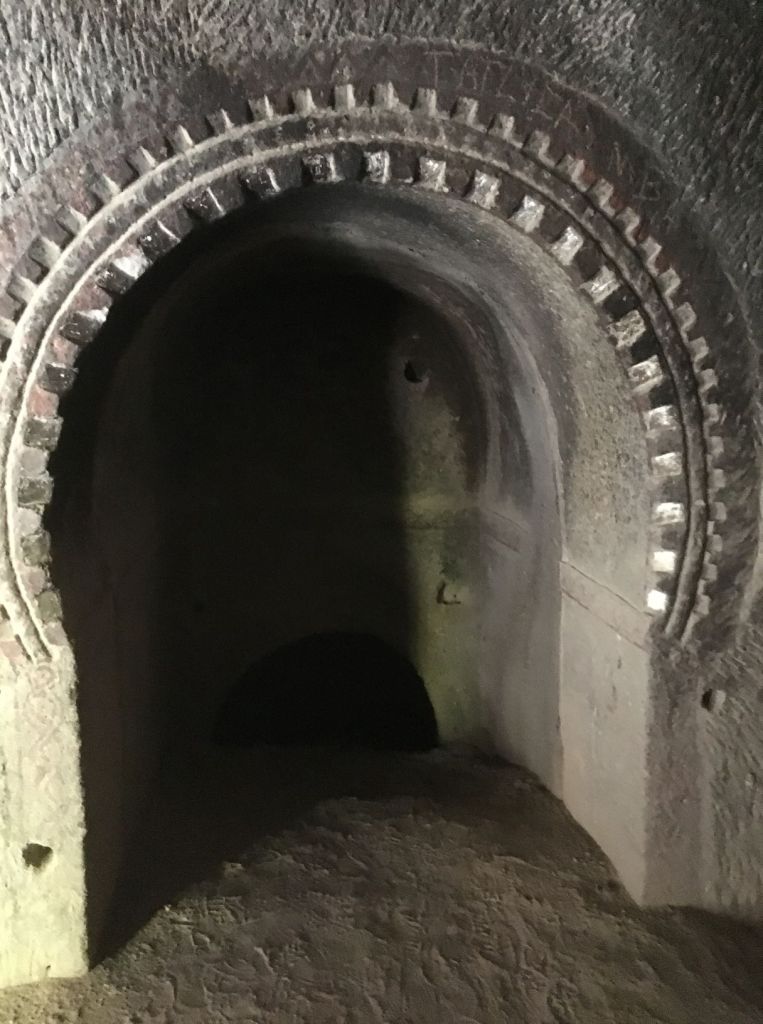
Others less so…
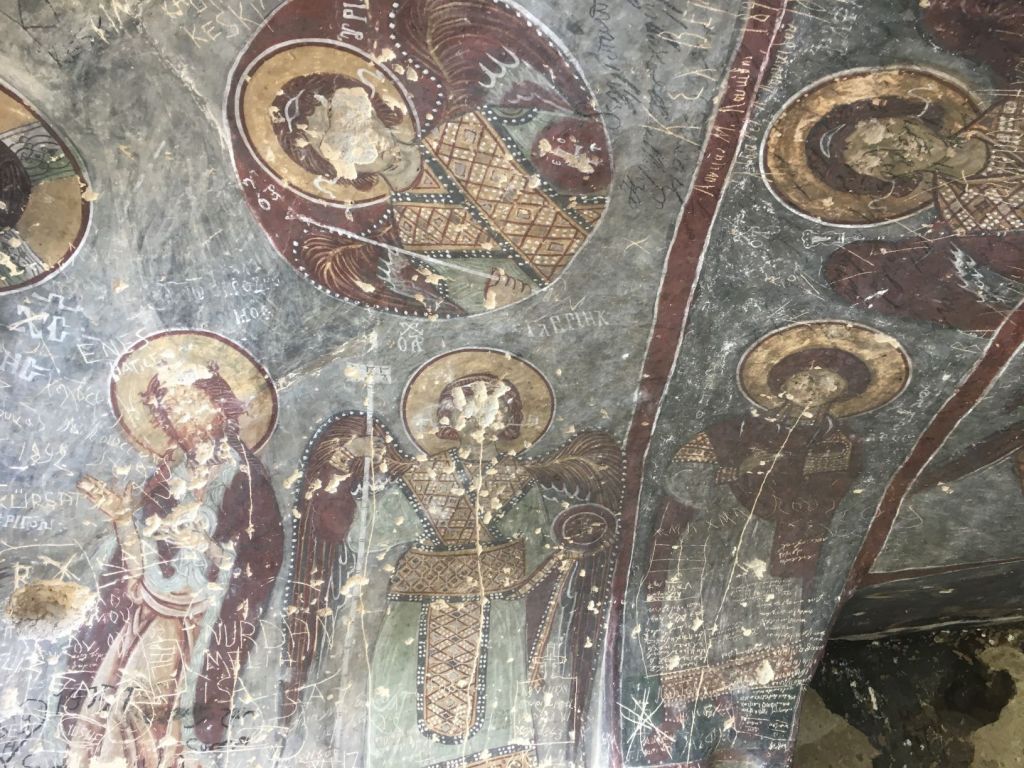
The frescos are awesome; to imagine that they have been around for more than a thousand years…
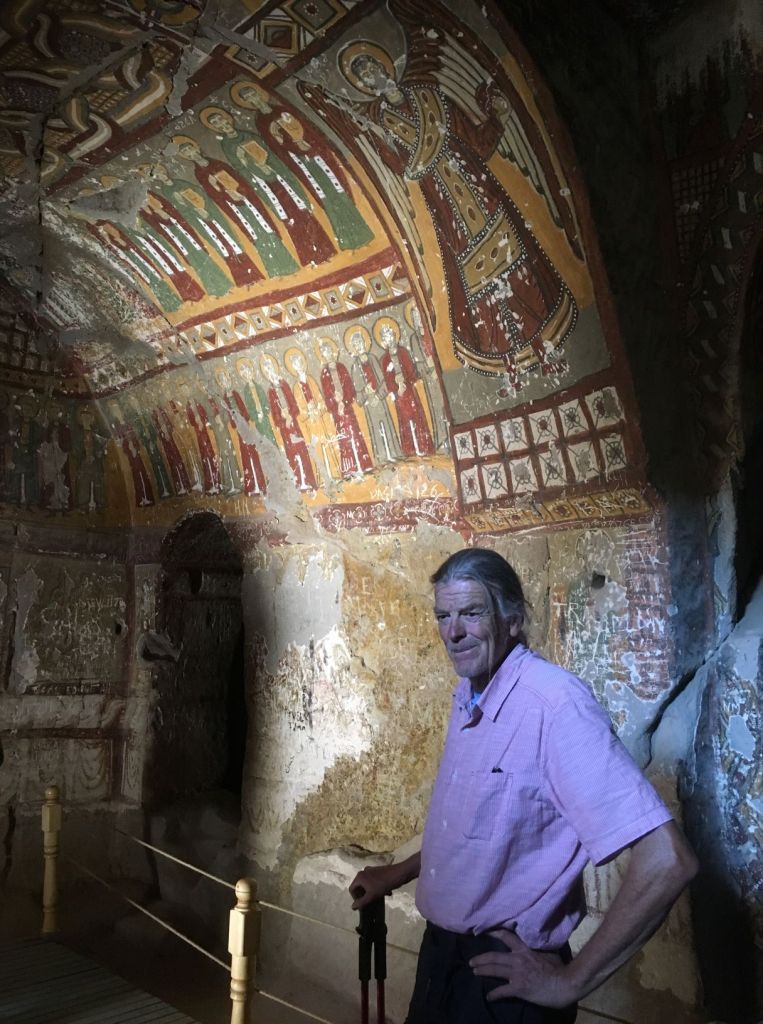
But it is rather disturbing to see extensive defacing, probably by overzealous Islamists.
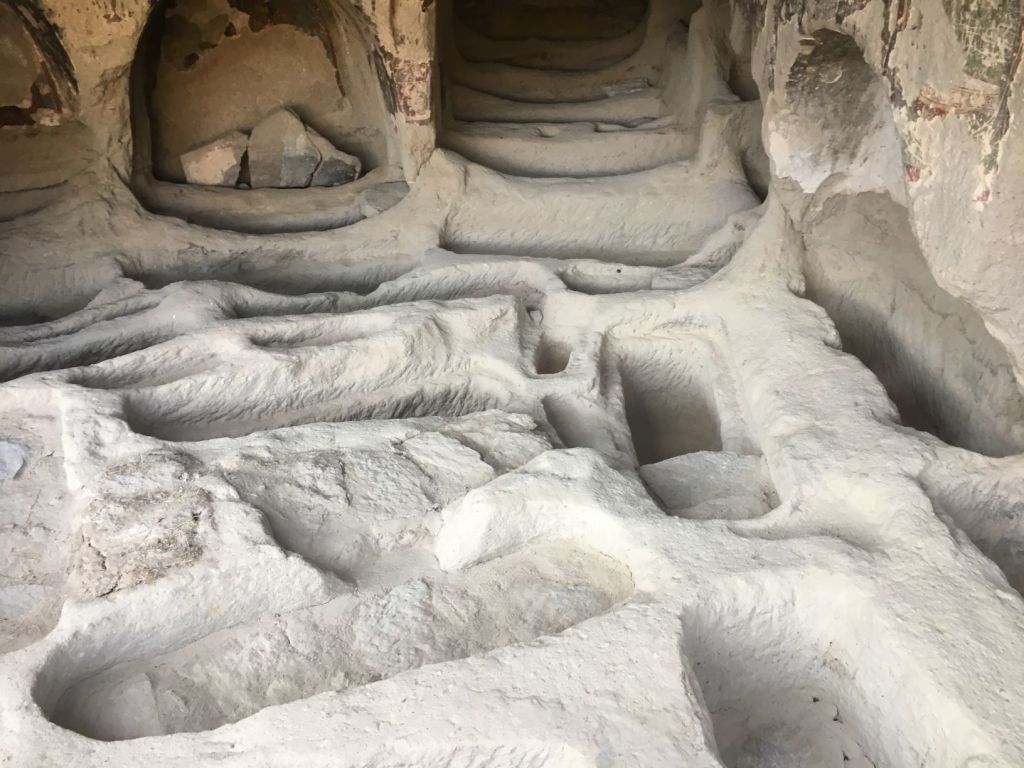
Some of the churches have a graveyard inside
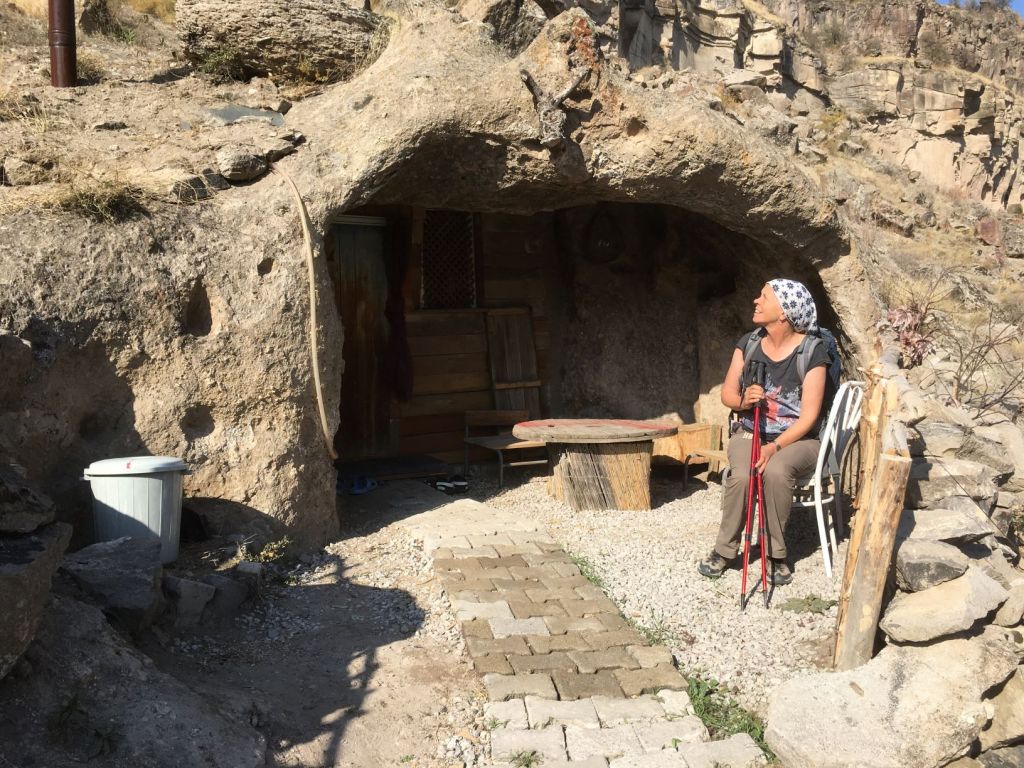
There is also the occasional dwelling place still in use.
We are quite hungry after the walk and are lured in to a restaurant at one of the entrances. Something Roelf absolutely does not like: “Come in to my place to eat”. But we did it anyway.
After the meal we drive a bit further in the direction of Konya. We camp at a caravanserai; very fitting!
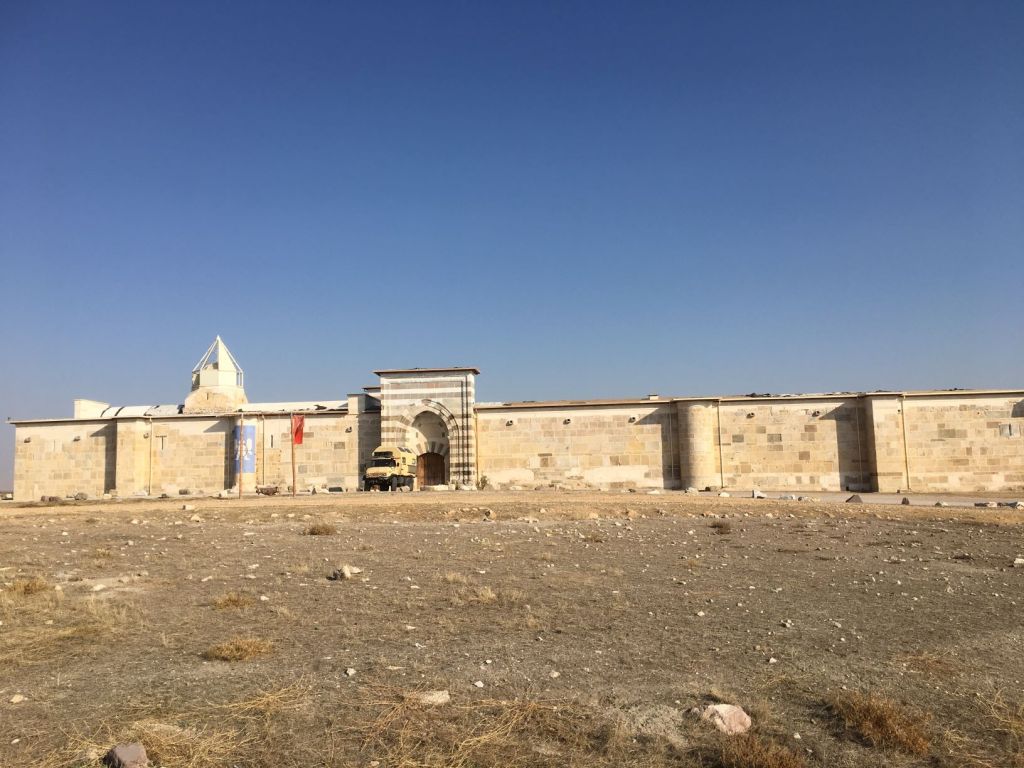
October 31
We hear a strange noise in the car. Are there birds in the cabin? Yes, several have got in along the engine block because we left the cover off overnight to help get some heat into our sleeping quarters. They are delighted to be let out and no damage done to bird or car.
We drive the short distance to Konya. it is a lovely day and we park a km or so away from the centre of town to walk in. Interesting to see who live here. There are many women here wearing black and some have everything covered except their eyes. We have not seen this strict Islamic dress code for some time.
In the central square in town we see what people come here for: the mosque but especially the mausoleum and the place of learning for the Sufis.
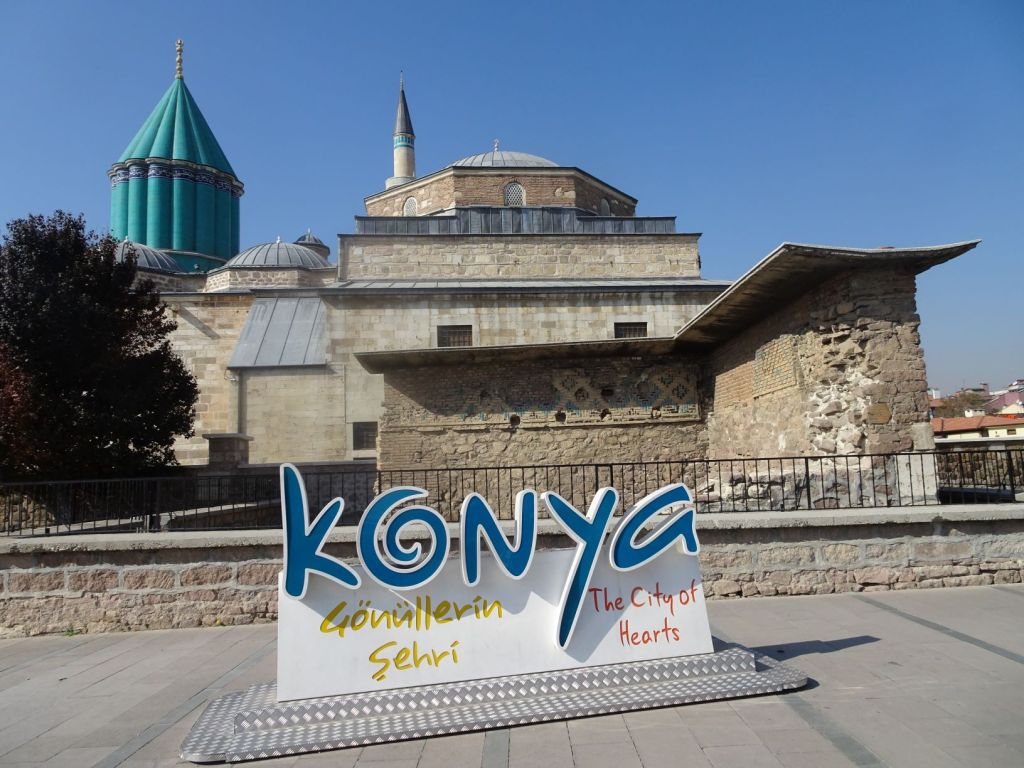
Sufism became a branch of Islam not long after Muhammed’s death. Some believers felt that the muslim teachings were too worldly and did not keep to the strict principles of Islam. Most Sufis are Sunnis. They were called the ascetics initially, but were named Sufis later after their dress. ‘Suf’ means wool and Sufi’s are those who dress themselves in wool. Sufism has had a number of prominent thinkers, and one of the greatest was Jalal ad-Din Muhammad Balkhi Rumi, popularly known as ‘Rumi’. He was a Persian poet who was born in Balkhi, Khorasan (present day Afghanistan) but spent his working life in Konya where he died in 1273. He was given the title ‘Mevlana’; Mevla means God (Allah), and Mevlana is ‘he who thinks about God all the time’. The title is given only to someone very highly regarded in terms of religious influence. Rumi is hugely influential, even today, in Central and Eastern Asia, but also in the United States where he was declared best selling poet at some point in the recent past.
Many quotes are attributed to Rumi; the one we like is: “Sell your cleverness and buy bewilderment”
We first visit the museum housed in what used to be the ‘cells’ for apprentice Sufis.
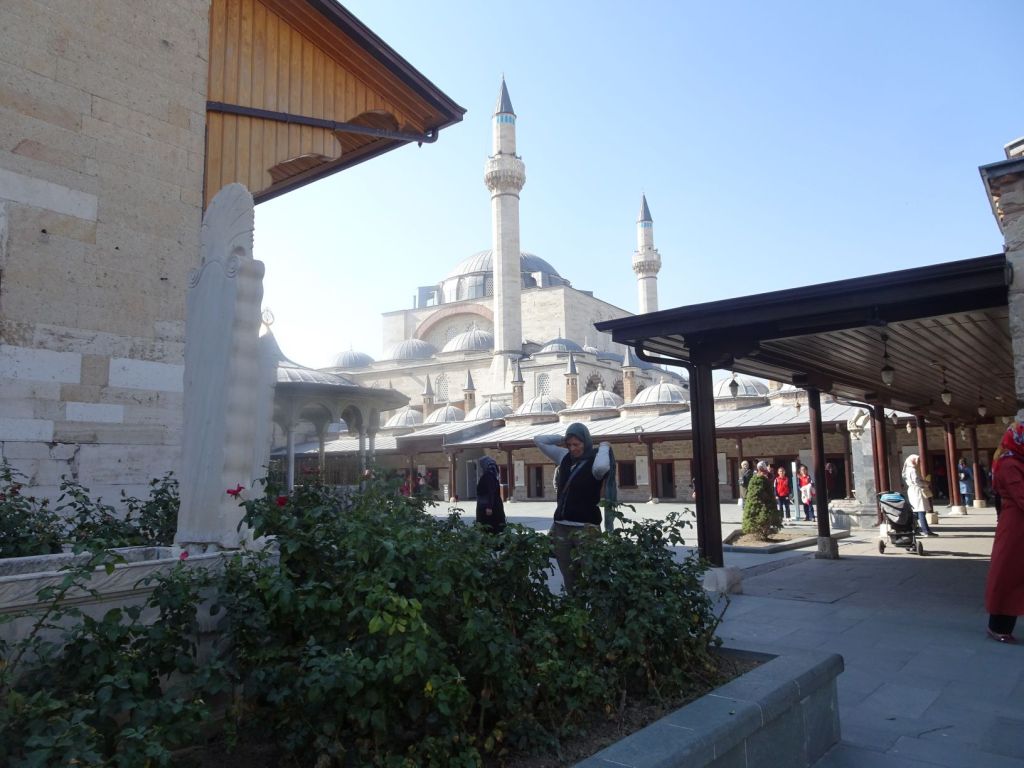
Here they would be trained in the skills of meditation, the dancing that is so special with the Mevlana Sufis, and in the music and singing that accompanies their dance. We see the clothes they would wear, distinguishing those who have just entered the madrassa and those who have qualified to wear the dervish tall hat.
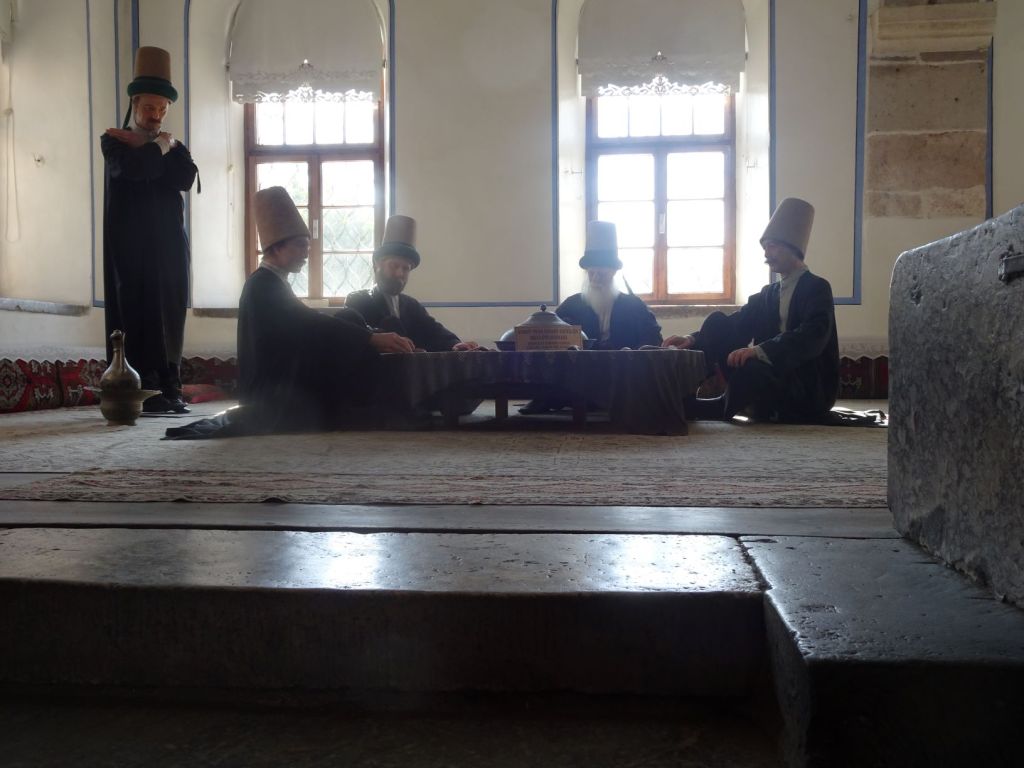
We see the books they would read and study, the calligraphy, the musical instruments. These cells are around a courtyard with beautiful fountains and places to wash hands and feet as part of the prayers, five times a day.
Then we enter the mausolem. It is huge and it takes your breadth away.
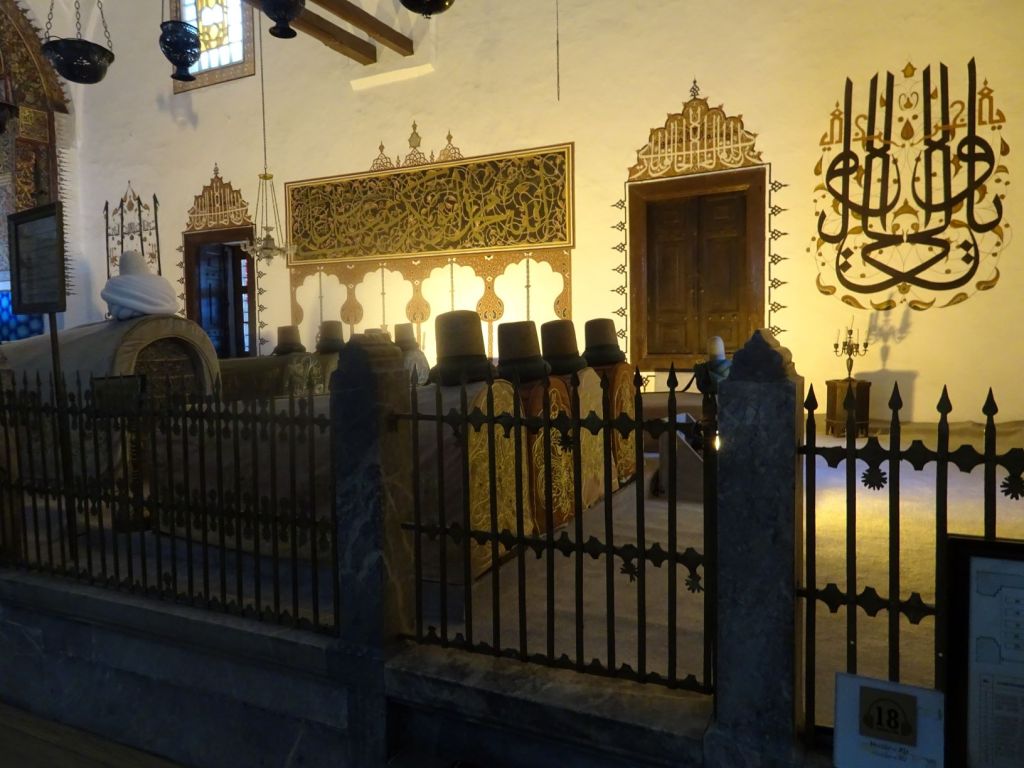
We had not expected the tombs of so many important Sufis. And for these to be so prominently displayed. Most prominent amongst them all is the tomb of Rumi.
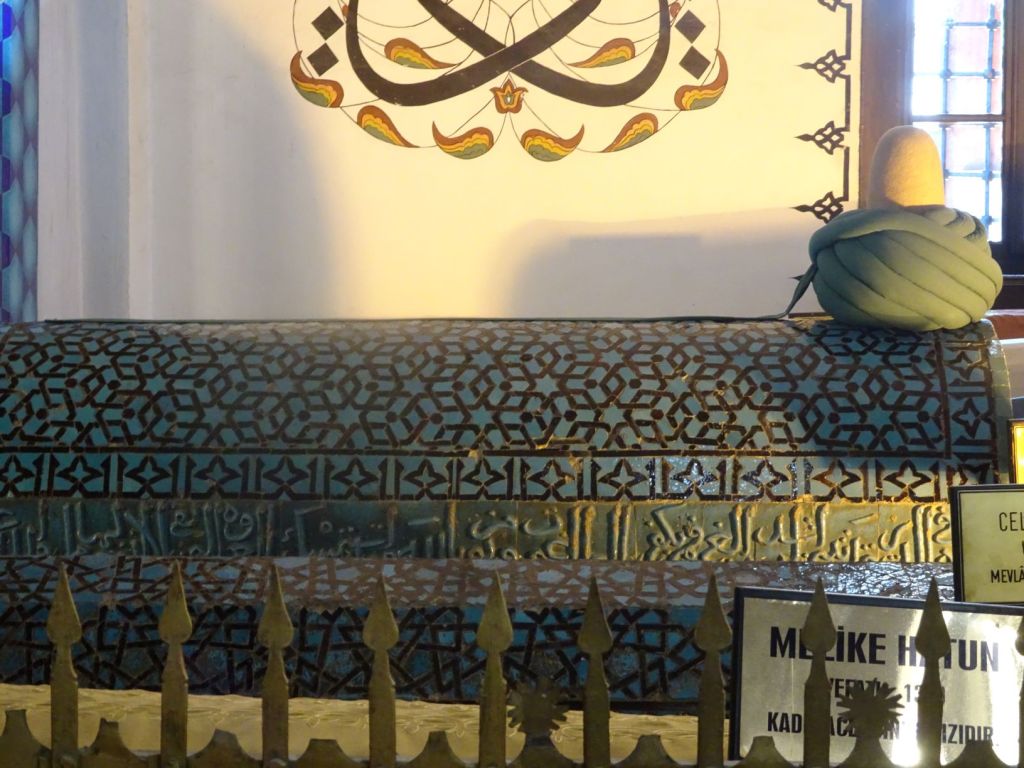
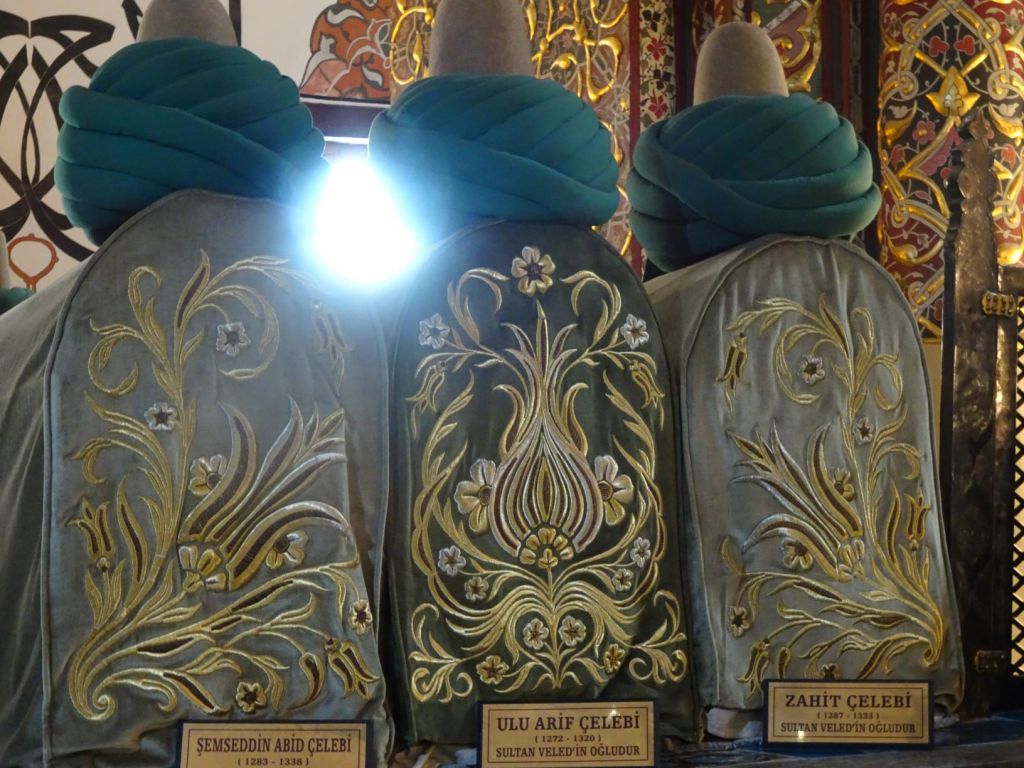
The tombs are covered in embroidered cloth and on top is the typical headdress of the person, commensurate with his rank. The one of Rumi is the highest of all. We later learn that the hats represent the male generative organ, hence only tombs of men have these headdresses on top, women don’t have them nor young boys.
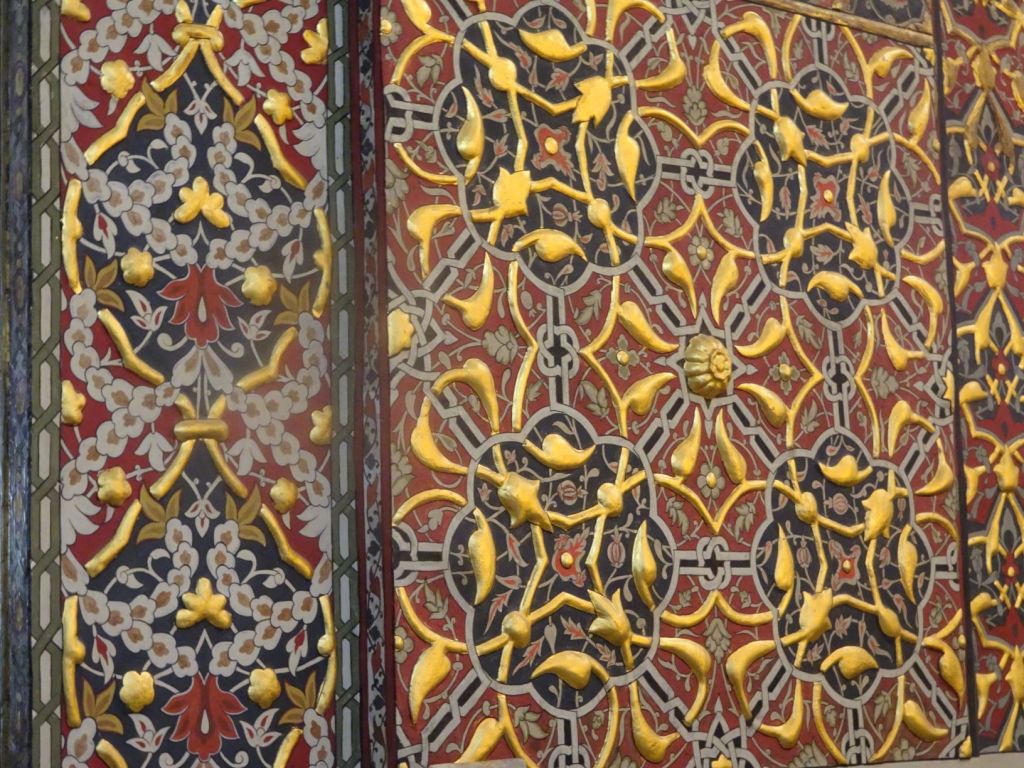
The building is decorated with scripts ad also beautiful gold and coloured patterns on columns and the domes.
There are incence burners and glass containers for candles (lighting candles was another important role you could have in this sect). It is quite busy, many Turkish families have come to visit this site of pilgrimage.
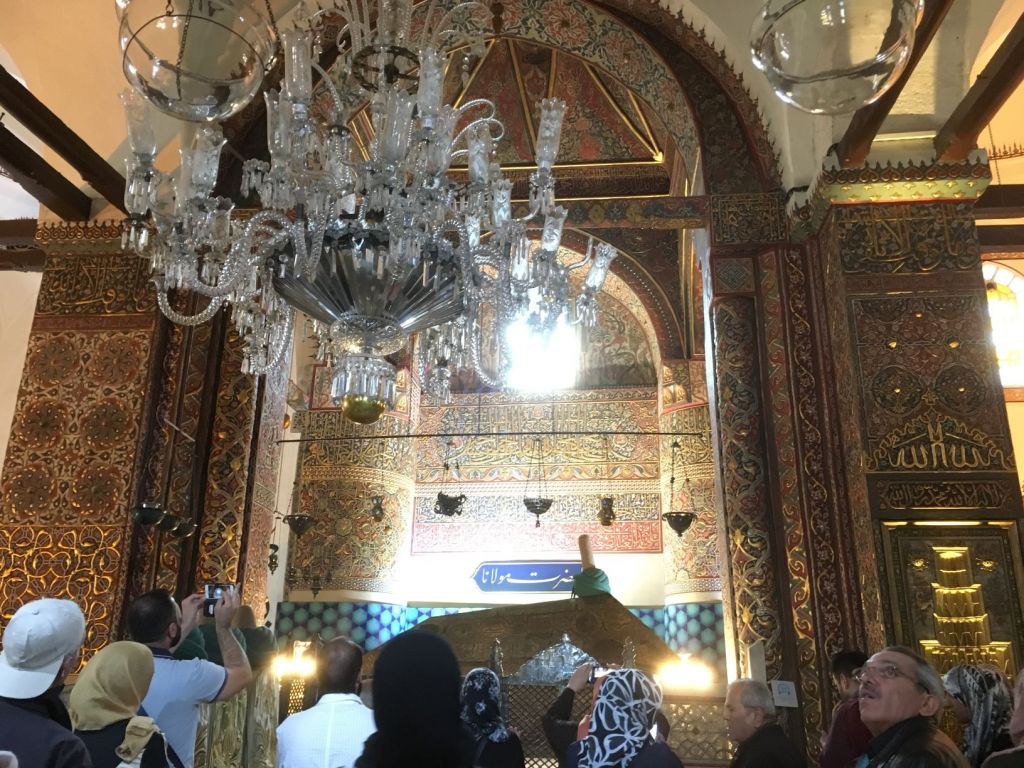
Not only is this a shrine for Sufi muslims, it also houses inside a gilded box hairs from Mohammed himself making this a site of pilgrimage for all muslims.
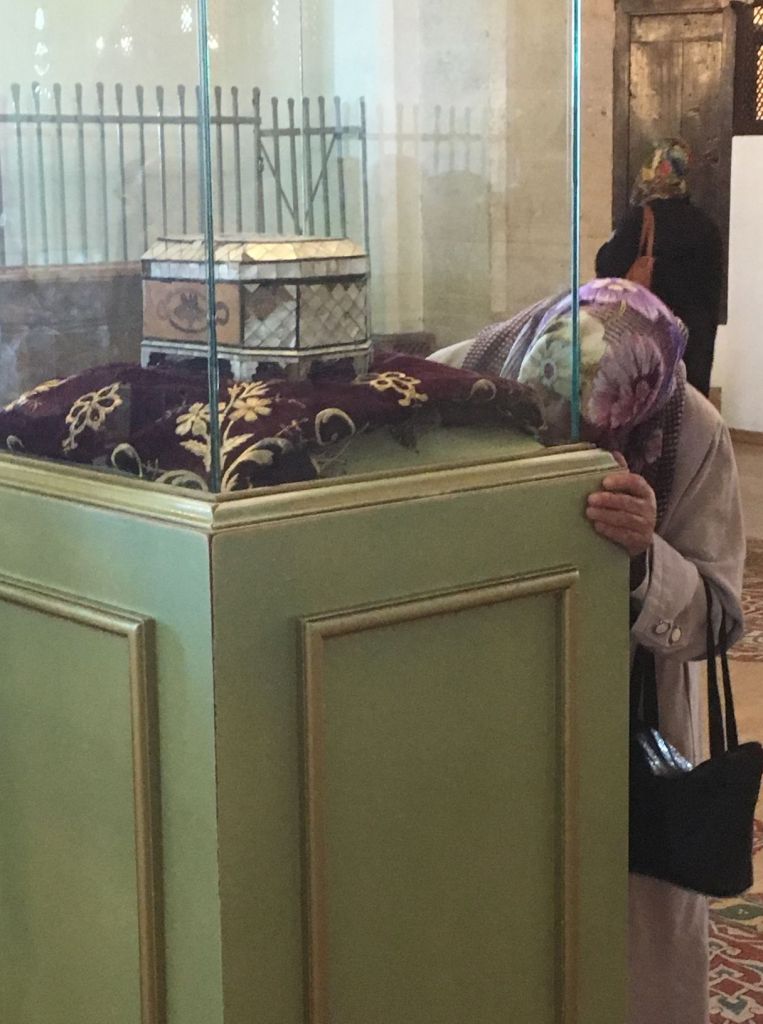
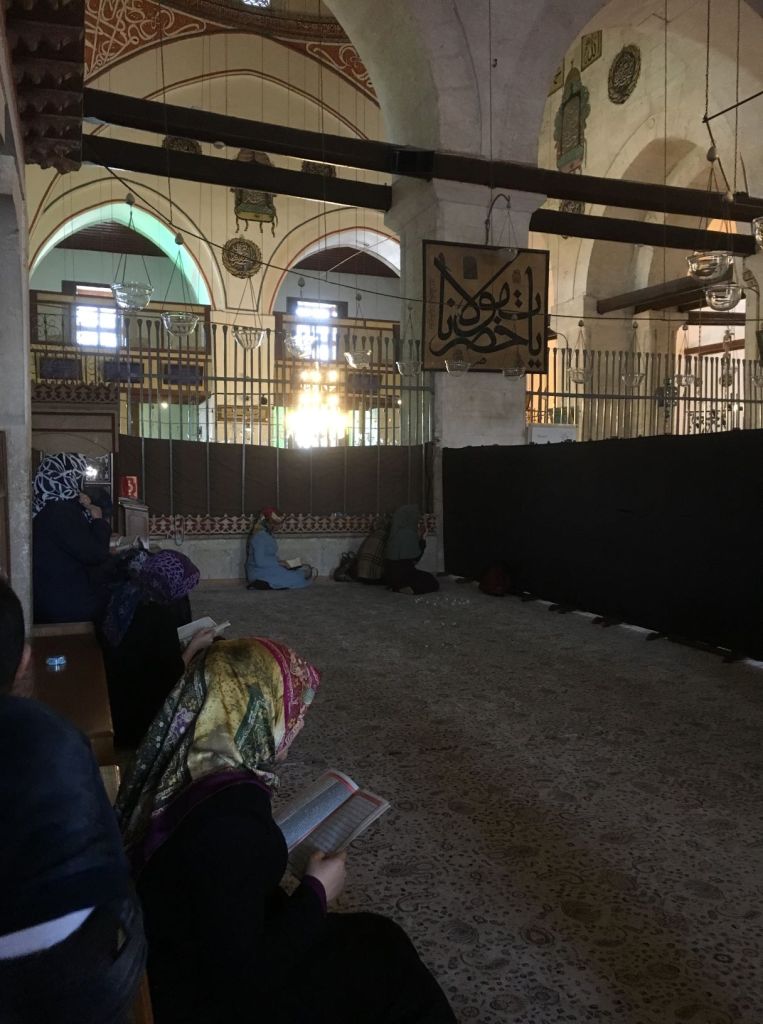
Those who visit pray in front of the tombs or circle the cabinet that houses the gilded box. They are often very emotional. On exit we come pass another place of worship, here the women are separated from the men. Many younger women sit and read saying the words aloud. Religion is clearly very important in this era as well.
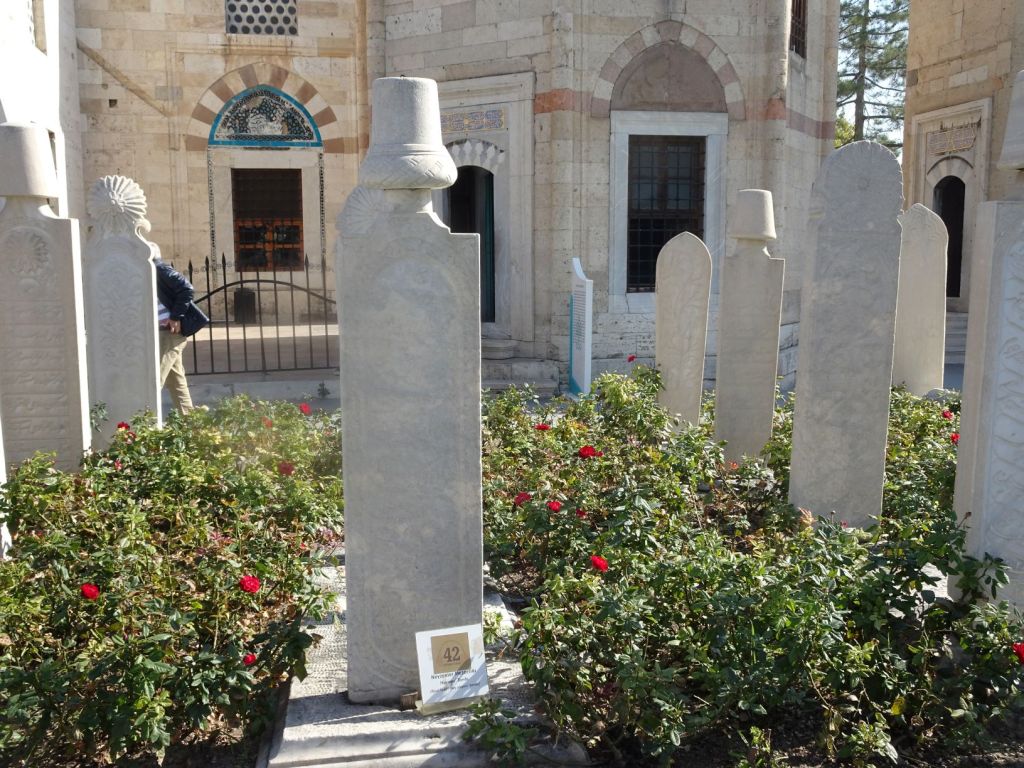
Outside in the courtyard there are the graves of prominent Ney players.
Konya is a world away from the blatant commercialism we have seen in Cappadocia. We find it all very moving and the place quite wonderful.
Then it is time to eat. The square is adjacent to the bazar and there are bakeries, shops that sell Turkish sweets, leather goods, textiles and so on.
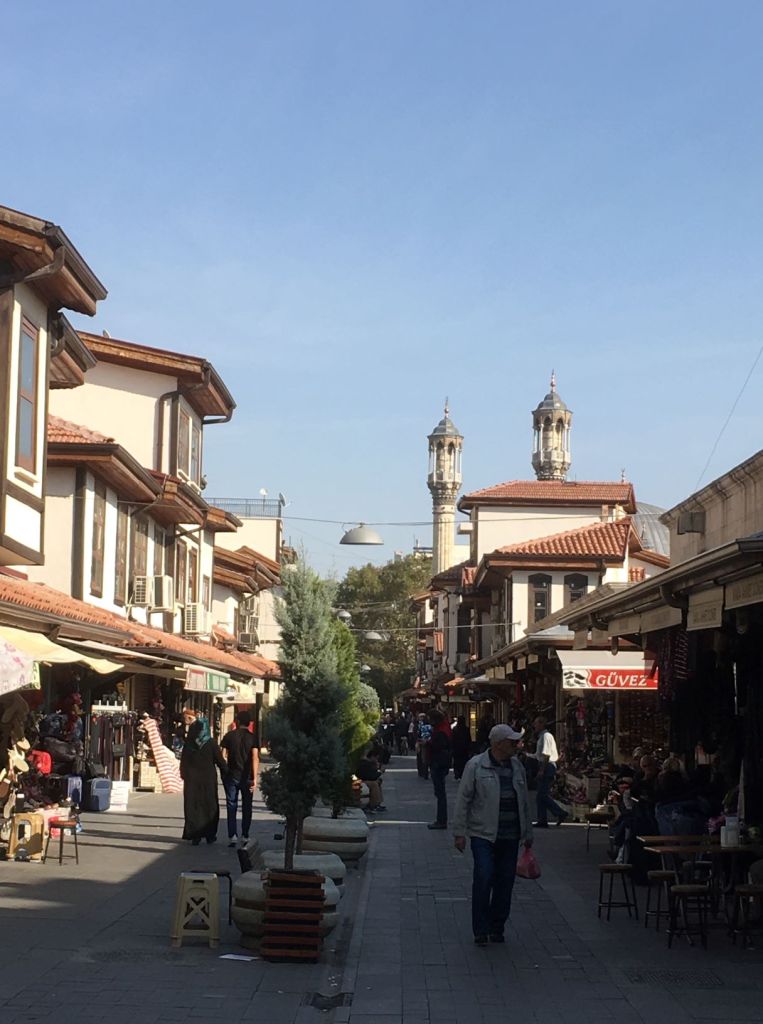
We eat bread with cheese, quite salty, and go to find a bankomat and see some more sights. It is time for prayers again; the men (and some women) hurry to the mosque 5 times per day!.
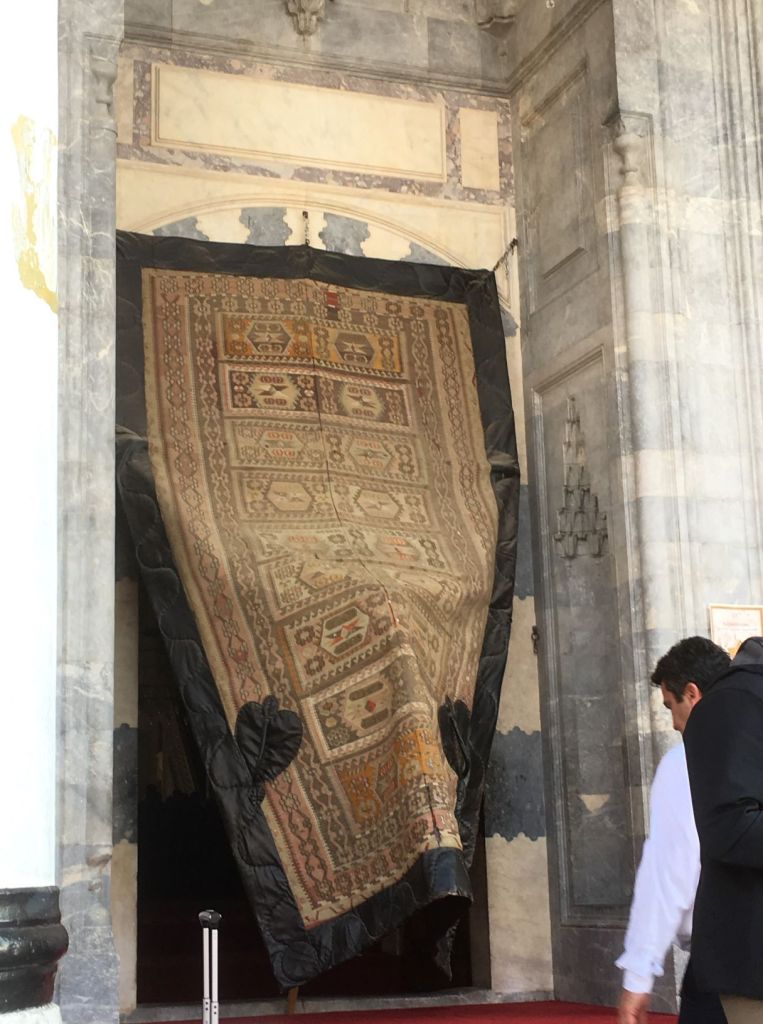
We keep walking along the bazaar and then a rose-covered hill that offers some panoramic views and where tens of men and women are working as gardeners. We buy Roelf a leather cap and a new wallet, some of those typical tea glasses they use here and things to eat including honey.
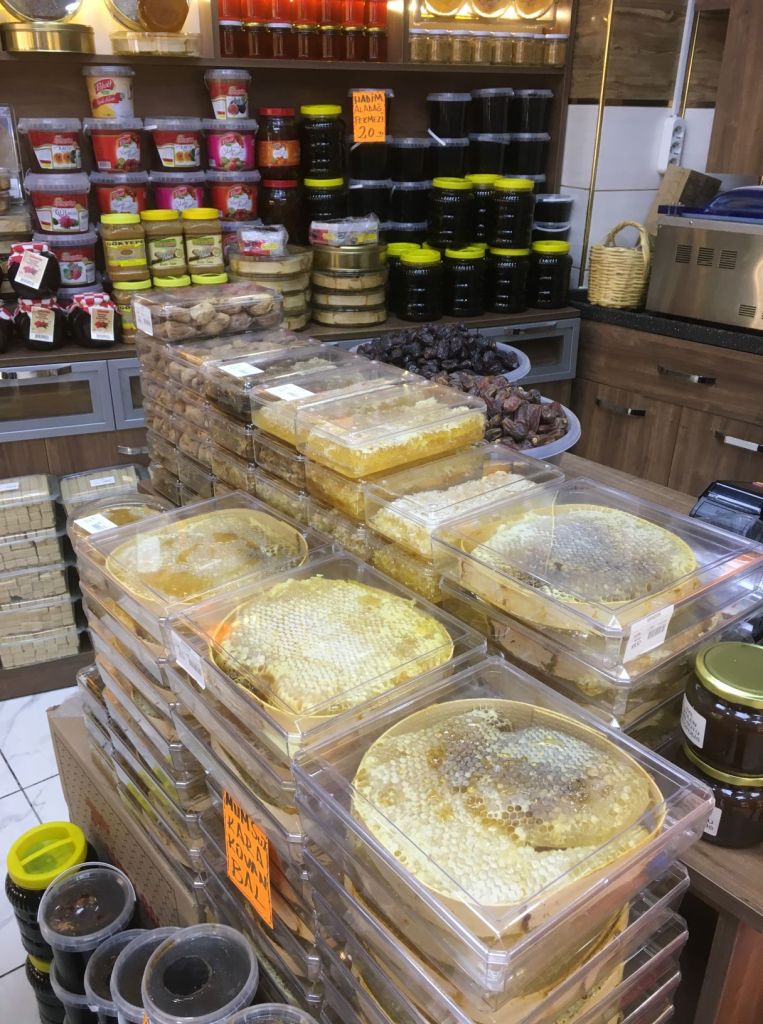
We visit a shop full of goods that Roelf likes: honey, cheese, dates, sausages, and more. We taste many types of honey and end up buying chestnut honey a chunk of cheese, and a large sausage.
When we get back to the car, a young family gives us a melon and a bread. The mother gives us the warmest, and the young girl the happiest, smile you have ever seen. You can easily imagine you are a bit of an imposition, with a big car and clearly not part of their religion and culture, but then suddenly someone comes forward and welcomes you so sincerely. It feels good, but also embarrassing: all these welcomes when we visit them, but in the UK we are too afraid to welcome foreigners into our own country.
This has been a good day. Konya has a great atmosphere and it was a very honest place. No harassment, just people going about their normal business and allowing us to be amongst them as their guest.
November 1
Yesterday we drove out of Konya and found a place to camp on the shore of Lake Aksehir. The lake is quite significant in size but only 7m deep at it’s deepest point. It is fed by a number of streams but also underground springs.
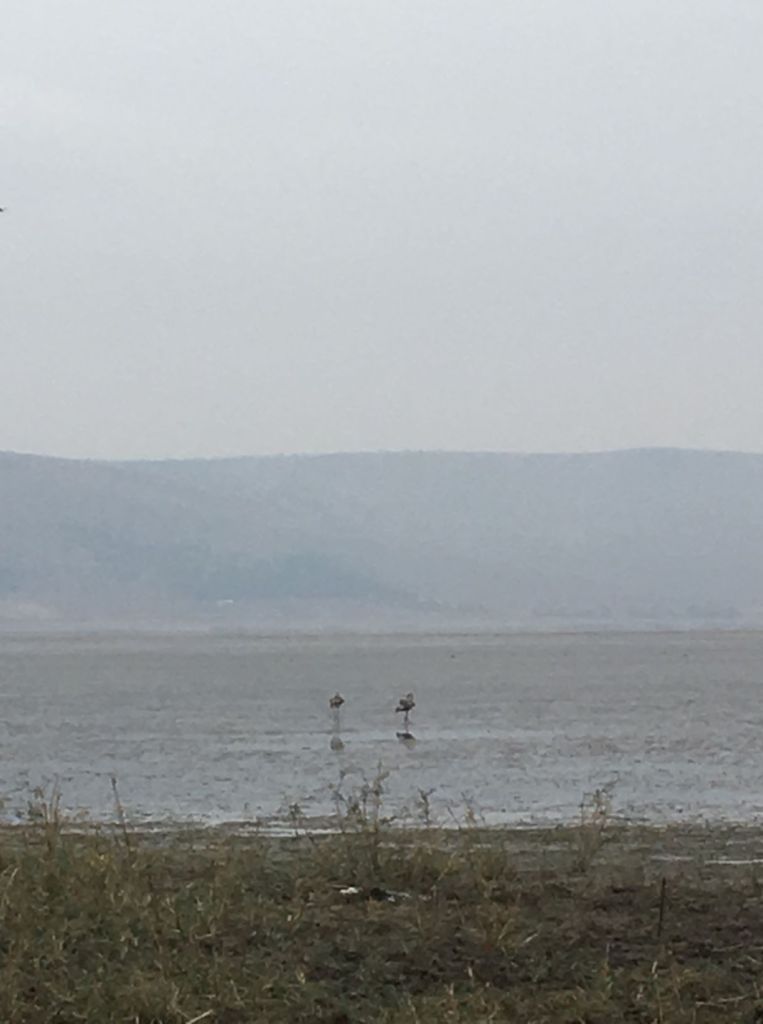
The lake is full of birds. We think we see Egrets more towards the middle, and close to us there some flamingos wading for food.
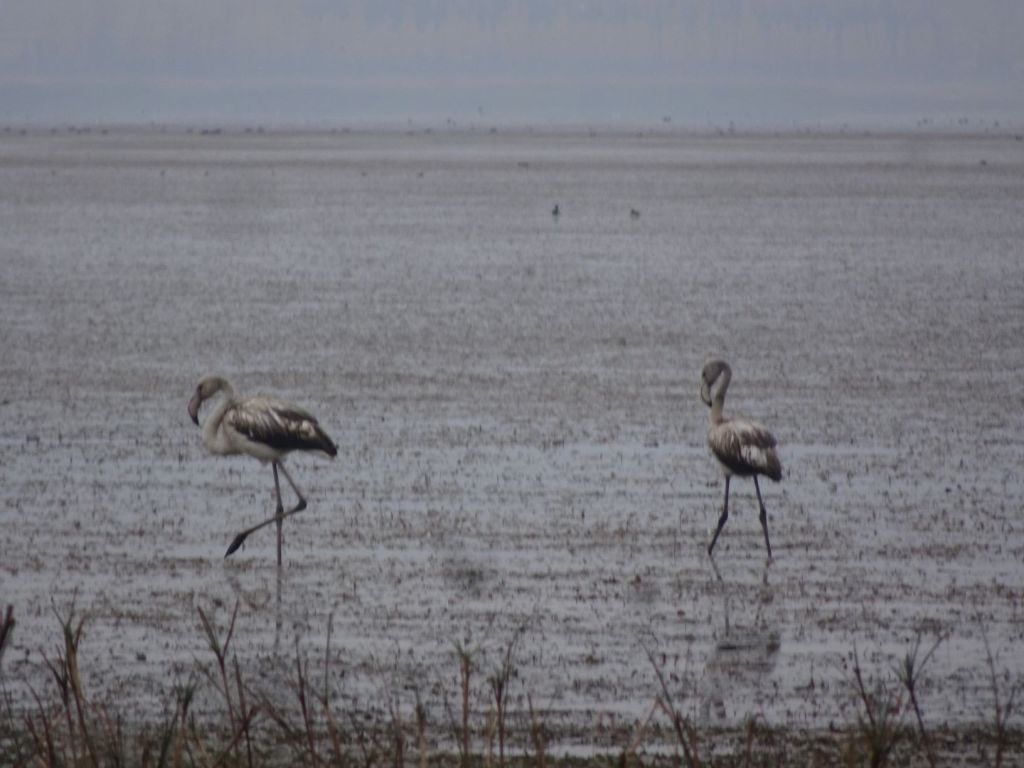
Flamingos
Today we will try to get as close to Bursa as we can, a relatively long drive of 200+ km. There is not much to see. This is the first rainy day we have in 2 months!. The town signs tell you their altitude and the number of inhabitants. We are surprised that the total population of Turkey is ‘only’ 80 million as we see so many cities with a population of >250 thousand and Istanbul alone has 17 million.
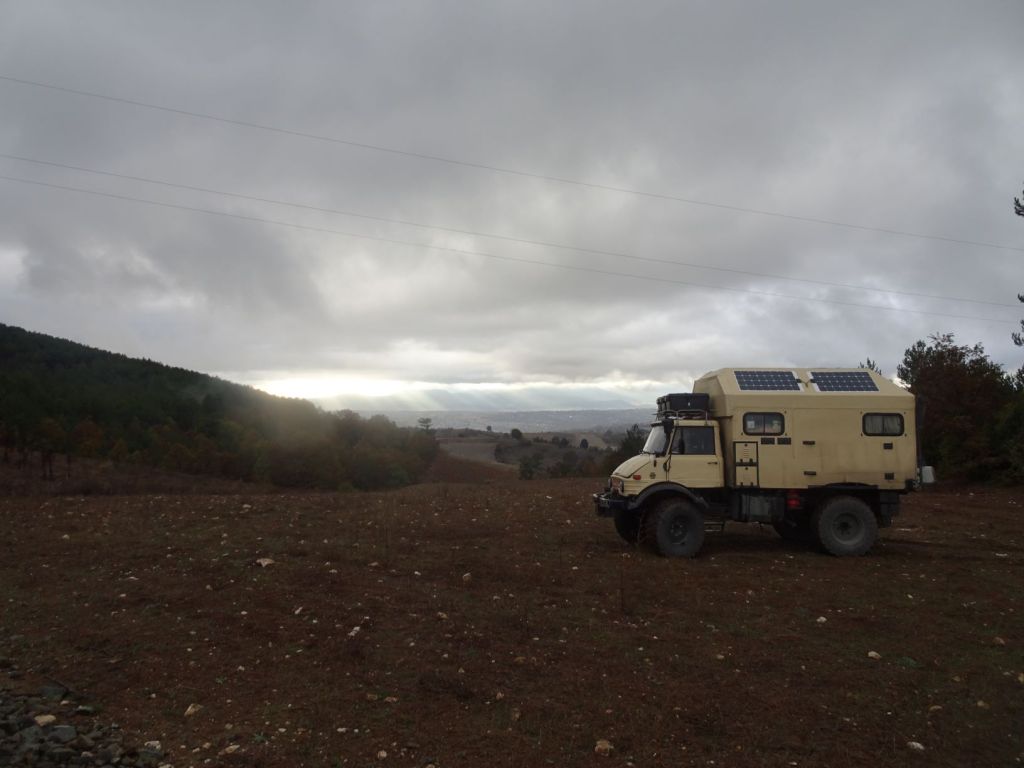
Closer to Bursa the terrain becomes hilly and the weather clears up a bit. We go off the road at around 5 pm at a spot with nice views towards the west and the east to camp. We are welcomed by two hunters and their dog. They carry not only shotguns but also a pistol!. All demonstrated to us with great pride. We do not feel uneasy about this at all, as they are incredibly friendly.
The spot is very muddy and we leave our shoes on the steps of the Mog. We have a good meal and look forward to tomorrow as the forecast says the sun will return.
November 2
When waking up yesterday morning, we had two flamingos outside the Mog; today we have two diggers!. They are digging trenches right where we are. Well, it is a change from barking dogs we suppose.
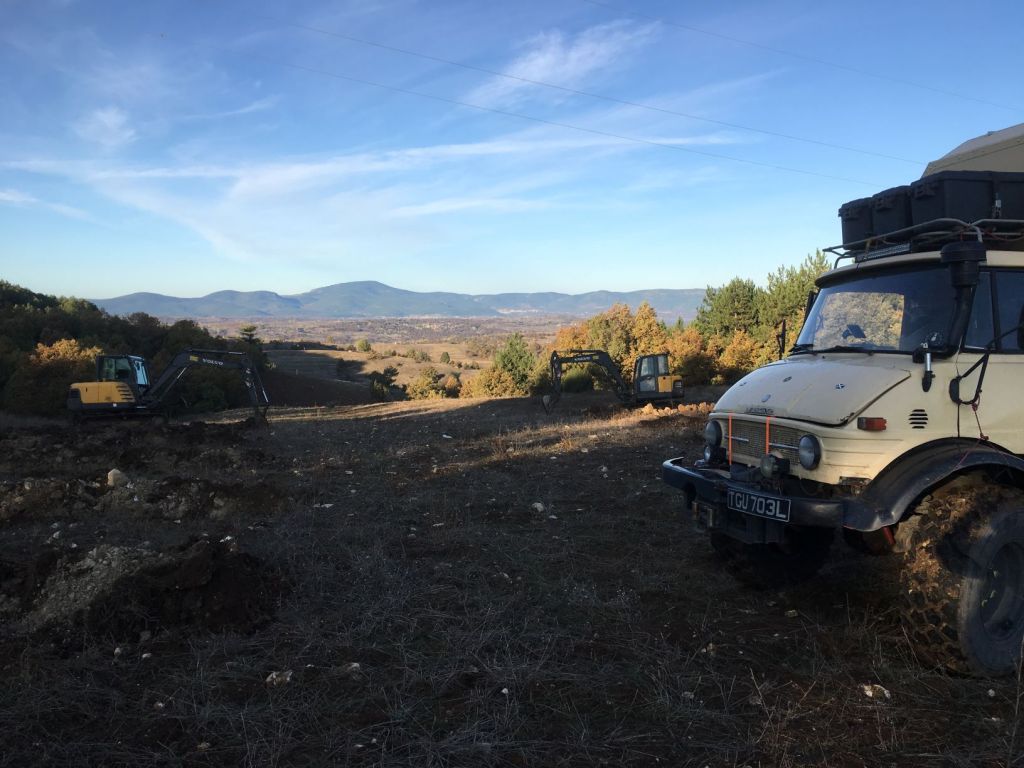
We hurry to get away from the spot before we get boxed in. the drivers are laughing at us, we think it is funny also.
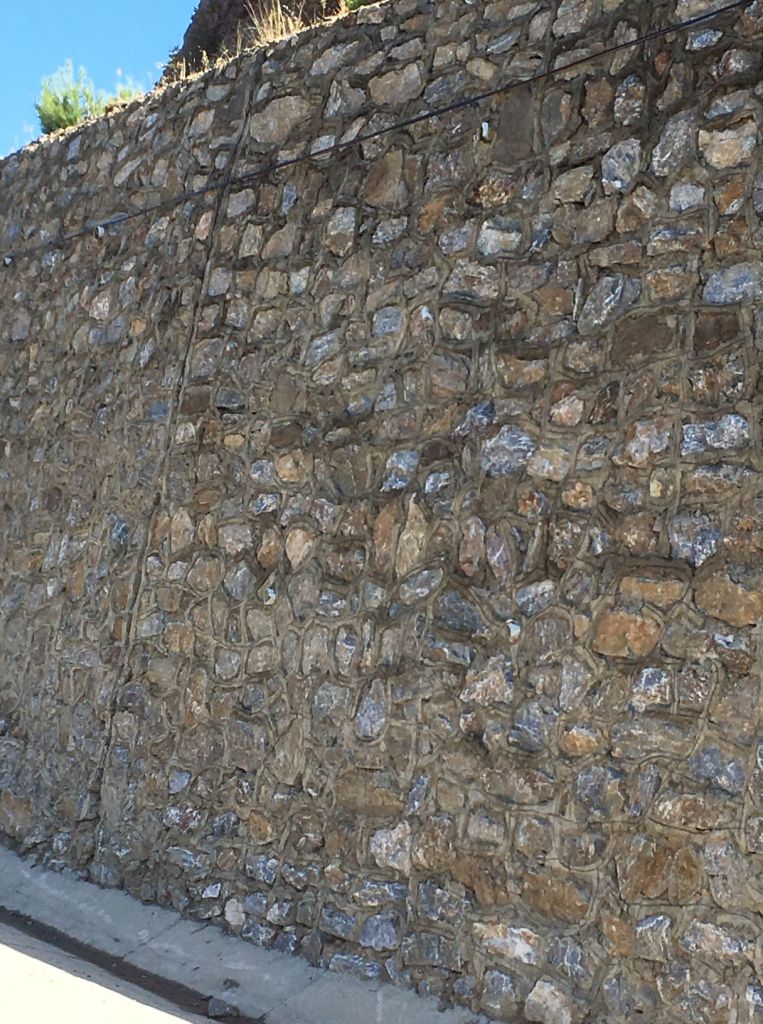
The weather is good and the drive to Bursa very nice. It is all downhill from the Turkish Highlands to the Aegean coast. We admire the roadworks; the retaining walls in particular are very tasteful.
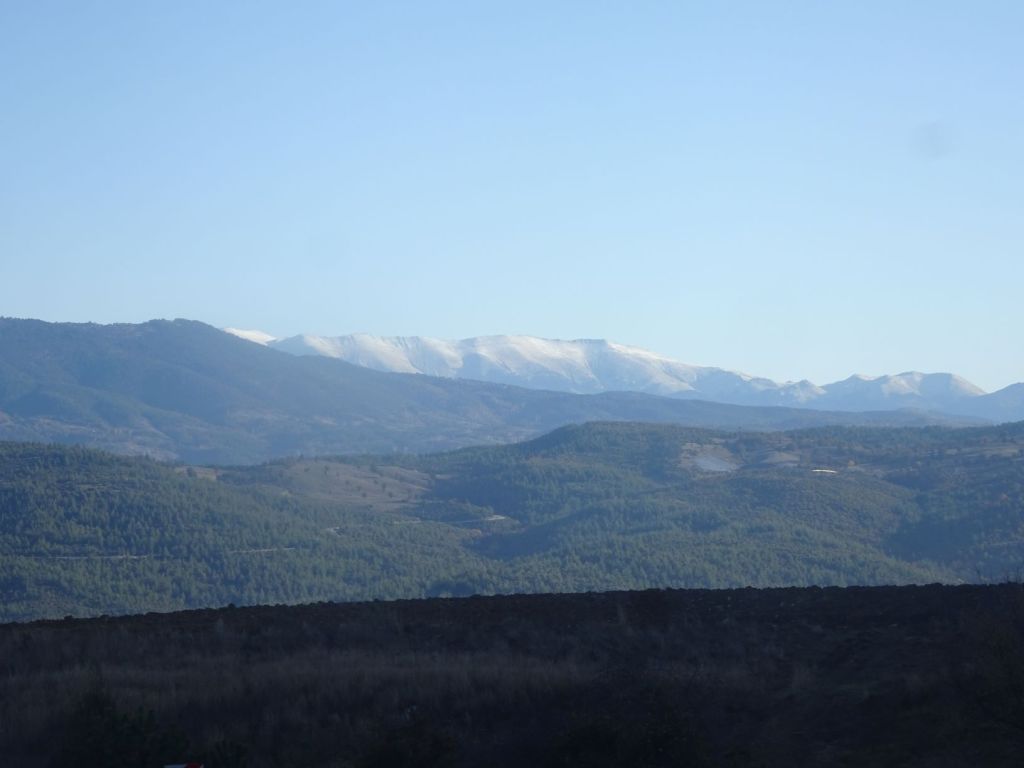
With a population of almost 2 million, Bursa has parks and gardens located across its well organised urban fabric and is surrounded by hills and forests on all sides. One of them, Mount Uludag is high enough at 2543 m to provide skiing in winter.
The city has been a settlement since 5200 BC. It was the capital of the Ottoman Empire between 1335 and 1363, and the mausoleums of the early Sultans are located here. Bursa is located on the western edge of the Silk Road and was the source of most royal silk products during the Ottoman period. During the 20th century, silk production has been in decline, but most recently there seems to be revival with new silk factories opening their doors.
We do not know where to park when we enter the city, and keep going towards the city center. It is very busy and the streets are cute but narrow; we feel a bit embarrassed driving through this in our big truck. Everything is well kept with new buildings mixed in with the old. No patches of barren waste ground like in previous cities where we can park the Mog.
We drive right through the center a bit up hill in to a residential area. At last we see a parking spot on a steep road. We need blocks to stop the Mog running back down the hill. We worry that we are a nuisance where we are parking and it seems that a local man has been watching us parking the car. But he is just very nice, welcomes us, and wants to know where we are going.
Miep knows she wants to go to the famous Bursa bazaar Koza Han. The man gives his name as Husseyn, but he speaks no English at all and we do not speak Turkish, so communication is very difficult. Husseyn has worked for 35 years the Fiat factory in Bursa and pointing to the Fiat Doblo’s we see on the road, indicates to us that he has had a hand in each and every one of them!. He is now retired, and unfortunately, his health does not appears brilliant.
Husseyn waves his hand and says “come, come” and we follow him. He takes us to the tram and pays for our tickets. The tram takes us to Koza Han.
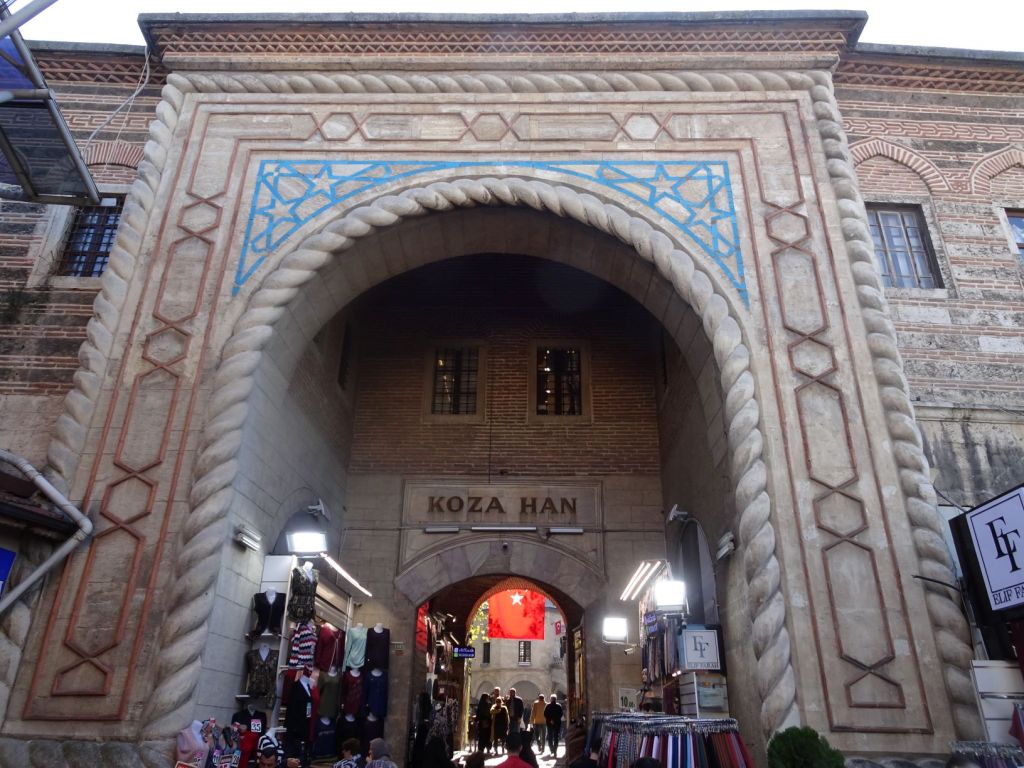
“come, come” Husseyn takes us inside.
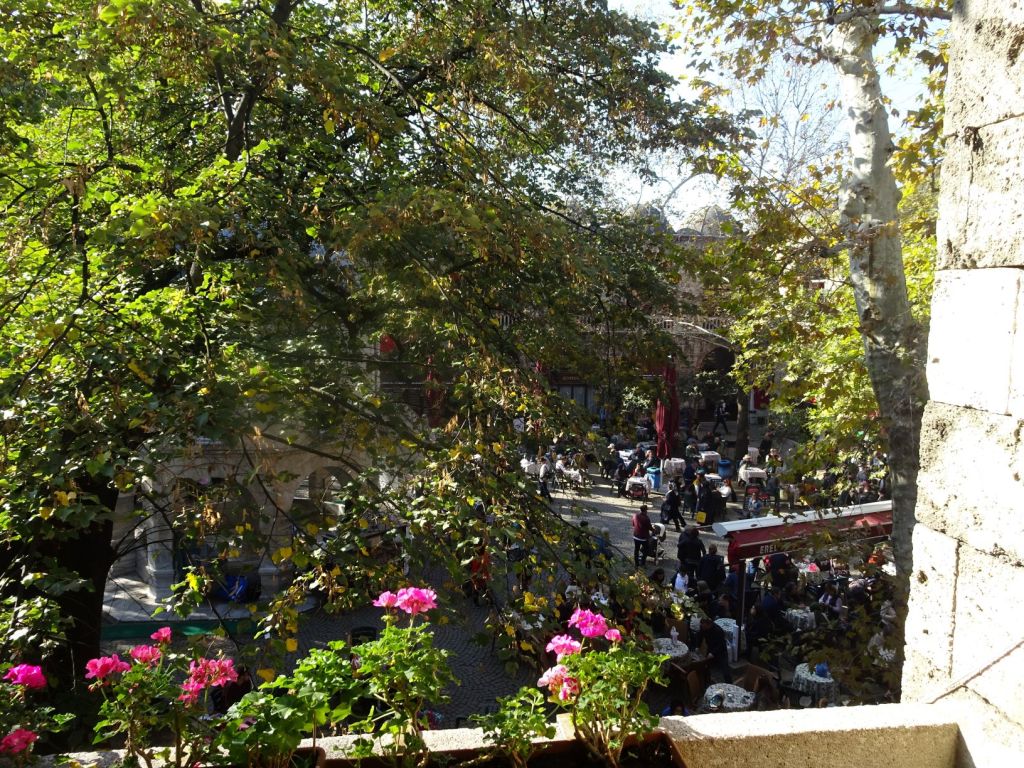
“come, come” Inside the bazaar, there is a demonstration of how silk is spun from unravelling cocoons.
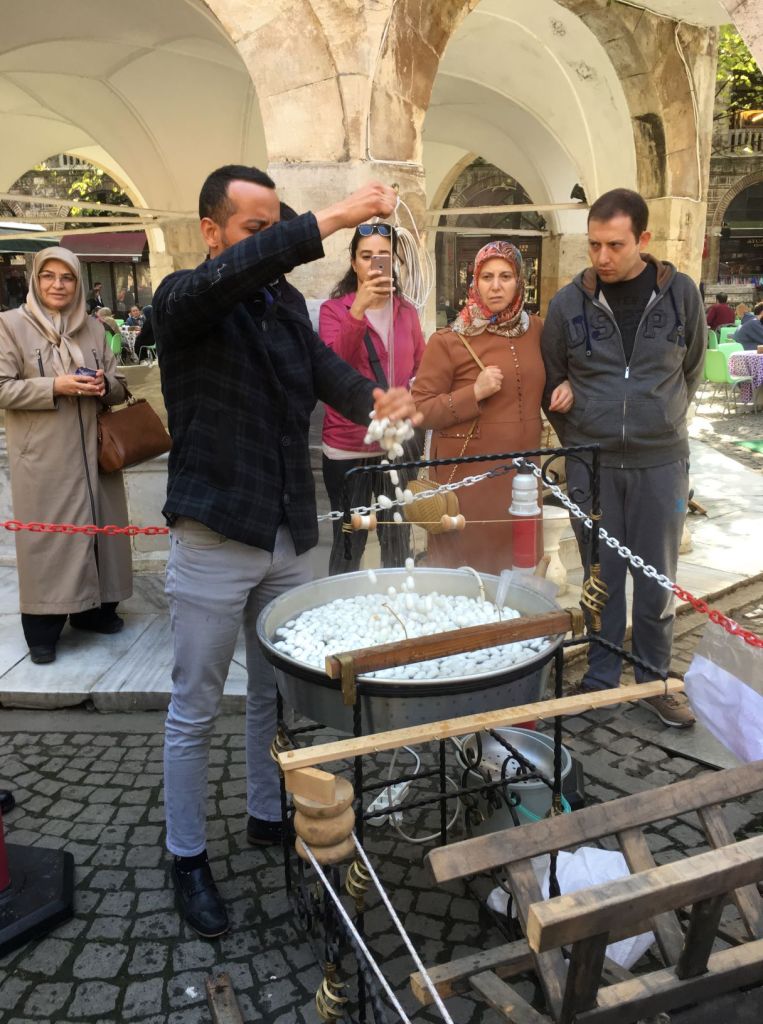
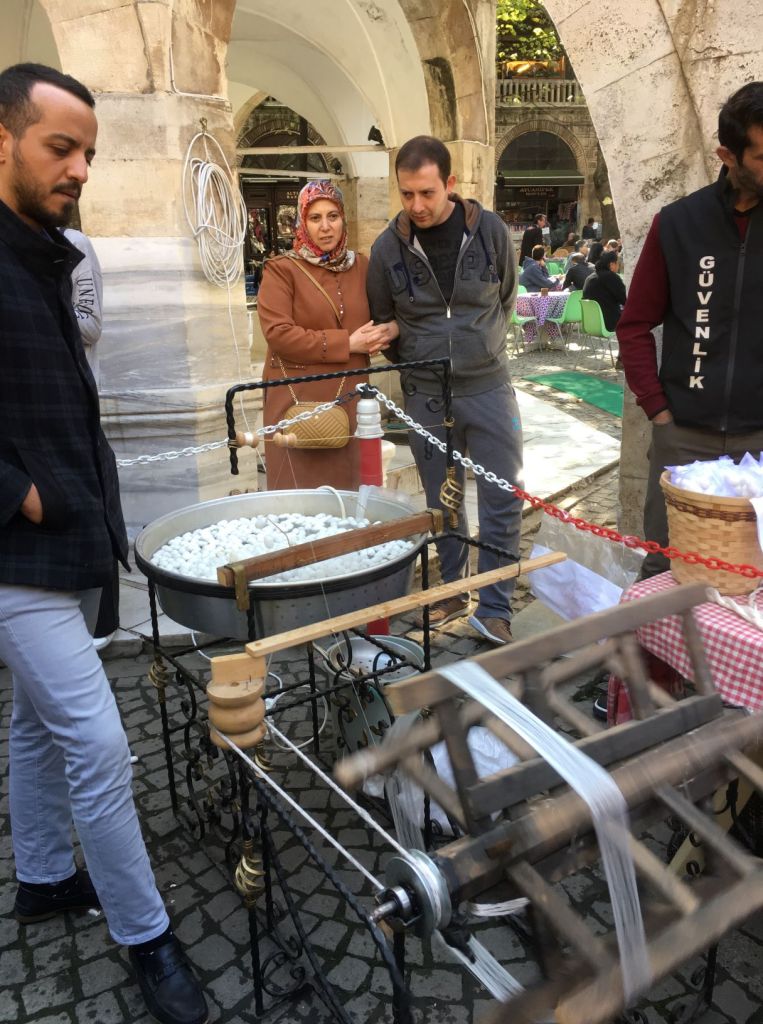
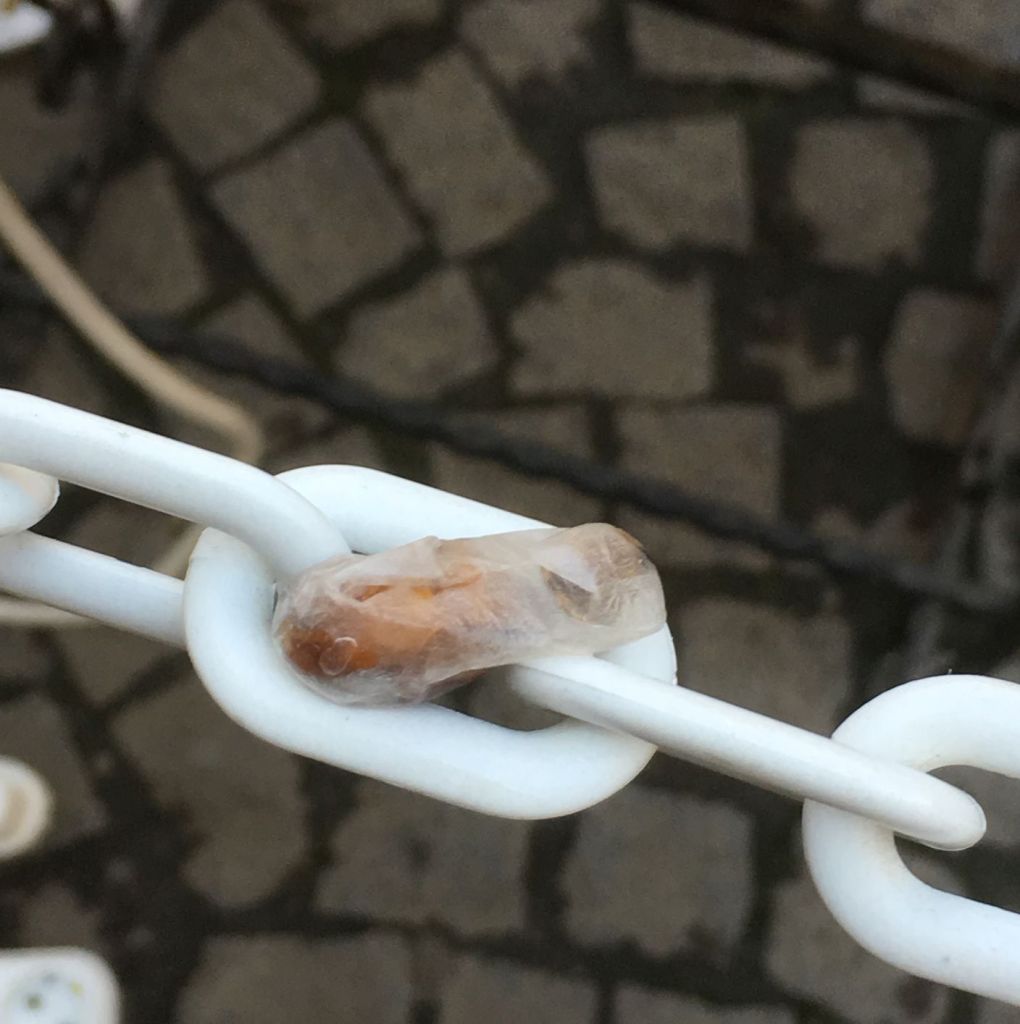
“come, come” Husseyn takes us to a shop which is total paradise for Miep. The silk thread she has been looking for all the way on the Silk Road.
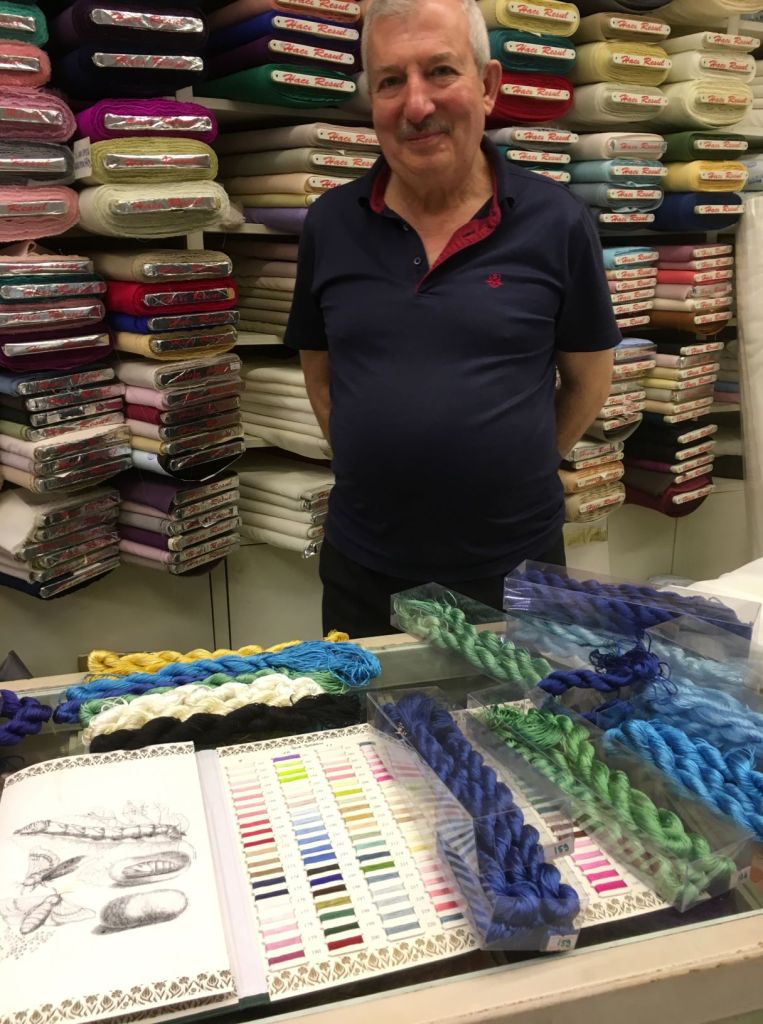
Miep tries to match the colors of the tiles she saw in Uzbekistan with the colors of thread in the shop. Husseyn and Roelf wait patiently outside.
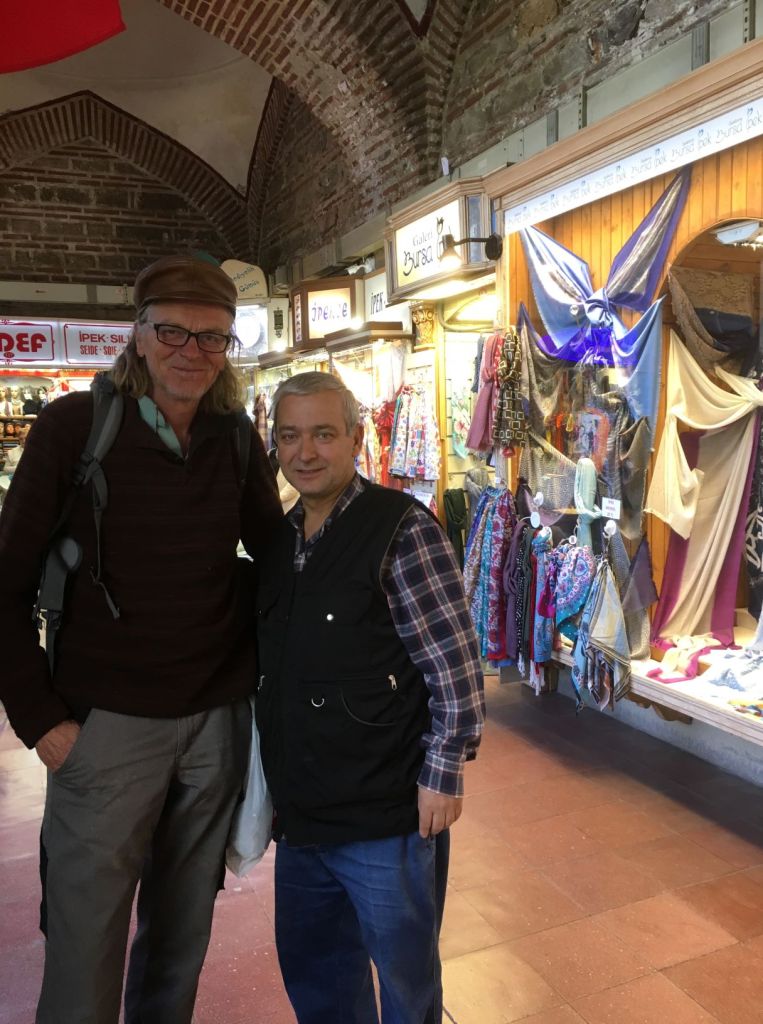
Miep buys 8 colors of the silk thread matching the tiles from Uzbekistan. The Persian colors will have to wait (those yellows, reds, and pinks).
“come, come” Husseyn takes us to a number of food stores; each of these would have been a highly specialised delicatessen shop in Western Europe.
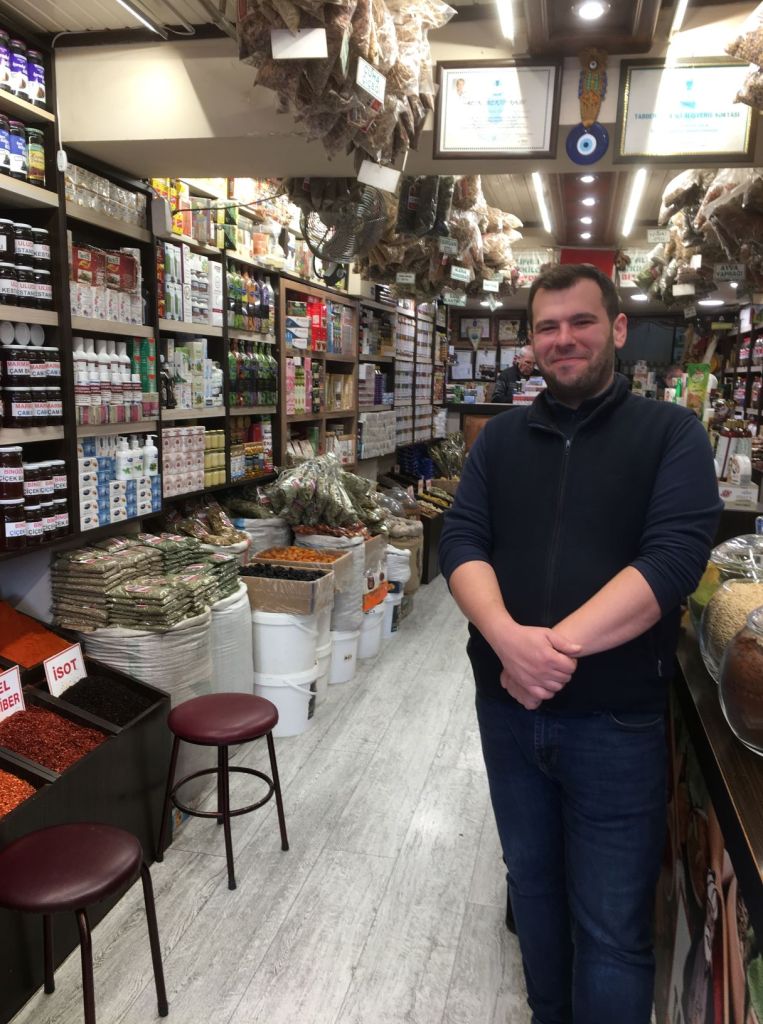
Husseyn leads us to the best places to buy spices and tea.
“come, come” Husseyn leads us to a traditional kebab restaurant. Another one of these where you do not place an order, but just sit down and get your meal served. Husseyn’s timing is impeccable because when we leave, there is a queue of at least 30 people outside. Husseyn himself refused to come in and insisted on waiting for us outside. Such a shame, we would have loved to share our meal with him.
“come, come” Husseyn takes us to the Grand Mosque.
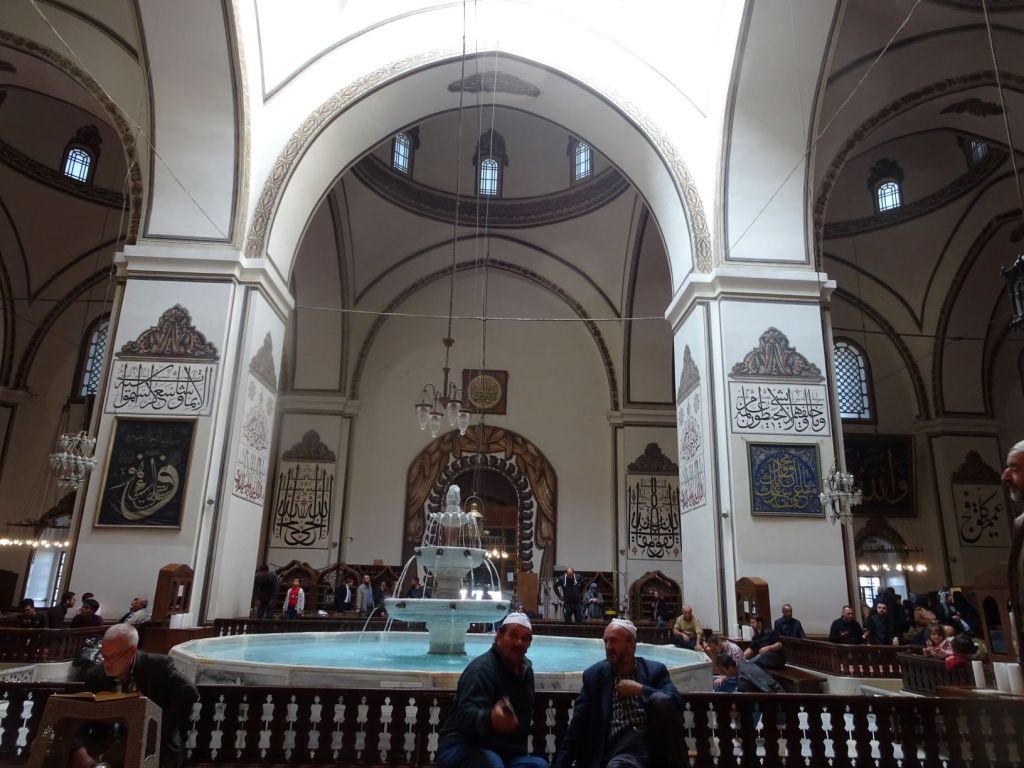
We are a bit at a loss to understand the exhibits because there is no explanation in English. We meet a retired teacher who speaks good English and very good German. His name is Mustafa. Now we have two guides!.
Mustafa is very keen to take us back to the craft shop at Koza Han. When we do so, it appears that we have been to the best shop to buy silk thread (well done Husseyn!). We see a bit more in the form of very intricate crochet work for jewellery.
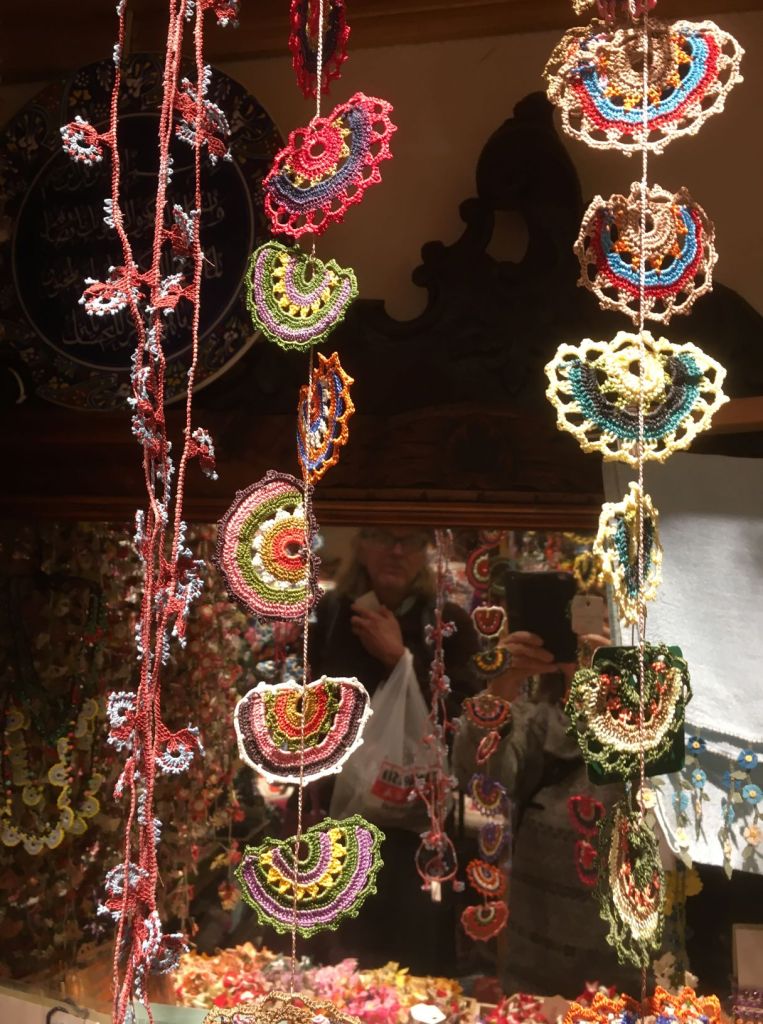
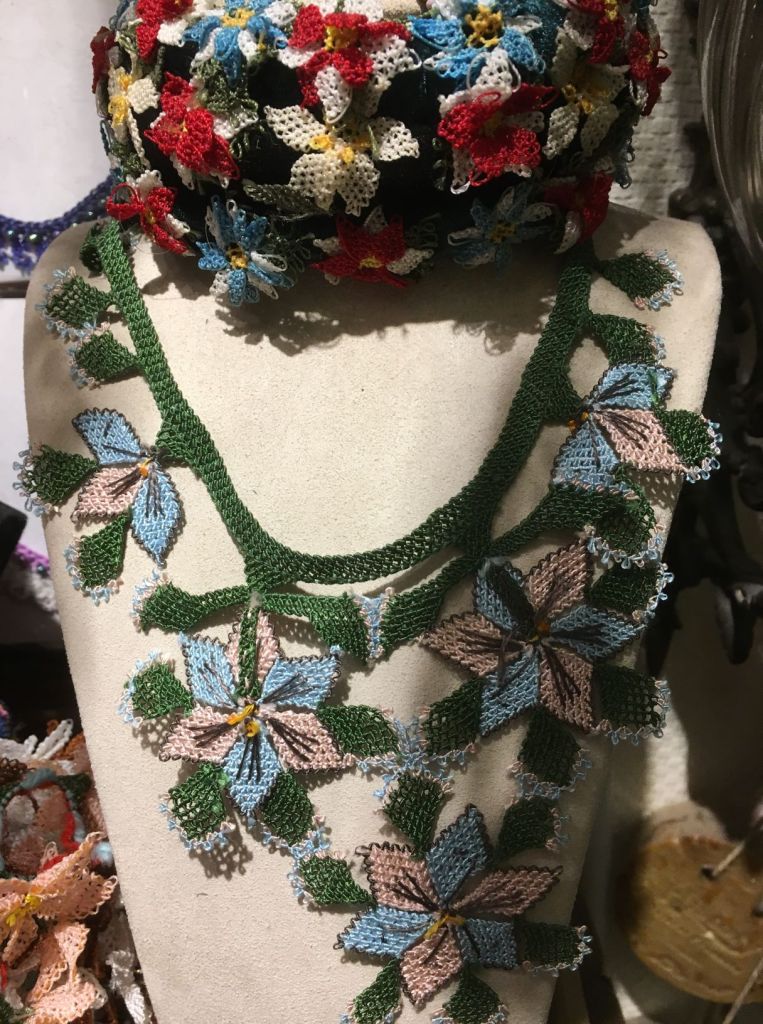
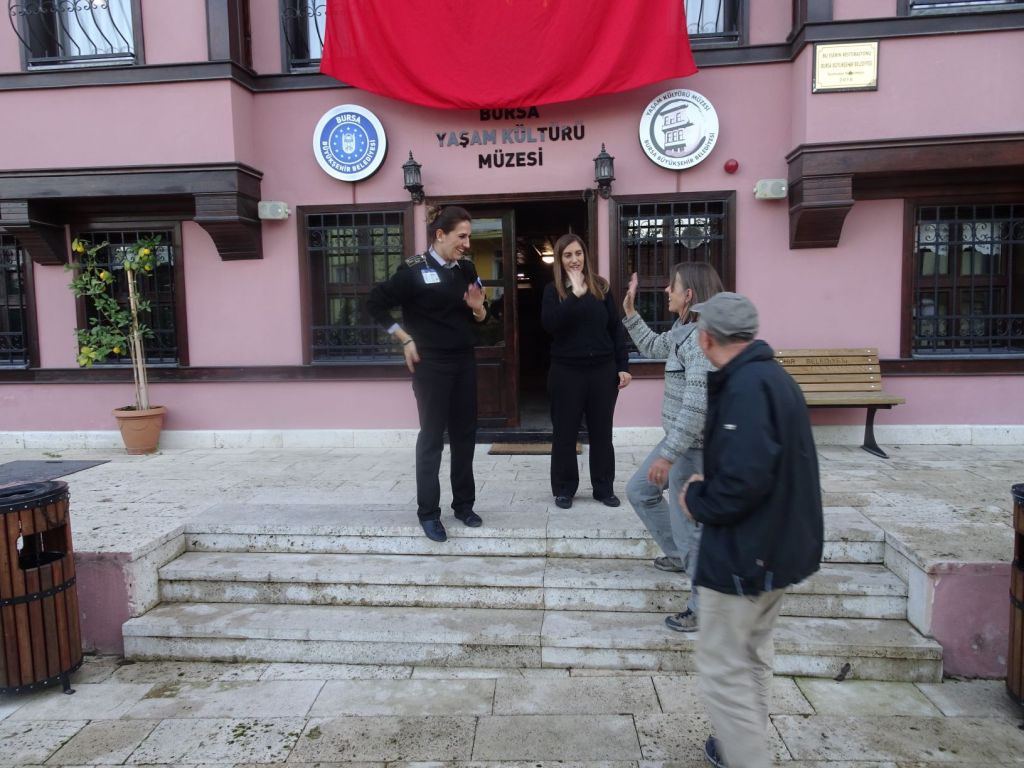
We say goodbye to Husseyn, who finds it a bit difficult to keep up with the speed that we are now taken round the highlights of Bursa. We visit two small but wonderful musea; old ottoman houses.
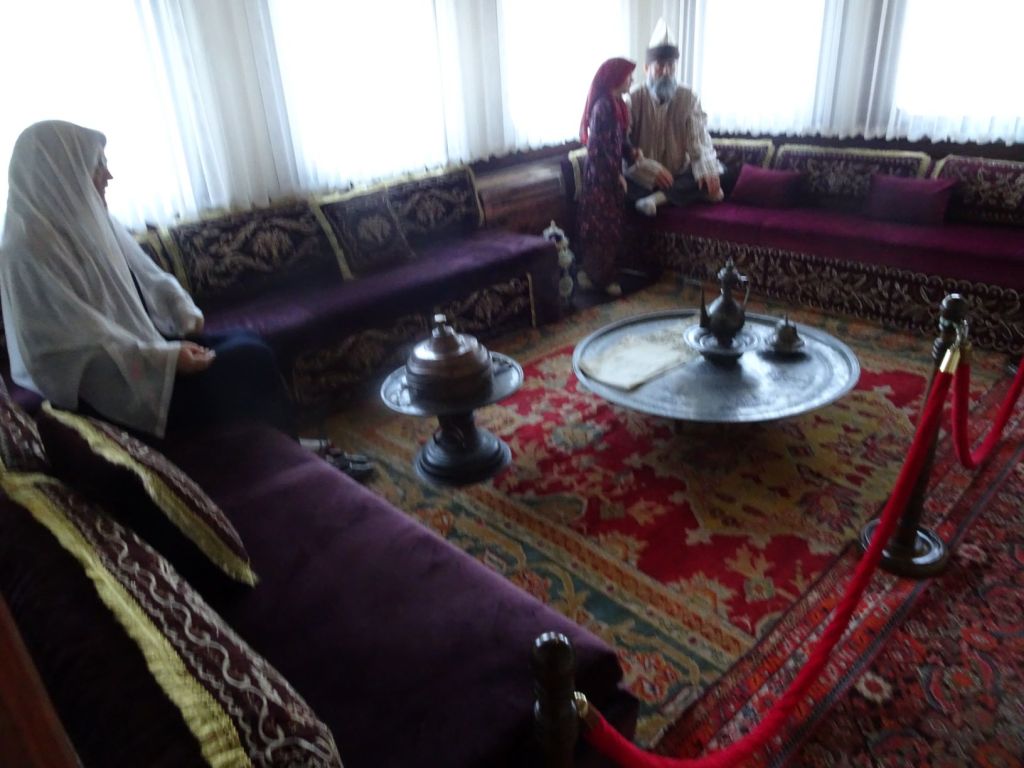
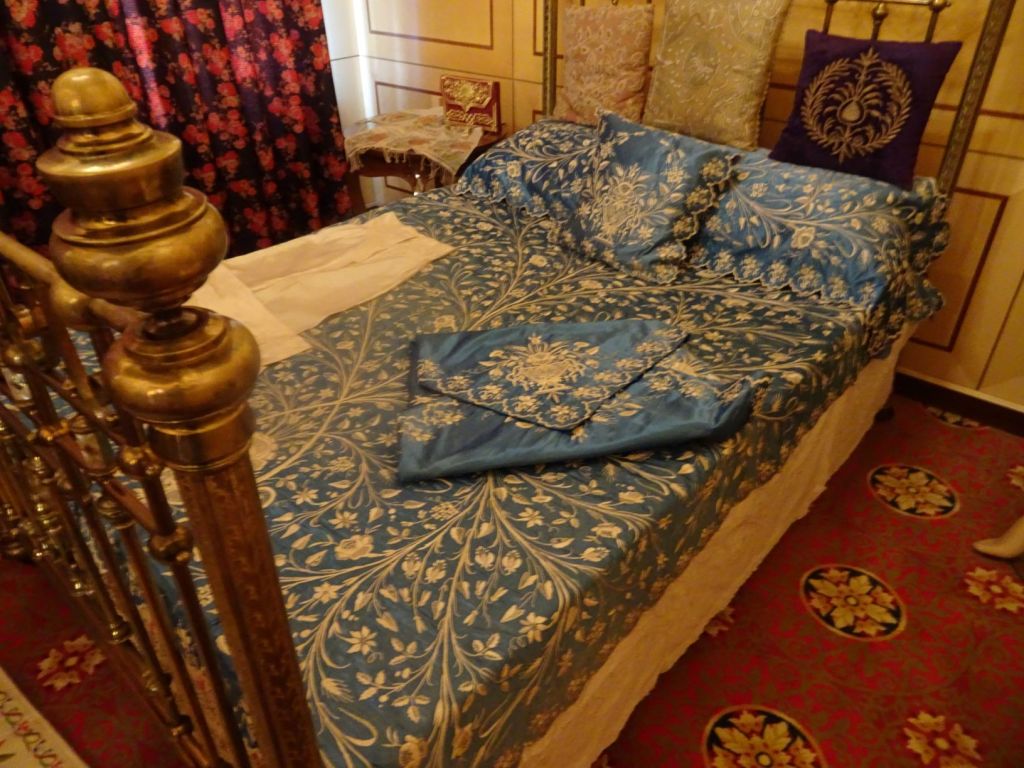
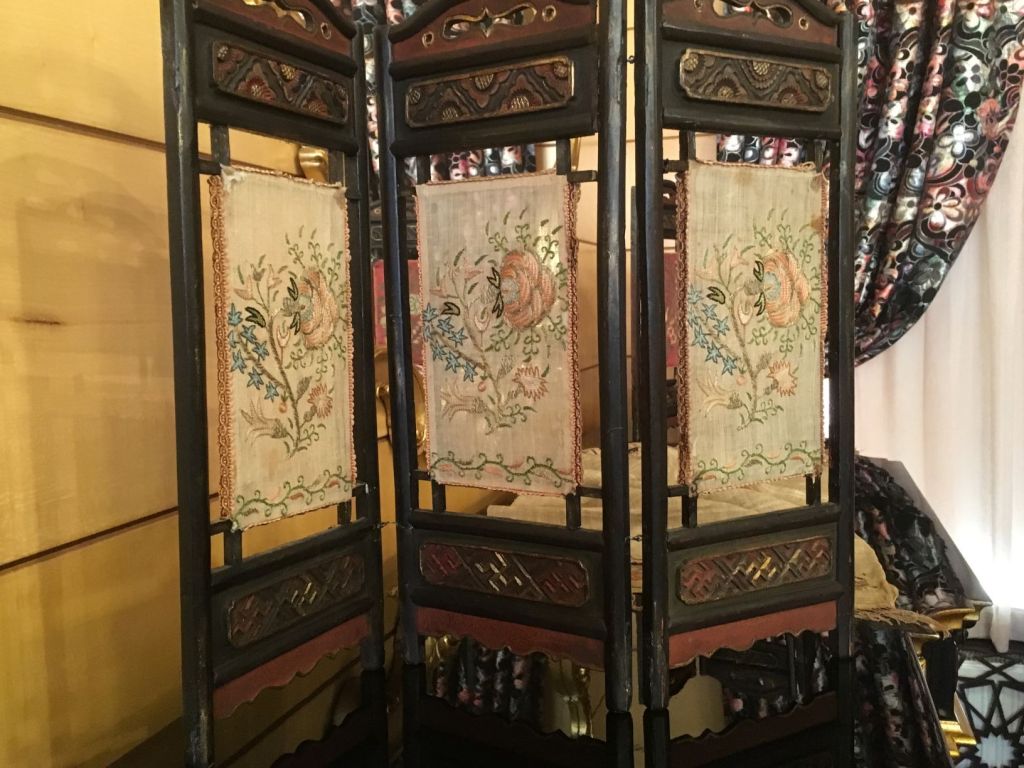
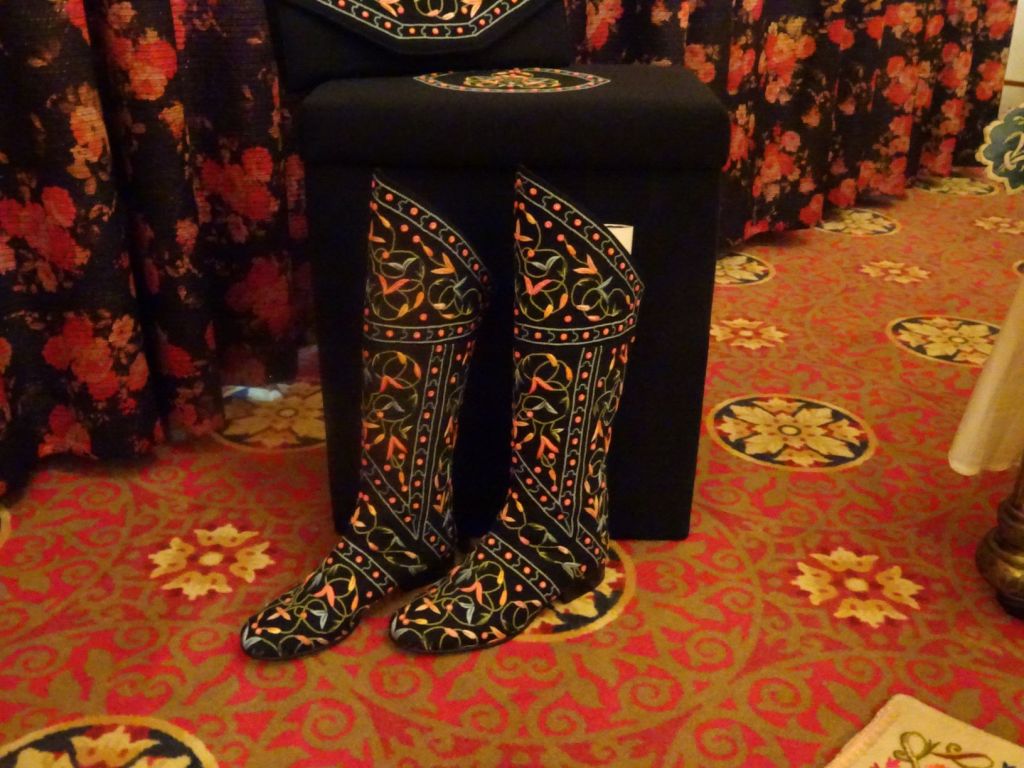
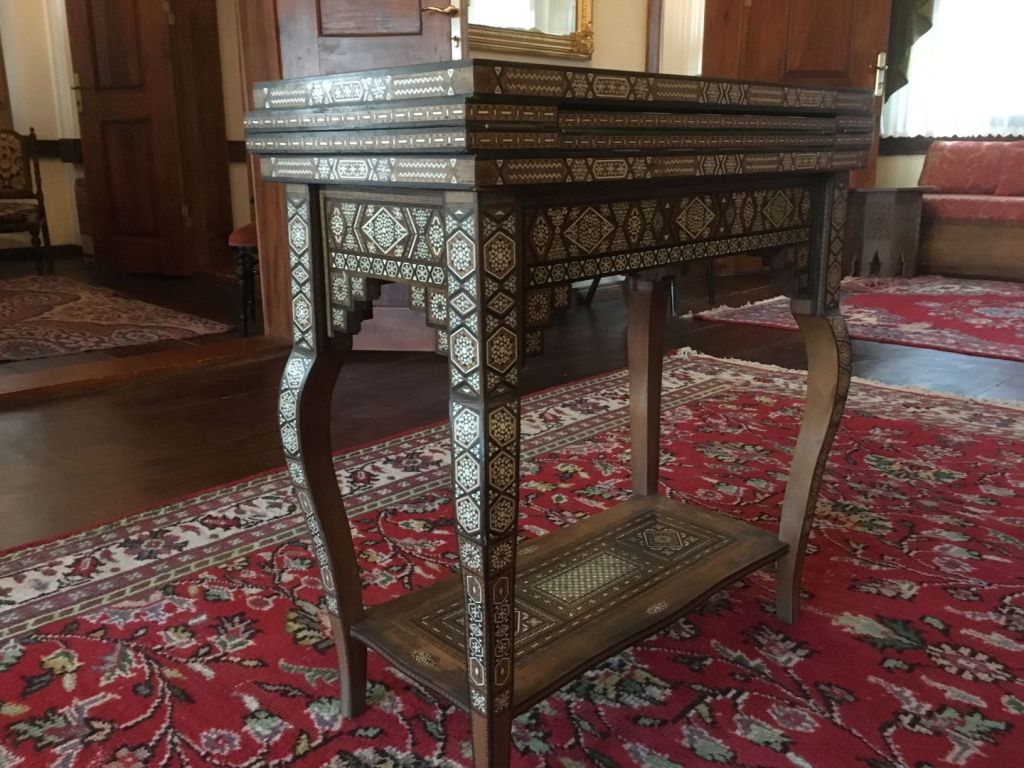
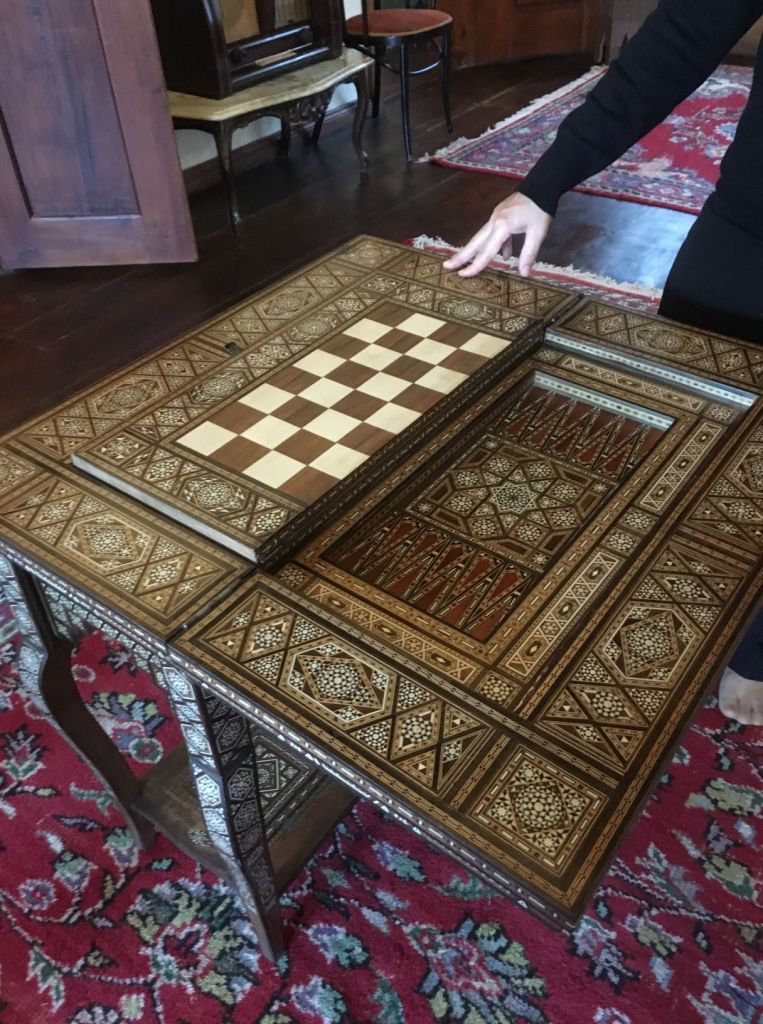
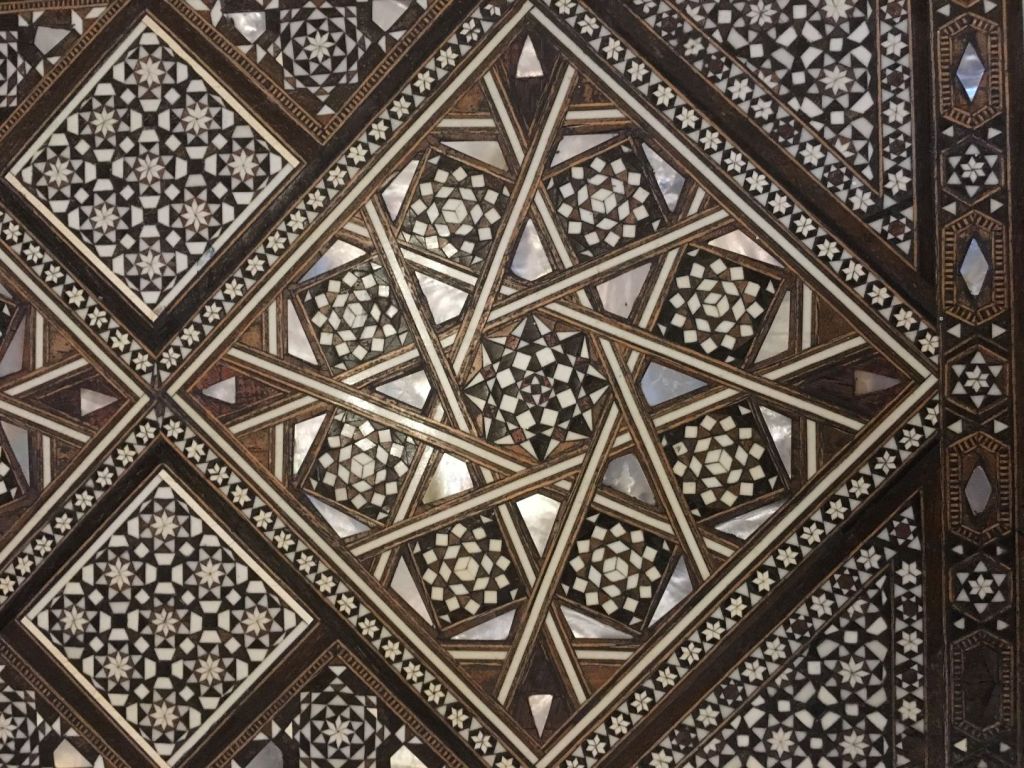
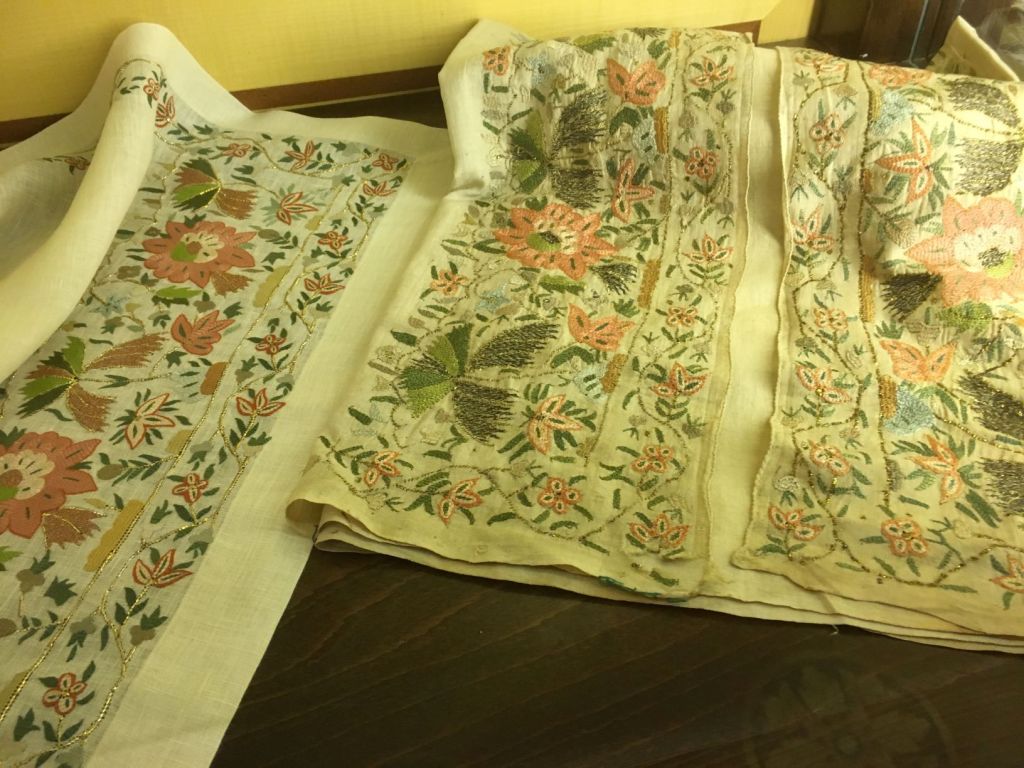
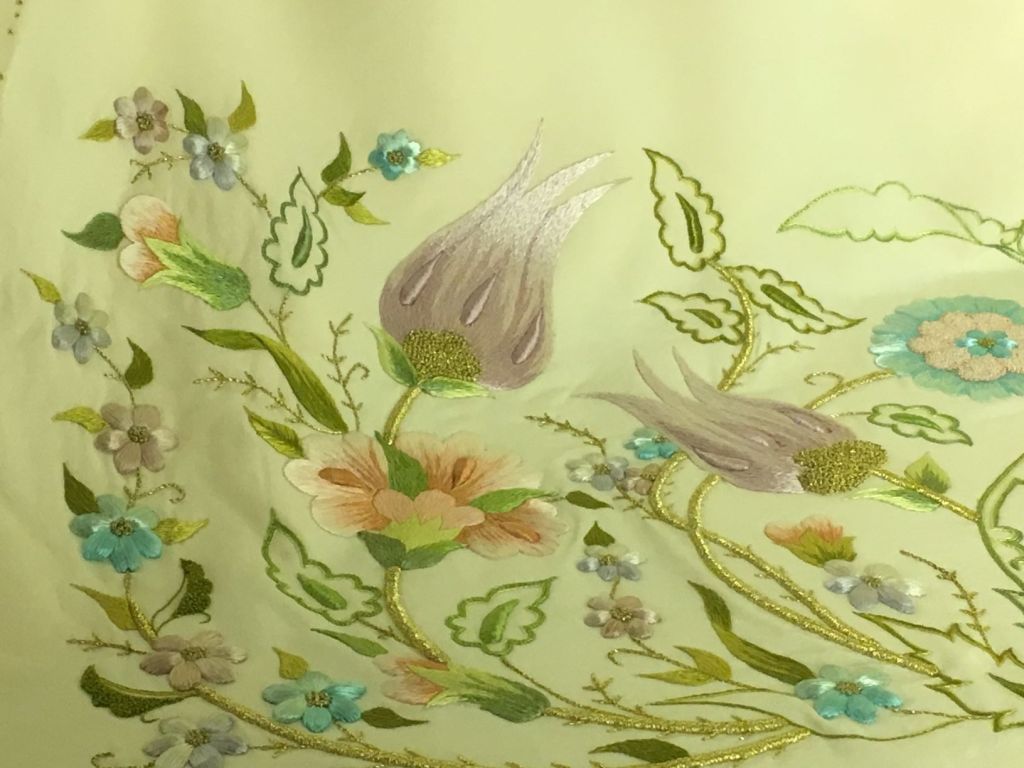
Quite overwhelmed by everything we have seen, we say goodbye to the museum staff; we have not payed a single entry fee.
Mustafa now takes us to the Sultan’s Palace which is normally not open to tourists but he seems to know the people there, and they open the doors for us. There is a restaurant with an incredible view over Bursa. The restaurant is still used by dignitaries to receive foreign guest for a meal there.
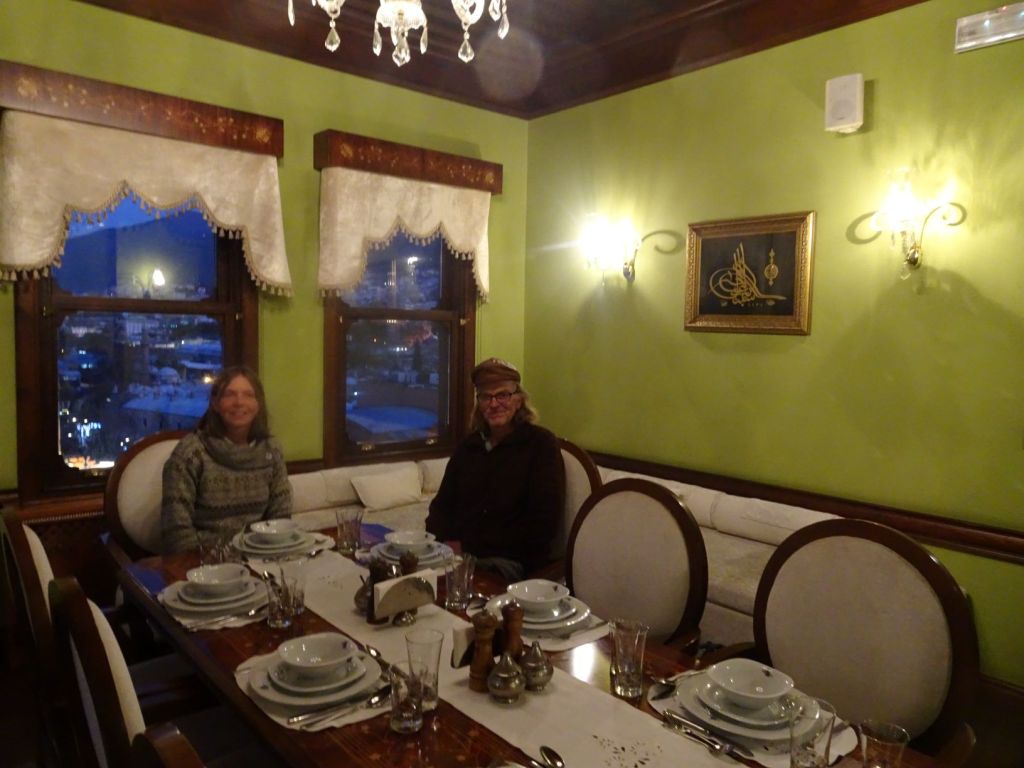
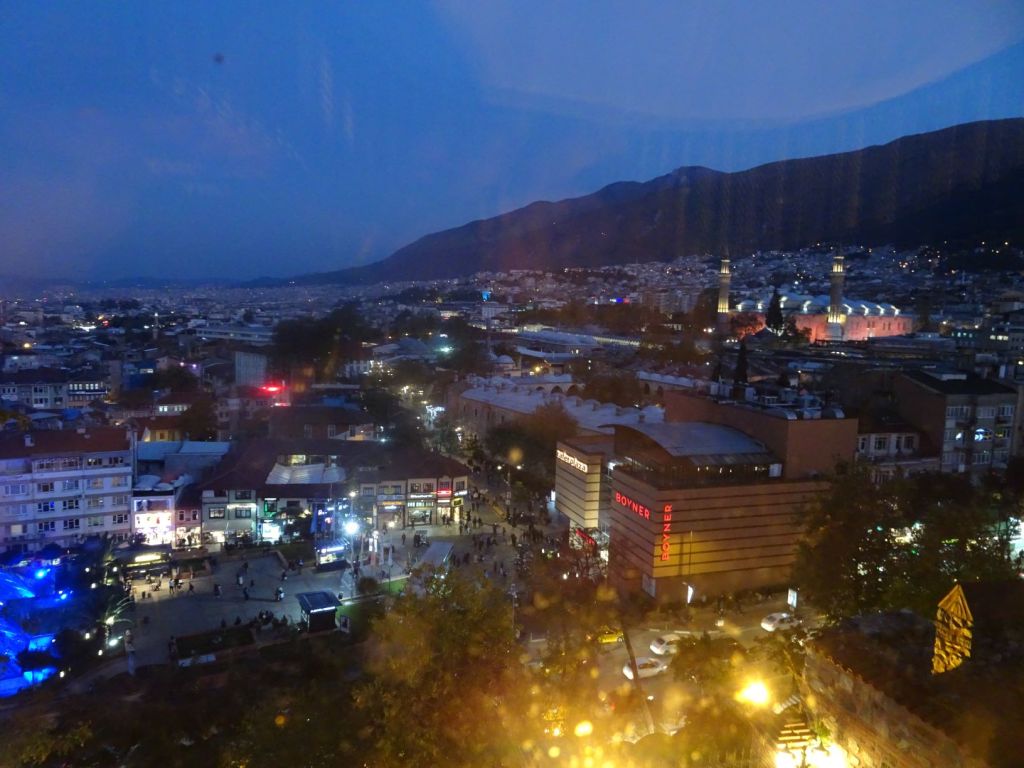
Mustafa invites us to a Dervishes dance for 10 pm that evening. Before that we go to Husseyn to say hello to his family. A warm welcome awaits us; food has been prepared and they have arranged for a place for the Mog on level ground. This will certainly make for a better night’s sleep.
We leave the family and hurry to our appointment with Mustafa. The venue for the dance is a steep walk up the hill. When we arrive, some hundred people are listening to a lecture in life science by a senior dervish cleric inside the dance hall, with another 100 people watching on a big screen outside. This is a live stream and apparently watched by many all over the world. We are served with tea and sweets for free, and when we have finished, a little boy is sent to give us second servings. Hospitality everywhere we go.
Then we go inside to see the show. The room is packed to the rafters. Women upstairs, men downstairs. The musicians, ney players up front, enter first.
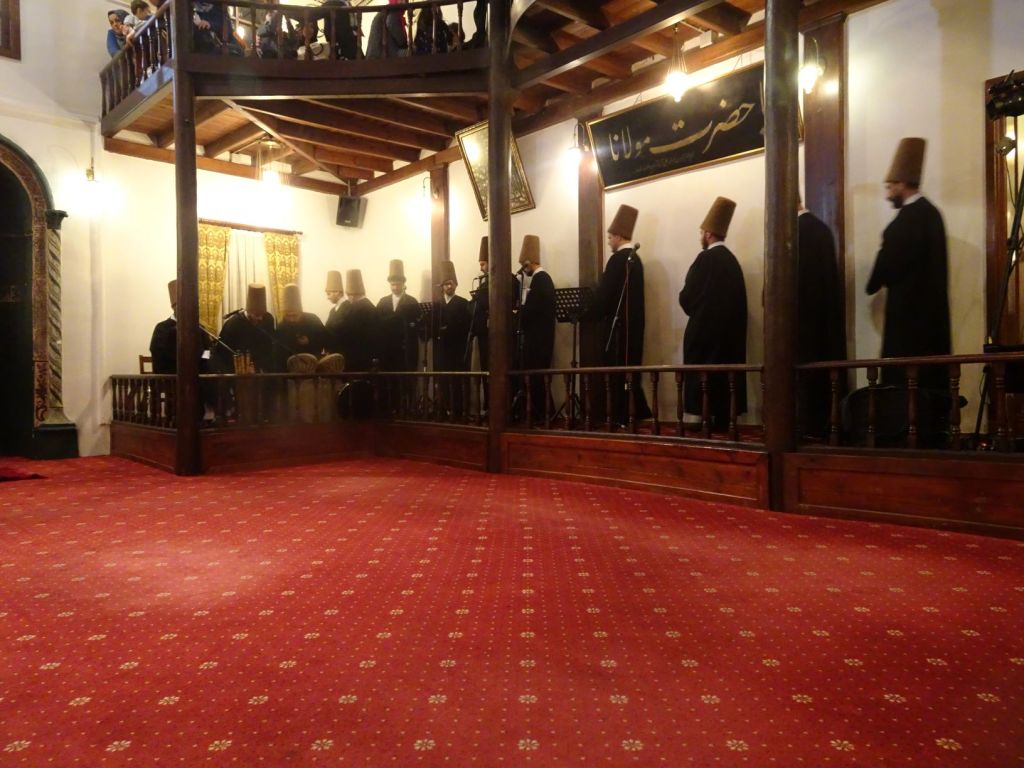
The dance is truly mesmerising. The dancers turn round for about 35 minutes to the rhythmic songs of the little orchestra. People pray and sing along with the music. We wonder how close the dancers feel to God.
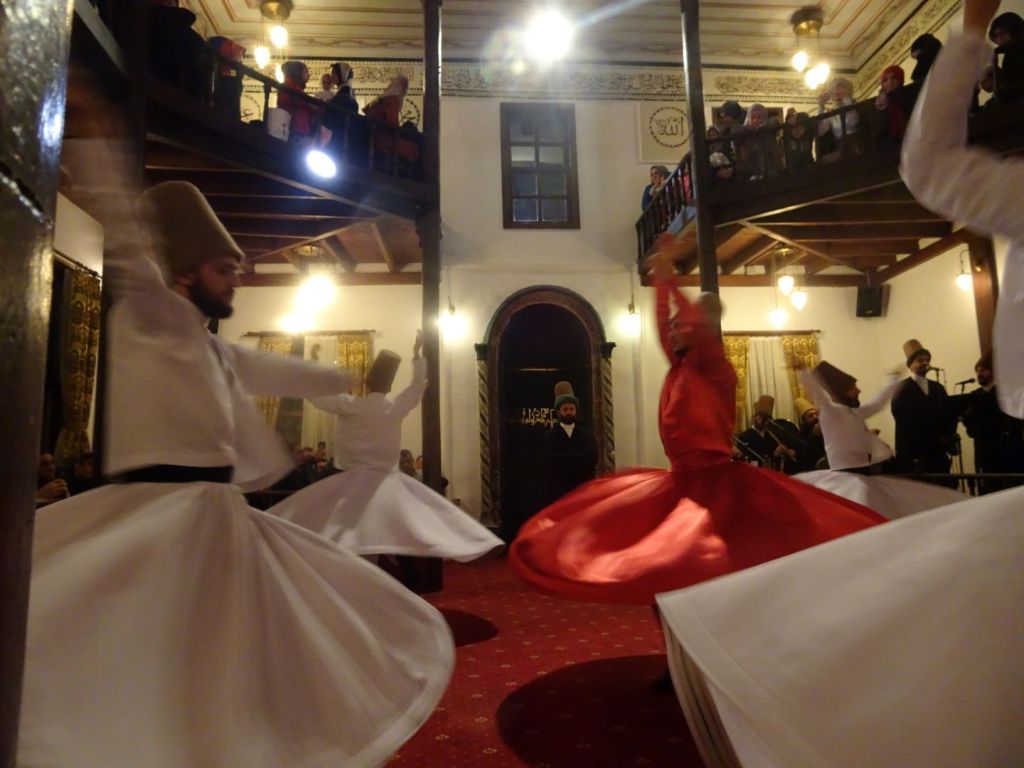
Totally exhausted we make our way back to the Mog. This has been the longest and the best day of our journey. We fall into a deep but happy sleep.
November 3
In the middle of the night, Miep realises that she has left her phone in the last museum we visited. We have breakfast in Husseyn’s home. Very extensive and we must try everything. It is all home made, even the honey!.
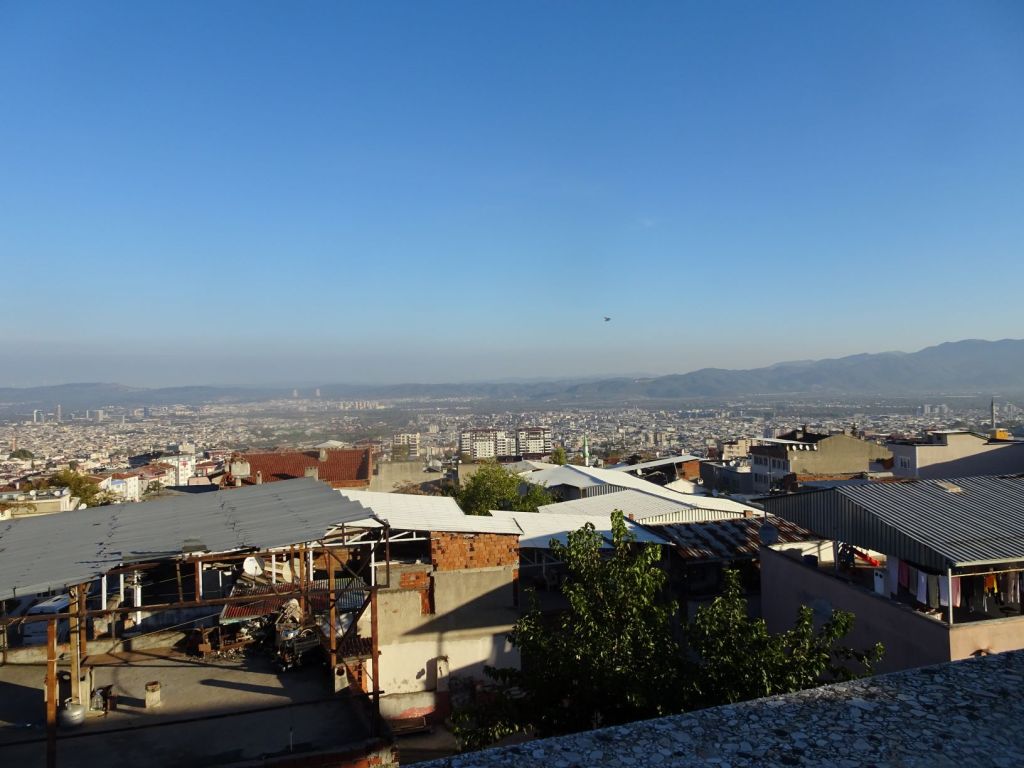
“come, come”, Husseyn takes us up three flights of stairs in his home to show us his roof terrace. A big surprise; this very modest home on a busy street has a magnificent view over Bursa; better even than the one we have seen from the Sultan’s Palace!.
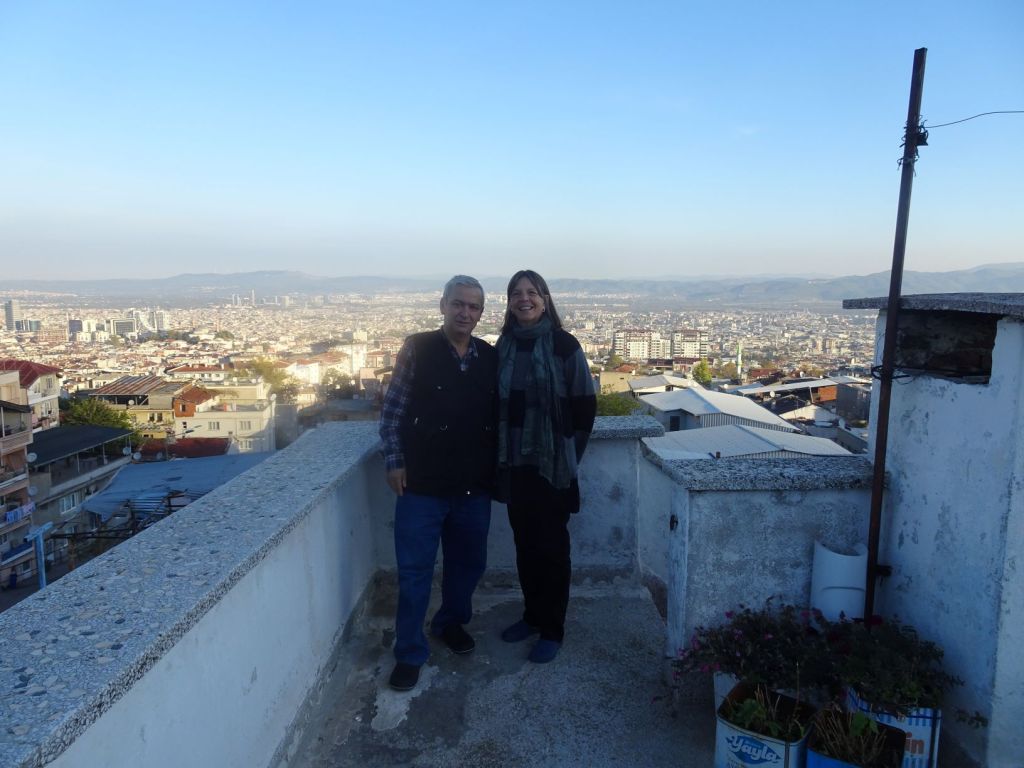
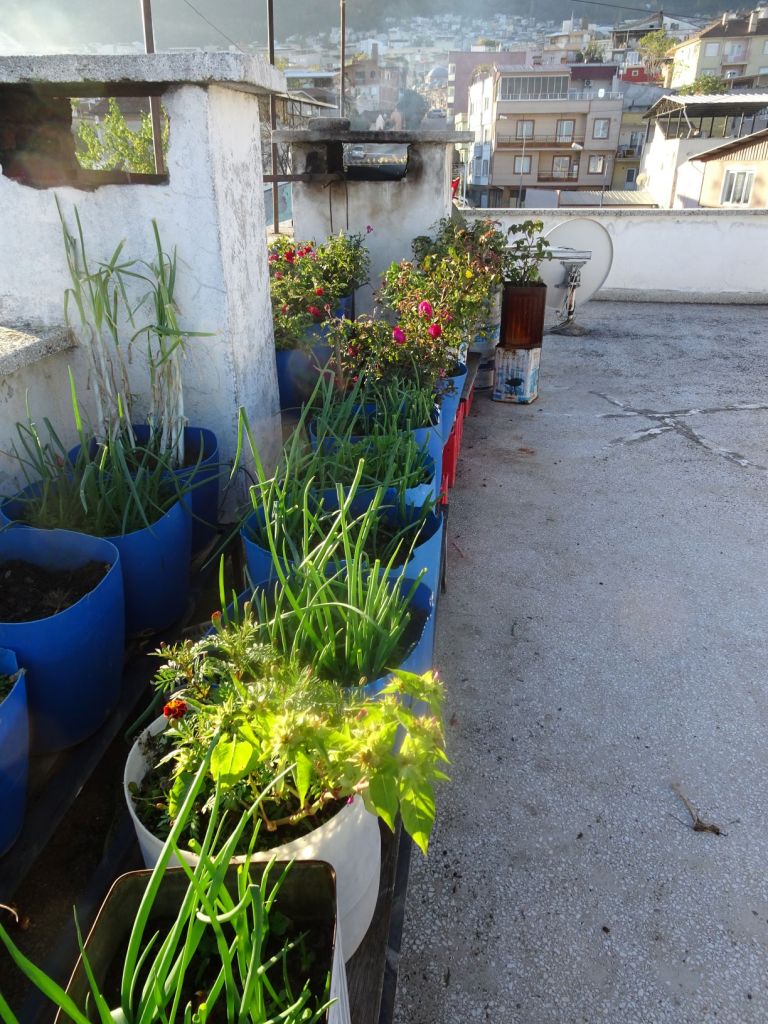
Some of the food we had for breakfast, comes from the roof terrace.
The morning sun was shining over Bursa.
Miep leaves a bit too soon because she wants to get to the museum early to ask about her phone. Roelf stays behind, not to embarrass the situation.
The museum did find the phone but has, dutifully, handed it in to the police station. There it appears that the officer who has the key to the lost property drawer is not on duty, so we have to come back in the evening to collect the phone.
We go on another tour of Bursa with Mustafa.
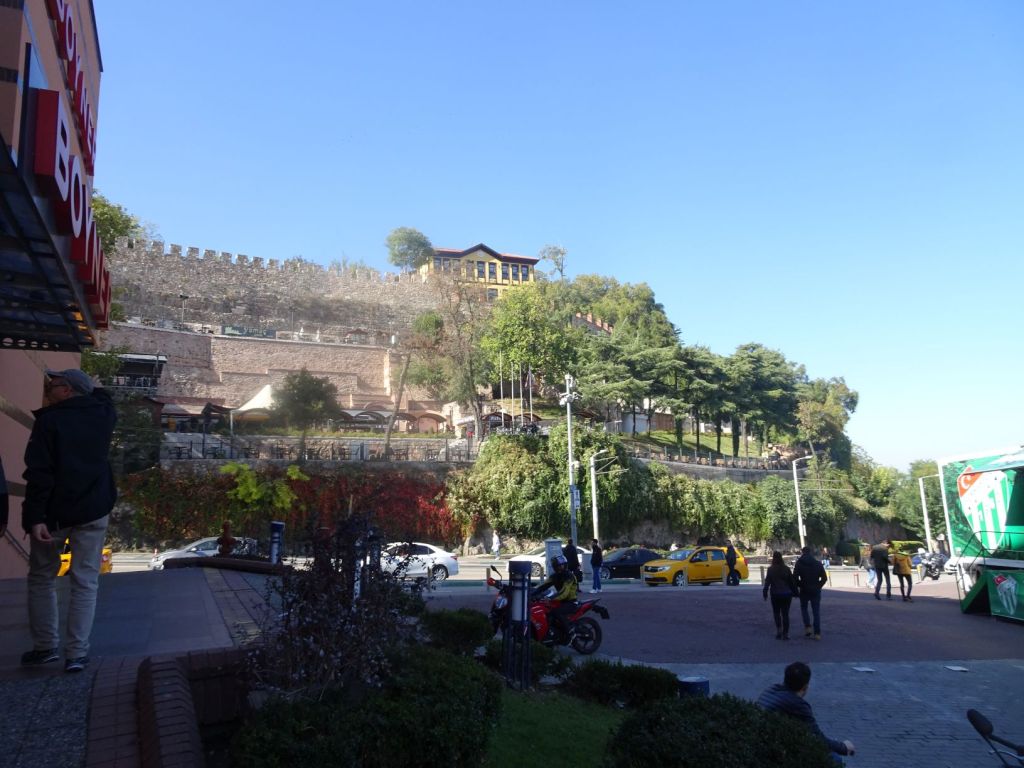
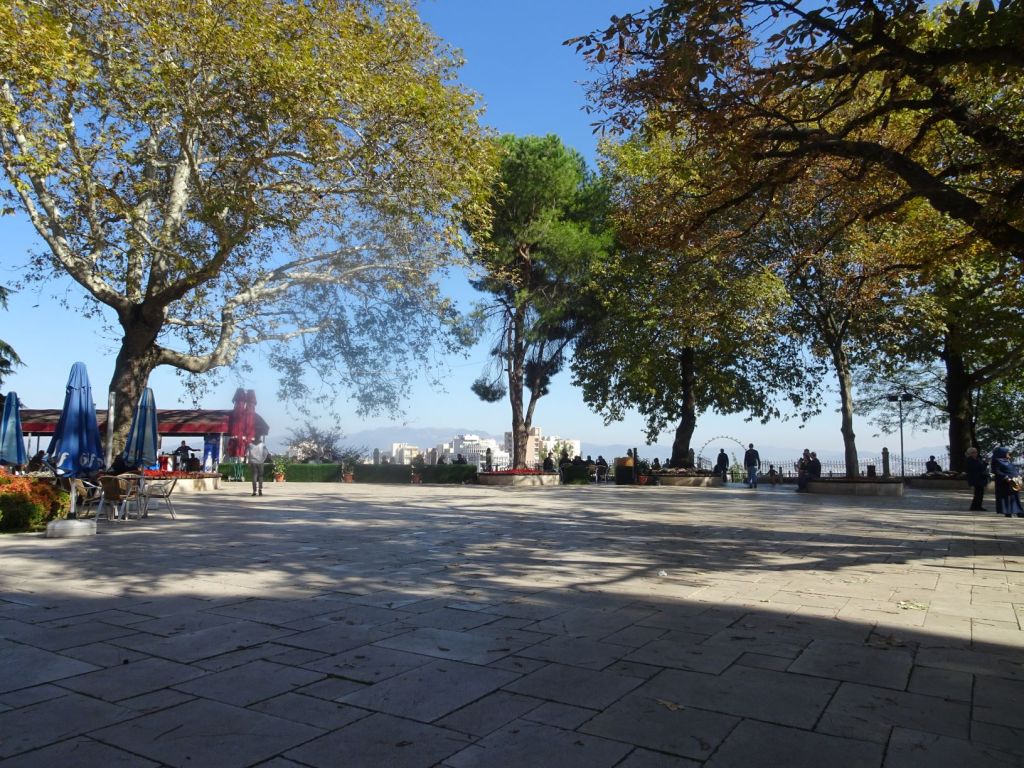
More embroidered silks, pottery and massive mausoleums for the early Sultans of the Ottoman Empire.
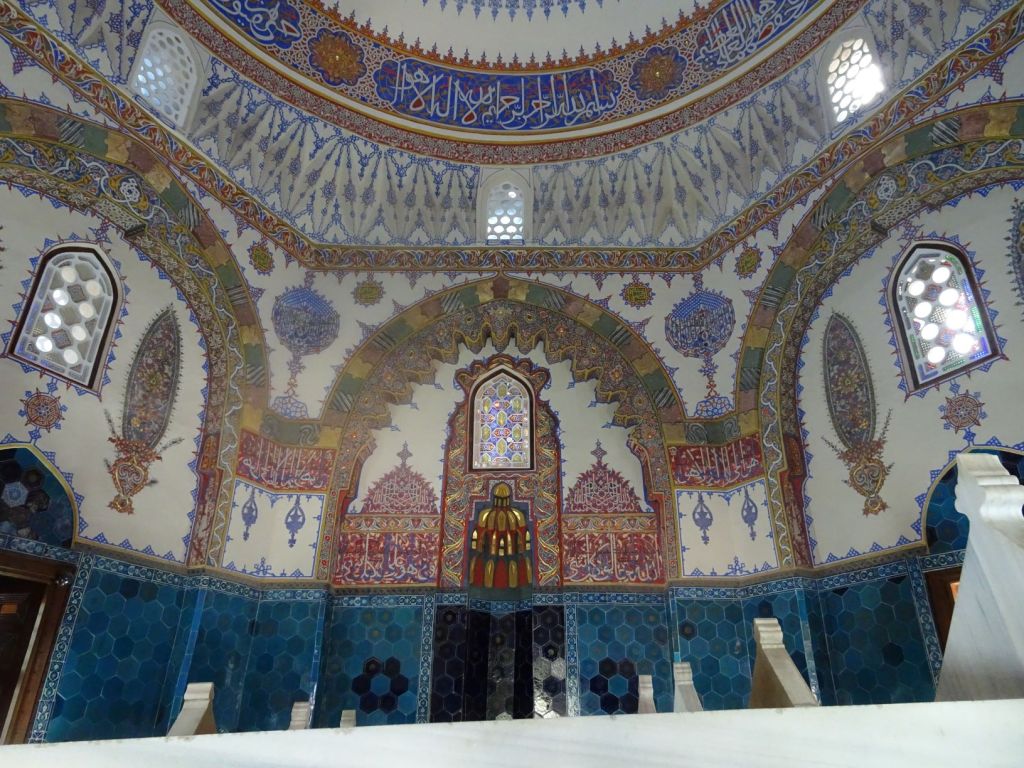
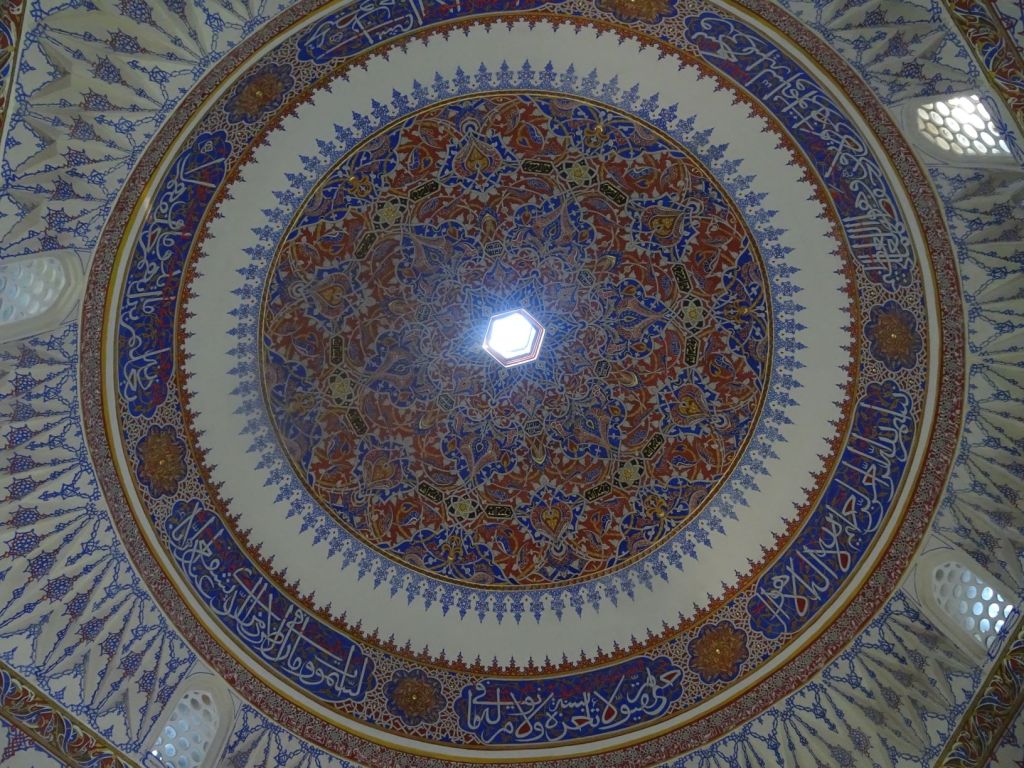
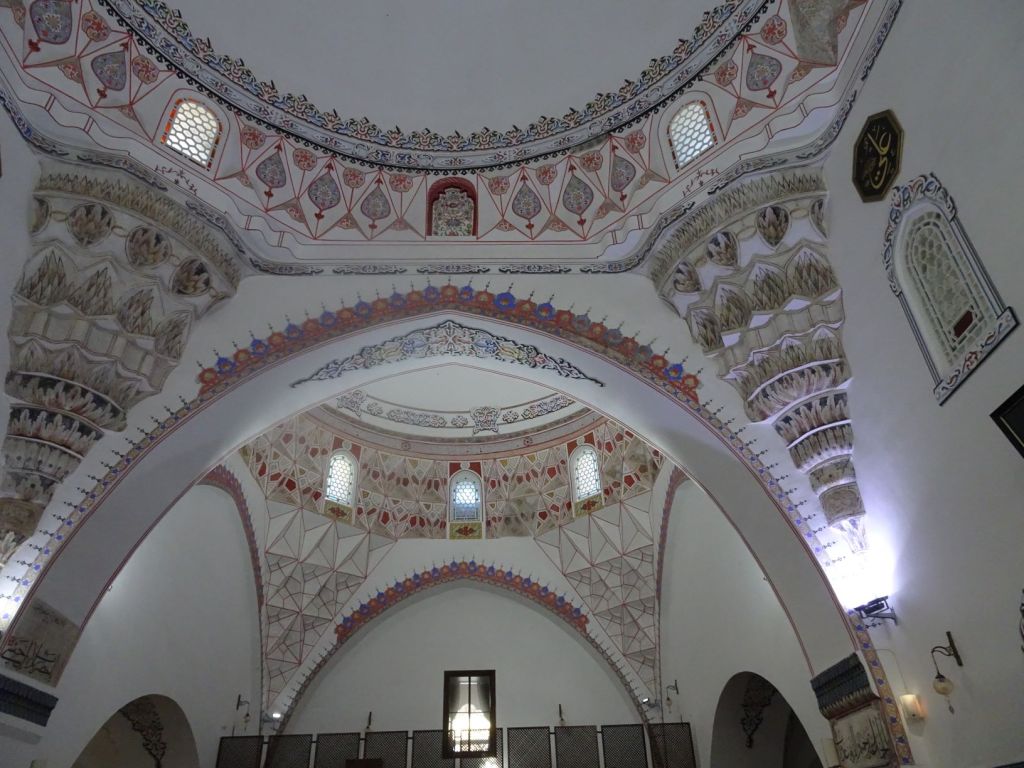
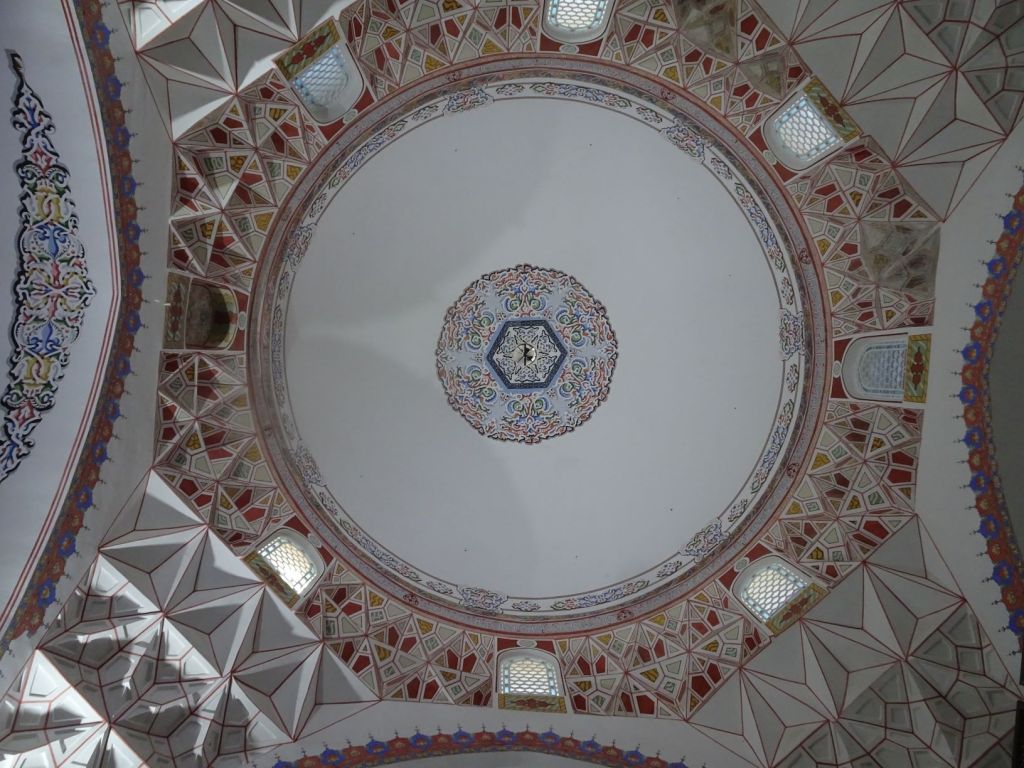
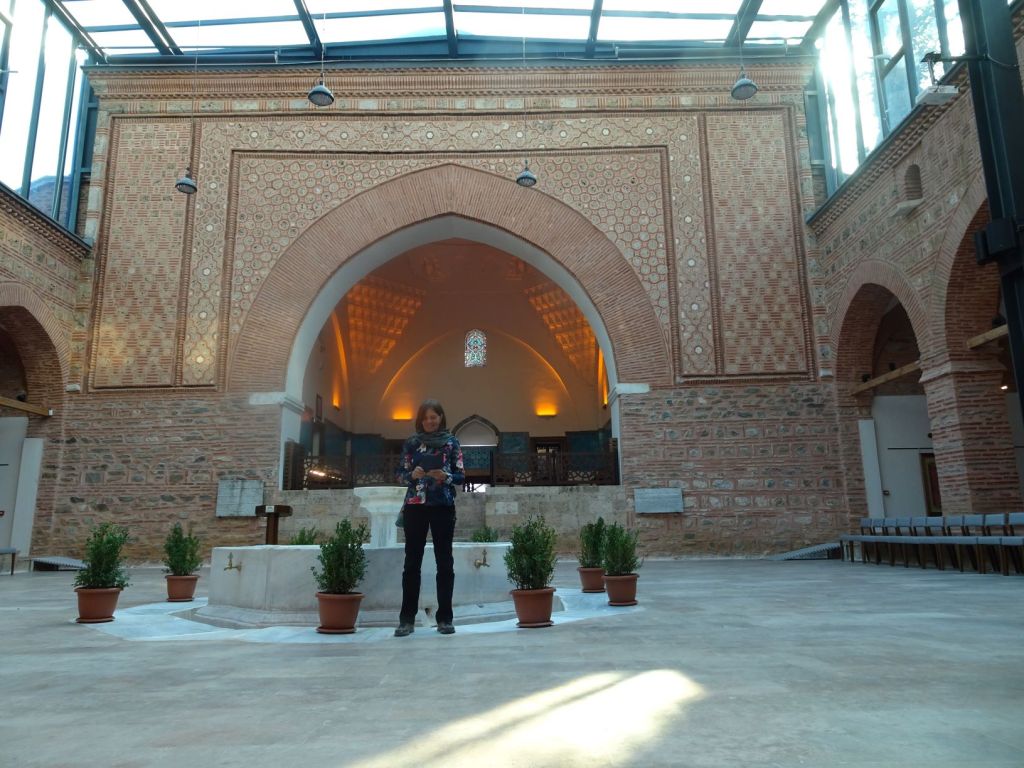
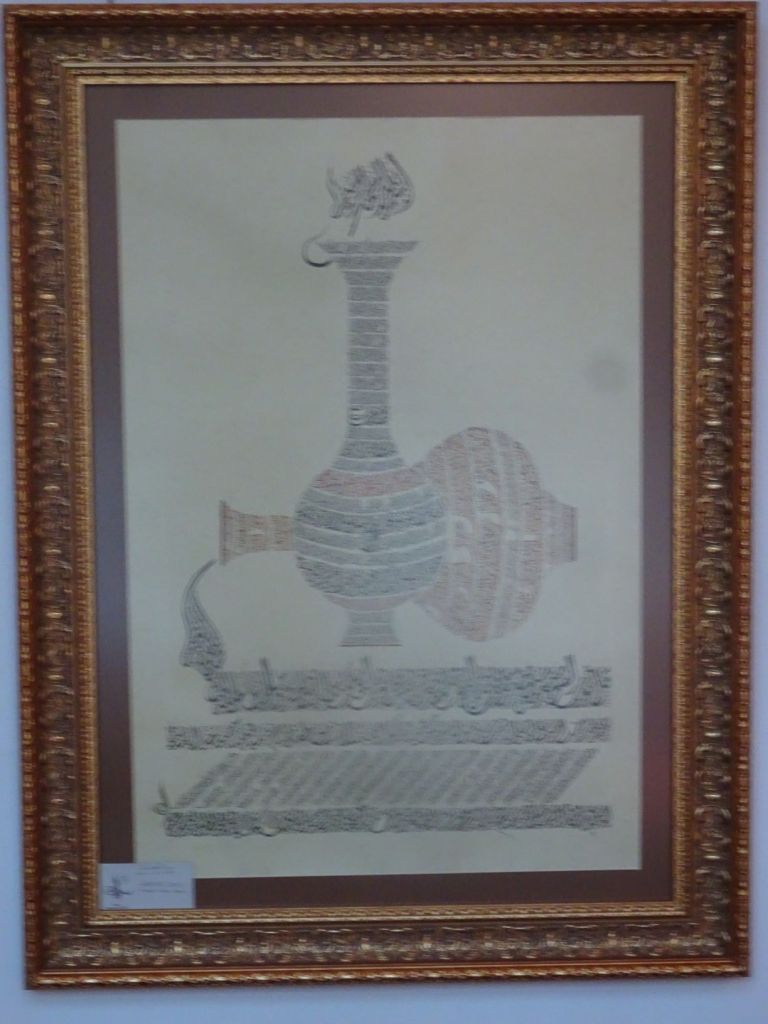
After visiting a number of mausoleums for former sultans, we visit a former hospital that has been turned in to a calligraphy museum.
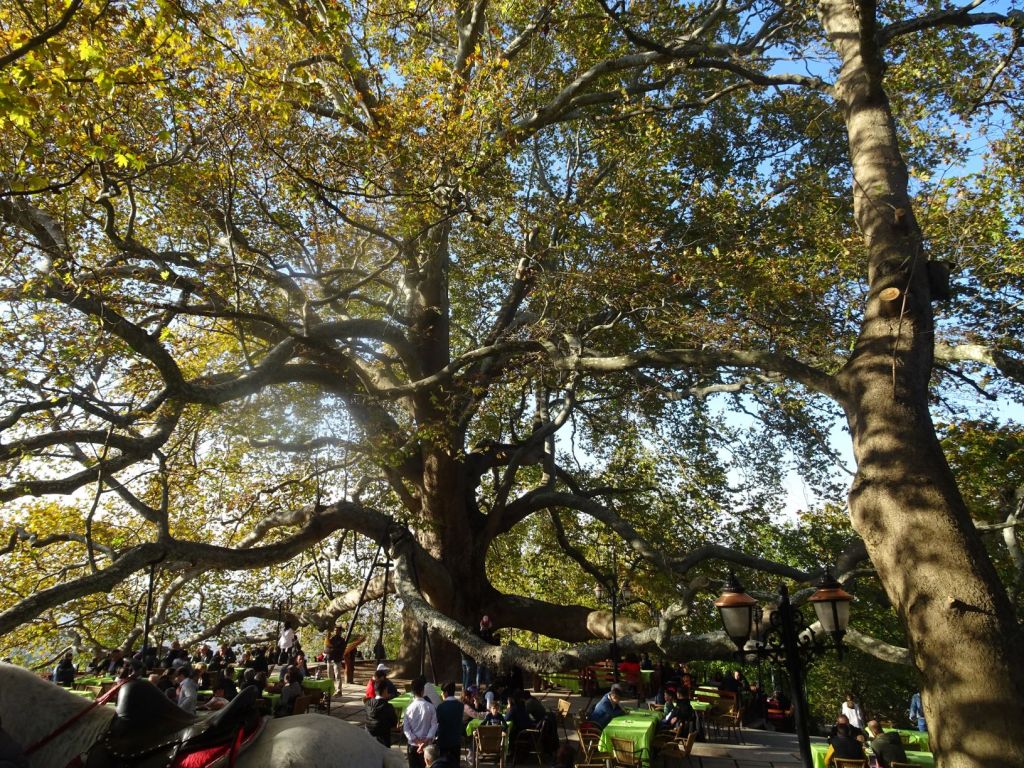
For lunch, Mustafa takes us up the hill on the flanks of Mount Uludag where there is a restaurant around a 600 year old Plane.
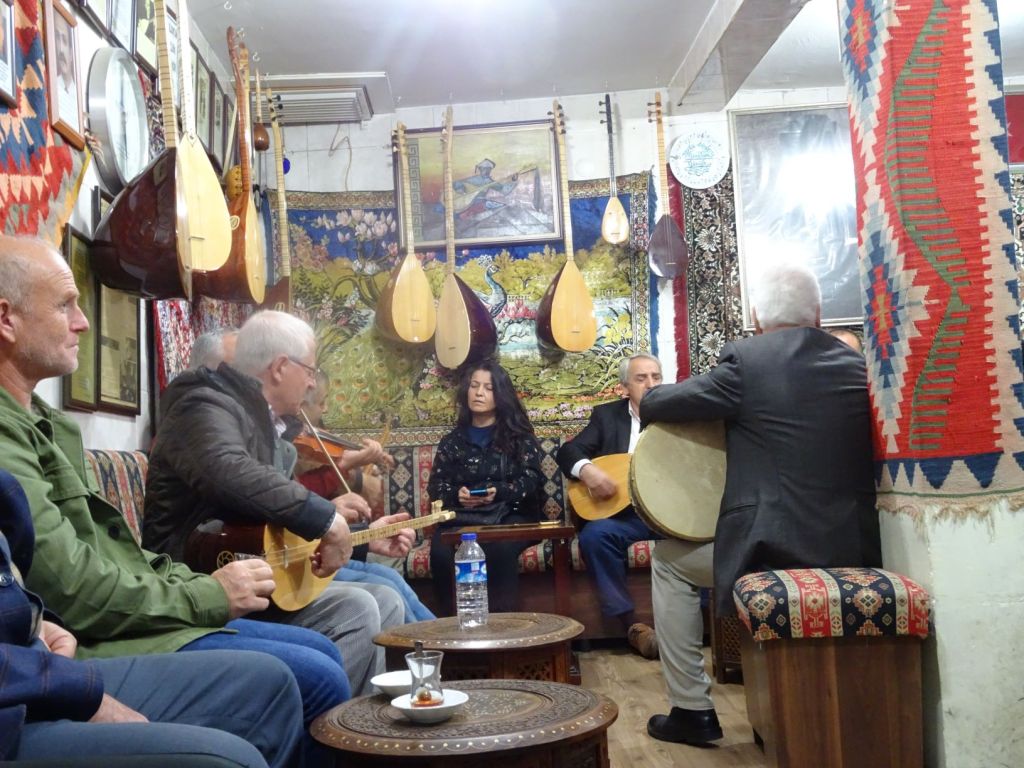
In the afternoon he takes us to a little café where people can play folk music. You choose your fellow musicians from the people who are there and the instruments are provided.
We visit the Green Mosque, the Turquoise Mausoleum, and several other buildings; we can hardly take it all in. Mustafa takes us round at such an enormous pace! He knows all the short cuts, all the buses to take, and all nice places to visit, big and small.
After dark, Mustafa takes us to the ‘Blue Mausoleum’. We thought we had seen it all, but are overawed yet again by the spectacle.
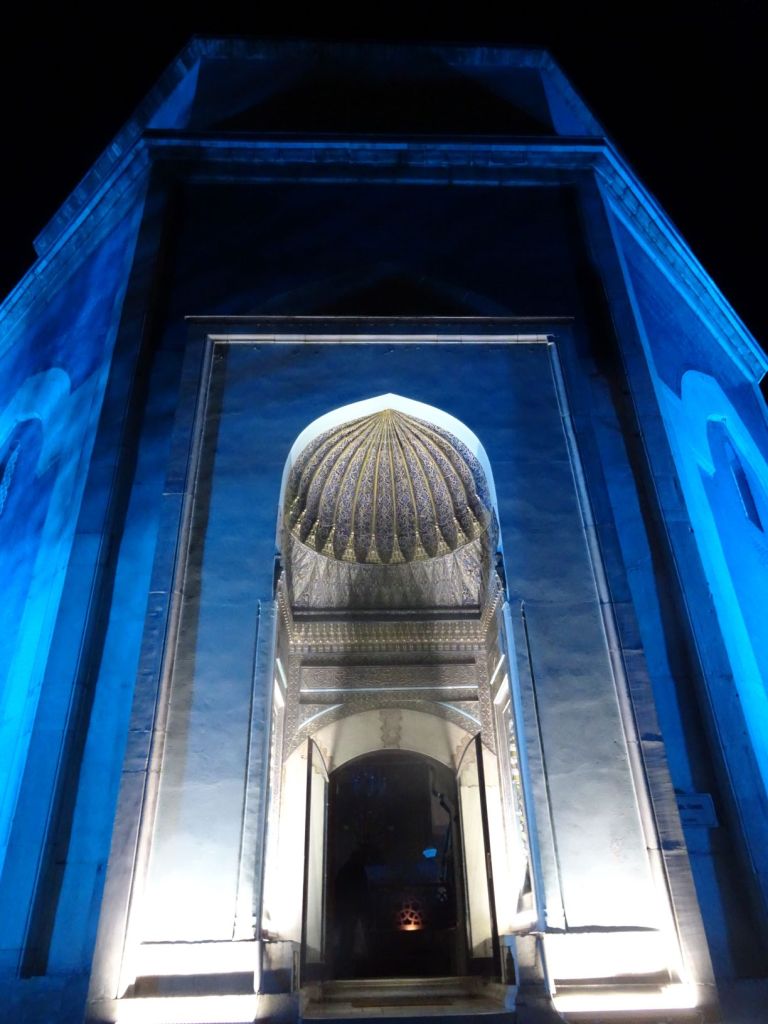
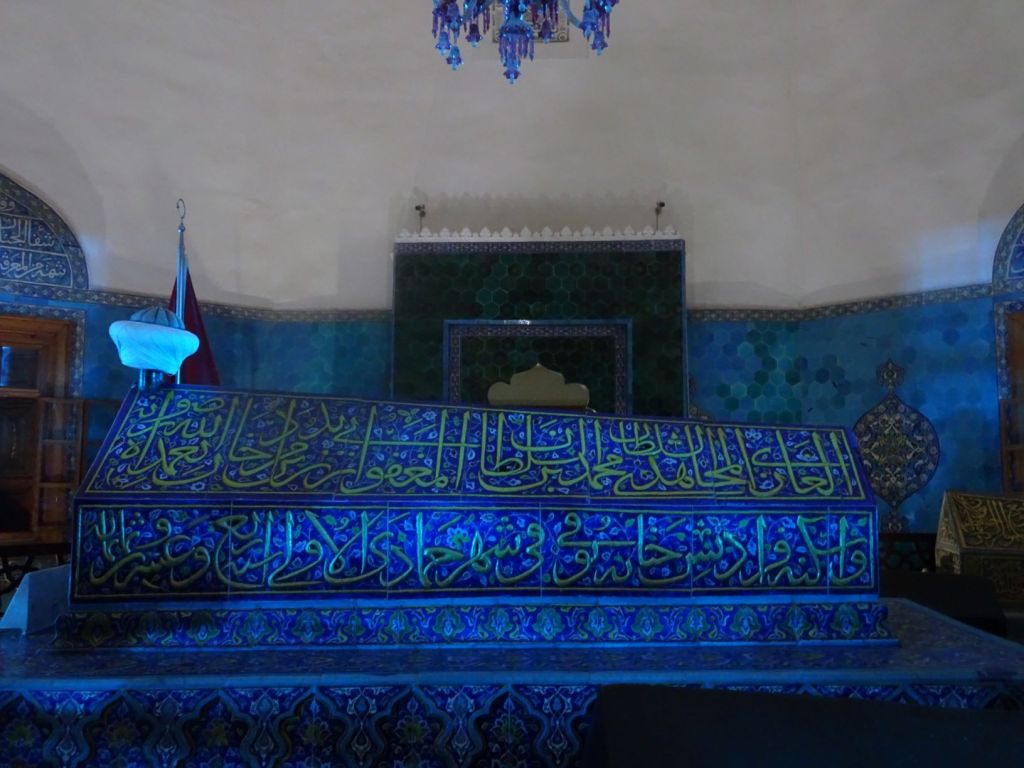
We find our way to the police station to collect Miep’s phone and go back home to the Mog.
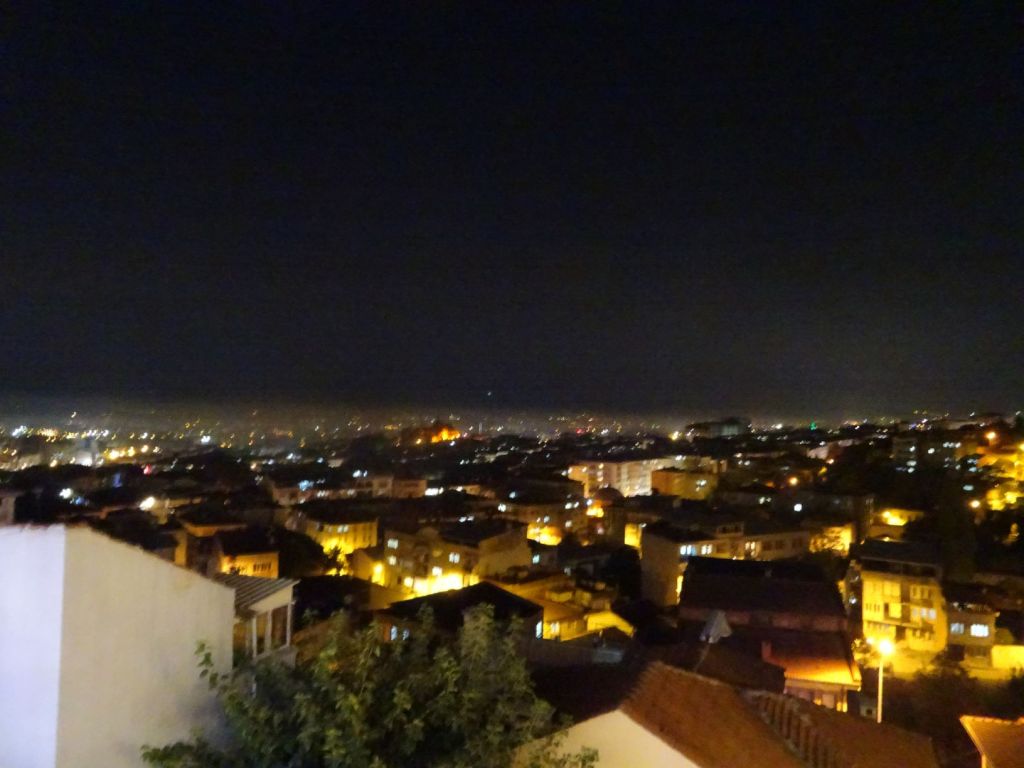
When we get back to the Mog, it is surrounded by people who live in the small street where it is parked. They want to see inside, and want us to visit their homes to have tea and nibbles. We get a pair of slippers as a present from one family. Husseyn is beaming: “We are all friends!” he exclaims.
Totally exhausted, we finally go to sleep.
November 4
We wake up in the small street opposite Husseyn’s garden.
Husseyn is around already, to make breakfast again but now in his back garden!
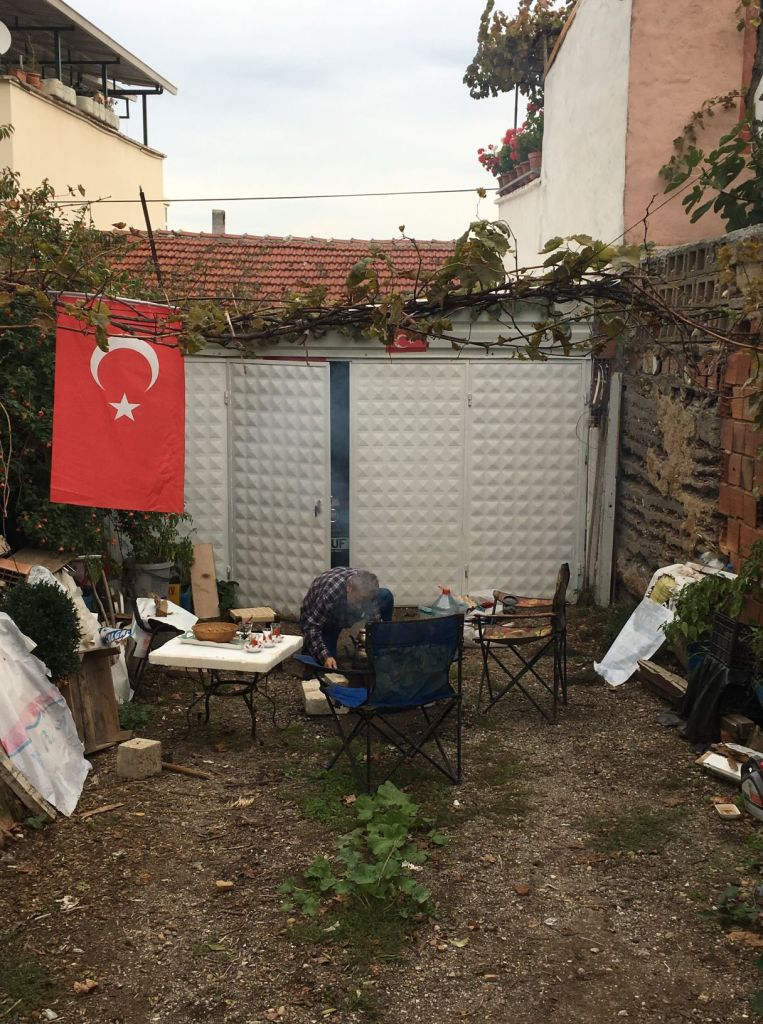
Husseyn makes tea on an improvised stove in his garden. It is amazing what comes out of his garage. We are treated to endless cups of sweet tea and all kinds of biscuits. Proudly he shows us his Fiat Doblo in his garage. He shows us the potatoes, onions, mint and peppers that still are to be harvested.
This is a happy place; it is amazing to see how much you can do with so little.
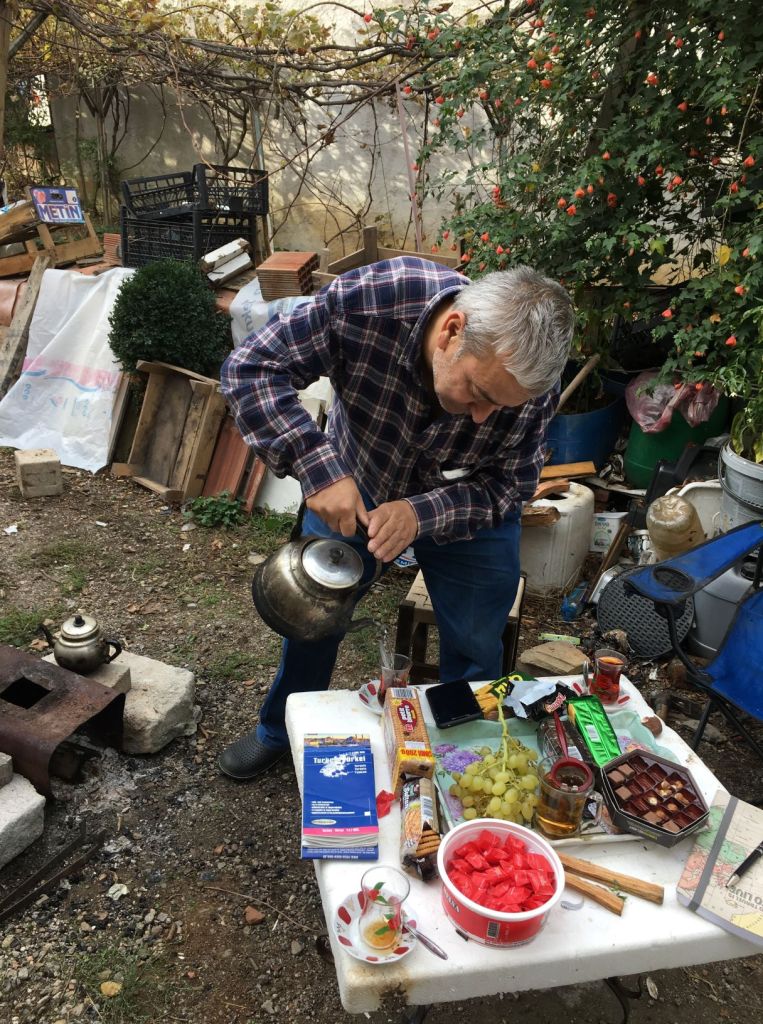
Reluctantly, we say goodbye to this lovely man and his family. More presents. Just before we get in to the car Husseyn shows us his last message to us on his phone with help of Google translate:
‘WE HOPE YOU COME BACK’
It is a short drive to the Sea of Marmara where we find ourselves a nice spot to camp. Roelf does a bit of fishing and lights the first campfire on this long trip: freedom at last!
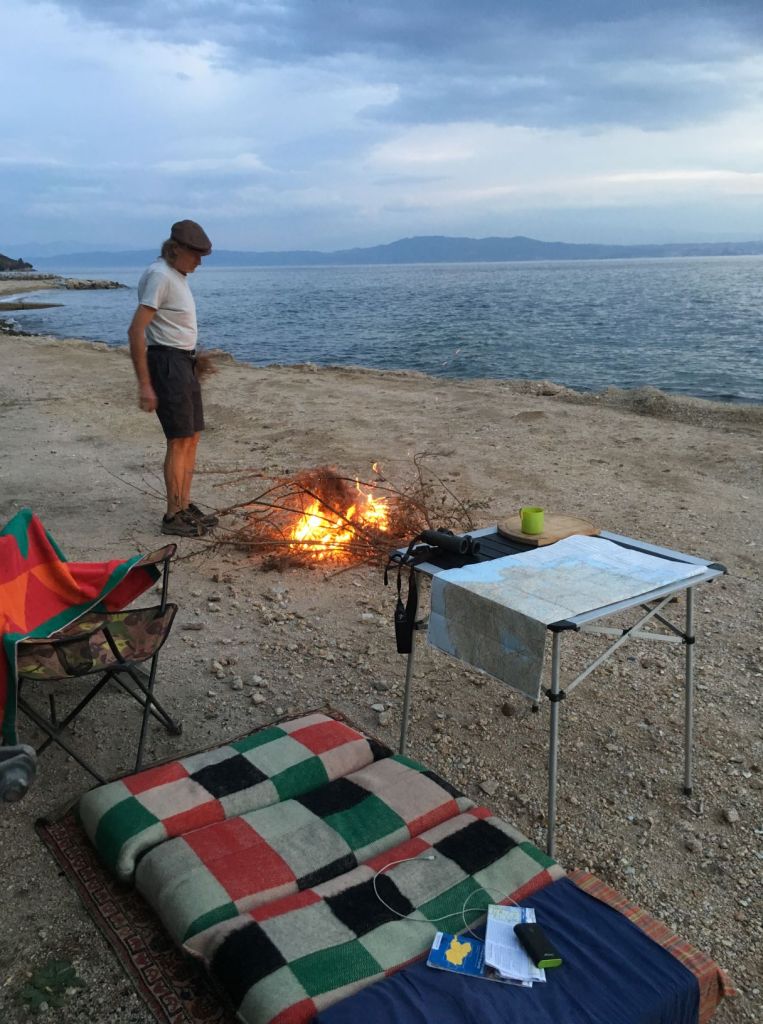
We eat bread and cheese and drink wine we bought in a small shop nearby.
November 5
It was on the cards for a couple of days; Miep’s mother is increasingly unwell, and at the age of 94, we should seriously consider going home quickly if we want to see her before she passes away.
We therefore decide to go home in one single swoop. The drive around the Armutlu Peninsula is beautiful with fantastic views over the Sea of Marmara.
To get past Istanbul, it seems inevitable that we have to pay toll, and toll will be required on the bridge across the Bosporus also. It says on the internet that a vignette is needed for vehicles > 3500 kg. Therefore, we turn off in Yelova to get a vignette at the post office as it says on the government website you should do. It turns out that the only post office that sells vignettes is right in the centre of town. Roelf stays in the Mog while Miep goes out to the post office. It does not take long before Roelf is approached by police; cars of > 3500 kg are not allowed in the city centre!. Whilst Roelf is being interrogated and asked for his papers, Miep is stuck in an endless queue in the post office. And Miep has all the papers. Finally a policeman decides to go and find Miep in the post office and with the help of an interpreter the situation is explained. The police can see the odd site of having to go in to a town centre where cars of > 3500 kg are not allowed, to get a vignette for cars of > 3500 kg!. We are advised to avoid the Istanbul bottle neck by taking the ferry from Yelova across the Bosporus. Normally this ferry is for cars < 3500 kg only, but the police escorts us to the ferry terminal and negotiates our place on the ferry. Another example of hospitality, this time by an official agency.
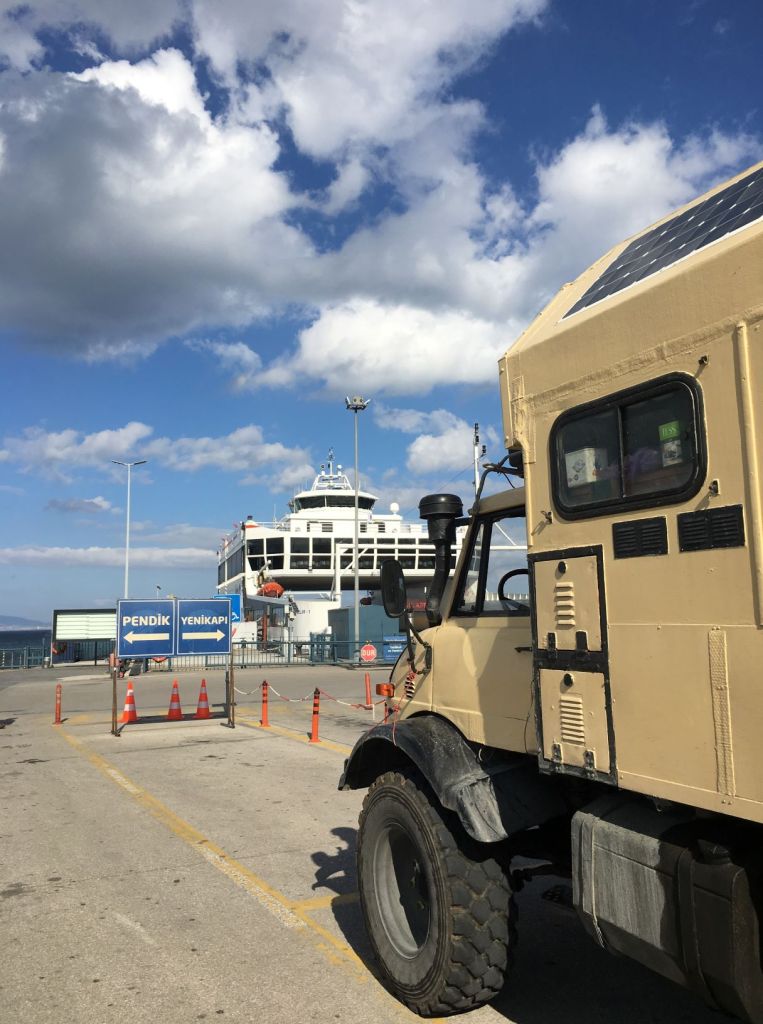
It is a wonderful day and a very enjoyable ferry crossing to what would be called Europe by any of the existing definitions for the border between Asia and Europe. We see dolphins, pretty little islands, and all the while, Istanbul in the distance.
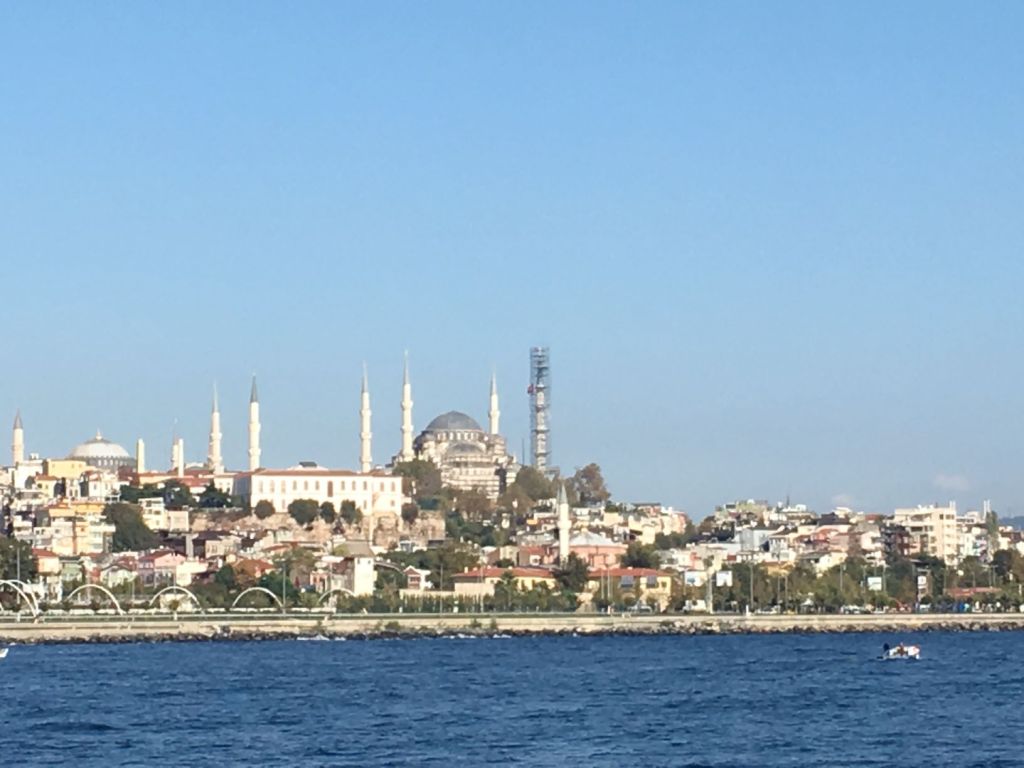
The ferry docks well west of the Bosporus bridge which saves us a lot of time. We are now in Thrace. It is easy to find the road north to Edirne but it takes two hours before we are beyond the suburbs of Istanbul (total population 17 million equal to the population of the whole of the Netherlands!).
We reach Edirne at about 8pm, and park up next to a supermarket. We spend out last Turkish lira in a wonderful sweet shop called ‘Mevlana’, ‘he who always thinks about God’ (Rumi again).
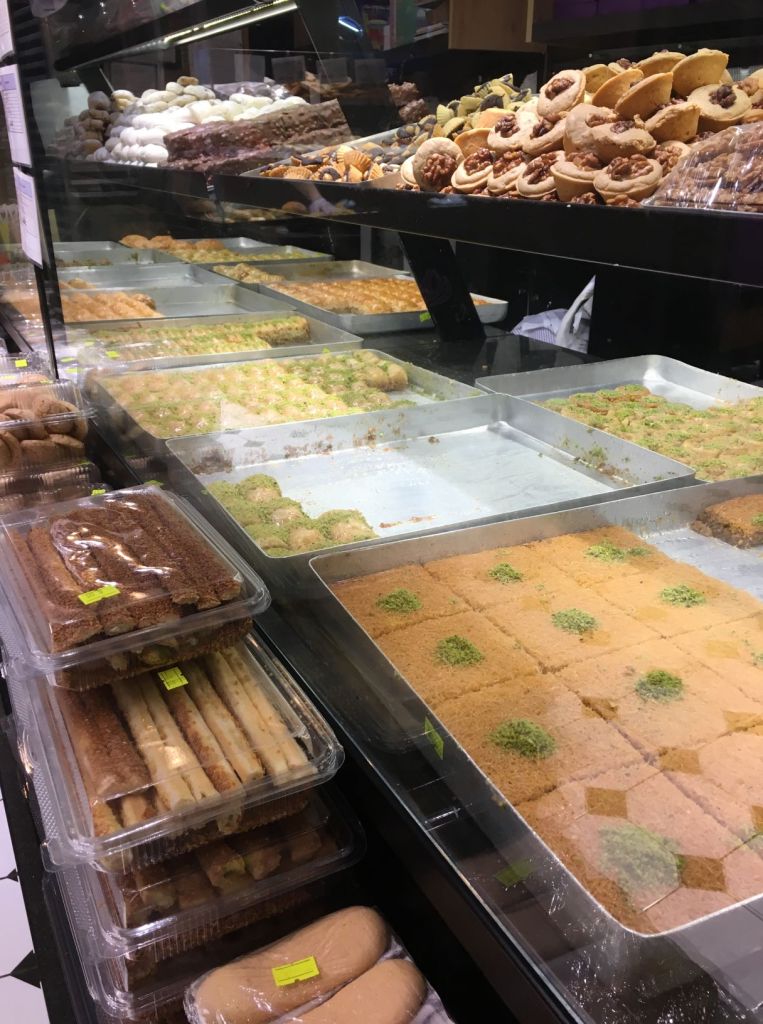
After extensive tasting, we choose the biggest box and ask it to be filled with a mix of Baklava sweets. They are impressed with our purchase and give us free tea and more sweets to enjoy. The owner is gleaming!
November 6
We wake up to a damp cold morning, but the sun comes through and burns the moisture away. We watch two women sorting piles of rubbish, separating wood, plastic and glass. When the bin lorry arrives to empty the container at the supermarket, it has already been ‘raided’ by these ladies and is half empty. An old truck arrives to take the bags of assorted junk. Several people seem to make a living out of this. It reminds us of the scene at Harwich at the very beginning of our trip when we witnessed trucks full of plastic waiting to board the ferry and dump our British waste elsewhere. Waste, in particular plastic bottles has been a returning theme wherever we went on our journey.
Driving out of Edirne, we see some beautiful old Ottoman buildings. Edirne served as the capital of the Ottoman Empire from 1369 to 1453 after Bursa and before Constantinople which was the empire’s final capital between 1453 and 1922. This certainly looks like a city we should come back to one day.
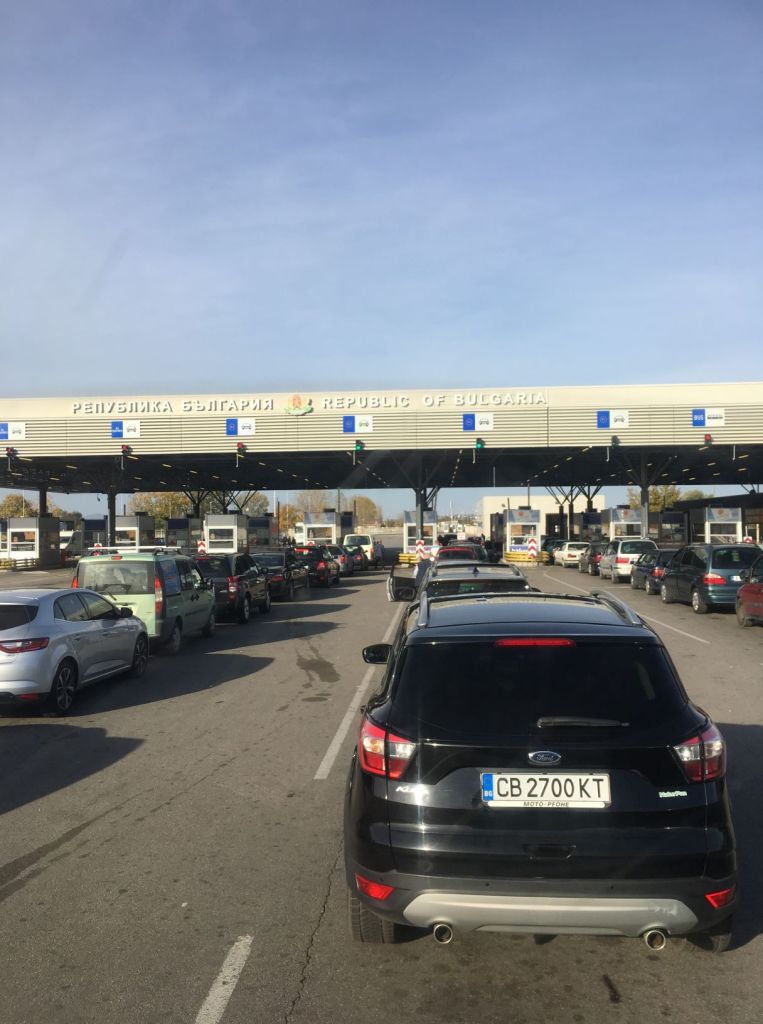
At the border with Bulgaria, we wonder if this will be the first time we have to unpack the Unimog. After all, we are now entering the European Union and there is plenty of space in the Mog to hide migrants. But yet again, as soon as the custom officer looks inside, he decides to leave it and wave us through. This is in sharp contrast with the trucks waiting to cross; we once counted a queue of 8 kilometers long; maybe that is what we will see in Dover soon.
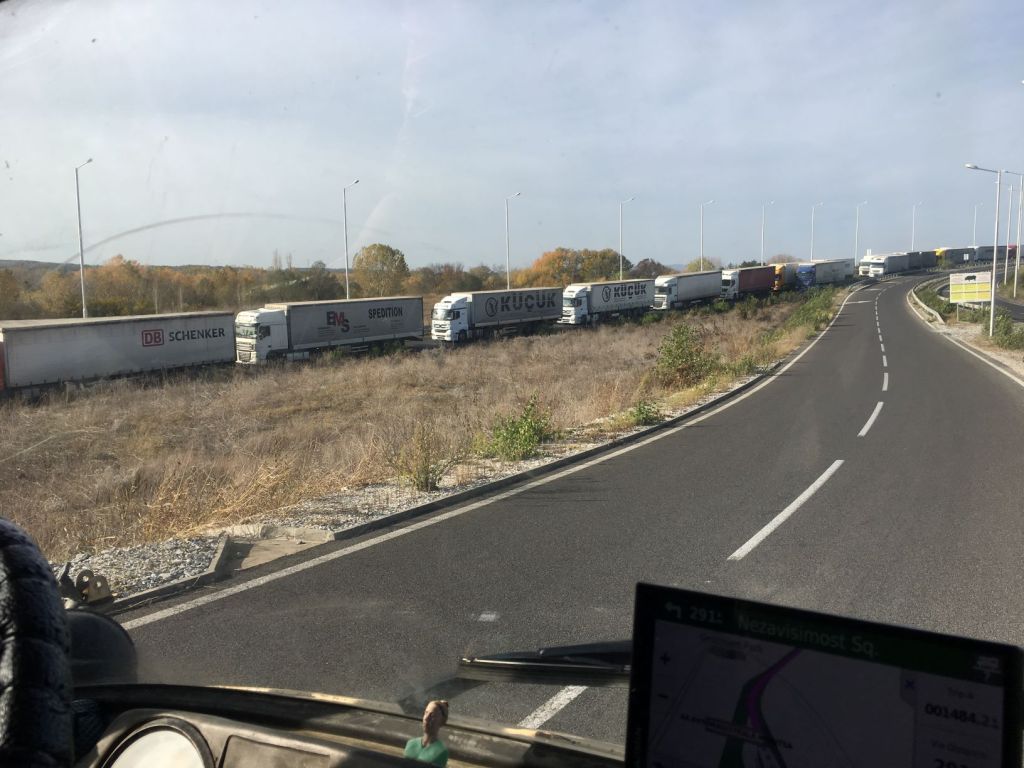
We drive day and night and pass through Bulgaria, Serbia, Hungary, Slovakia, the Czech Republic and Germany to reach Miep’s mother’s home in Zuidlaren, the Netherlands at noon on 9/11/2019. The Mog is starting to creak and it later turns out we had broken several bearings in the hub of the right front wheel hub. But we made it back and we are able to be with Miep’s mum and care for her until she passed away exactly two weeks later. We thankfully were able to show her, a master in embroidery herself, some of the wonderful things we had seen and brought back from our journey. When we left on this trip she told us that this trip would fill our heads with memories and inspiration for life. How right she was!


 Central Asia Roadtrip
mooie laatste aflevering van jullie blog met een gedenkwaardig einde
LikeLike
Heel bijzonder hoe jullie ook in Turkije overal zo gastvrij onthaald worden. Inderdaad gênant en in schrille tegenstelling met hoe gereserveerd en ongastvrij wij ons gedragen tegenover vreemdelingen, zeker als ze uit een islamitisch land komen. Reden te meer om zelf eens goed in de spiegel te kijken. Een mooi slot van een bijzondere reis, die we dankzij de blog van dichtbij hebben mee beleefd. Bedankt.
Gerard & Aukje
LikeLike