September 24
We drive south today past Qom and onwards to Kashan, an oasis town. It is very hot. We decided earlier that we would not visit Qom, although it is a famous city in Iran. Second only after Mashhad in religious importance.
The old Shia saying attributed to the Imam Musa al-Kashmir in 799: “A man will come out from Qom and he will summon people to the right path” was widely circulated in Iran in the 1970s.
Qom was the place where Ruholla Khomeini (1902 – 1989) studied and lectured before he became actively involved in the opposition to the Shah’s regime in the early 1960s. At the time of the circulation of this saying Khomeini was a messianic figure in Iran despite living a total of 14 years in exile. Mosques were celebrating that his face could be seen in the moon at night!
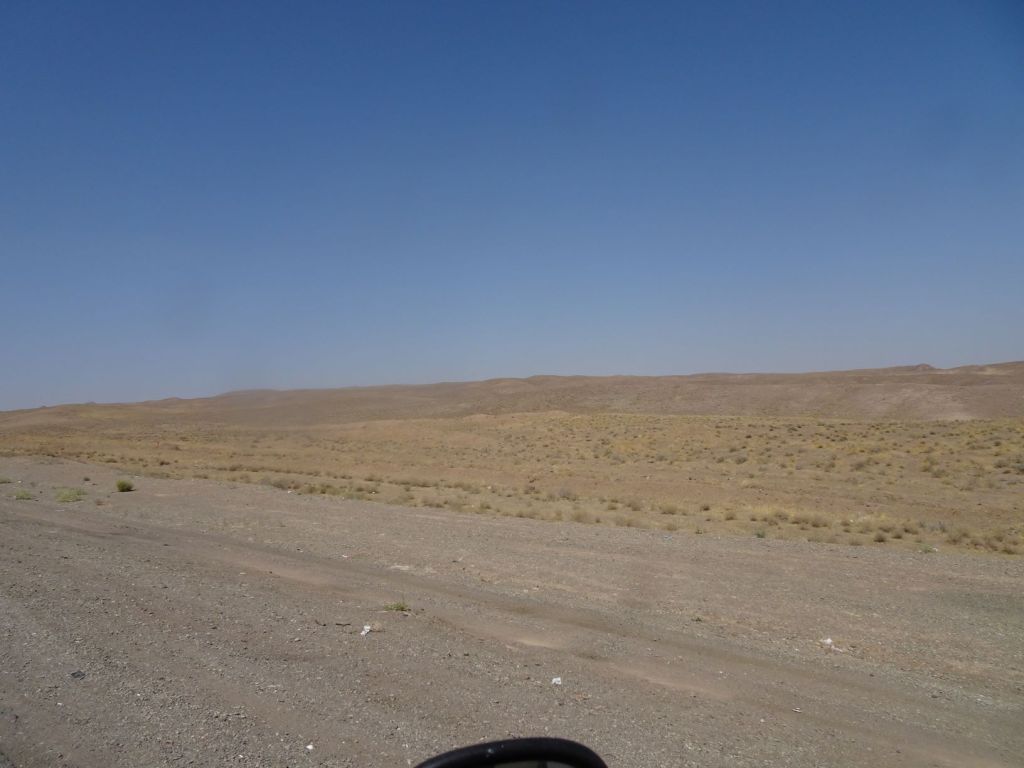
We drive past the Imam Khomeini shrine, close to the Teheran airport, which is still under construction and looks huge. Soon after we pass the city of Qom, but we move onwards into the desert. This is a real sand pit without plants. It is flat initially but then the mountain range in the West comes closer. Beautiful landscape.
We reach Kashan just after 3 pm and drive to the old town where we park up. It is dead quiet. People here do not venture out during the hottest time of the day, only tourists do!
Archeological discoveries have shown the region of Kashan is one of the primary centres of civilisation in pre-historic ages. It dates back to the Elamite period of Iran. By some accounts, Kashan was the origin of the three wise men who followed the star to Bethlehem to witness the birth of Jesus.
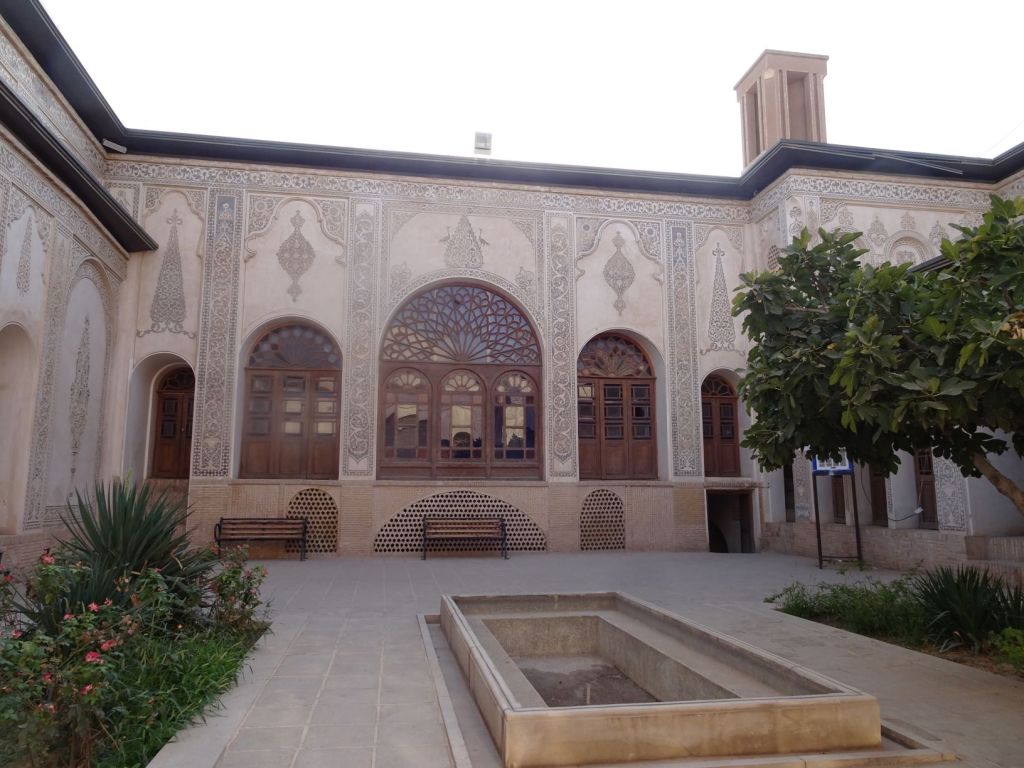
There are many old houses you can visit here. Some are made into hotels or restaurants, others are just monuments. Extensive restauration work is underway in most. Walls are covered in plaster decorations, stucco, and we see a man carefully filling in missing parts. There are courtyards with ponds (now empty) and fountains and spaces with coloured glass in lattice woodwork, all incredibly complex and there to show off the wealth of the owners (usually rich merchants). There are also fine painted and tiled decorations on the ceilings.
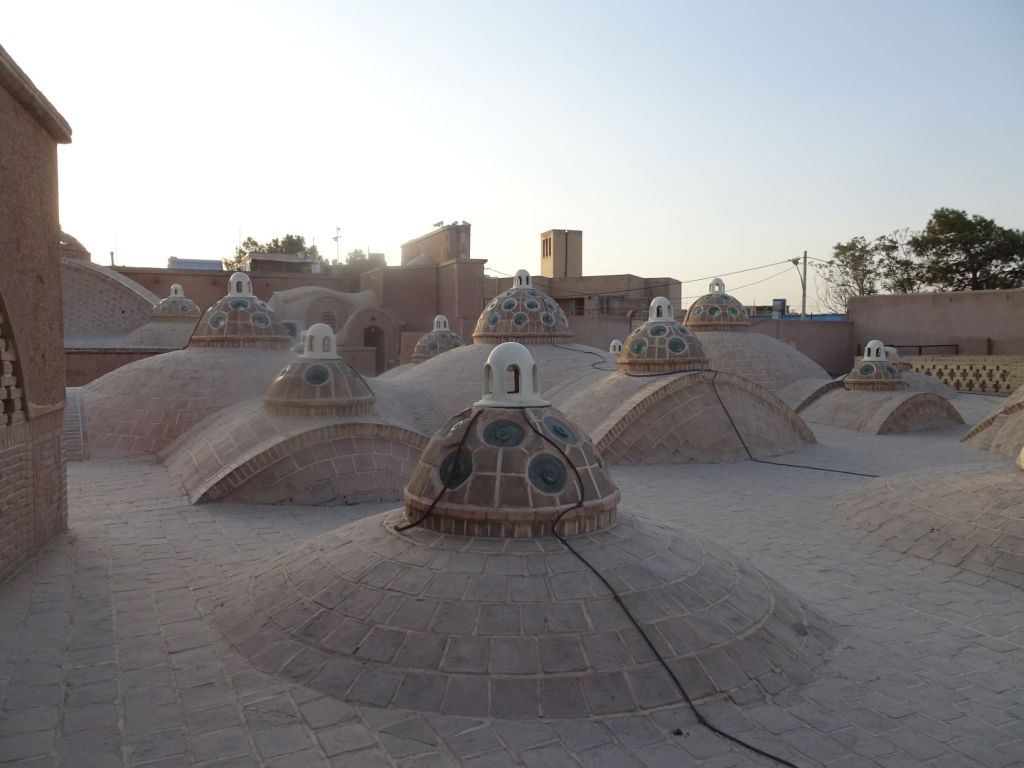
We also visit a former bathhouse where we are allowed to go on the roof. Its roof structure is interesting, but even more interesting is to see all the roofs of the old city. They have small chimneys to allow the slightest breeze from the desert to be caught and help to cool the house.
It is the end of September and 36 degrees. We cannot imagine how people live here during summer. We go to the bazar hoping for a cold drink and some shade. It is getting busier; people are coming out end of the afternoon.
We have the best milkshakes we ever had melon milkshake. We immediately have a second one.
Two young guys ask us to come into their carpet shop. They explain how they took this over from their dad who inherited it from his father. Apparently, this is how it goes with locations in a bazar. They are hard to get and passed down the generations. These two have a team of carpet weavers and commission around 20 silk, or silk and wool, carpets per year. They only sell 2 however. They explain how their trade has suffered since the latest sanctions. Their grandfather would sell 20 carpets per month! The carpets they have on display are absolutely beautiful, but we are not looking for one. We did not take pictures unfortunately. One is olive coloured with salmon tones, really unusual.
Then we go back to the car, a long walk and Roelf is developing a blister on his foot. We drive to our camping spot, a carpark next to a garden (Fin Garden) we will visit tomorrow. This one is again adjacent to a busy road. Just as well we are tired and sleep through all the noise.
September 25
Kashan was a leisure vacation spot for Safavid kings. Fin Garden was designed for Shah Abbas I as a classical Persian vision of Paradise.
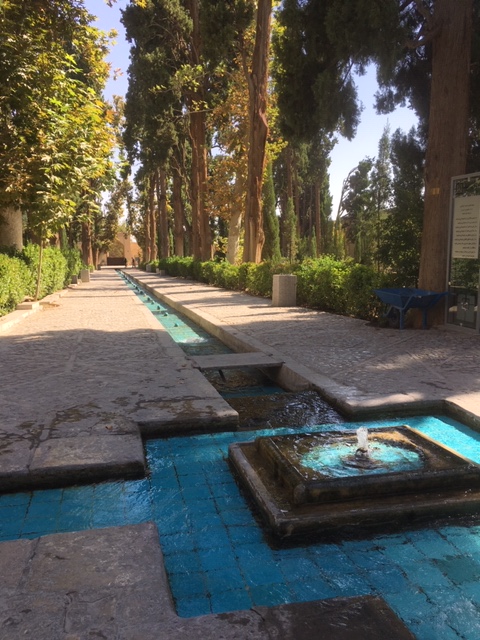
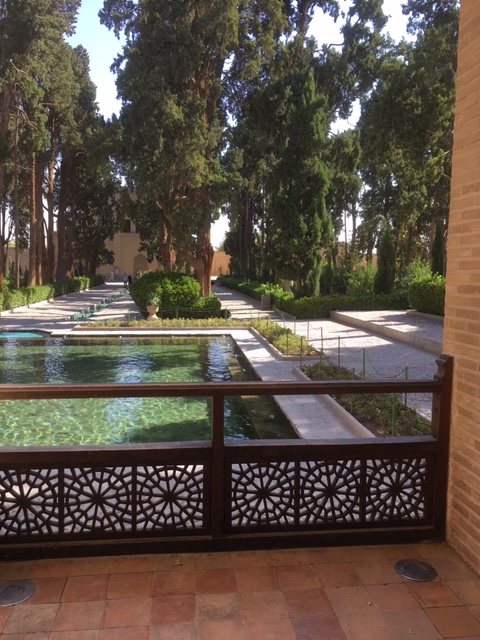
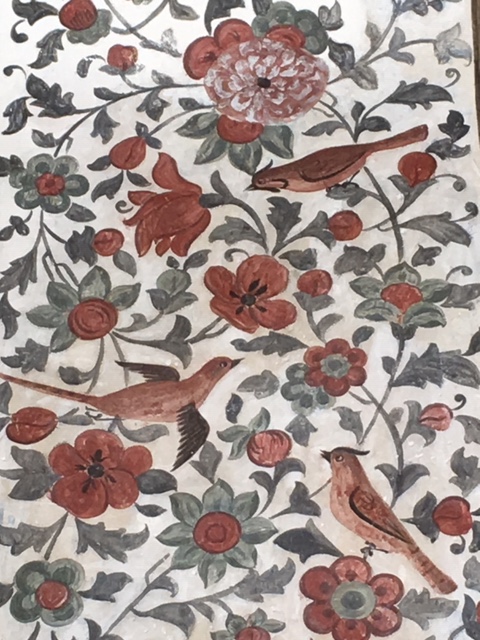
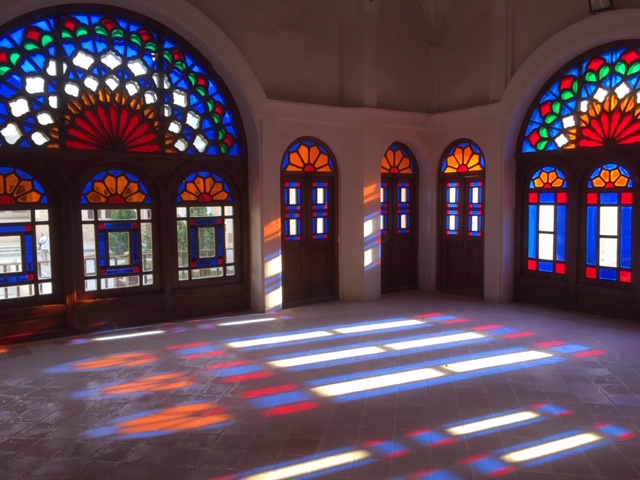
Fin Garden is gorgeous! Water comes from several springs and is led through channels and ponds down the slope. There are ceramic pots in the channels that let the water through so it bubbles up everywhere. There are pavilions for shade, again beautifully decorated with lattice work, stained glass and tiles. The painted ceilings show birds and flowers, the real Persian style. The trees provide good shade and must be quite old. The springs are so powerful that they provide this part of Kashian with drinking water too.
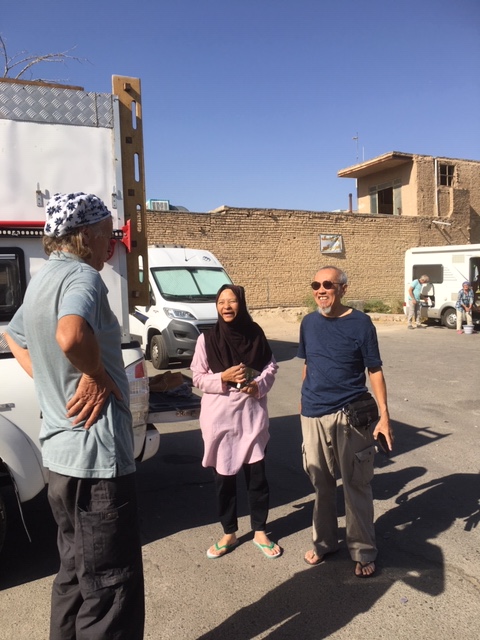
Before visiting the garden we have spent some time with a couple from Malaysia who were camped in the same carpark. They have built their camper, on a Ford pickup truck, all by themselves. He used to be a lecturer in interior design and is so happy to be free now he is retired: ‘no more deadlines!’. This seems to be a universal feeling with former academics. No more curriculum reform, no more assessments, free at last! They have been travelling since May and are on their way to their son who lives in Manchester. Perhaps we may see them again in the post-Brexit UK? They are an inspiration. Totally self-sufficient.
September 26
Our next stop is Isfahan and we set off at 11. The drive goes through desert, but now there are mountains on both sides of the road as we climb into the Zagros Mountains. We reach 2000 metres at one point.
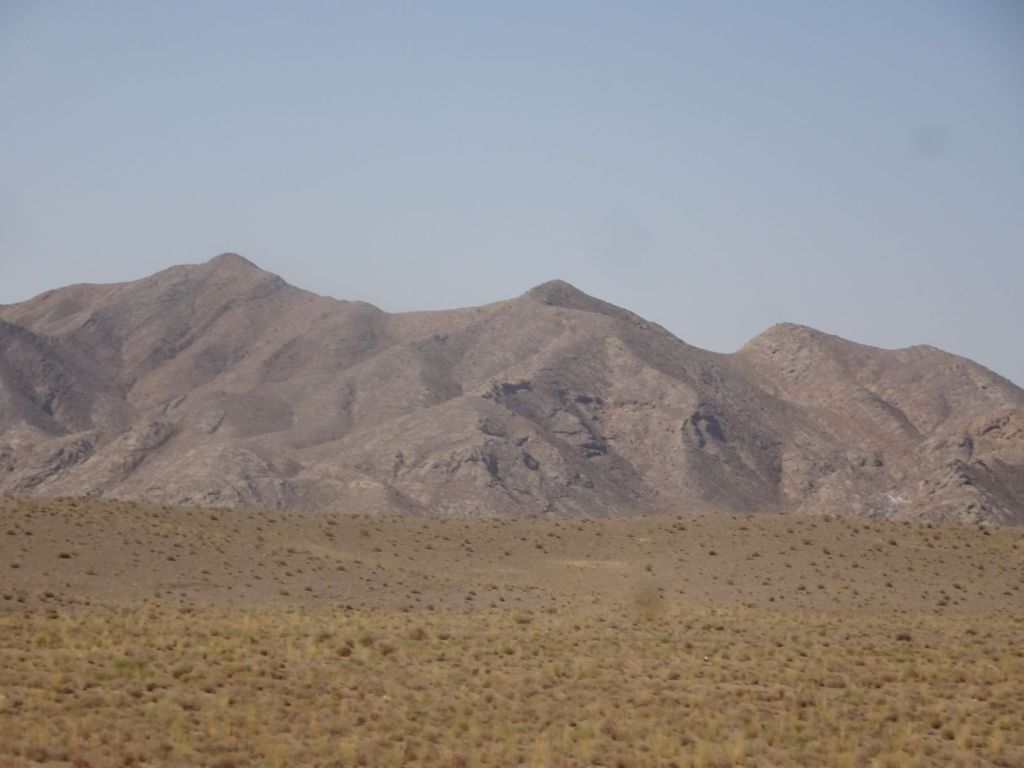
Then descending again to reach Isfahan which lies at about 1500 metres. It is very hot again and without airconditioning in the cabin of the Mog we find it tough going. The seats and all the black coverings in the cabin on doors and on the engine cover heat up and are too hot to touch. Roelf sits covered in a foil sheet when he drives to not burn his bare legs. Miep is covered in clothes and headscarf, so very protected, but possibly even hotter underneath.
When we stop briefly on the roadside the car won’t start again. This is a problem; we are slightly up hill and cannot push it. We have to flag down some help which thankfully arrives shortly. Two men from Shiraz come to push and the Mog roars into action. We stop another time on a hill to test the start button, no response! We must drive on and when we reach Isfahan, we park at the back of our cramped camping spot behind a hostel so that we will have some space to push the Mog in case Roelf cannot find the fault. We remember to take out the handbreak pin this time. A bit more difficult to reach now that the spare wheel is underneath the car, but thankfully still accessible. We leave the car issues till tomorrow and go for a walk round town.
Isfahan was made the capital of Persia in 1598 by Abbas I, the most successful ruler of the Safavid Dynasty.
The Safavids ruled Persian from 1501 until 1722 with a brief restoration by Nader Shah from 1529 until 1536. After 1536 Nader Shah took over as Shah and made Mashhad the capital.
The Safavid Dynasty is significant because it established Twelver Shia Islam as the state religion of Iran, and it reasserted the Iranian identity of the region for the first time since the Sassanid Empire. As such the Safavid period is seen as the beginning of the modern history of Iran.
Today, Isfahan has a population of approximately 1.6 million. This makes it the third largest city in Iran, after Teheran and Mashhad. However during the Safavid period it was one of the largest cities in the world. It still has much of its glory with gardens and boulevards and its famous Perso-Islamic architecture.
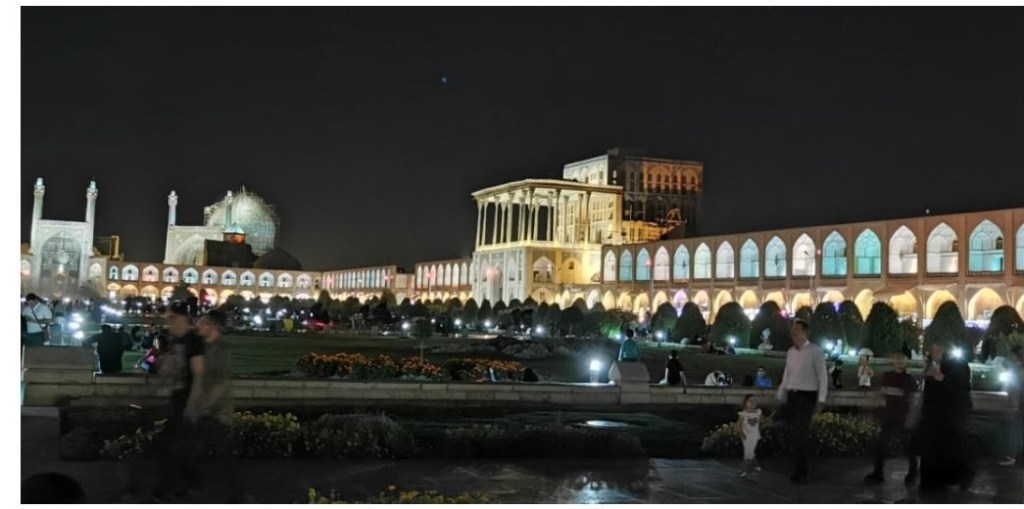
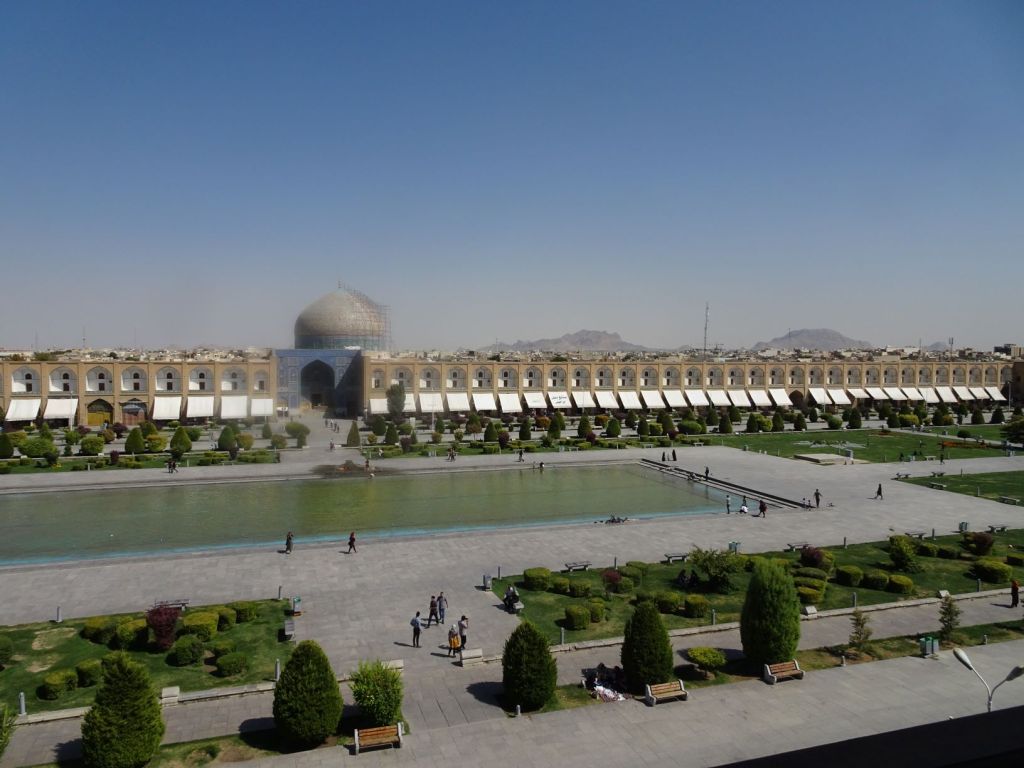
We are right in the centre and can walk to the bazar in minutes. And then we reach the place this city is famous for: the wonderful square built during the reign of Abbas I. Totally symmetry. A grand entrance to the bazar at one end, the Imam Mosque at the other. A beautiful 6 story palace on one of the long sides and opposite that another Mosque. In the middle a large polo field, now with a pond in the centre. All beautifully lit and along all the sides are shops with handicrafts. Hundreds of them, bustling with people. You can spend hours and hours here and we do.
When we are exhausted, we eat in a restaurant just off the square, a former villa where the garden is now an eatery and the house an antique shop. It has great atmosphere. We eat rice and lentils and kebab, all quite simple foods, but tasty. We still have to find the Persian cuisine here, on the streets all you find is fast food as in western Europe. This has been a great first glimpse of Isfahan and we are looking forward to seeing more on our guided tour tomorrow.
September 26
Breakfast in the hostel. A simple affair with bread, boiled eggs and tea, but it is sufficient. We hand in our laundry and Roelf gets to work on the car. He wants to have a go at the starter problem before calling a mechanic. Miep goes with the group for a tour of town. First to see the Friday Mosque, a building built and added to over many centuries.
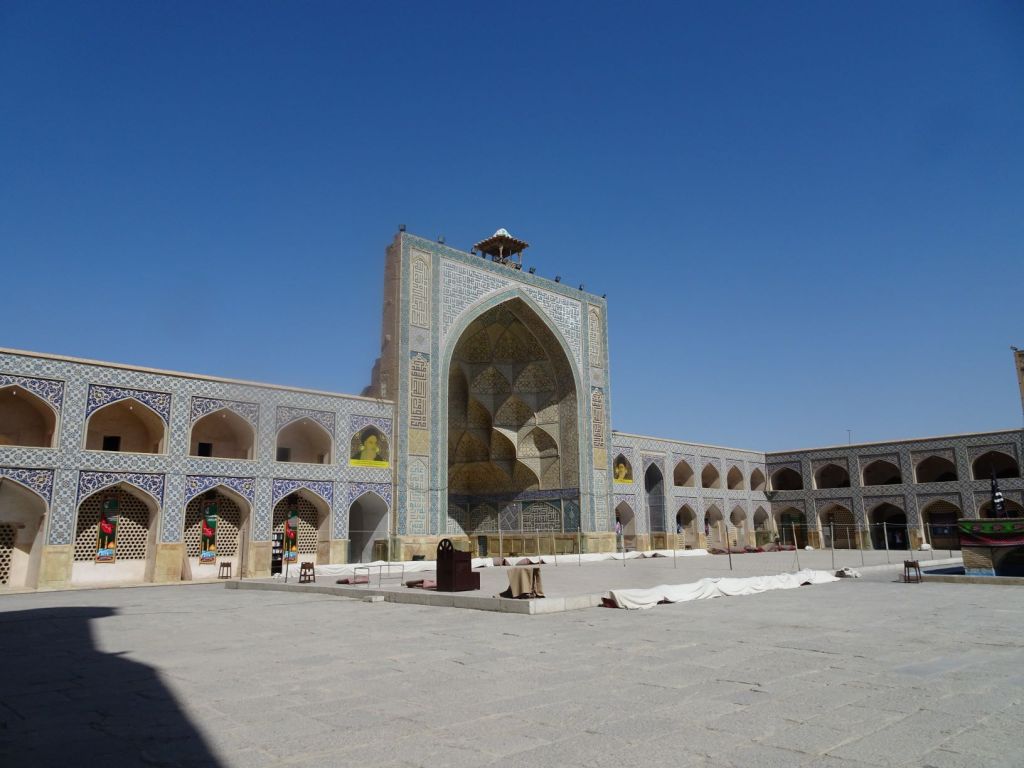
There are elements of more than 1000 years ago. It is a warren of halls and pillars and domes. Some beautifully decorated in brickwork, others painted and some with sculpted elements.
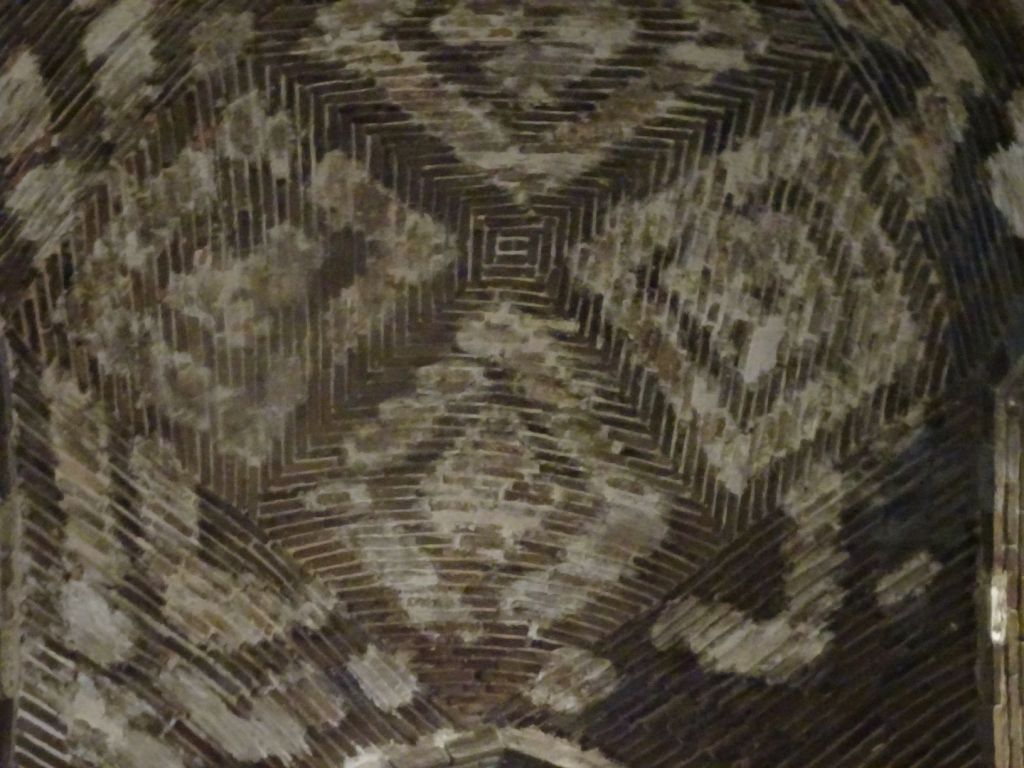
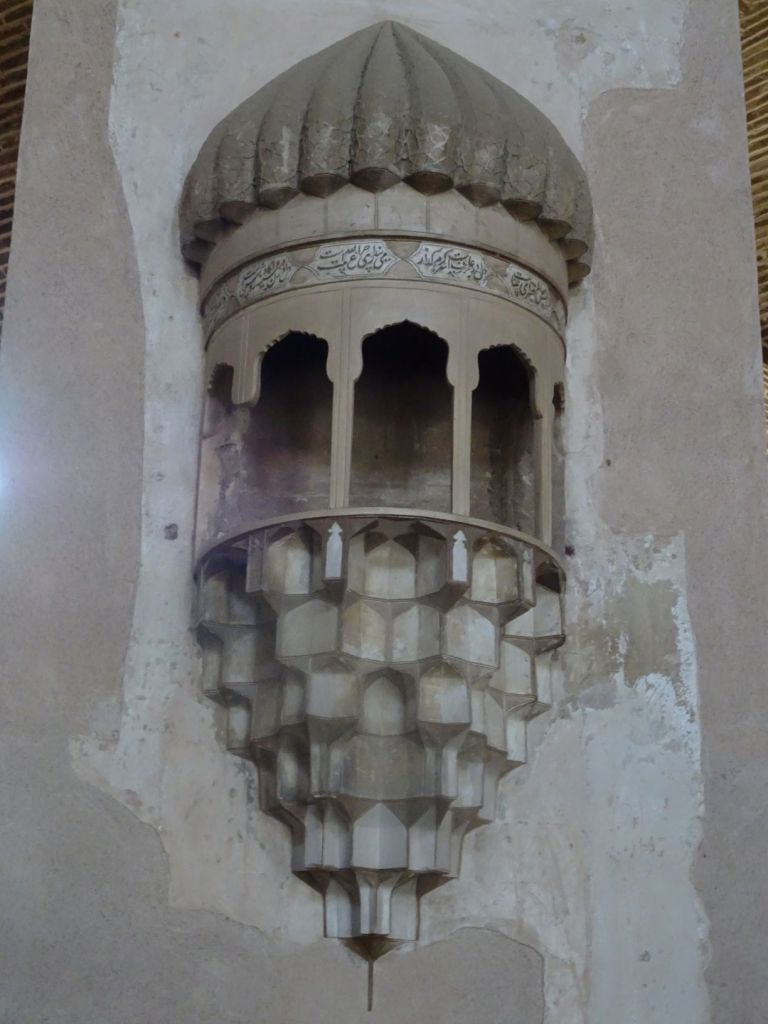
The guide tries to explain it to us, but we are a difficult group, all walking in different directions and he is not good at telling us where to gather for explanations. Never mind, we can admire the workmanship without all the details. What comes through is that a mosque is and certainly was, more than a place for worship. This is a place where people could gather, away from the worries of daily life and just be. It must also have been essential as a place that stays cool all day in this stiflingly hot city.
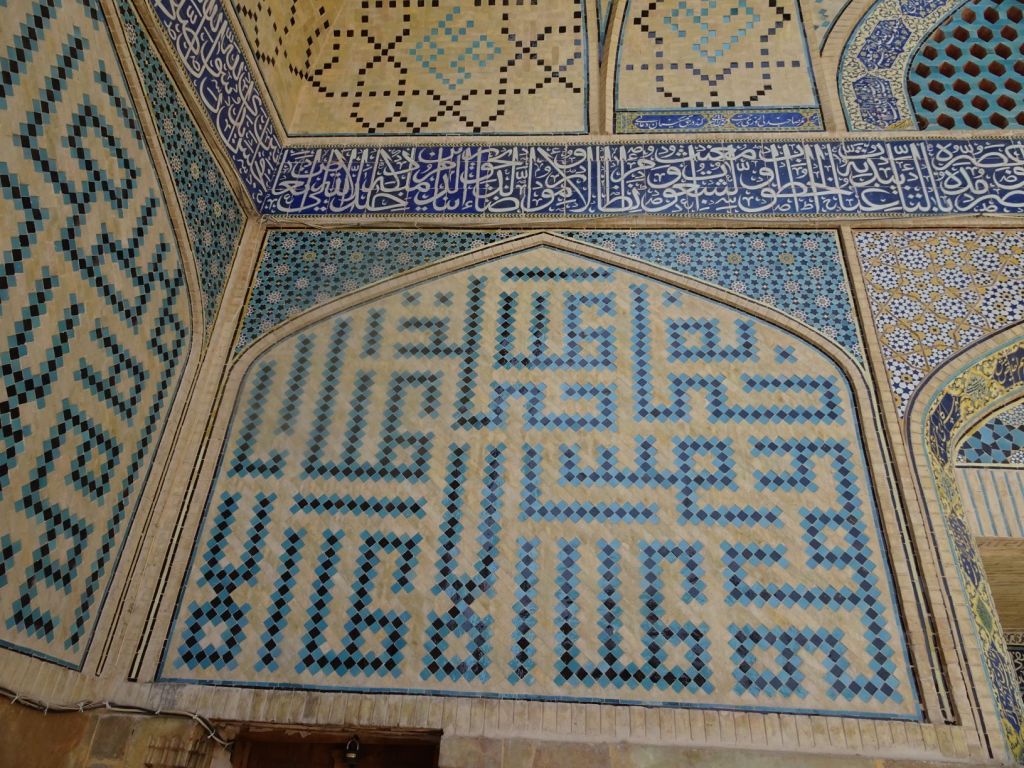
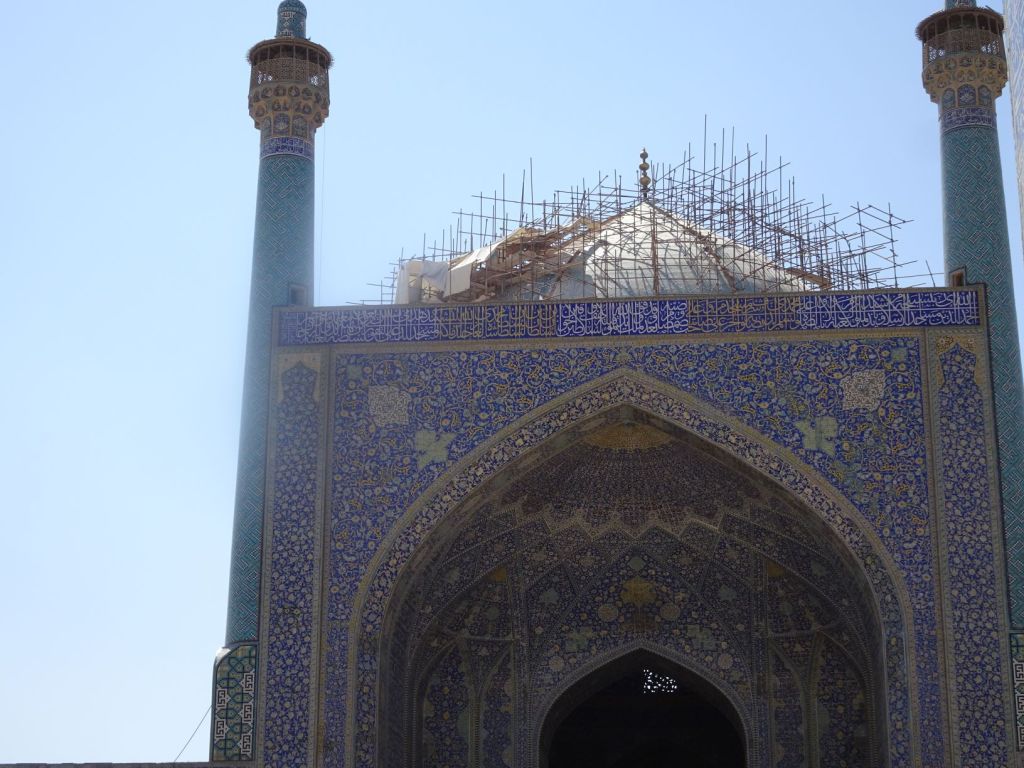
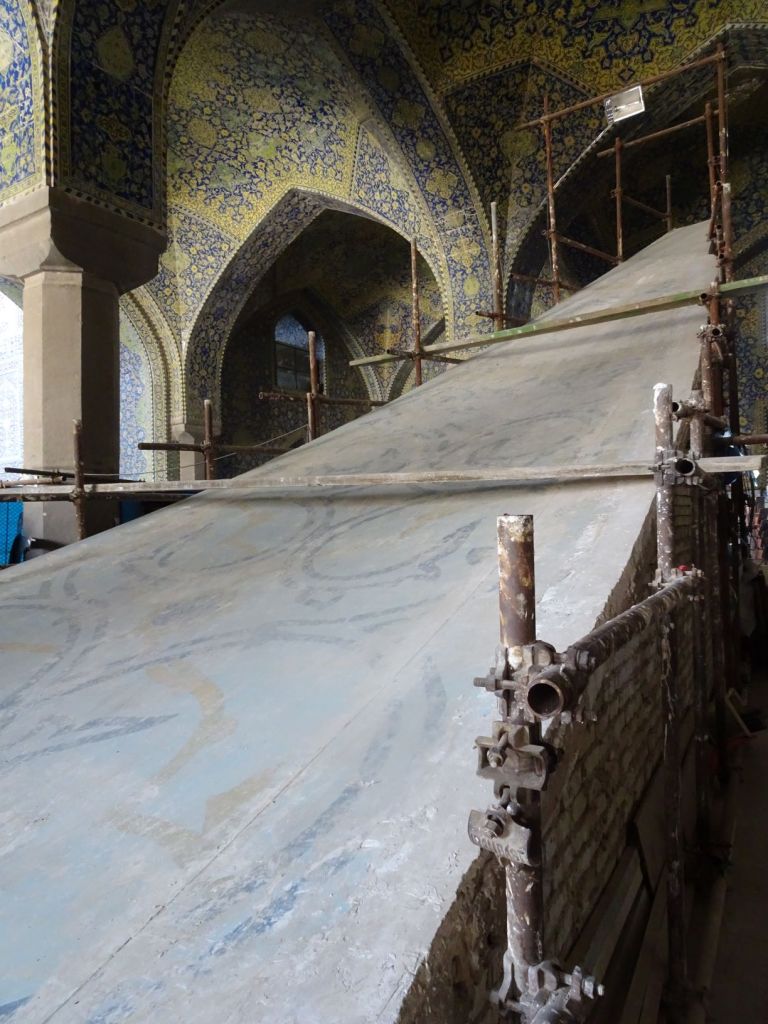
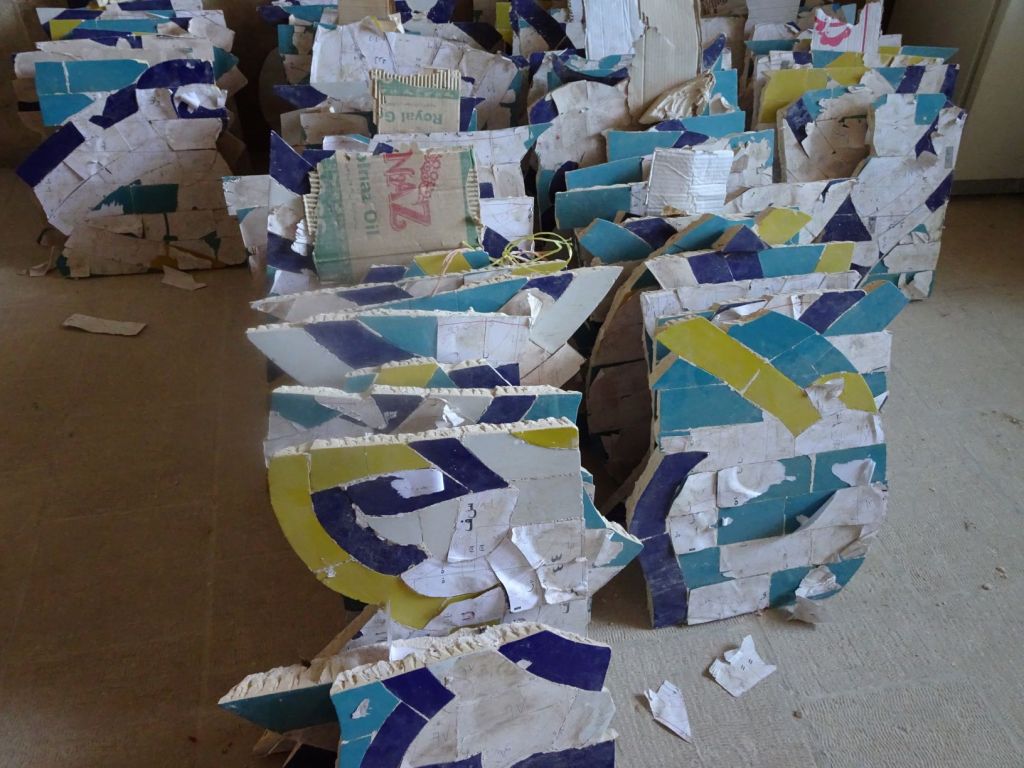
Then we head to the grand square and see it by daylight. We visit the Imam mosque and see how restauration work is carried out on the dome. They have built a mould inside that has the precise shape of a section of the dome and on this they craft the mosaic tiles. It all looks incredibly heavy and it is difficult to imagine how such domes can work mechanically, but they do. This is part of a double dome, the construction method that allowed ever larger diameters of dome to be built.
We also visit the Ali Qapu Palace on the square, all 6 floors of it with the beautiful portico on pillars that allows grand views over the whole city (as this is one of the highest buildings still).
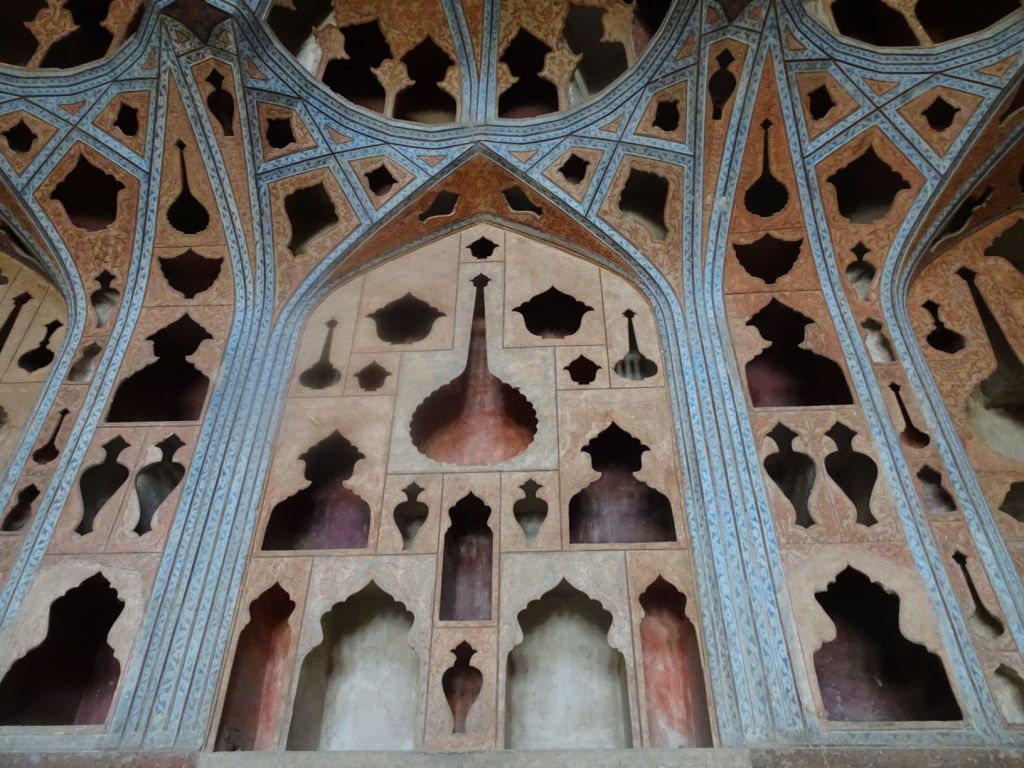
The music room of the Palace at the very top has intricate walls and ceilings to help with the acoustics.
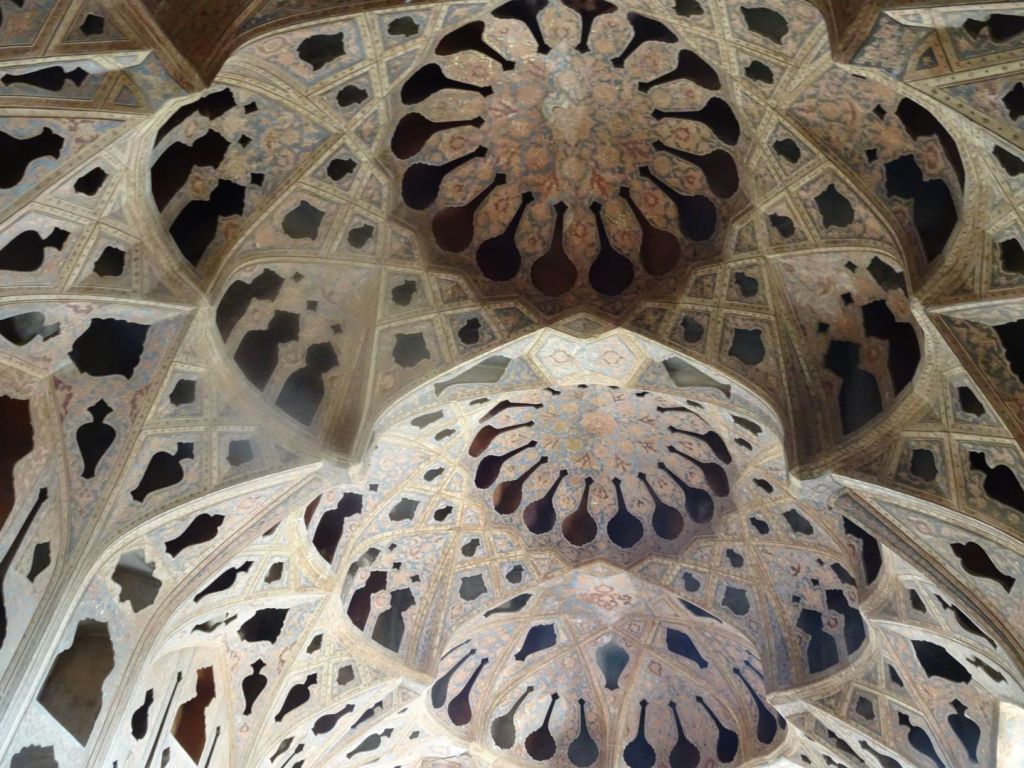
In the afternoon we visit the Chehel Sotun Palace, another wonderful Persian garden with glass mosaic pavilion and a Iwan with huge cedar pillars. Inside are paintings of the battles of the Saffavid kings: the win over India and the loss against the Ottomans. The latter is significant as we will learn a lot more about this during the rest of our trip, in Isfahan itself and later in Armenia.
nnn
King Abbas I when fighting with the Ottomans in the Azerbaijan and Armenian provinces and realising he could not win, marched the Armenians home with his army. They helped build his capital city Isfahan. An Armenian quarter still exists and this is where our visit continues. There is a cathedral with beautiful paintwork, musea showing some of the culture and a section that deals with the terrible suffering the Armenians faced in later centuries, especially at the hands of the Ottomans when 1.5 million people were marched to death. It is all very sobering and a reminder of the many times that in this region whole peoples were murdered or displaced over the ages. We finish at the beautiful bridges over the river Zayandeh.
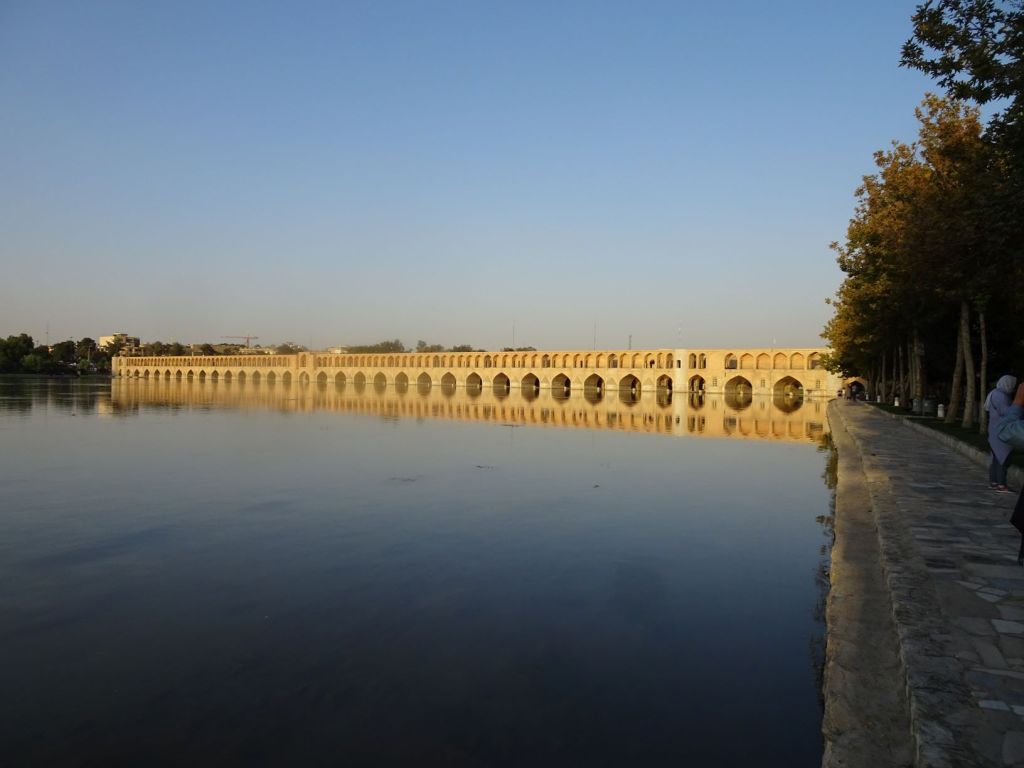
It is Thursday night and tomorrow is Friday, a day off. The streets are full of people enjoying the start of their ‘weekend’. We are people watching all the way back to the hostel and sleep well in the relative calm of the chaotic yard in which we are parked.
September 27
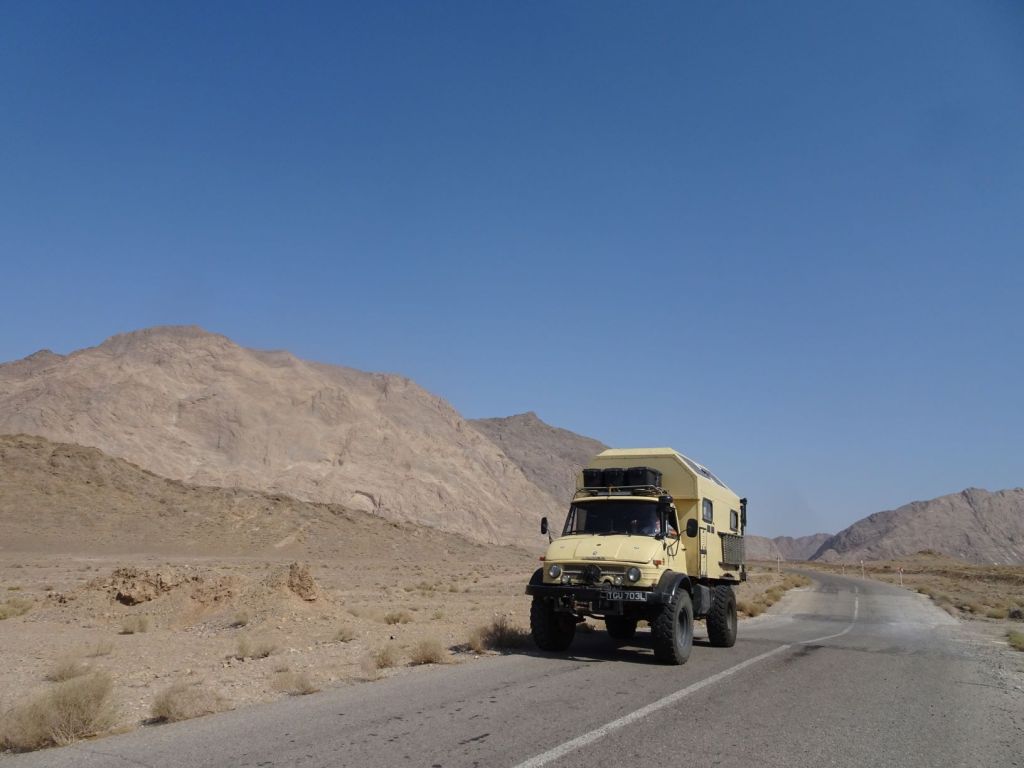
A relatively long drive (310 km) through the desert to a pilgrim’s place, Chack Chack, in the hills. All is well and we drive through flat sand desert on good roads for a couple of hours. We stop to get diesel. This is a bit of an exercise here in Iran. Generally, you cannot pay with cash and have to wait for someone who has a card to pay with and then ask to use their card. The fuel stations have attendants and they will help with this. As we need diesel, we need to wait for another diesel car, generally a large truck. The attendant then increases the price on the pump to double what locals pay and sometimes wants something on top. Here we go for double the price. We find a willing truckdriver; they get some money from the attendant for use of their card and in this instance the attendant does not change the price on the pump, so he gets whatever extra he charges us minus what he gives to the truck driver. We fill both tanks, 100 litres. This costs us (remember we pay double) the pricely sum of 6 euros!!!
We drive through pure desert and it is hot, hot, hot. More than 40 degrees.
Chack Chack is a temple of the Zoroastrians. It is high up a hillside.
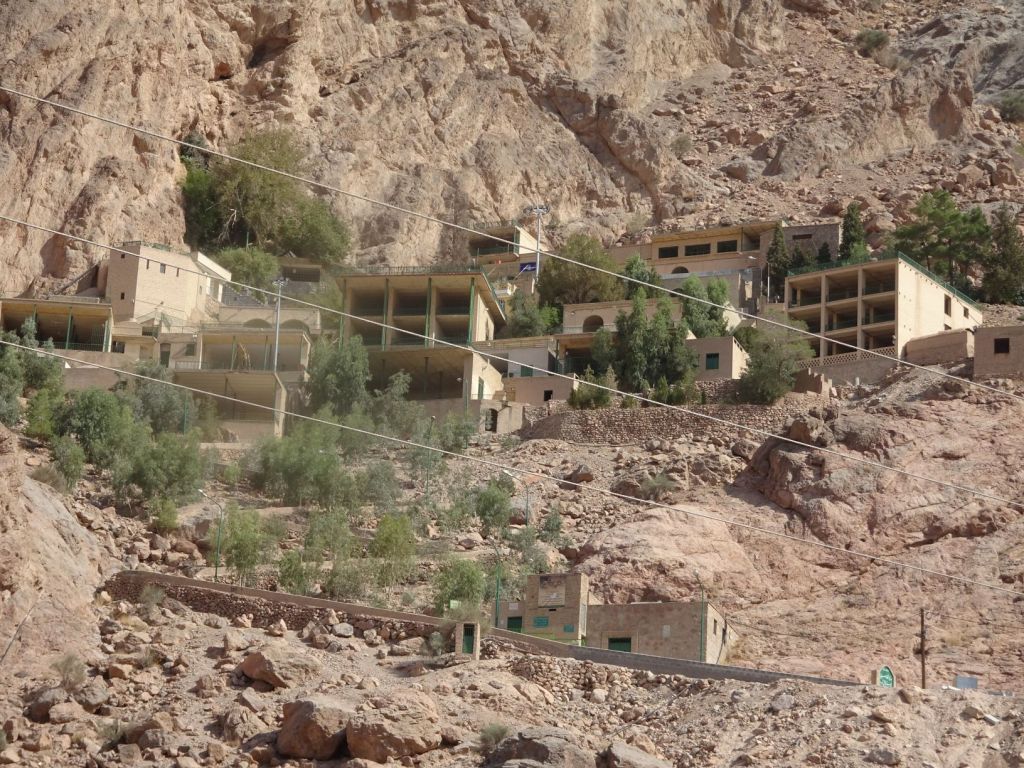
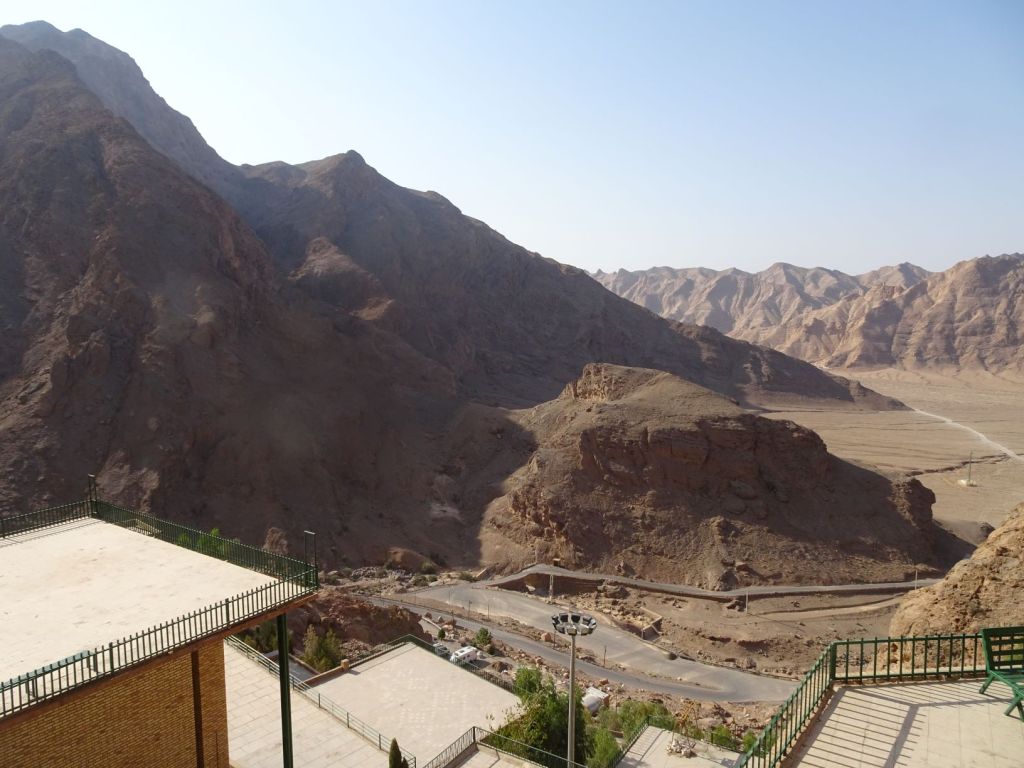
The story is that a princess who had run away was about to be caught when she asked the mountain to embrace her. She was taken inside the mountain and a slip of her dress is still visible as a different colour of stone in the mountain (we did not see this though). Water spills from the rock and this is thought to be her tears. We arrive too late to visit the temple as it is getting dark. A beautiful red sunset over the desert. We lay down on the hot rocks beside the Mog and watch the stars appear. Then suddenly a lot of sound from above: several families have gone up to the temple and are now making music with drums and singing. The echo is phenomenal against the rocks.
It does not really cool down, the stones are so hot, they still radiate heat. We would like to sleep outside but are unsure which creatures might visit us in the night so we retreat to the Mog with every door and window open.
Zoroastrianism was the state religion of the pre-Islamic Persian Empires. It enters recorded history in the fifth century BC as the state religion of the Achaemenid Empire of Cyrus the Great.
However, Zoroastrianism has its roots as far back as the second millennium BC. Ascribed to the Iranian speaking spiritual leader Zoroaster (also known as Zarathustra) it proclaims an uncreated benevolent deity of wisdom, Ahura Mazda (wise lord).
The religion explores the principles of good and bad with the free will to choose between them, followed by a divine judgement and options of heaven and hell.
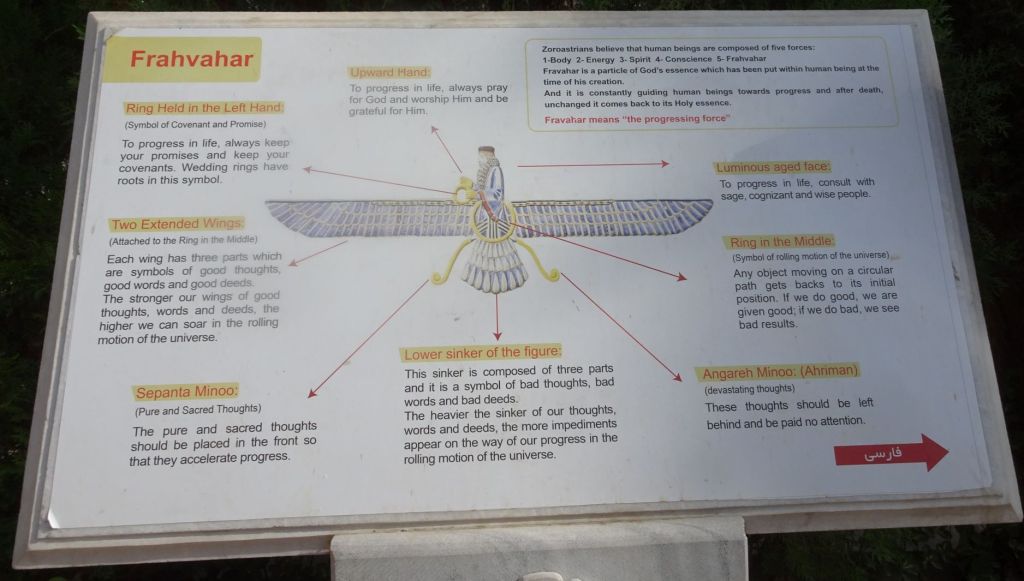
The followers of the religion are required to observe the Threefold Path of Asha revolving around Good Thoughts, Good Words and Good Deeds. There is a heavy emphasis on spreading happiness and respecting the spiritual equality and duty of the genders. There is further emphasis on the protection and veneration of nature.
The logo of Zoroastrianism is the Frahvahar:
September 28
We start the day early as Miep woke up suddenly remembering that we have no break and cannot roll the Mog down the steep slope to kickstart it: we would not be able to stop to make the sharp turn.
Oh, what now, how can we get it going, we thought we had been so clever parking it up this steep hill. We ponder and think we have found a solution, but then we try the starter motor and it just roars into action! So no need for worry, we build up pressure in the break system and switch off the engine. We will definitely get away and we can visit the temple first. It is a climb up a lot of steps along large platforms built into or on top of the hillside. These must be places for the Zoroastrians to worship and perhaps to sleep. We visit the small temple, where indeed water comes through the rock wall.
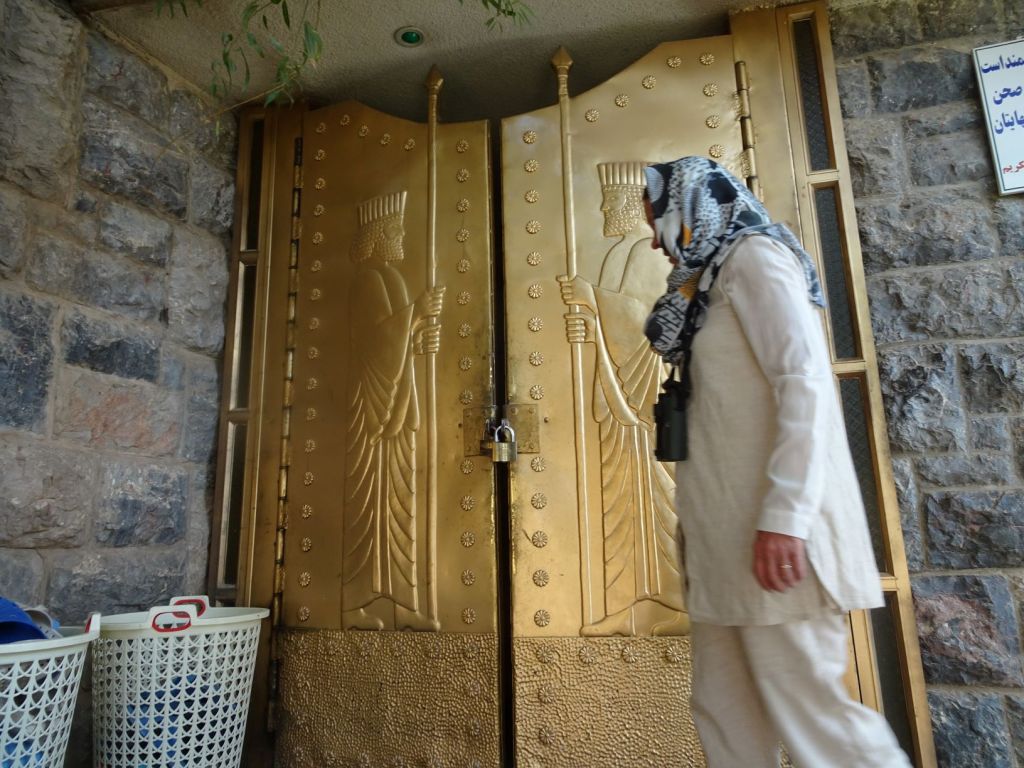
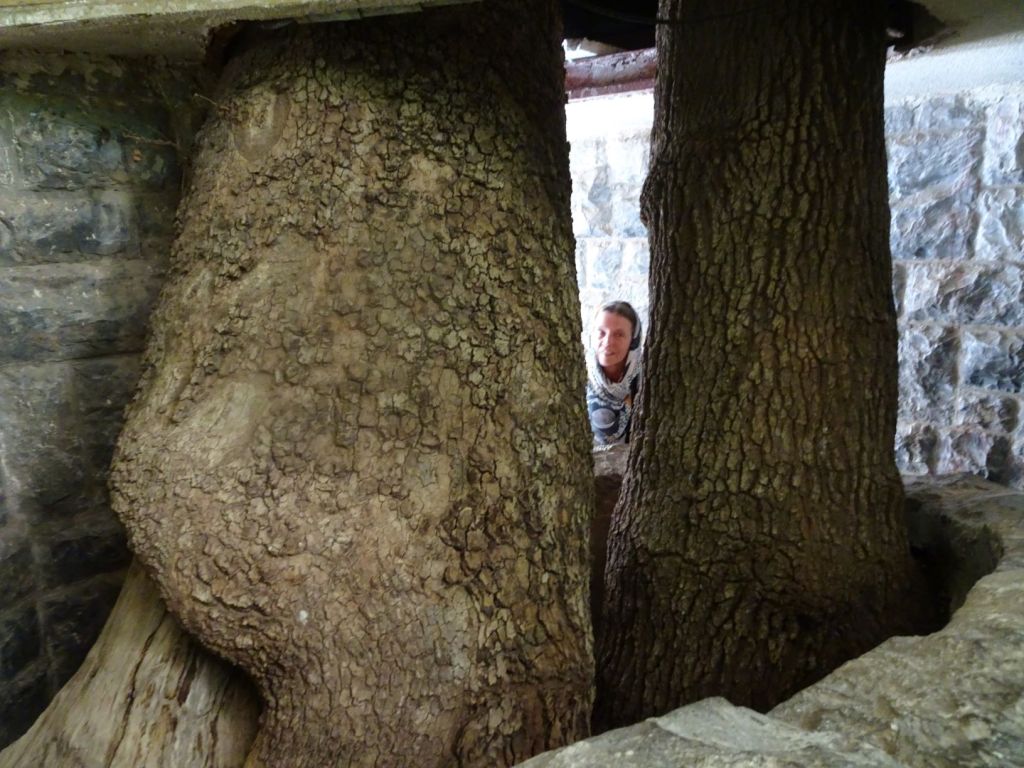
The temple is simple and silent, but the most wonderful thing about it is that it is built around a tree. A huge trunk sticks out of the wall and the roof is covered with the leaves. There are several other trees too and it is clear that this is a type of rock ‘oasis’ where trees can grow in the middle of the desert. Tears of the princess, or perhaps a natural spring after all?
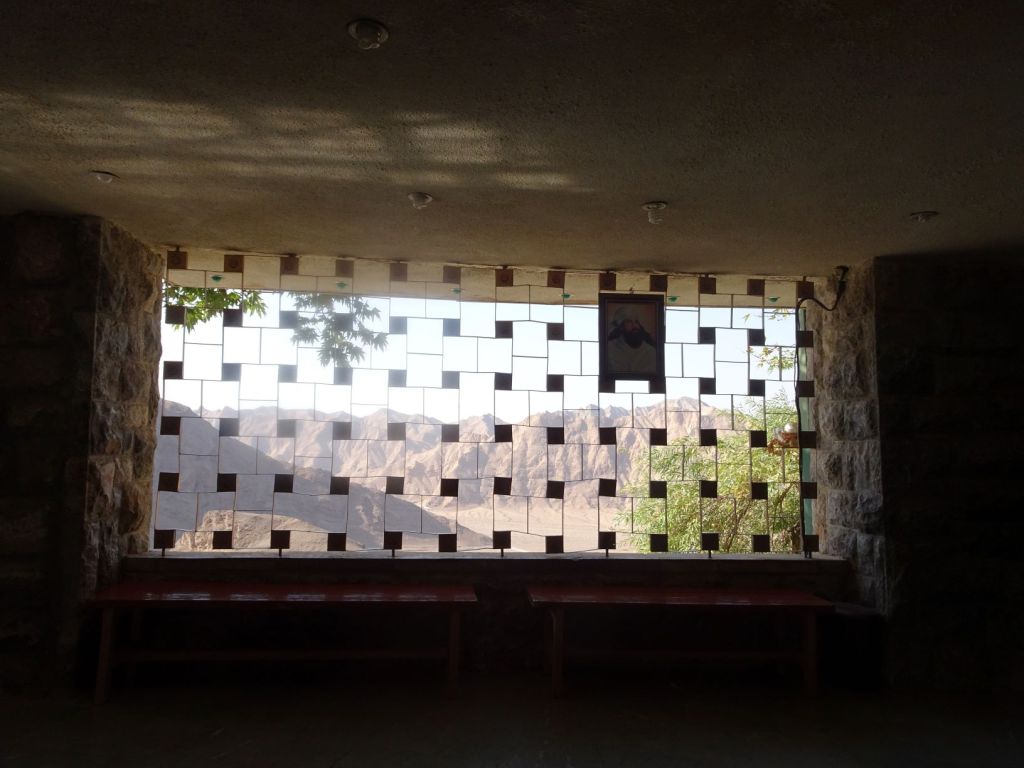
Work is being done to extend the site. The builders ask us to join them for tea. They are from Afghanistan and have moved to Iran with their families because of the war back home. They are not going back there they say.
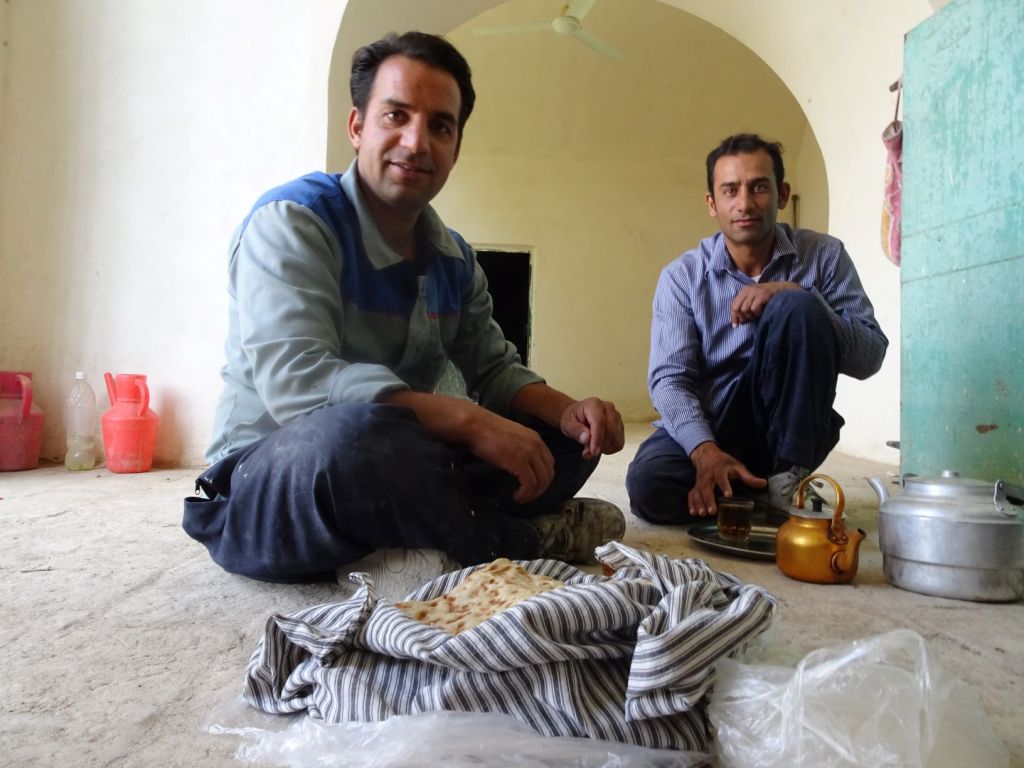
The movement of peoples across borders in this part of the world is never ending it seems. We spot several flocks of birds on the way down amongst the trees. The only one we know is a pied flycatcher. There are several and it is apt they are there since the place of full of flies.
We drive to Yazd today but do so with a short detour via Meybod. We cannot help thinking about ‘Maybot’ which sounds just the same. We have tried hard to get away from UK politics and Brexit, but how you can get sucked right back into it……
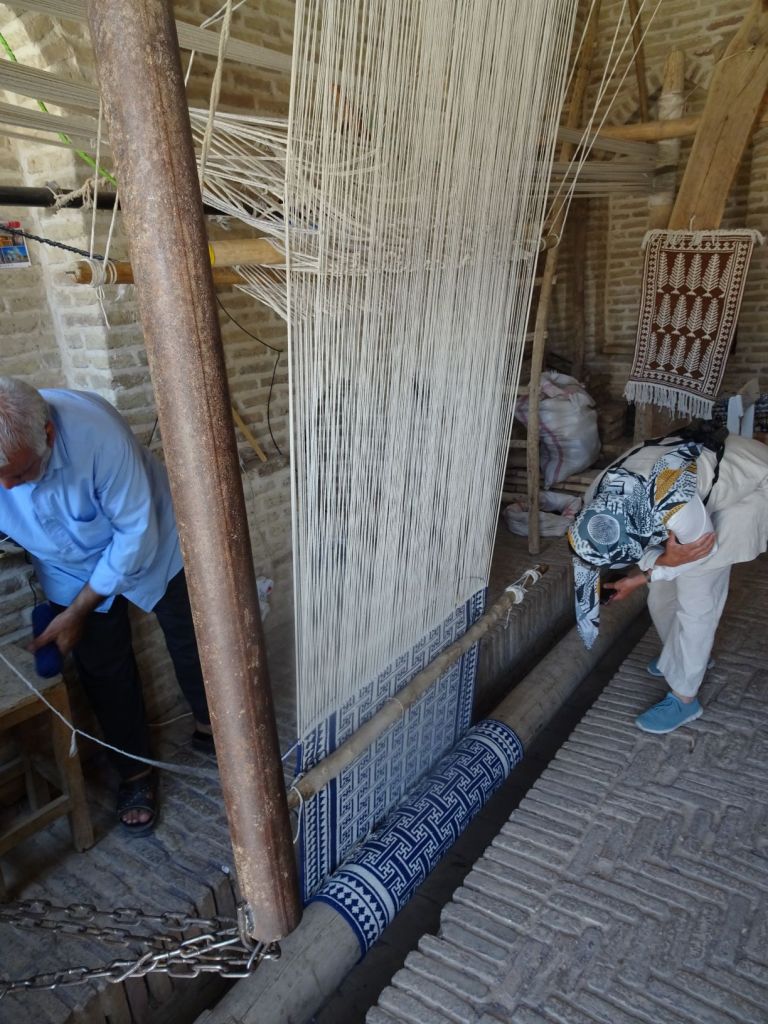
Meybod’s historic centre is typical of an oasis town. There is a beautiful caravanserai, now in use as workshops for craftspeople and we have a look at the typical pottery and weaving done here. The weaving is the most interesting. It is called Zilu weaving. On old big wooden looms cotton thread is woven in a double patters (the reverse on the other side) in two colours. The patters are either a cypress tree, or geometrical. Miep likes it a lot and even gets a chance to have a go herself on the loom.
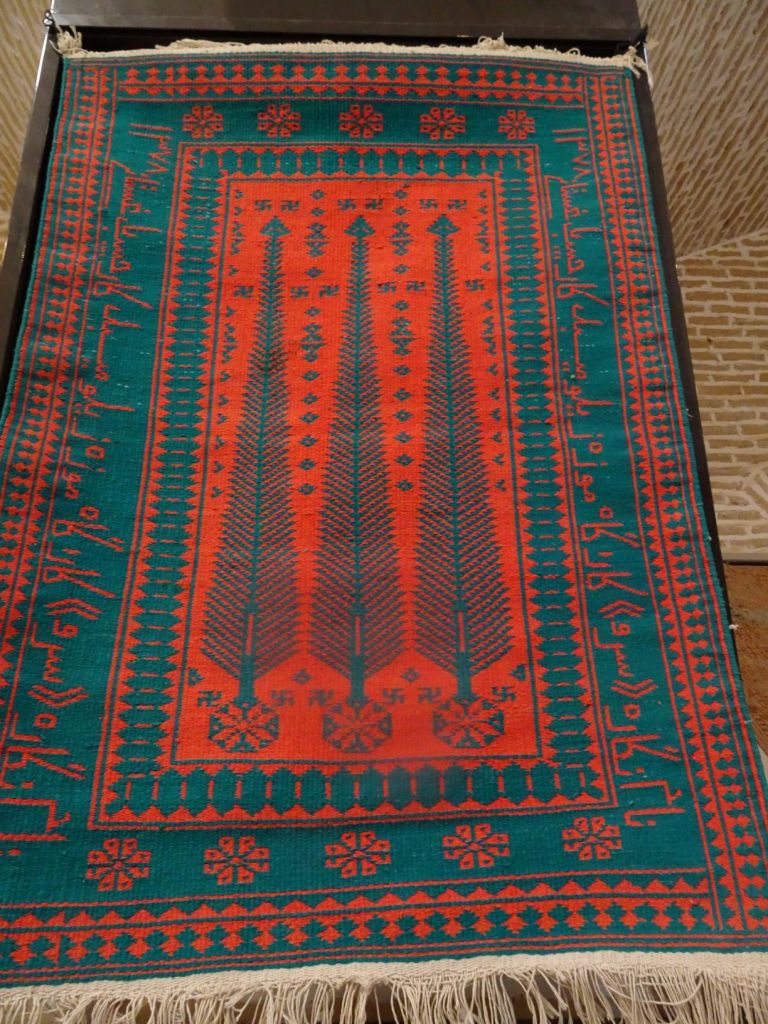
There is a small museum on the square where some fabulous examples of Zilu weaving are displayed. The largest pieces feel like a ‘merklap’, where the weaver is demonstrating their ability to weave a wide range of patters. Some are made with ikat died wool and have a more subtle feel than the carpets woven in strong primary colours. Wonderful craft and totally unique to this town.
We also visit Narin Castle, a mudbrick stronghold of the pre-Islamic period with parts dating back to the Medes and Achaemenid periods, 2.5 thousand years ago.
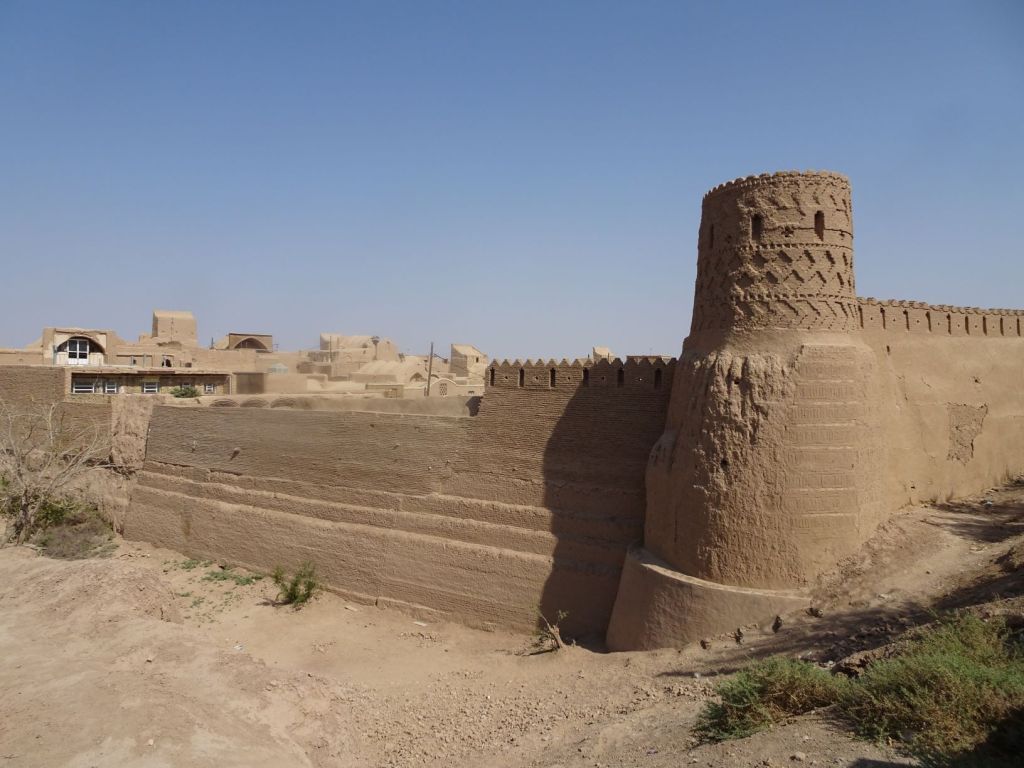
Then it is time to drive to Yazd where we park up at the Caravan Hotel, quite far out of town, but at least in a quieter spot than usual and under trees! We only go out to find some food in the local neighbourhood and will see more of Yazd on our guided tour tomorrow. For now, Yazd looks like the other chaotic cities we have visited. Many broken buildings, unfinished building work, missing pavements and dust and piles of broken bricks everywhere. But we find the shops we are looking for, it is busy on the streets and there are, as always, English speaking people keen to converse with us and take pictures with us. There is an atmosphere, even amongst the chaos of this area. Lentils and eggplant for supper, quick and filling and then a quiet night.
Sept. 29
We tour Yazd with guide Saeed. He is off to a good start with us with perfect English, good information and humour. He understands the group and we feel in very good hands.
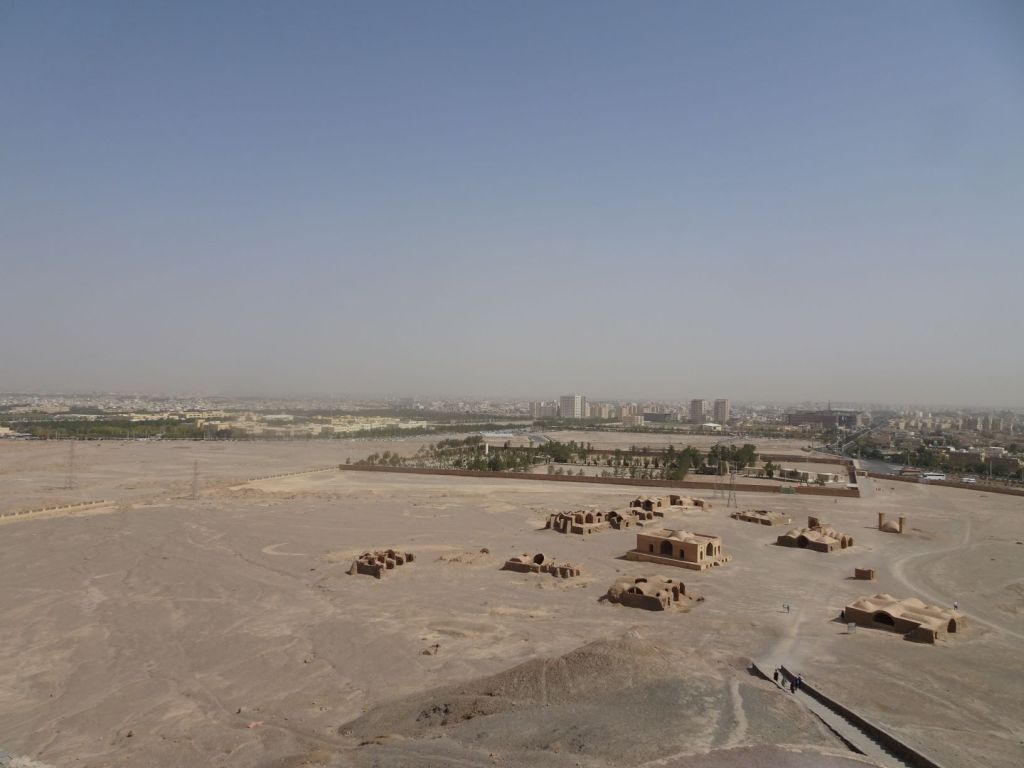
First stop are the silent towers, the burial places of the Zoroastrians.
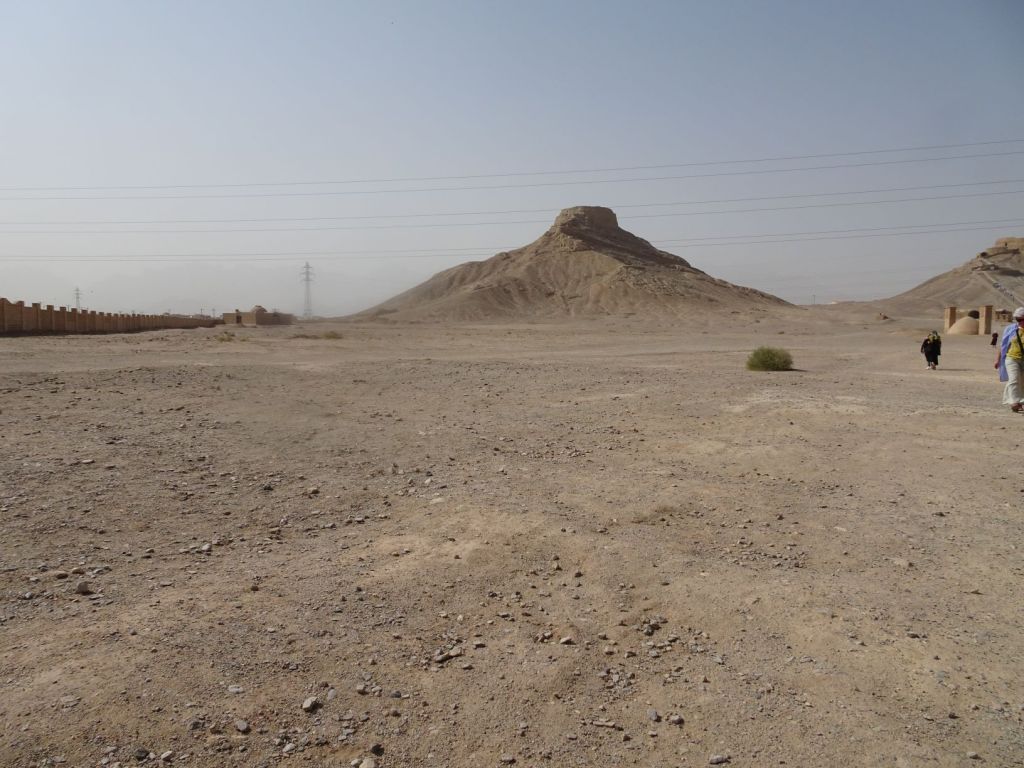
Yazd is their centre and her they used to bury people on silent towers until about 60 years ago. Now it is no longer allowed and a ‘normal’ cemetery is now built on the site too. The silent towers were built at various point round the cities. They consist of huge walls on top of natural hills. Within these walls the dead were laid out so that vultures could eat their flesh and then the bones were disposed of in a deep pit in the centre that was regularly treated with acid to help dissolve those remains. Miep will have to read up more about that: what precisely did they use to deal with such large amounts of bones? The walls were very high and the entrance was closed off so that no wild animals could get to the dead and remove parts. Apparently the vultures were hungry and could clean a body in about 9 hours, leaving it precisely where it was put.
There have been problems recently in place where Silent Towers are still operational. Many people take Non-Steroidal Anti Inflammatory Drugs (NSAID) during the last days of their lives. Vultures cannot deal with NSAIDS and develop fatal kidney failure. This has caused complete extinction of vultures in places where the Towers are still used.
There were specific people who were in charge of dealing with the dead, placing them into the tower and dealing with the bones. They were not allowed to enter into the city and had to live their complete lives with their families at the silent towers.
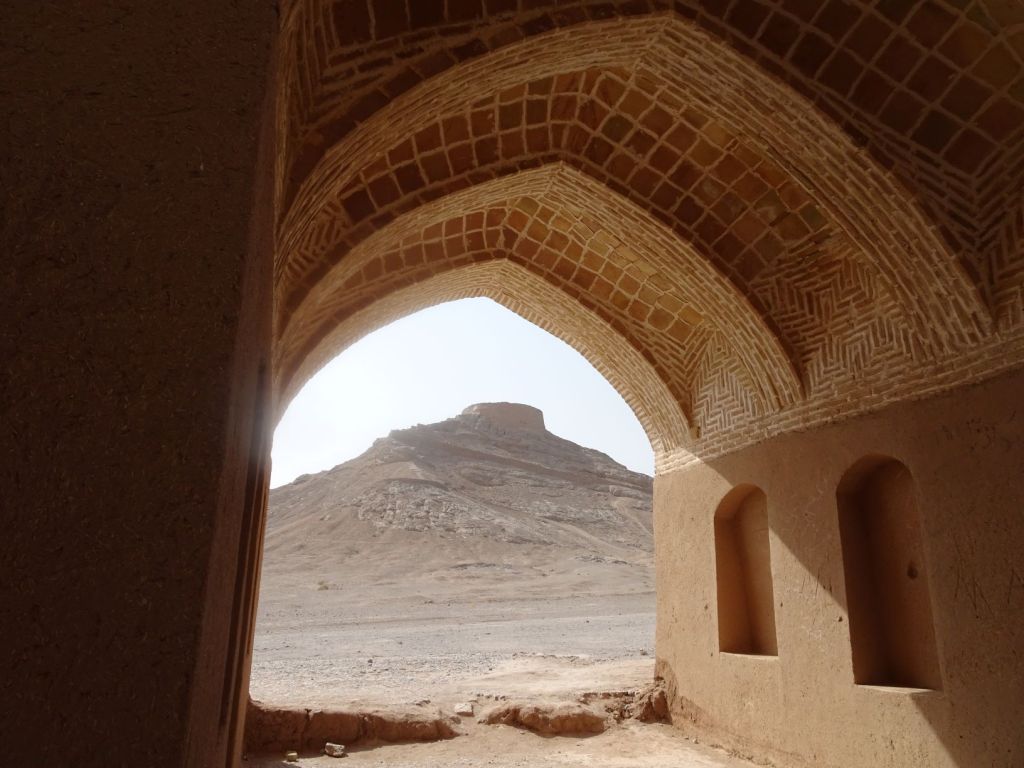
This was to prevent any spread of contagious diseases which the dead might carry and they could potentially pass on. They must have had help, donkeys perhaps, to get the bodies up these steps up the tower, especially in this desert heat! There were buildings where the relatives of the dead could stay for a couple of night to perform their rituals and allow them to travel back to the city during daylight hours.
It is an impressive site. You sense this was a spiritual place. It used to be way outside the city, but in recent times Yazd has grown and now you can see how buildings are encroaching on the site. The Zoroastrians worship 4 elements: fire, water, earth and wind. They could not contaminate the earth with the dead, and hence this way of burial was used. It all makes good sense and apparently was a good way to deal with epidemics that caused a lot of death: it is much quicker to lay out bodies on the silent towers than to dig graves.
We walk up one tower and take in the scene. This place impresses us and it is too soon we have to leave for the bus. Miep runs up the second tower too, thinking there were still some bones left there, but there are none. She returns to the bus absolutely boiling hot. The sun is already hotting up and it is only mid morning.
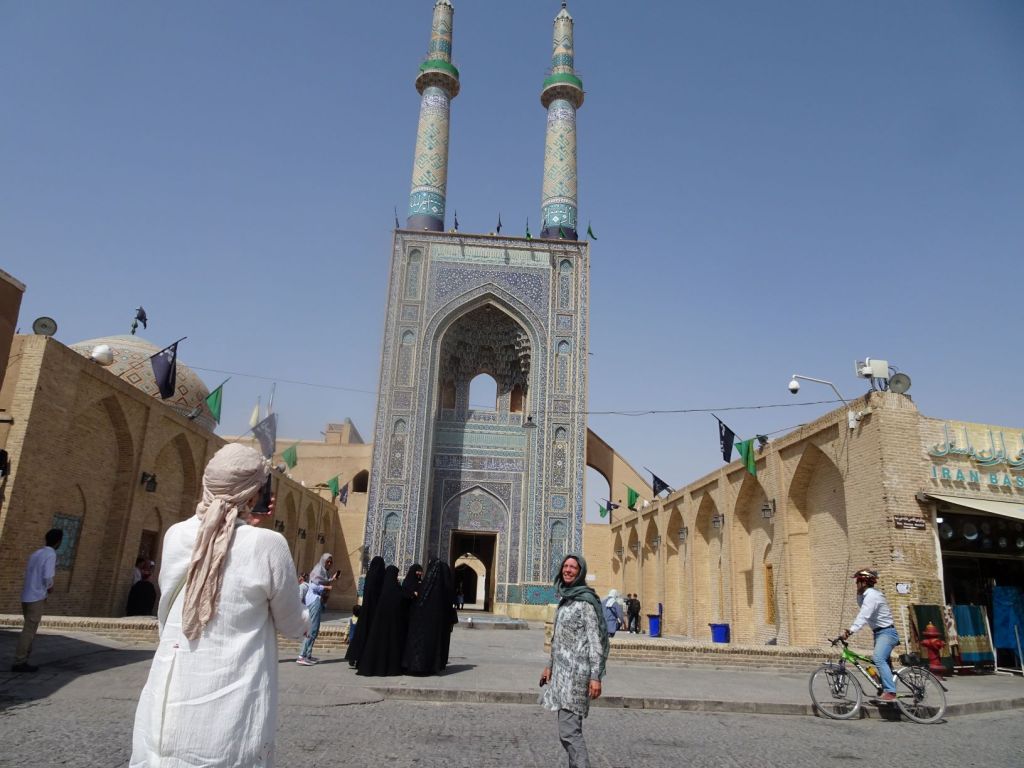
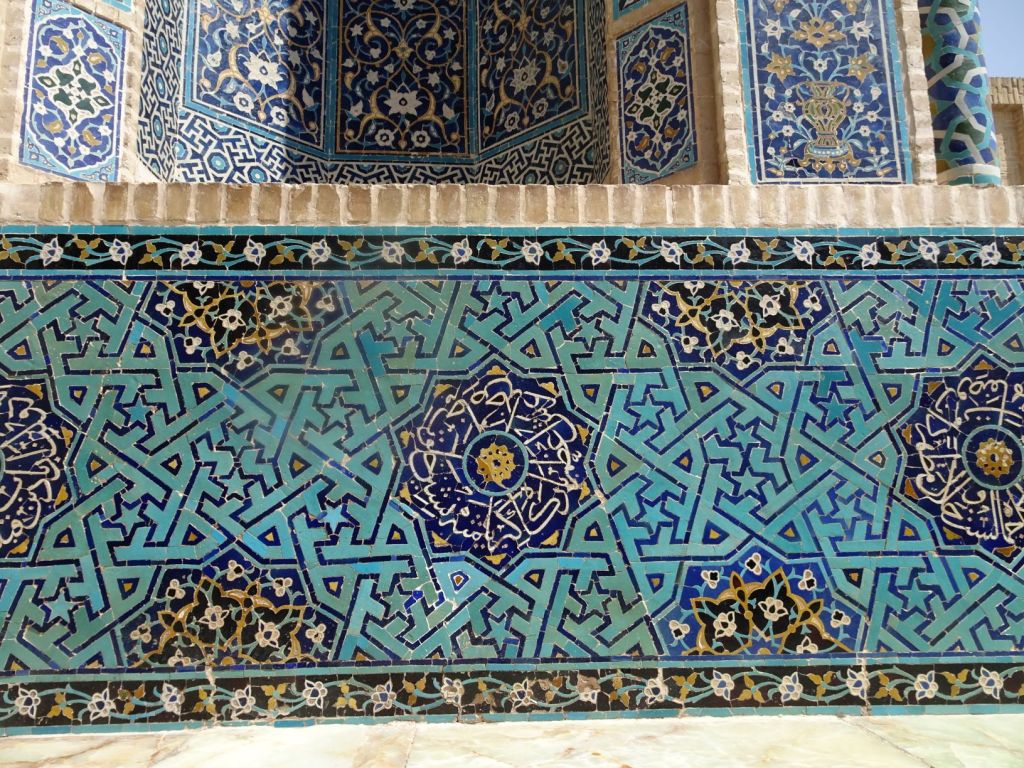
Then we go into town and visit a number of beautiful places: the Friday mosque with its twin minarets and beautiful tilework outside and inside and the small streets surrounding it, all made with mudbrick walls and vaulted ceilings.
The guide tells us how every entrance to a house in Yazd looks the same, but some doors lead to small apartments, whereas others lead to large mansions with gardens. You cannot tell from the outside and everyone had to enter through these small alleys, called peace alleys. Since you were bumping into each other all the time in these narrow streets you’d better make up with your neighbour.
Yazd is traditionally a tolerant city where peoples with different beliefs live in harmony together, Christians, Jews, Zoroastrians and Muslims.
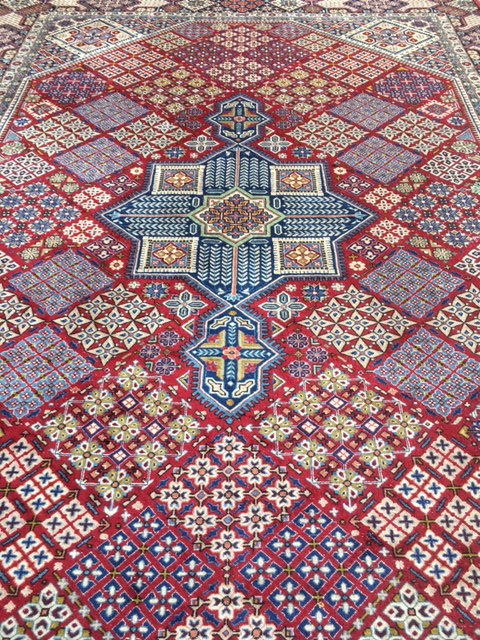
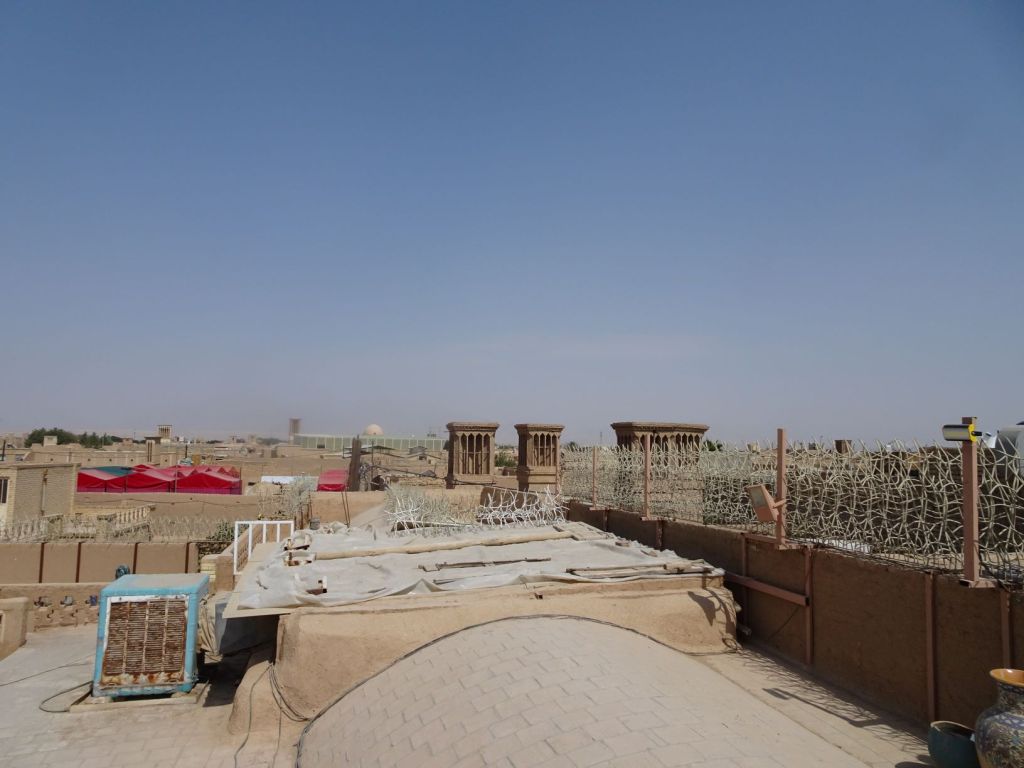
Now we visit a carpet show that has a nice roof where we can see the many windtowers of Yazd. But first we get an explanation about carpet weaving. The guide starts and then the carpet experts from the warehouse take over. More and more carpets are laid out in front of us. They are beautiful and we begin to understand the different types of knotting, the patters, the wool and silk materials and the difference between knotting and embroidering (carpet and kilim). Tea is brought and the discussion moves to potential buys. The guide is anxious we go on the roof and stick with the programme but also keen that we get a change to make purchases. In the end some deals are made (including by us!) and the carpets will be delivered to the campsite in the evening so we have time to find our cash, all hidden away in the campers.
We go to the roof and see the windtowers. These are wide ‘chimneys’ with vertical slits in them to allow even the slightest breeze to enter and help cool the building below.
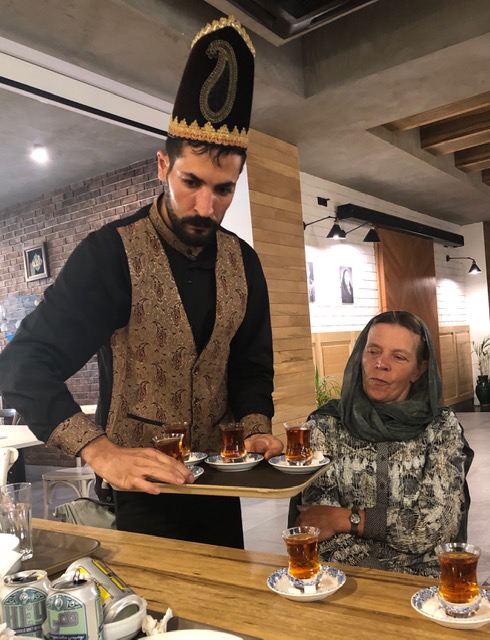
We go for a nice lunch where we get the change to sample some good local dishes in a kind of ‘salad bar’. The ceiling is covered in mirrors so it looks as if we are hanging upside down. We enjoy a nice glass of tea as desert.
Then we visit the water museum to learn about qanats. These are the underground channels dug to bring water from the desert mountains into cities and the surrounding agricultural lands. This is what made it possible to irrigate land, the inhabit these places and build large cities. Some qanats are still in use, but many have now run dry. This is in part because deep wells are dug where water is pumped up mechanically, but also because the qanats have not been maintained. This is a fascinating museum, built in the below ground levels of a mansion in the city. We see how such large merchant houses had their own water supply with a qanat running right underneath their house and would pay for the number of hours per day they were connected up.
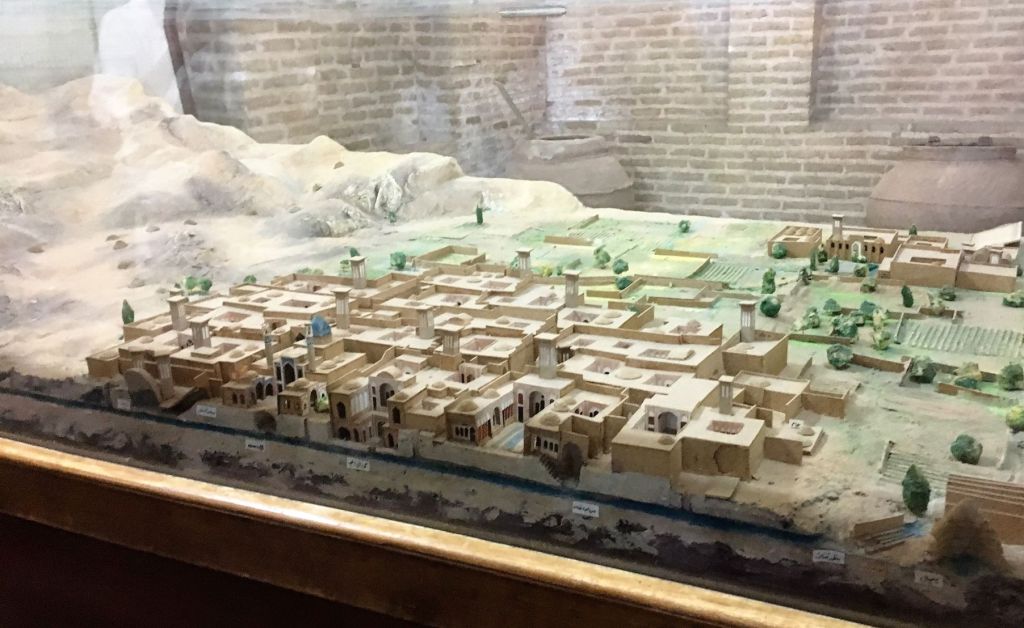
It is scary to think how much water is required to keep these large desert cities supplied and all the agricultural land irrigated. Is there still enough water in those mountains? The guide thinks there is, but as so many before, he starts talking about changing patters of rainfall and climate change. Water is the thing people worry about most in these dry countries. But there is little evidence that water is considered the precious commodity it is. It flows freely in the parks and even in the streets. There do not seem to be restrictions on use, yet we know it comes from wells underground as all the riverbeds are dry.
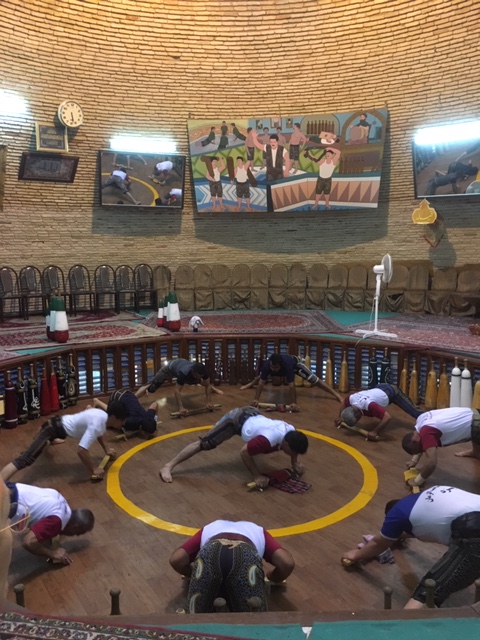
We go to see a sports school where we are introduced to the ancient sport of Zurkaneh. Young and old exercise together and at different levels of expertise. The exercises are part of Shia Islamic culture and the men carry the statues and cartwheels during Shia processions to commemorate the murder of Imam Hosein at Karbala in 680 AD.
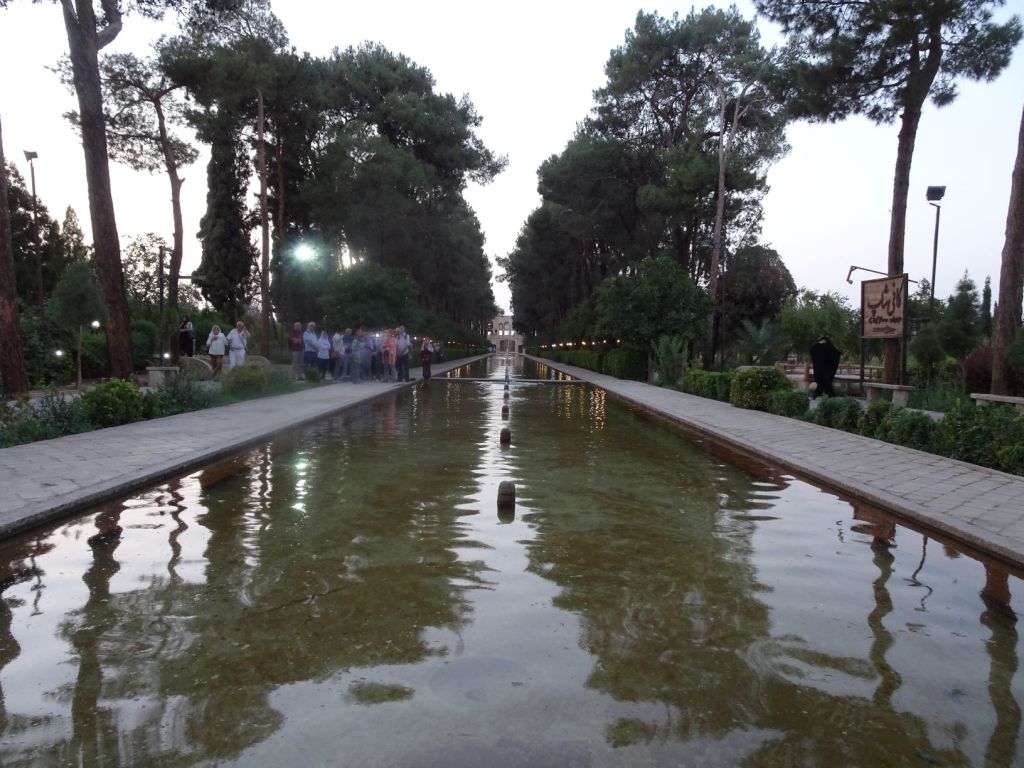
Then we finish up with a visit to a beautiful Persian garden. This one demonstrates the 3 principles beautifully: symmetry, a pavilion and of course a central water feature.
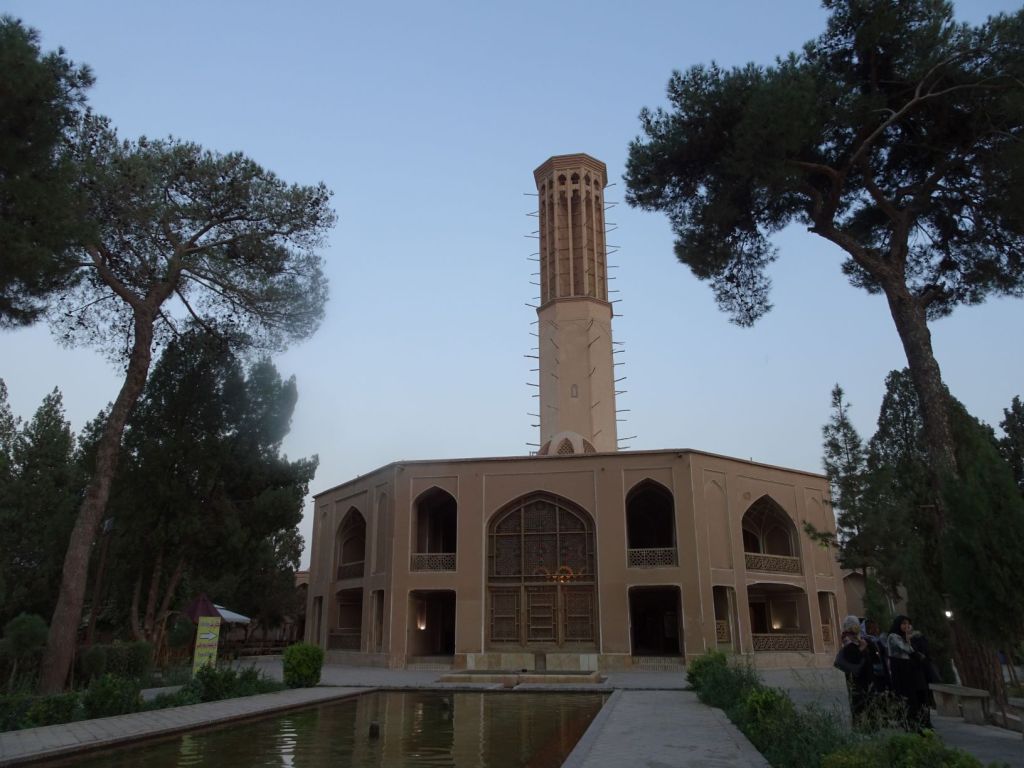
The windown in the pavilion are made of stained glass set in a wood lattice. Beautiful! The pavilion has the highest wind tower in the world. But, as the guide reminds us, windtowers are only built in this region!
Miep has a short visit to the bazar before going back to our camping place which is a good 7 km out of the city centre. A taxi is required to get there and the taxi driver is very interested to see our campers. He does not understand why we did not just park up just beside the Friday mosque right in town. You have everything you need there, water, toilets and walking distance from the sights. He is perhaps right, but it would have been noisy. It is good to know that everything still goes here. You can indeed park up pretty much where you like and with so few tourists with their own transport magical places can be found.
It is a busy evening. When the taxi departs the carpets arrive and then our guide Saeed arrives. He is going to help us install a VPN to allow us to access our blog again.
It is educational to see how the sanctions affect so many aspects of daily life here. It is possible to circumvent the filters the government installs with apps, but for many apps you have to pay and that is not possible as the international payments via credit cards are blocked. But he manages to fix us up with a free VPN and we are finally able to access WordPress again. We have 7 days to catch up from where we left off: the last days in Uzbekistan. Saeed has been such a good illustration of how far this country and its people can go if only given a chance.
Saeed has certainly succeeded in giving us a little bit of understanding how a city survives in the middle of the desert…
 Central Asia Roadtrip