The early history of Uzbekistan was determined by Iranian nomads who build large irrigation systems in the region 1000 BC. The region became part of the Achaemenid Persian empire around 500 BC until Alexander the Great conquered the region in 333 BC. His successors ruled until the Islamic conquests of the seventh century established a strong perso-islamic culture under the Abbasid Dynasty. The Arabic golden age lasted from 750 to 1258, most particularly under the reign of the 5th Abbasid caliph Harun al-Rashid (763-809). The Dynasty maintained relationships with India and China, as well as with the Holy Roman Emperor Charlemagne (768-814).
The 8th and 9th centuries were very prosperous times because of the emergence of the silk road with Bukhara and Samarkand as important trade centres. The Persian Samanids ruled in the region including Samarkand and Bukhara. they are replaced shortly by the Turkish Ghaznavids who had been their slave guards but the perso-islamic cultural identity survives these political changes.
The invasion by Genghis Khan was a massive shock to this prosperous and relatively peaceful world. Many citizens were killed, buildings destroyed and irrigation systems damaged which took generations to repair. Famously, Genghis Khan told the people of Bukhara: ” If you had not committed great sins, God would not have sent a punishment like me”.
After the death of Genghis Khan in 1226, the empire was distributed amongst his four sons. The empire remained stable for a number of generations, but in the 14th century a number of tribes were fighting for dominance in the region. From these Amir Timur emerged as the victor and he continued to establish a massive empire ‘Turan’ reaching from India to the Caspian sea.
Timur’s reputation has been created from the chronicles created by his victims. ‘Tamerlane’ was coined by the Persians meaning Timur the lame pointing towards his disability after he was wounded in early battle. He is described by these chroniclers as bloodthirsty bandit who fought wars to enrich himself and his empire.
However, in Uzbekistan today Timur is a national hero who everyone in the country wants to identify with. They don’t like the title of Tamerlane but speak of Amir Temur. They emphasize the respect that Timur had for arts, science and islam; he (forcibly) brought scientists from the countries he conquered to Smarkand, his capital city.
What is certainly true is that the persian-islamic culture flourished under Timur and his successors. His grand son Ulugh Beg was a famous astronomer and mathematician. Ironically all this culture and science was a bit too much for the more conservative religious elements in society and Ulugh Beg was murdered at the age of 54.
The Timurid Empire lasted for some 100 years until the beginning of the 16th century. A very unstable period followed with various khanates fighting each other constantly. The region was also invaded from the north by the Uzbeks which originated from the Siberian steppes and were forced south themselves.
The region was subject to the ‘great game’ between the British and the Russians in the 19th century with the Russians annexing the famous cities of Bukhara and Samarkand during the late 1860s.
The Russians brought many settlers to the region which were favoured over the indigenous population. This caused resistance and uprising which came to a head in 1917 when the Tsarist regime tried to recruit Uzbeks to serve in the Russian army during the first World War. In the second world war Uzbeks fought again in the Russian army and 60.000 were killed.
The uprisings were unsuccessful, and after the Russian revolution the Soviet Union created the Soviet state of Uzbekistan which initially included Tajikistan. Collectivation and monoculture of cotton were introduced by the Soviets which caused a famine in the region. During the second world war Stalin deported large numbers of Tartars from the Crim to Uzbekistan to change the ethnicity over there to become more Russian. Interestingly, very recently the mainly Russian population of the Crim has allowed Putin to annex the Crim again, after Khrusjtjov had given it to the Ukraine in the early sixties.
Despite all these problems, many in Uzbekistan look at the Soviet period quite favourably; education was improved greatly, and in particular equality between men and women took a leap forwards. Since the independence in 1991, Uzbek society has become a bit more conservative, with 90% of the population identifying as Islamic, although the state is formally secular and it is not allowed to teach Islam, or any other religion, at school. People we met in Uzbekistan stated that if it had not been for the Soviets, Uzbekistan would now be under Sharia law and look something like the Arab Emirates.
August 30
We travel to Fergana through the Fergana valley, the fertile agricultural area in the East of Uzbekistan. We stop for a lovely shashlik in one of the small towns we pass through. It feels different from Kyrgyzstan already. The young people speak English and are keen to practice. The roads are lined with flowers. The houses all have vines growing over trellises and over their above-ground gas pipes to provide shade. It is a lot cleaner than on the other side of the border. Remarkable how instant that change has been. It should be an easy drive, but the Mog overheats several times and we only manage to arrive 15 minutes before our excursion to the silk factory in nearly Margilan departs. Roelf decides to give this a miss and work on the car, but for Miep this is an absolute must see.
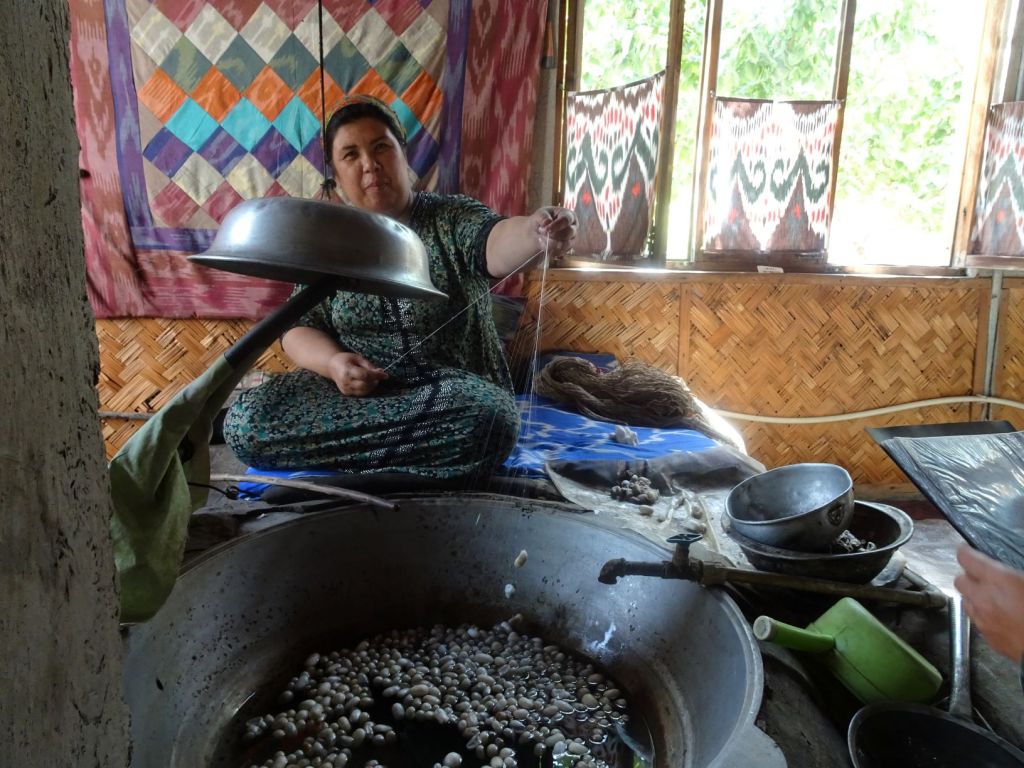
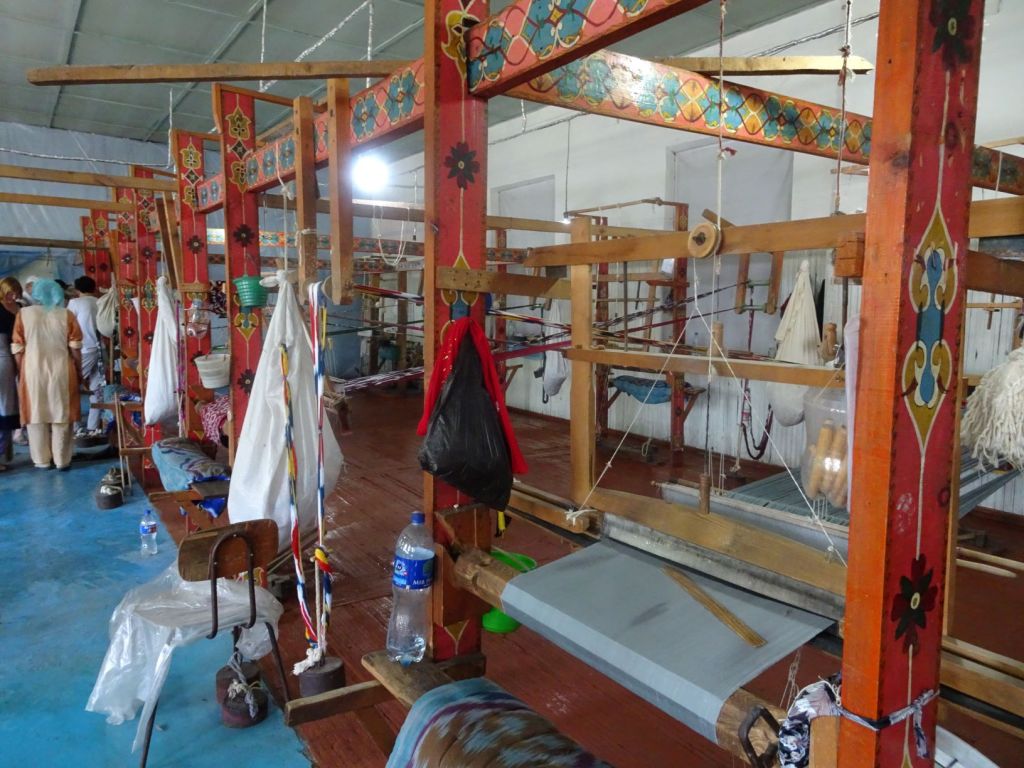
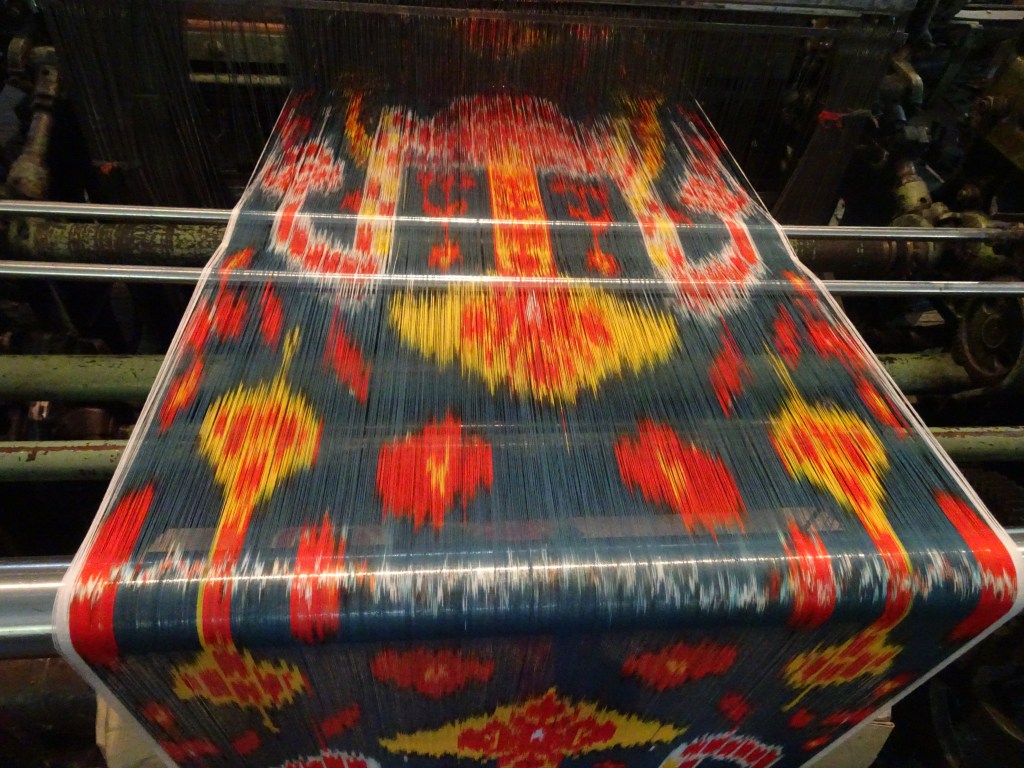
The excursion takes us to a silk factory where they explain the whole process of silk cultivation. The silkworm is fed fresh mulberry leaves in spring, then when the worm has reached a certain size it begins to create its cocoon to pupate. This process requires a quiet environment: no unexpected noises are allowed near the worms at this stage or otherwise they will temporarily stop excreting their saliva which forms the silk thread and resulting in a break in the thread. Big cocoons with long uninterrupted threads are what is desired. The worms can make a cocoon with a silk thread of at least one kilometre in length! We cannot see this process live because it is the wrong time of year, we just see the harvested cocoons. The worm, now a pupa, is still inside, but killed. This way cocoons can be kept for a long time and apparently it is the job of women in villages all round to sort the cocoons into sizes. The cocoons are put into very hot water and then unwind. A lady shows us how she scoops up a number of threads, some 20 or so and then uses a big wheel to gradually unwind those cocoons. She uses her fingers like someone spinning, to guide, or twine, the threads into one smooth thread. Then these are dyed using the tie binding process using cellotape and natural dyes. One nice red is from the dried blossom of the mulberry tree. Then the dyed threads are woven, by hand or mechanically. This ikat process of creating silk or also cotton materials is the most common one in Fergana. It is all quite inspirational, the colours are beautiful and the resulting silks quite stunning. Even a good weaver can weave only 3 metres of silk fabric per day, the threads are so thin it takes a long time.
We also visit a former Madrassa that is now used as workshops for artists and artisans. What an inspiring environment: small workshops around a courtyard with pomegranate trees. We hope there may be exchanges with artists from Western countries in the future. So much to learn, old skills are clearly valued here and there is a lot of interest to actively revive the skills. We meet many young people who are keen to learn the traditional methods and find employment in crafts, either as craft person or as a guide and translater in this area. Margilan is building a lot of new shops and workshops to practise and commercialise crafts and an international craft workshop will be held in Uzbekistan (in Kokhand) in September this year.
August 31
Our time in Fergana is already up and today we travel to Tashkent, the capital of Uzbekistan. We leave early as we know there is a long way to go and we want to see the potteries in Rishtan on the way. We get to the pottery town early and are amazed to find it lies partially in ruins. It appears that the government has decided that all the gas pipes and waste pies should be laid underground (sensible in principle), but this has resulted in the removal of all the trees and vines along the houses and even the demolition of all the houses lining the main streets. Everything is being rebuilt at the same time. Locals are unhappy, not only because of the chaos, but also because the loss of shaded walkways has resulted in an unbearably hot town. It will all be fixed in time and trees replanted, but an upheaval it is. We keep finding this as we travel through this country: big projects to improve infrastructure, with everything being done at the same time rather than gradually. It must be good for the bricks industry: the production must be enormous. Everything is built in brick here as it was in the past. Lorries full of bricks are everywhere.
The pottery we visit is wonderful: as we enter a kind Russian-speaking man comes forward to show us the process of making plates, firing, painting and refiring and then takes us to the showrooms where the finished products are displayed. One room after another opens up and mountains of pottery appear. He shows us displays that are for show only, such as the largest plate they ever made and miniature reproductions of tiles we will later see in the Registan in Samarkand.
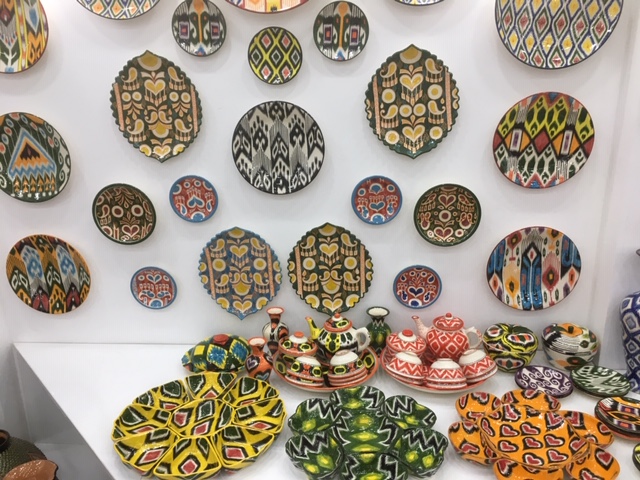
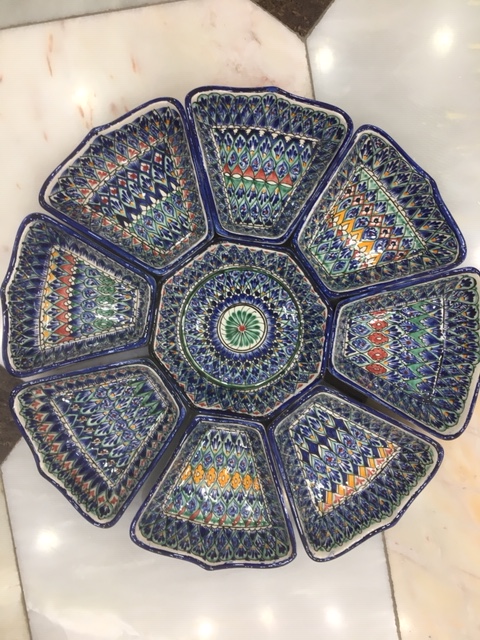
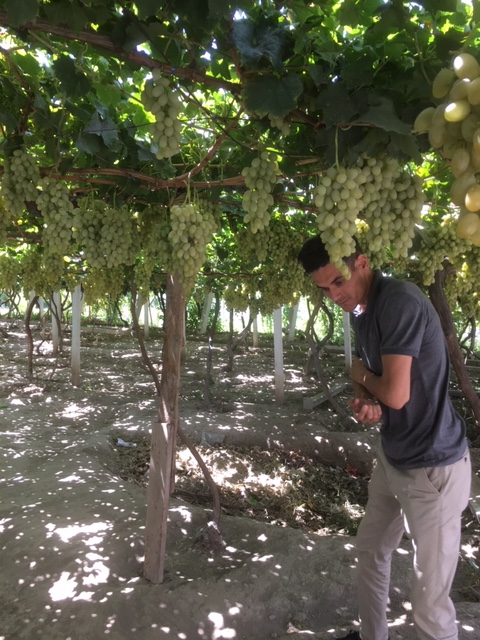
We buy several items and as he is wrapping them up for us he asks us about our lives. When Roelf says he was a doctor and treated patients with stroke he suddenly gets quite excited: we have to speak to his boss whose mother has had a stroke and has problems with a swollen leg. We agree to do so and are taken to a house where Roelf has a consultation with the poor lady who has indeed suffered a stroke resulting in a quite severe right sided paralysis, dysphasia and visual field loss . Roelf quietly goes through a physical examination and then explains, with help of the English tutor of the family’s daughters who acts as translator, that the problems are all related and that the swelling is caused by her immobility. They listen intently and seem to understand that they should try to mobilise grandma more. All the while we are offered tea, bread, homemade raspberry juice and when we leave, grapes from their courtyard, shaded by vines. It has been a sobering but wonderful experience. The trust these people had in Roelf. The time they took to try and understand what was communicated and their hospitality. They even take us to their vineyard and leave us with a crate of the most delicious grapes we ever ate.
But now it is already past midday and we have some 300 km to go. We drive on up over the high pass that separates the Fergana valley from Tashkent. The Mog goes up slowly as the gradient is steep. We make it to the top with minimal overheating and hurtle down towards our overnight stop. But light is fading and the road is poor. We drive for 2 hours in the dark, hitting some potholes hard. Then, some 40 km before Tashkent we realise we have made a mistake in the coordinates and find outselves in a township outside the city. We get lost in the small roads and end up in a dead-end street. We have to turn back but suddently the GPS system gives up and now we don’t know where we are. We stop frustrated having tried so hard all day to reach the destination in Tashkent where a warm shower and food await, but it is not to be. We find a place to park up for the night. And when we get out of the car we see that there is an even bigger problem then just having lost our way: one of our fuel tanks hangs half loose, precariously dangling under the car! Several men appear out of nowhere and start to ‘hello’, but we quickly realise they have been drinking ahead of the national holiday ‘Independence Day’ and are a bit tipsy. We are exhausted. We don’t think this is a good combination to do this intricate work and ask them kindly to leave. We want to deal with this problem in the morning. Nothing can keep us awake that night. Not the endless people visiting a nearby burger place, the cars driving past on the busy road, nor the stream of small busses in the morning that pick up workers from the area. When we wake up we find this:
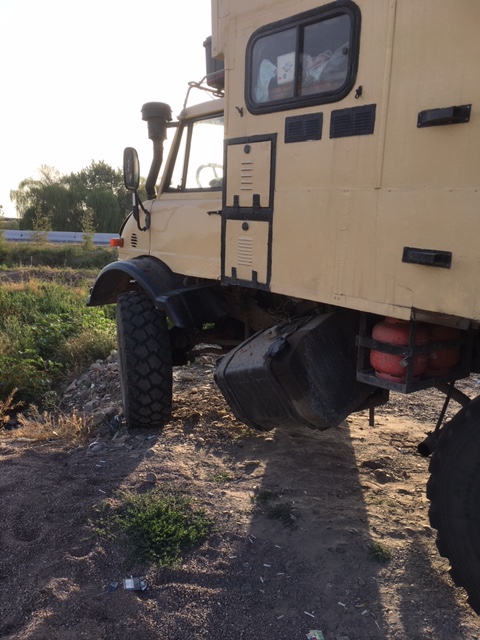
September 1st
This is Uzbekistan’s Independence Day and everyone has a day off we have been told. Luckily this does not include shopkeepers and we get some sustenance from the nearby shop before tackling the problem. We need to jack up the tank (which is half full, we’re so lucky it has not come off completely) but we cannot find enough materials to get the required height. Then a man who has been watching us from his nearby house brings what we need: his sturdy small bench!
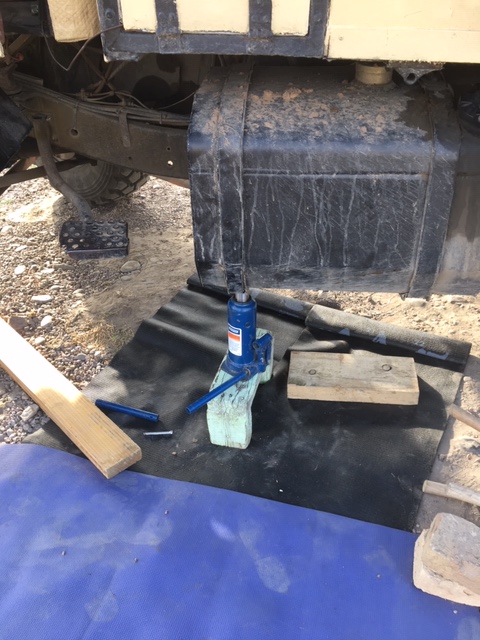
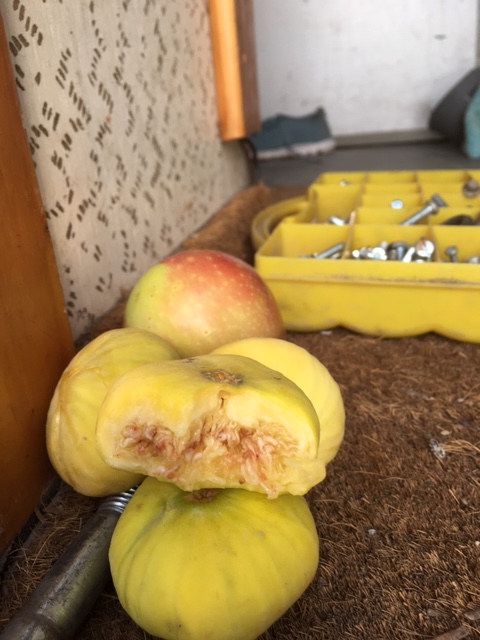
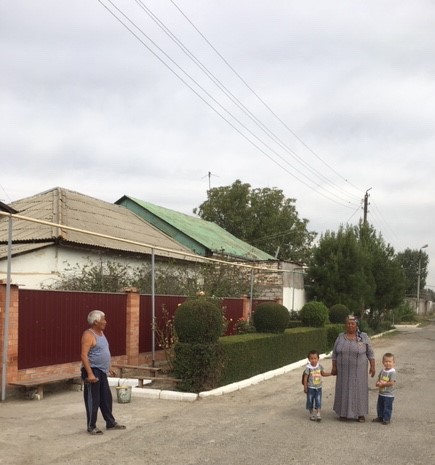
Now we can make progress and Roelf manages to get bolts into the holes where the originals are missing or even broken! This is incredible: a big bolt was cleanly snapped in two parts. The man comes back to give us fruits from his garden, apples and yellow figs. He observes what we have done, is satisfied it has gone well and collects his stool. We are allowed one picture of him, his wife and and his grandsons, in front of his beautiful garden in this strange crossroads. How we wish we could speak Russian.
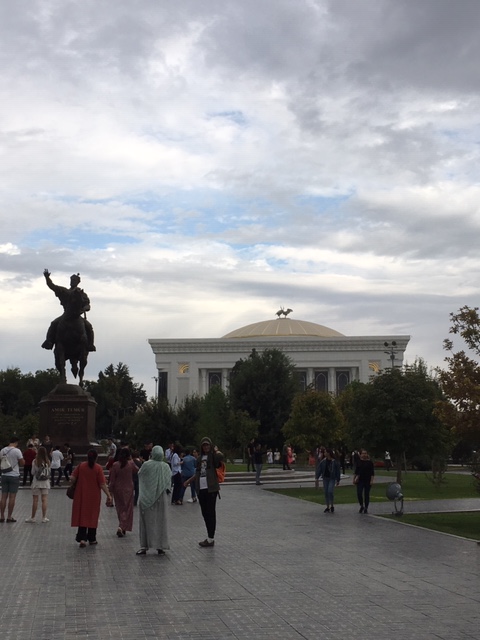
Now we have to get to Tashkent and thankfully on the way there we find a proper hardware store to buy the correct size of bolts and nuts. We get to Hotel Uzbekistan by 11.30, again quite exhausted but happy nothing worse has happened. Roelf gets to work on the Mog and then we both have showers in rooms we rent in this hotel as a group to have facilities. This is a big, very big hotel in the new part of town close to the park with the statue of Timur on horseback and close to the museum built to honour him now that he is the official hero of the country. No better day to visit this than Independence Day. Interestingly, on the many fairs throughout the city that are held because of the festivities, we find that the boxing stands are the most popular. Clearly being a strong man in Uzbekistan is still of importance and many people come to honour their strongman at the statue in the nearby park (see picture at the beginning of this post).
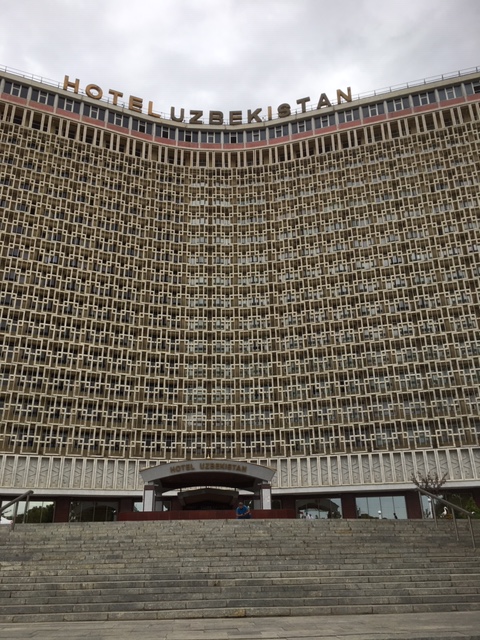
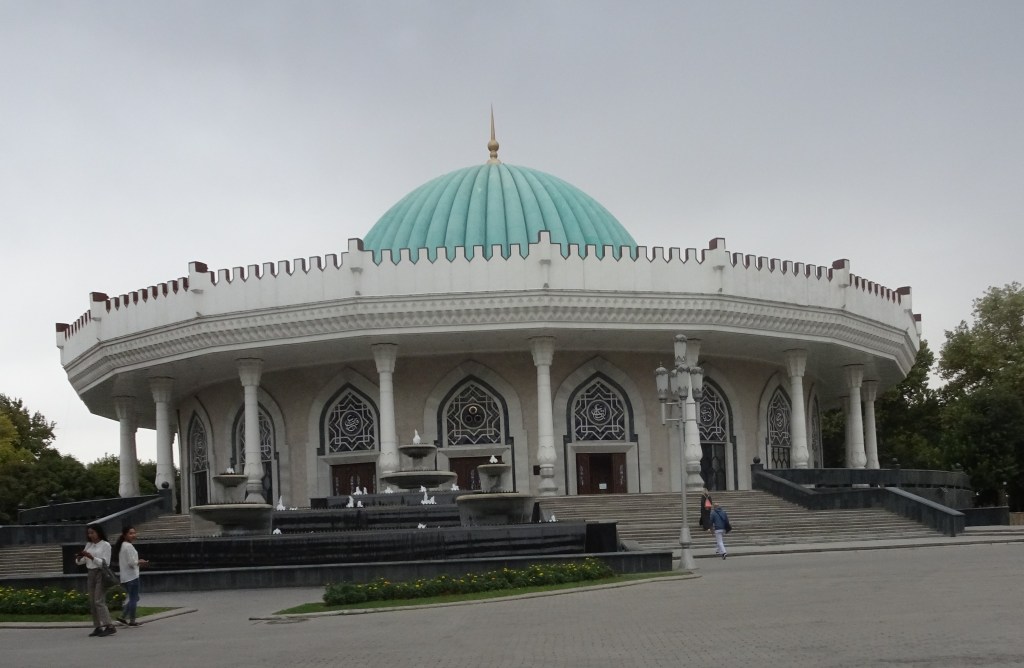
We finish the day with a meal in a posh Tashkent restaurant with most of our travelling group. There are fireworks outside to celebrate the national holiday. The place is beautifully decorated and we eat from handmade pottery plates from Rishtan. The food is wonderful as it has been throughout in any small or larger eatery. This place is miles away from where the ordinary Uzbeks will be able to dine and we are a bit embarrassed to be here. Still we pay only what an ordinary meal in a run of the mill restaurant back home would cost. Just some 250.000 Cym per person! I give them the full amount for the two of us in small notes. It is too much to fit in the folder and they do not even count it!
August 2nd
We are going to one of the most famous silk road cities today: Samarkand. Samarkand was Timur’s capital and he concentrated all his war trophies there. He himself, ever the nomad, prefered to live outside the city in a yurt with his men and horses.
Given our luck with the car we leave early. It is 9 and we are on our way. The GPS system sends us the wrong way out of town, but we don’t realise this until we come past the same hardware shop we have been to earlier. A good opportunity to stock up on some more bolts etc. We happen to park in front of an artisan bakery and can see the full process in action. Two guys are shaping the round breads from dough balls. They make it flat and then put in their special mark with two stamps full of small nails. Every bakery has their own decorations. They put something on top to create a glaze effect and then the special bit: one guy delves deep into a gas-fired clay oven to stick the bread to the ceiling! The whole ceiling is covered and the breads are all at different stages of being baked. He dives in again, now holding a pan on a stick to catch the breads which he dislodges with another device, a type of pizza holder on a long stick. Out they come smelling delicious. We want to buy one but he wont accept any money. We leave with one special bread and the guys smiling and waving at the Mog.
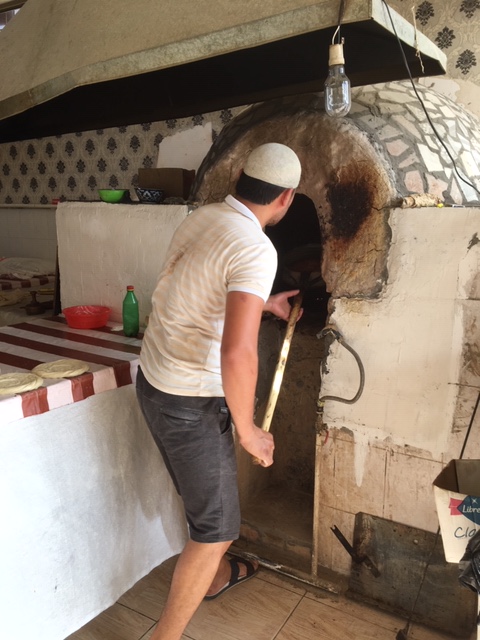
On we go and we accept the wide detour to get back to where we should have been. At least we are driving outside the city. We find a pump that sells diesel. This is not a commonly used fuel in Uzbekistan. All small cars and even some of the very old, former petrol-driven lorries are powered by LPG. Gas is a natural resource here whereas they do not have oil. Huge new fuel stations for LPG are built everywhere. It is immediately clear how much cleaner the air is here, especially in the built up areas. No major smog here like we saw in Almaty with this cleaner type of fuel. But not for us, not for the Mog, we need diesel. We have to pay cash and do not know how much we have left. We have mainly small notes and we need some 400.000 Cym. We give the attendant big wads of money and he puts them through his counting machine. We have enough for 60 litres. We are happy, this fills our half-empty tank that is now properly fixed to the car again and we leave all smiles.
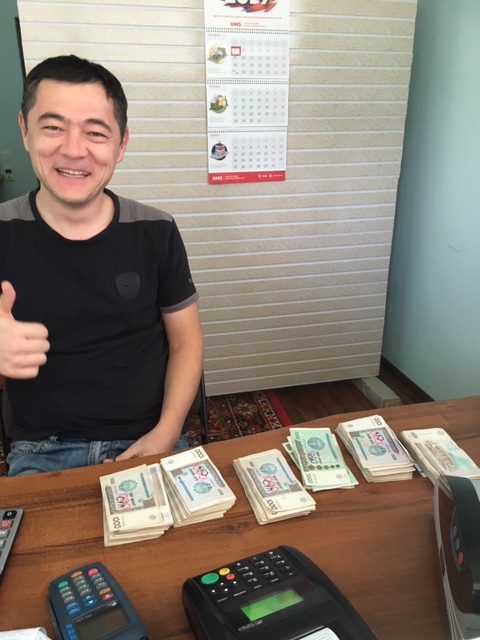
Happily we move on. The Mog purrs when we finally clear the ring road of Tashkent and are on the long road to Samarkand. But then a strange sound and car light flashing. We stop thinking it is the tie of the boxes on the roof that indeed is loose. But when we have driven off some 5 km again we suddenly realise what it was. No, not again….! We have again driven off with the roof hatch on top of the roof, unattached to its chain. Would that just have come off, some 40 km away from where we started? Roelf is jumping up and down with frustration and anger. When we get back in the car and drive off we realise he has now lost his glasses too. This makes him even more mad.
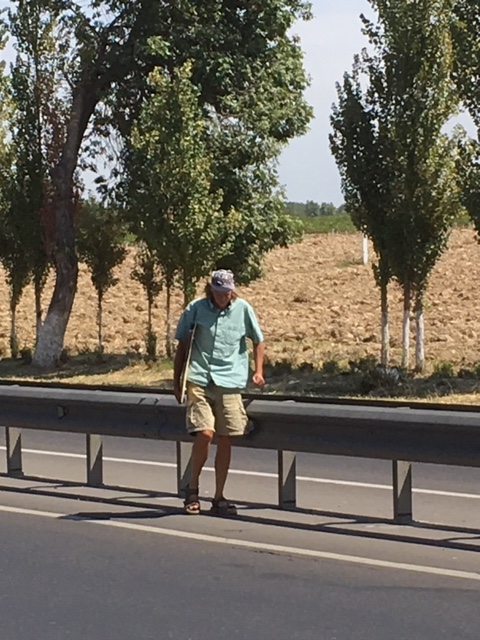
Miep decides we should turn back and look for the hatch and the glasses. The latter will be relatively easy to find again but the hatch would take so much time to re-make. It is worth one hour of searching. We stop at several places while driving back. This is a 4 lane road so each time we have to cross the lanes and jump over the central barrier. We don’t find the glasses but would you believe it: when we turn back again, now only 6 km from Tashkent and drive in the direction of travel when we think we lost the hatch we see it. It is on the overtaking lane and it seems in one piece! Roelf retrieves it and we cannot believe our good fortune. There has been no major accident and we have our hatch back. Bent and bruised, but it will fit with some hammering. We give up on finding the glasses and finally set off at 1.30 from just outside Tashkent, some 4 hours after we left originally!
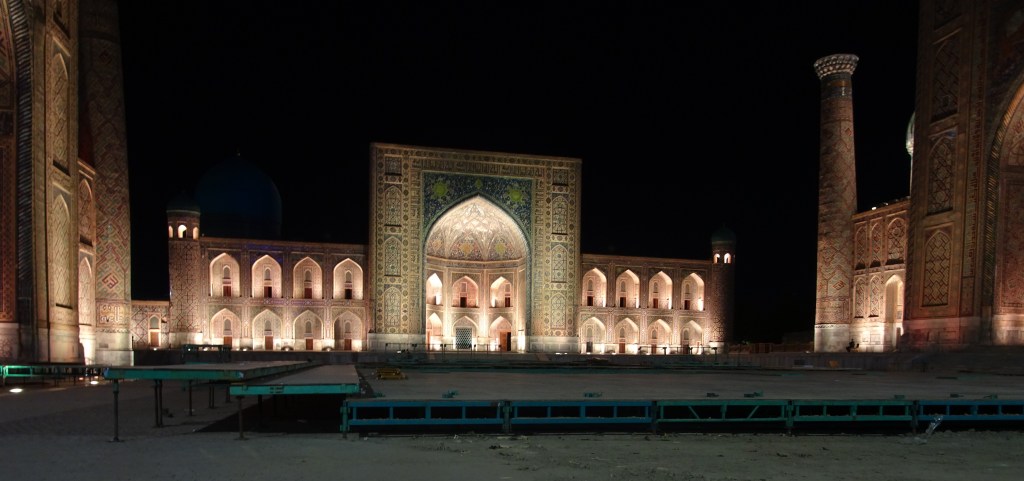
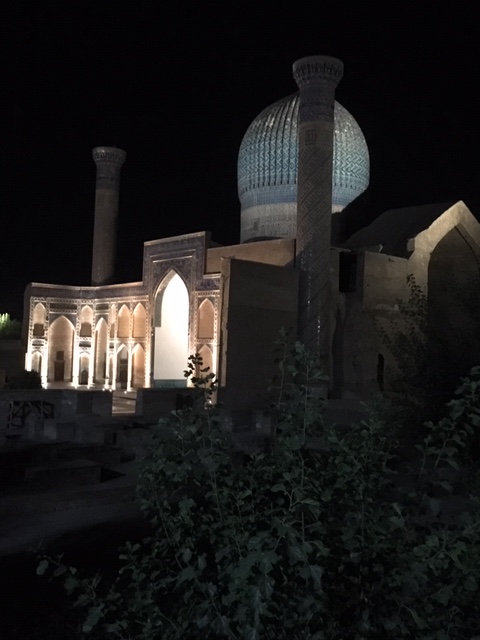
Now we can finally get on our way and things go smoothly apart from the regular water refilling of the radiator. Eventually we have to get water from a river and we have to sieve out the many small fish we accidentally scoop up too. The drive is a bit monotonous. Agricultural land, a poor road most of the way and a fairly flat landscape. We are stopped by the traffic police at one of the many checkpoints. Six officers surround the car and we have to speak to the daughter of the chief by phone because she can speak English. We keep wondering when they want to see our papers, but it becomes clear that all they want is to see the car. Thumbs up for the Mog and we are free to go. We make it to Samarkand at 7.30. it is dark when we arrive but it could not have been a more atmospheric place. We drive past the Registan, all beautifully lit and we are parked directly in front of the Mausoleum of Timur. Other members of our group are waiting for us and we relax with some nice wine hidden in coffee mugs watching the beautiful buildings. Nice parking attendants have offered to look after our cars the next day and have made us feel very welcome. We make sure we keep the site tidy, this is such a historical place, we must be respectful. But we do have our wine….
September 3rd
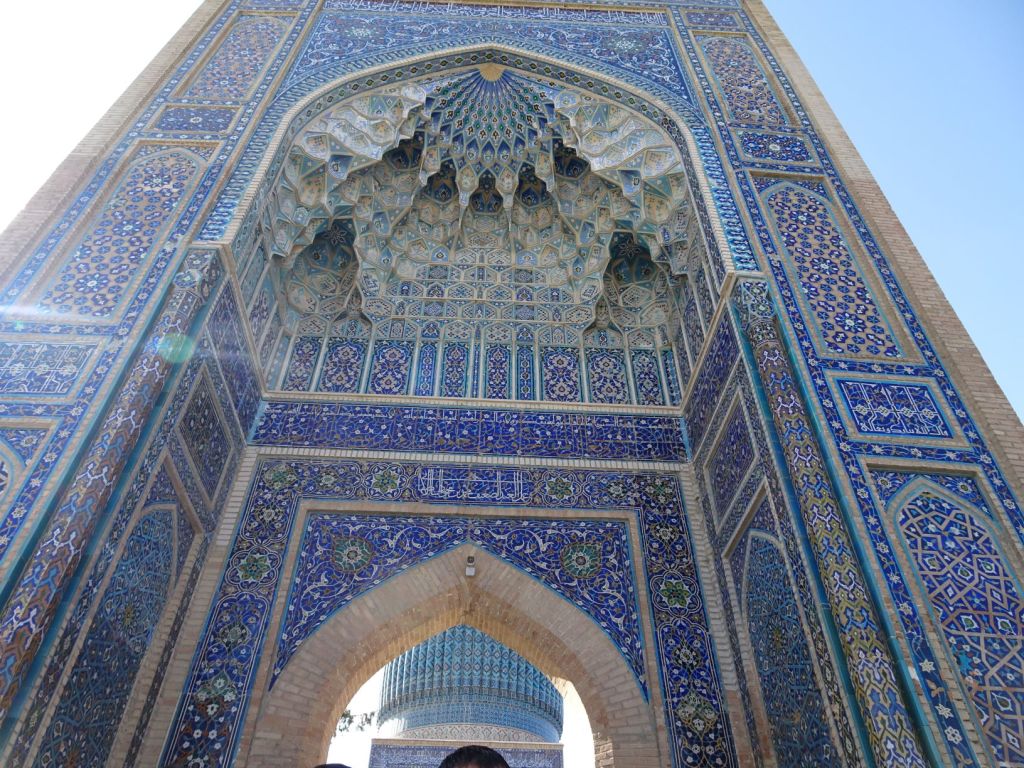
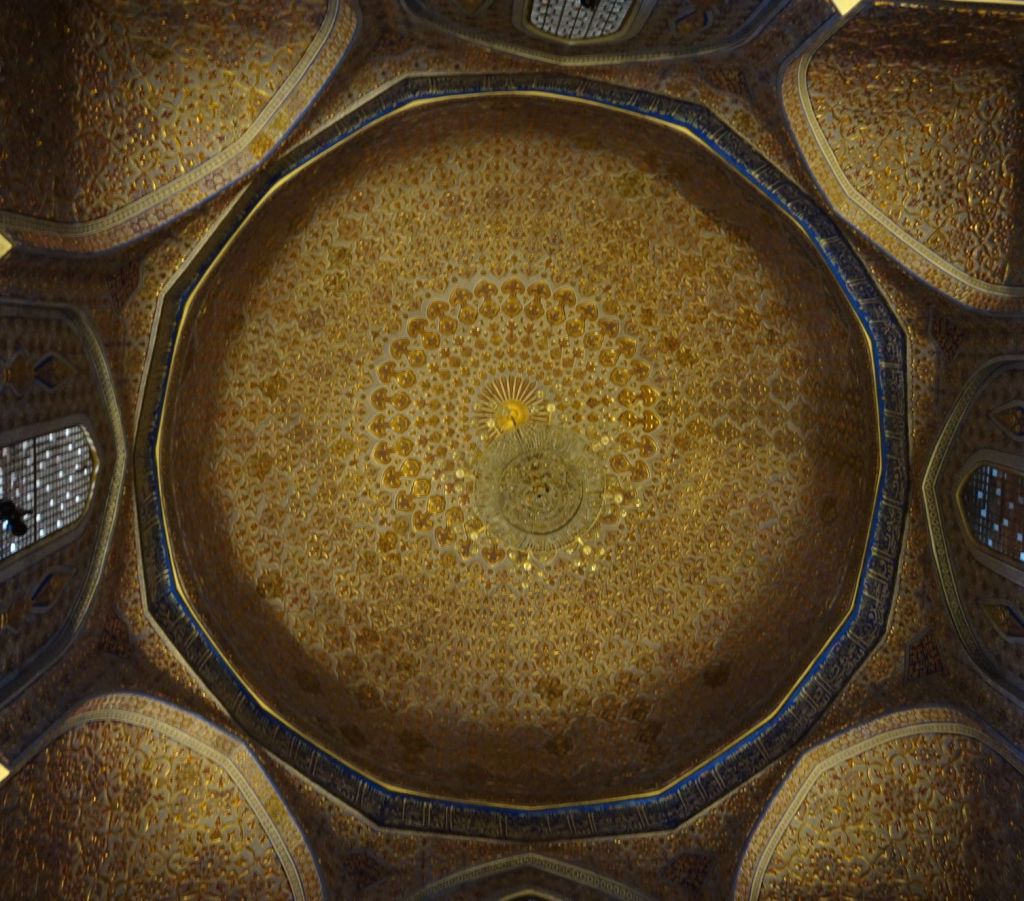
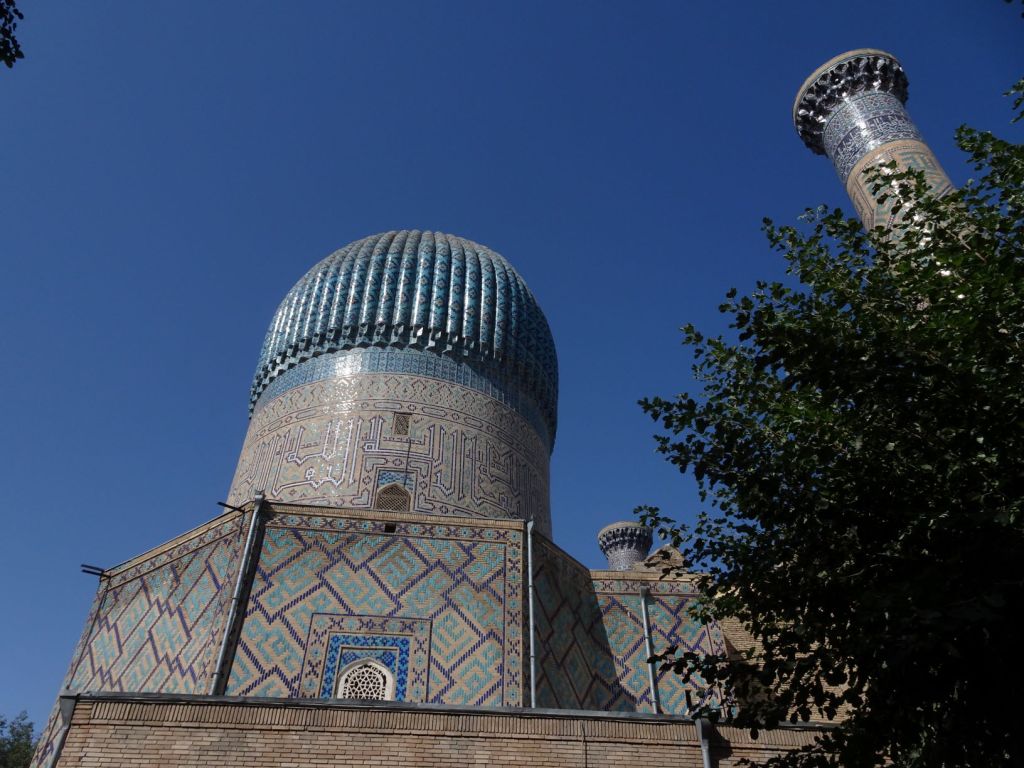
We have a full day tour of Samarkand with a lively guide. We start with Timur’s Mausoleum. The entrance portal is beautifully decorated in blue, but the greatest surprise is inside: the dome takes your breath away quite literally.
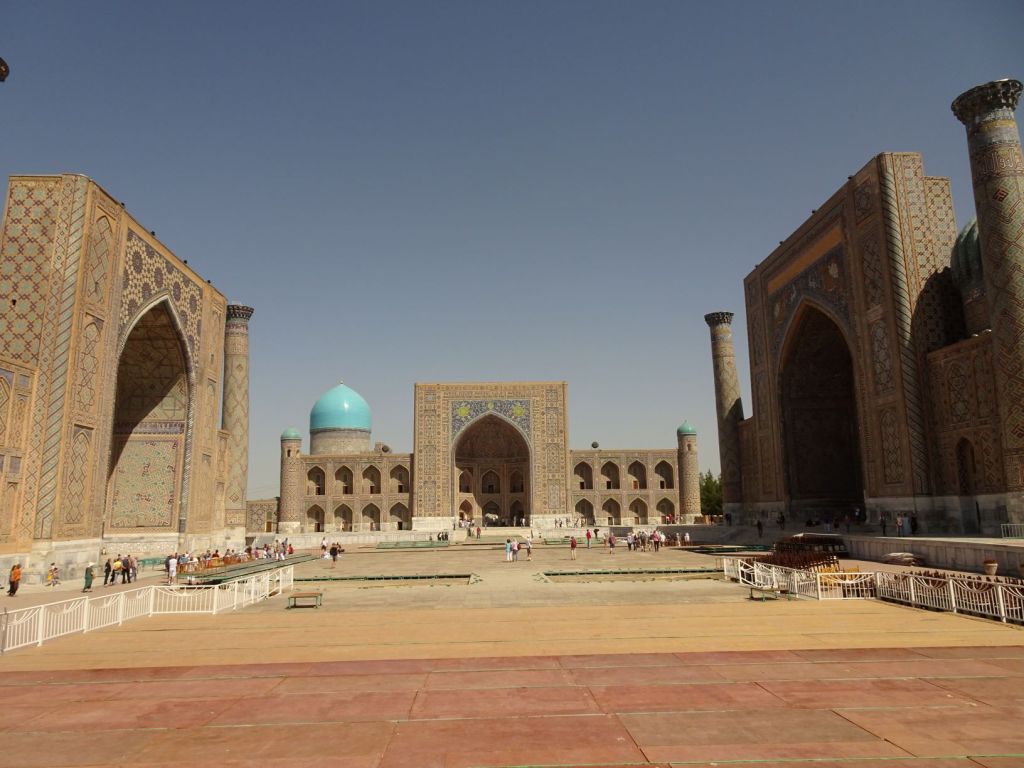
We spend some time in and around this wonderful building and then move on to the Registan, the great square we had already seen at night when we arrived. In the light of day the blues and the mosaics shine and the overall feeling of being in this place is quite overwhelming. Some people think this is the most beautiful square in the world. It certainly is the most colourful one we have seen. The symmetry of the madrassas opposite each other and the mosque in the centre is very serene. Things just feel right in proportion and size. There is inspiration for knitting patterns everywhere. All the patterns are drawn out in glazed tiles on the walls. We spend quite some time visiting the madrassas and the mosque which is now a museum. There are artisans everywhere occupying some of the rooms that in the past were teaching rooms. To have been a student here must have felt so very special. Ulugh Beg built one of the madrassas and this was a forward looking place in its time. He felt that it was the duty of each Islamic citizen to search for wisdom. He taught at this madrassa (university) himself. We learn about the different styles of building with flowery patterns inspired by Iran and others with symbols borrowed from the Zoroastrian faith. These buildings were in ruins until the Soviets started to restore them. This is remarkable because religion was forbidden at the time. But our guide tells us that the Soviets did this because they wanted to preserve the cultural heritage of the region and they also wanted to appease people in the region.
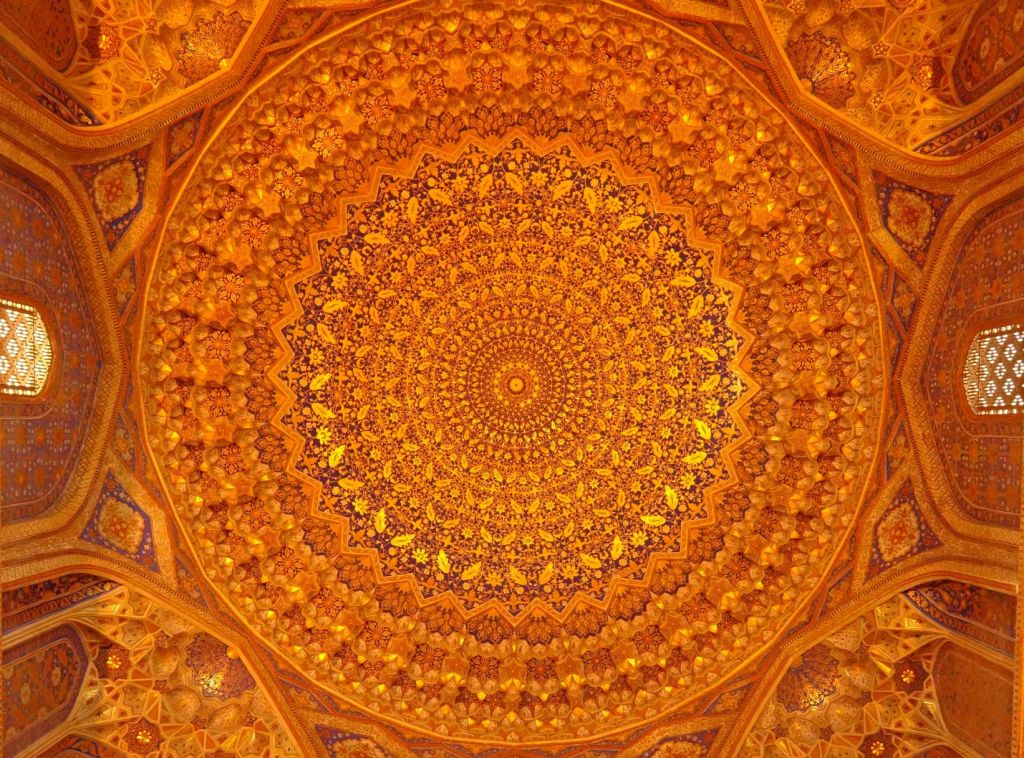
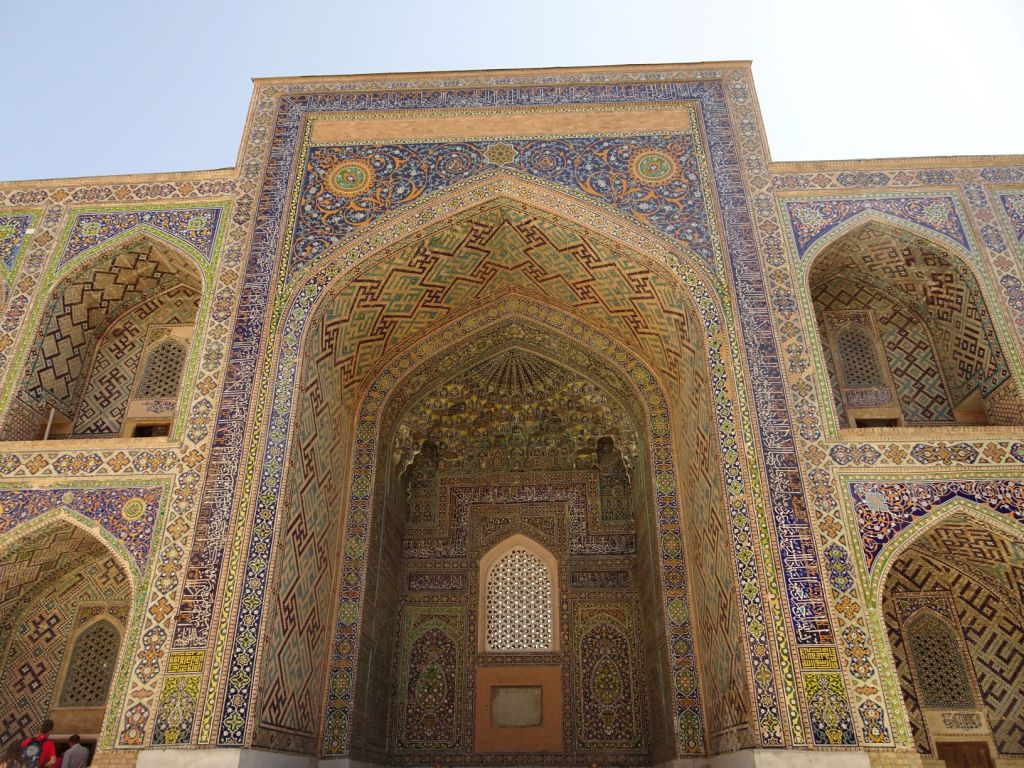
We also visit several other historical buildings with two highlights; the observatory that Ulugh Beg build on a hill just outside the city walls, and the necropolis with a collection of mausolea for important people from Samarkand.
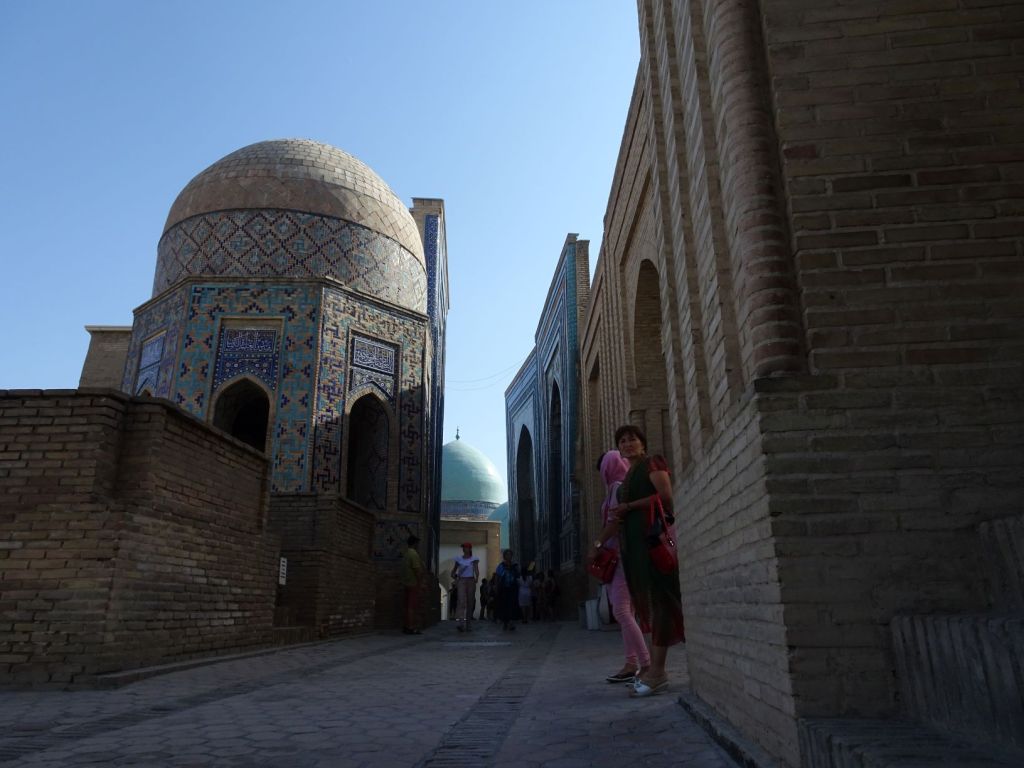
The overall impression we get from this great city is one of great wealth and art in its heyday. It is great to see the buildings restored, although we hear there is some concern about the way in which this is done with perhaps too much ‘renew’ rather than ‘restore’. But we enjoy seeing the buildings more like they would have been in their prime, rather than leaving walls unfinished or unpainted to show only the surviving material. In the evening we walk back to see the Registan at night and we also walk through some of the areas of the old town where the current citizens of Samarkand live. These are quieter neighbourhoods where men sit and talk under trees, where boys play football on the square and where we get glimpses of courtyards with trees and flowers. Samarkand is a big city with lots of activities and tourists, but here we feel the atmosphere of a small town. It is very enjoyable to get back to the Unimog parked under a tree in the midst of all of this.
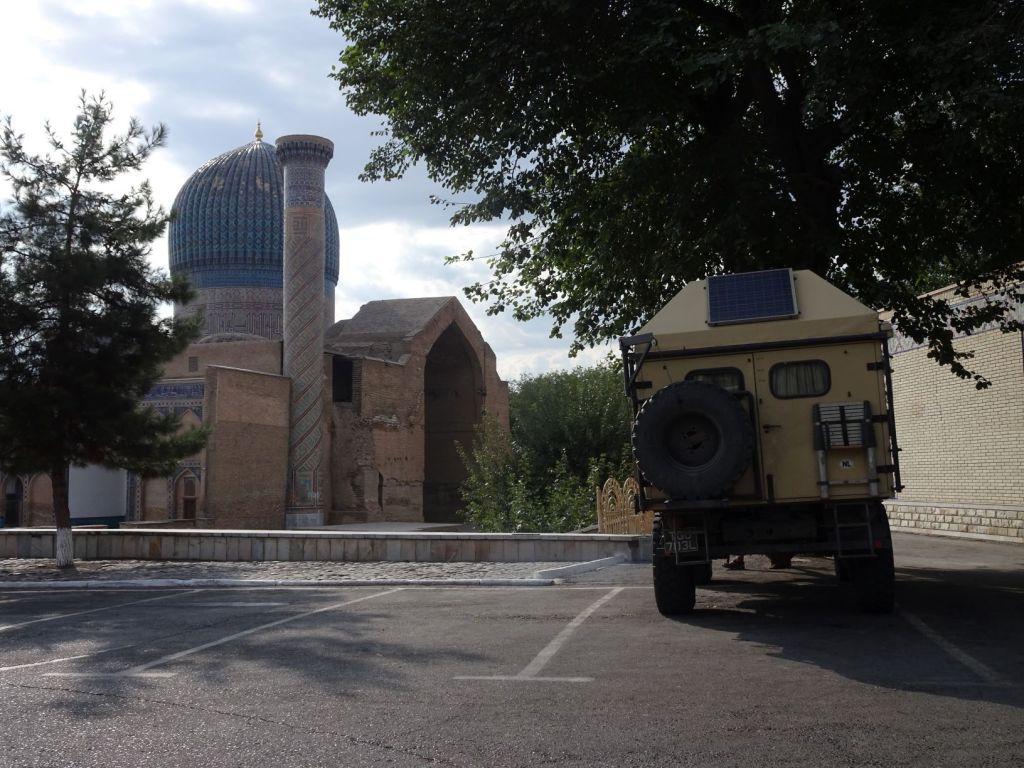
September 4th
Today we are on our way to Bukhara. Bukhara is one of the oldest cities in Central Asia stretching back some 2500 years. Its city gates pointed to other famous cities on the silk road; Merv, Gurganj, Heart, Khiva and Samarkand. The city hit its high point some 5 centuries before Samarkand in the 9th and 10th centuries under the Samanid Dynasty.
The city was totally destroyed by Genghis Khan in 1220, and remained in ruins for more than a hundred years. The city was temporarily revived in the 16th century when the Bukhara Khanate, one of the warring khanates after the decline of the Timurid Empire flourished. however the Silk Road was in decline because of the discovery of sea route alternatives to the Silk Road by Vasco Di Gama.
The drive is going smoothly and is uneventful. The road is going through quite a built-up part of Uzbekistan. We see endless villages, small towns and agriculture inbetween. We stop to check the water level and decide to add the radiator fluid that should stop small holes. The small drip-drip stops…….
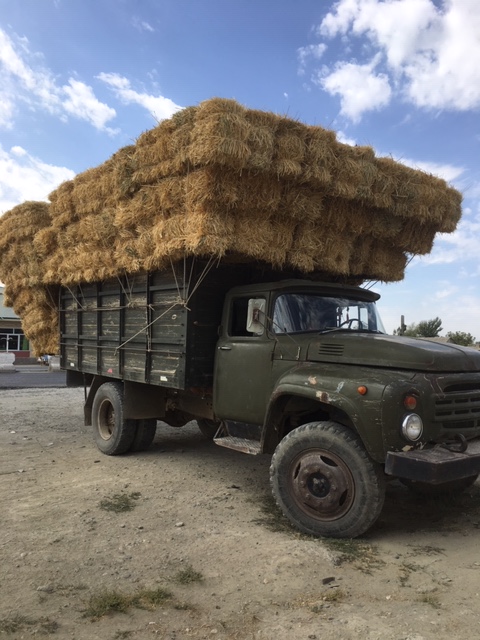
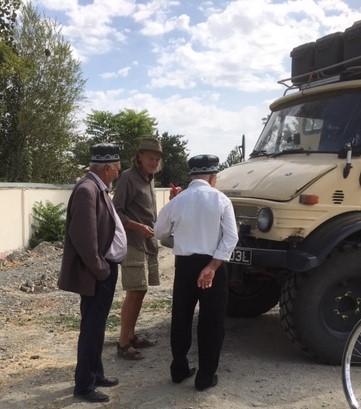
As always a small crowd appear and then an even larger one when the school goes out. Hundreds of schoolchildren cross the road, all immaculately dressed in black trousers and skirts and while blouses. The boys also wear a waistcoat and the young girls have large white pompons in their hair. Soon after we see them again now in their normal clothes, riding bikes against the traffic, eating ice cream and playing on the roadside. We try to speak to some of the older boys but they do not appear to know English. We are not sure whether it is true or just shyness. Three older men are circling the Mog. They wear the typical caps older men wear here. Their own car is a vintage hay wagon that runs on LPG!! Again our lack of Russian is a problem and the conversation stalls. Big waves when we depart.
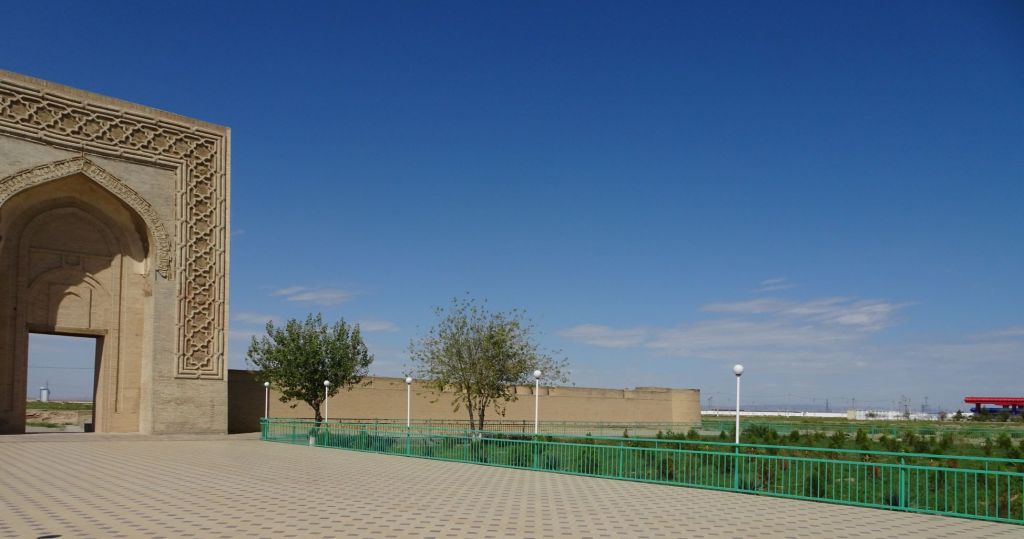
We make just one stop on our way. This is to visit what is left of a Caravansary. The walled places where the travellers on the old silk toad could find a safe rest, a meal and a place for their camels and horses to rest, drink and eat. There is only the big entrance left and some foundations of the walls of what was once inside. On the other side of the road is an old water container of the same time. This is a fabulous building over a deep basin. A round dome, made of brick would keep the water cool and even, through evaporation and condensation on the bricks, provide a kind of water filter. Water would be present naturally, or be diverted into the reservoir or even snow and ice would be placed in it in winter to have sufficient supply. Similar places existed also in cities. This one must have been for the Caravansary. A nearly building with beautiful old pillars is being renovated to become a restaurant. There is even a clean toilet block on the parking. This historical monument is ready to receive tourist from everywhere. All that is lacking is some interpretive signs.
September 5th
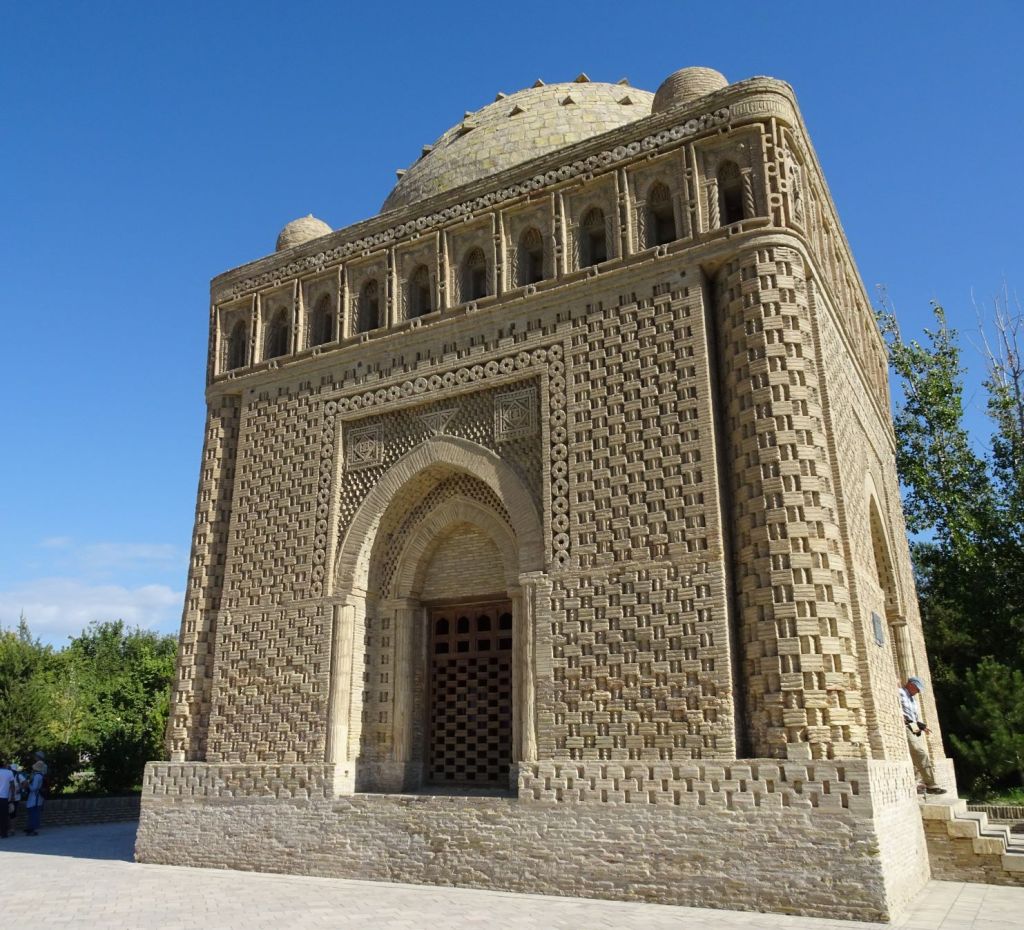
Today we visit the city with a guide. There are only 3 buildings in Bukhara that survived the onslaught of Gengkis Kahn. Small but beautiful is the Ismail Samani Mausoleum. The intricate brickwork of this cubed building with dome is fascinating. It was buried in sand which has helped it to survive since the 10th century. Another saving grace may have been the fact that it was situated in a large cemetery, a place of the dead that ironically scared the cruel great Kahn.
 Central Asia Roadtrip