The land of mountains, rivers, lakes, horses, eagles and yurts.
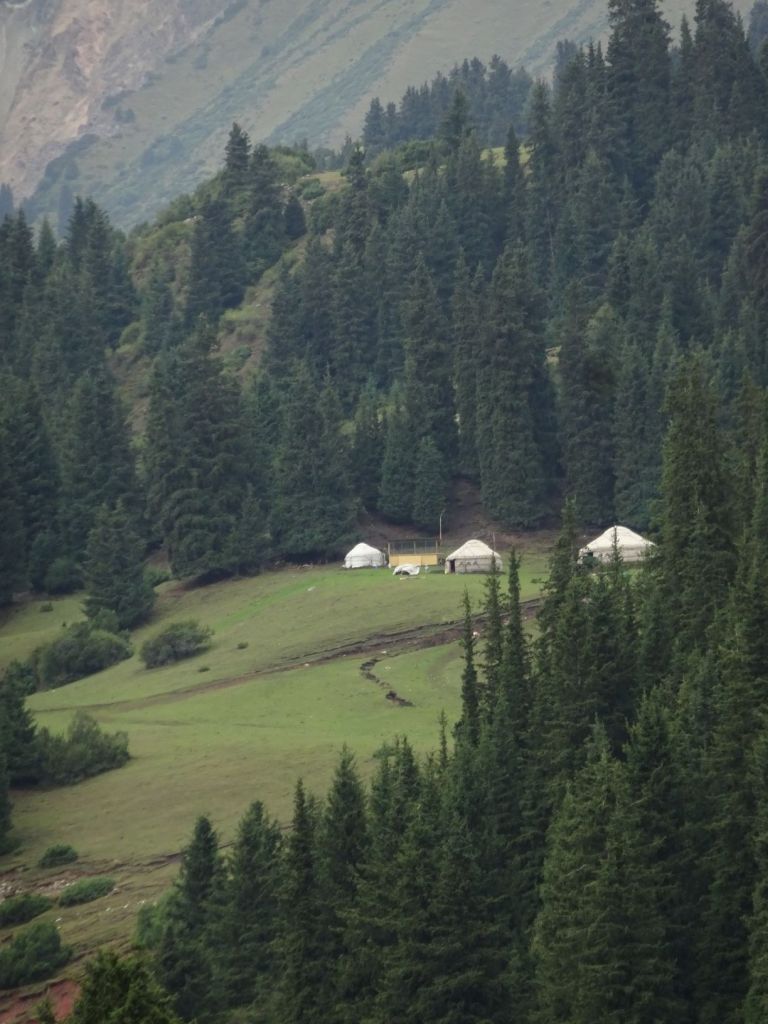
The Yenisei Kyrgyz are from the upper Yenisey valley. The Yenisey is one of Russia’s three large rivers and runs from central Siberia to the Arctic Ocean.
The Kyrgyz were ruled by the Gokturks who established the first Turkish Empire in central Asia in the 6th century AD. Later the Kyrghyz were ruled by the Buddhist Uyghurs who were from Mongol origin. The time in the spotlight for the Kyrghyz was when they defeated the Uyghurs in 840 CE and founded their own empire which lasted for about 200 years when it gradually succumbed to increasing Mongol domination. In the thirteenth century the Mongol armies under Genghis Khan forced the Kyrgyz people further south into the northern Tian Shan mountains, an area which is now known as Kyrgyzstan.
In 1876 tsarist Russia annexed Kyrgyzstan and gave preference of rights to Russian settlers. This lead to a failed and disastrous uprising in 1916, just before the Russian revolution. In Soviet times Kyrgyzstan functioned as the Kyrghyz Soviet Socialist Republic. This was a time of great social and economic change. Urbanisation replaced the traditional nomadic lifestyle and literacy increased dramatically.
Like other Central Asian countries Kyrgyzstan gained independence when the Soviet Union collapsed in 1991.
August 14
As soon as we have passed the border the land is green and there are meadows, beehives, birds of prey in the air and horses everywhere. What a contrast with the emptiness we have just left behind in Kazakhstan. We drive for some 50 km over a rough road and the Mog loves it. That is until we hear a loud bang and one of the mudguards comes off. Thankfully it fits inside and we go onwards to our camping destination on lake Issyk-Kul. We have our first encounter with the local police when we fail to stop at a rather hidden stop sign. We have to negotiate but get away without out a fine. We arrive just before sunset and see the mountain ranges that surround this famous lake. Then the full moon rises on the other side. quite magical. It has been an exhausting day. Half of our group do not make the final destination because of the poor roads and we catch up with them again the next day.
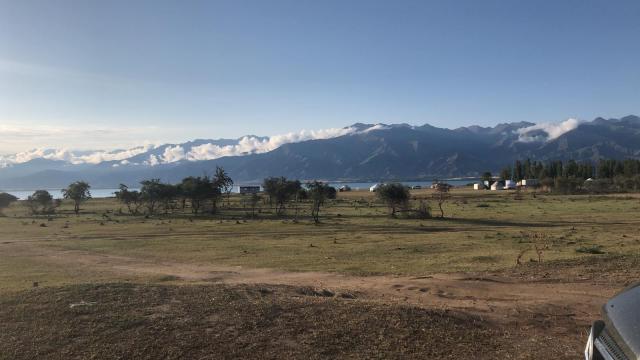
Issyk-Kul translates as ‘warm lake’ in the Kyrgyz language because it never freezes in winter although it is surrounded by snow capped peaks. It’s salinity is 2%, maximum length 178 km, maximum width 60.1 km and max depth 668 metres. Issyk-Kul is the second largest saline lake after the Caspian Sea. It is the tenth largest lake in the world.
August 15
We wake up after a night of rain on the shores of the lake. A swim is a must and it is wonderful to float in the vastness of lake Issyk-Kul.
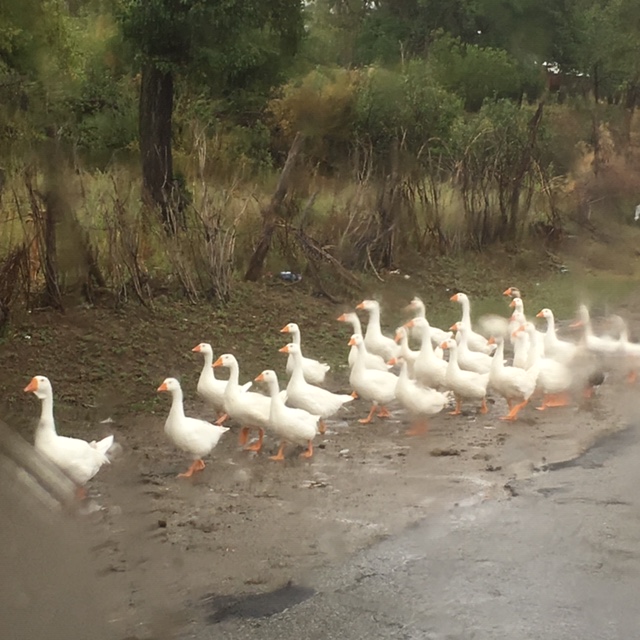
We drive through sodden roads through puddles and past happy geese dancing around in the water back to the main road. It all looks so much easier to negotiate in the morning after the long day before.
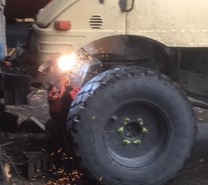
First mission is to find a welder who can fix the mudguard back onto the cabin of the Mog. We know it is going to be a tall order because there is little original steel left to fix it to. The rain is relentless and we begin to understand why Kyrgyzstan is so green. First garage cannot do it but points us to a second one. There they are helpful but in the end cannot do it either. The owner kindly drives ahead of us to a yard where we find what we are looking for: the welding artists that can put back together any car. Two guys drop what they are working on (a Russian army truck chassis with a Mercedes Benz engine and cab) and immediately understand what is to be done. The main welder is a slight guy who squats while welding intricately.
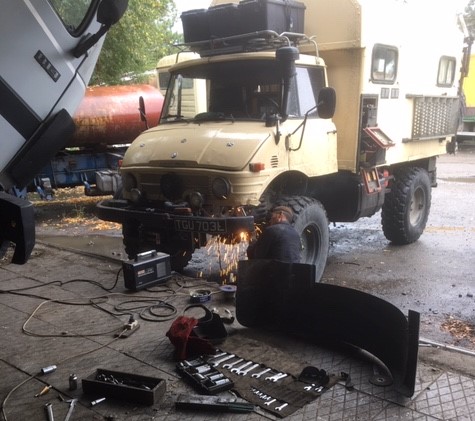
He recreates the corner of the cabin from a bit of steel expertly shaped to fit and then welds the connection for the mudguards in exactly the right place. We observe and admire his work. After a good hour it is all done and the other mudguard checked and all bolts tightened as well. We pay 1000 Som, around £12. Tips are not accepted.
August 16
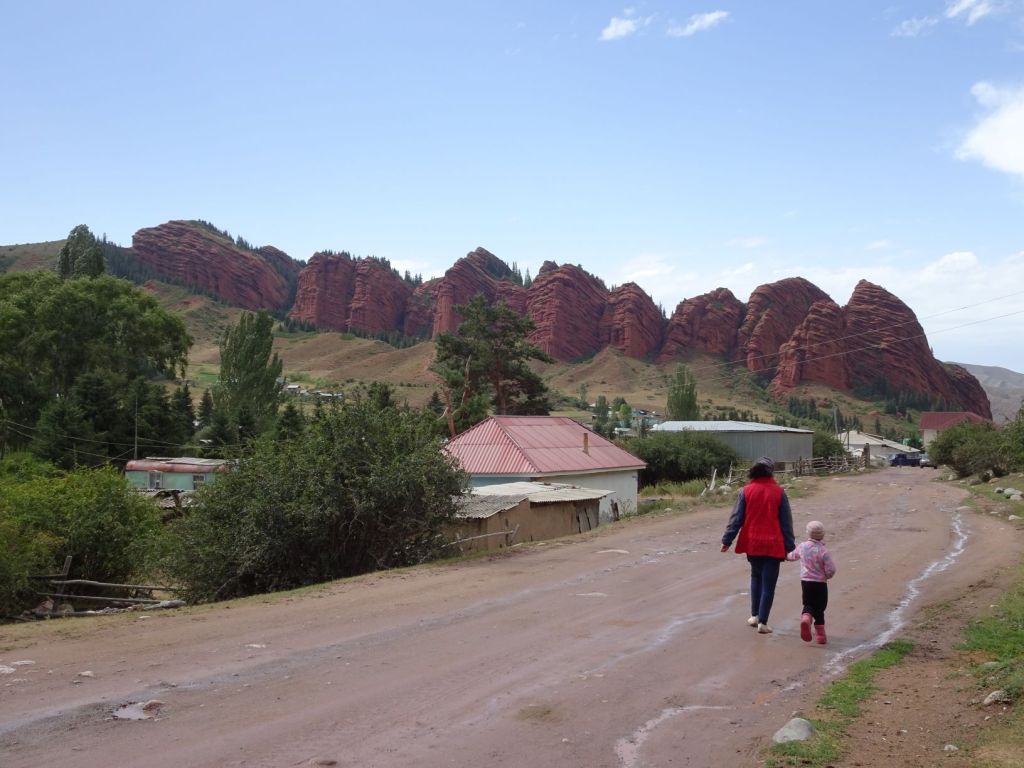
We camped at the ‘broken heart’, an interesting rock formation, some 10 km up into the mountains. We are now at 1700 m. A wild stream flows down from the higher mountains behind. It stops raining for a bit and Miep goes on a walk with 2 couples from the group, while Roelf sleeps and tries to help his recovery by having a very quiet day in the Mog. We follow a track up along the river. What we have not realised is that there are some yurt villages higher up into the mountains and that this is a tourist attraction. Car after car passes us as we walk through the rain. The road is poor and it is remarkable how many cars attempt the journey. There are 6 bridges of doubtful quality over the wild river, but nothing stops the cars and heavy trucks.
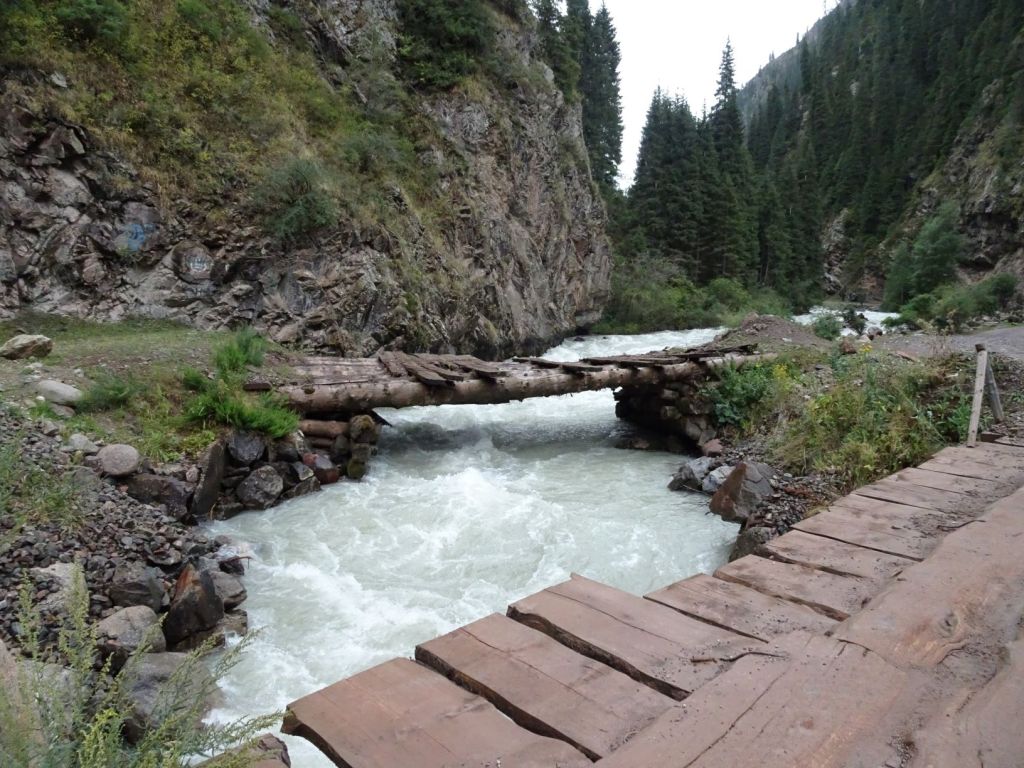
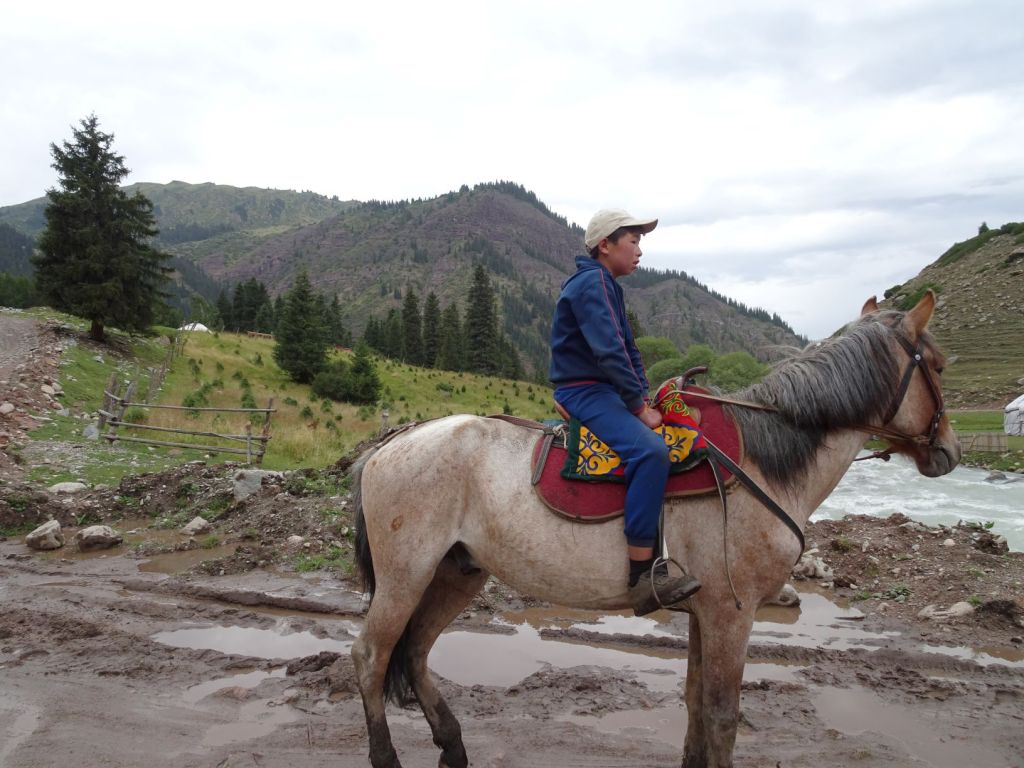
This track is better suited to horses and indeed we see several locals on horseback.
We arrive at the first alpine meadow after some 2 hours and have tea at the yurt. Chai is always served with bread and homemade jams here.
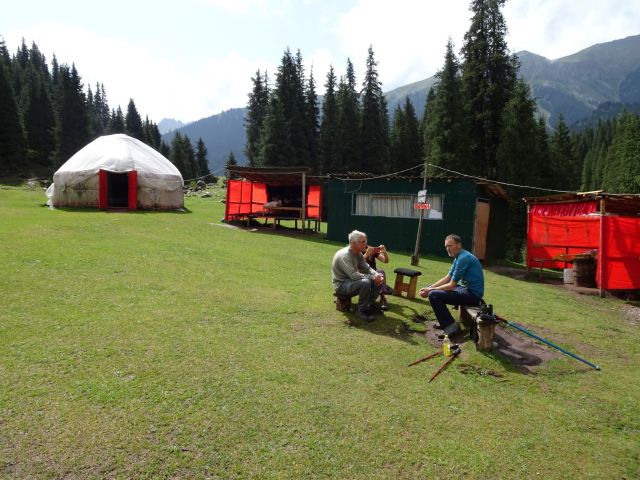
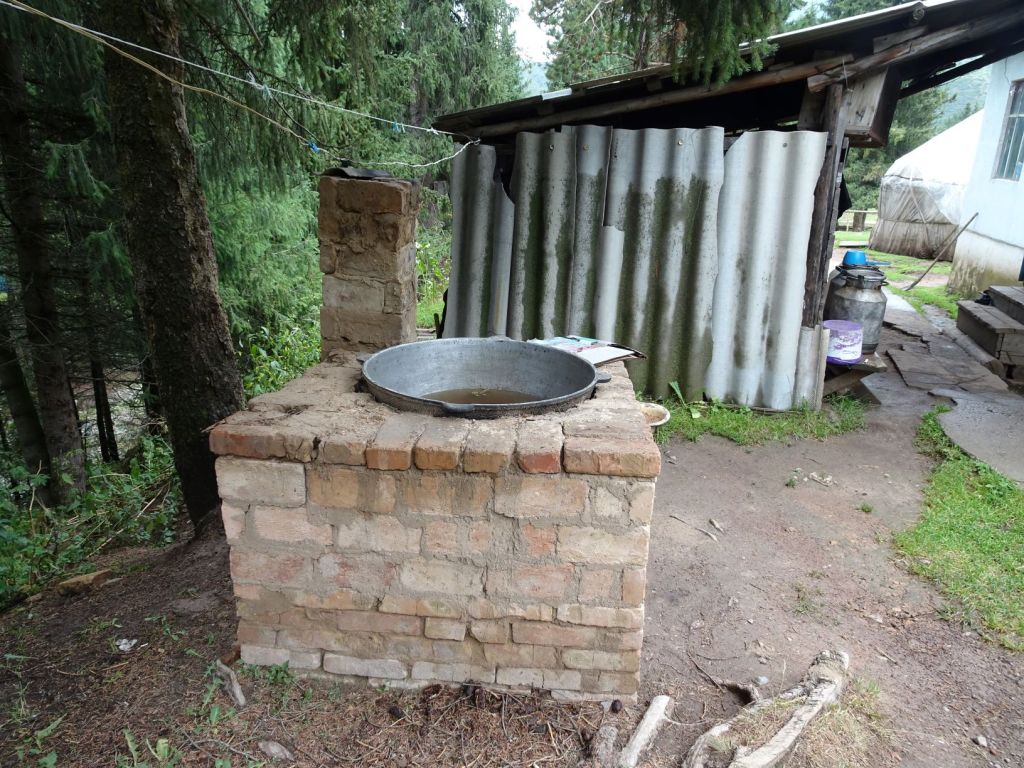
Everything is prepared on wood-fired stoves with beautiful containers to boil water and large steel bowls over open fires to cook.
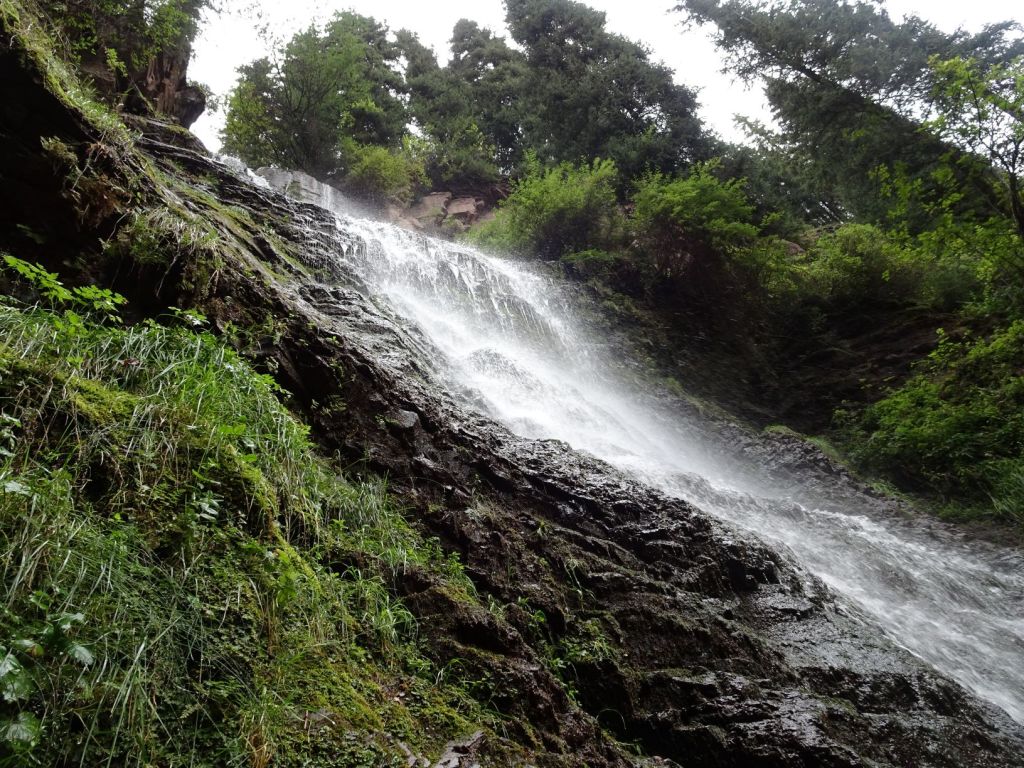
The highest point of the walk was a waterfall. The road up was muddy after much rainfall and the journey down best done on horseback.
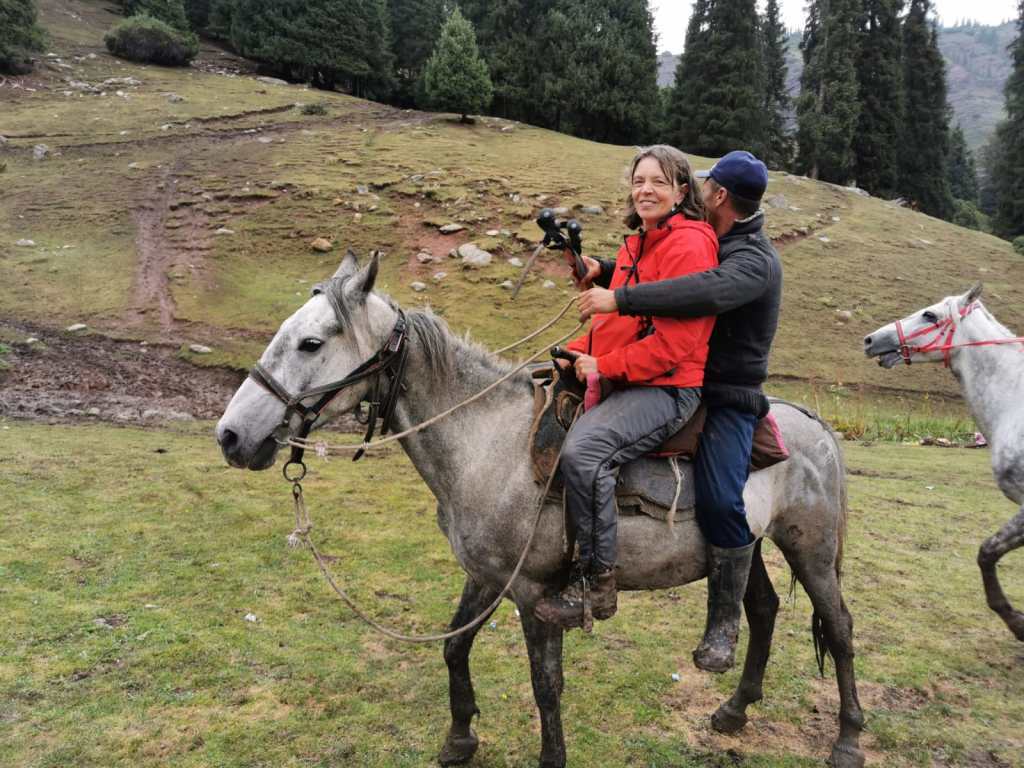
Walking down is easier and we get great views of the rock formations. We buy some local honey and also a fermented honey drink called mead, the ‘drink of the gods’. It contains a fair amount of alcohol and is very sweet. Lovely in tea!
August 17
Another day with heavy rain and some changes to our original schedule. We won’t camp in the mountains as it is too wet and the larger campers are unable to negotiate the muddy roads. Roelf is feeling a bit better and we decide to go back to Karakol to get some supplies. Miep a new waterproof raincoat and Roelf new glasses. We enjoy a nice coffee in a coffee bar and manage to find everything we need. We really like this town, it has a friendly and lively atmosphere.
August 18
Our camping spot is at a hotel/holiday house compound called South Beach. We wake up to a much better day, the mountains are visible on both sides of the lake. The lovely Svetlana, the manager of the hotel shows Miep round the kitchen and explains the various ingredients of the dishes they serve guests. Pasta-like dishes are predominant, noodles and Mante, dough-enclosed meat parcel. They make all the doughs from scratch, just as we saw in Kazakhstan. Today the cook is preparing Laghman, a Uyghur dish we still have to taste. It uses marinated beef. She also shows the herbs. Lots of sesame seeds and wild garlic, garlic and fresh and dried coriander.
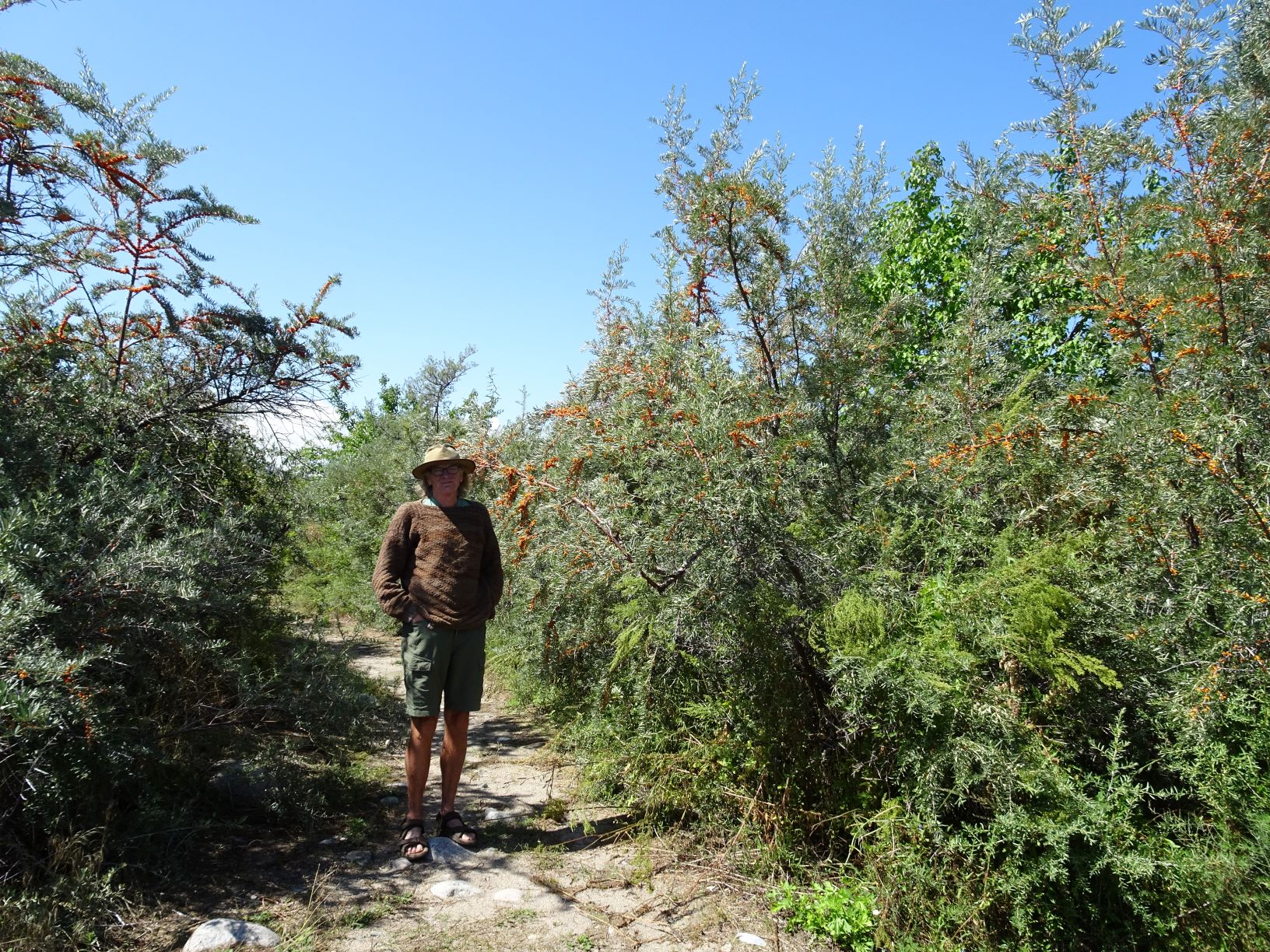
The beach is beautiful, the path towards it leads through a vegetation that looks familiar, we know the plants from the salty beaches in Holland and Scotland. Clearly this is a saline soil.
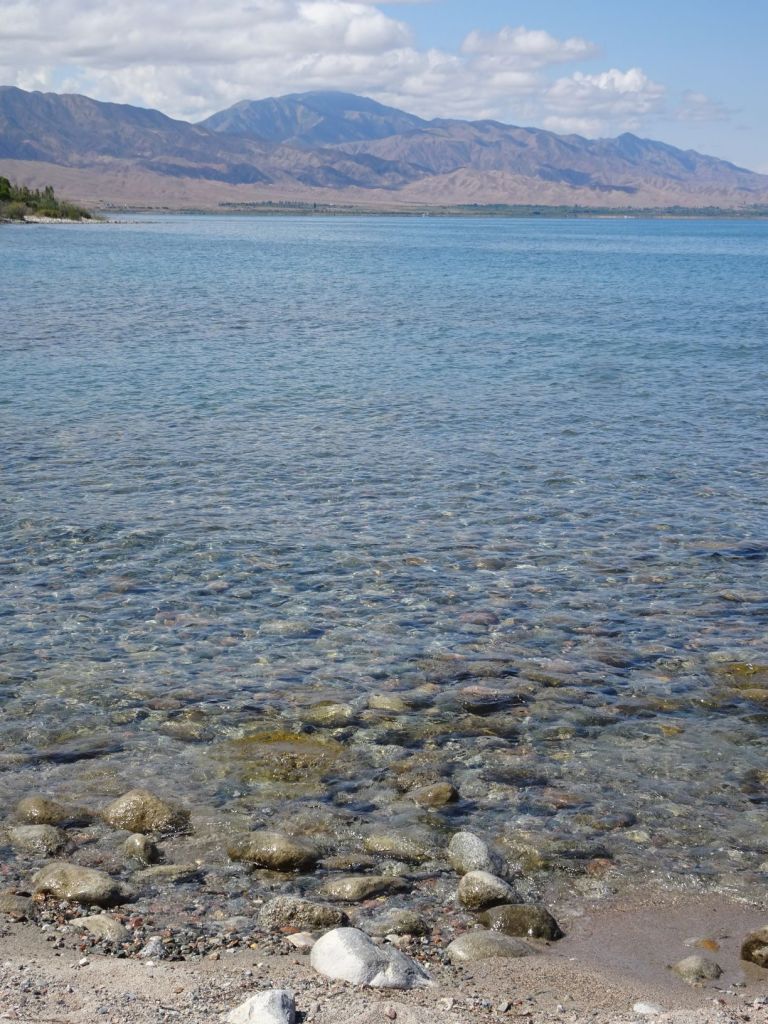
At the beach we met the coach of the young tennis star Stefanos Tsitsipas! She is on her way to the American Open but had decided to come to Kyrgyzstan en route to see the country as advised by her Kyrgyz physio.
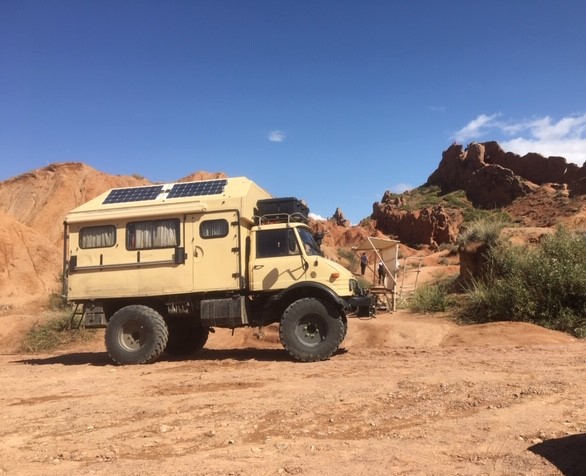
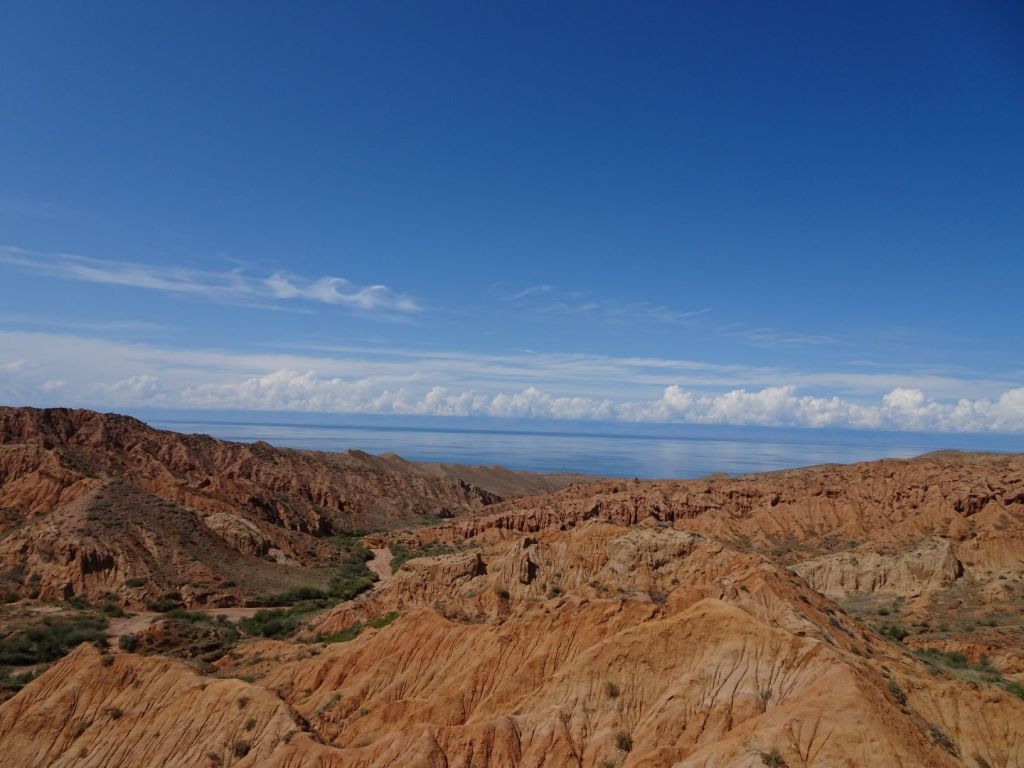
In blazing sunshine we drive to the Fairy Canyon, a formation eroded by the wind. The Mog can easily drive up the sandy track where many other vehicles get stuck. We even manage to pull out a van full of tourists. The canyon is beautiful especially when standing on top and seeing the blue lake in the distance.
August 19
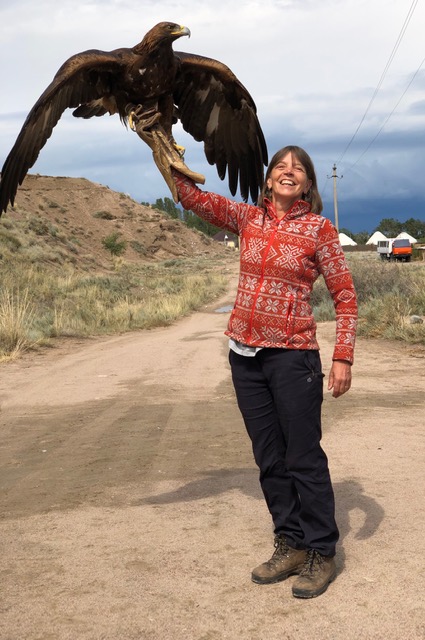
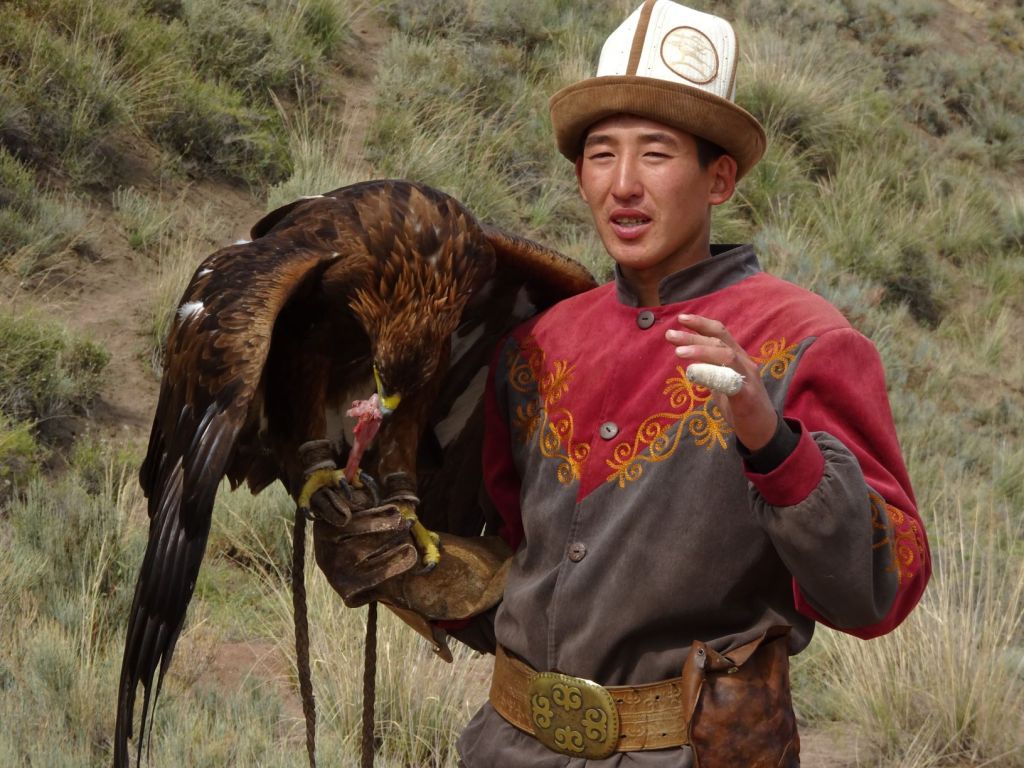
Another night of rain, but thankfully it clears up a bit in the morning. We skip breakfast in the yurt to allow Roelf to sleep in and hoping this will help his recovery. Still slowly upwards. Miep goes to see the eagle hunter demonstration. Two brothers come with their dog and fabulous bird. They demonstrate the speed of the female eagle and also show how it catches a live rabbit and work together with their hunting dog. It is a Taigan dog, a local breed with heavy coat to be able to hunt in winter too. We all get the chance to be photographed with the eagle. A bit of a gimmick, but still quite impressive to be so close to what is in essence a wild eagle. After working with the eagle for some 20 years they are released back into the wild to breed. Those who have permission to be eagle men take a young bird from the nest and train it together with a young Taigan dog and a foal so this threesome together with the eagle men are trained and bond as one.
August 20
Breakfast in the Yurt on the campsite. Very cosy. We will split from the bigger group today to go to lake Song-Kul. High in the mountains and a difficult road, but we hope it will be the road to recovery for Roelf.
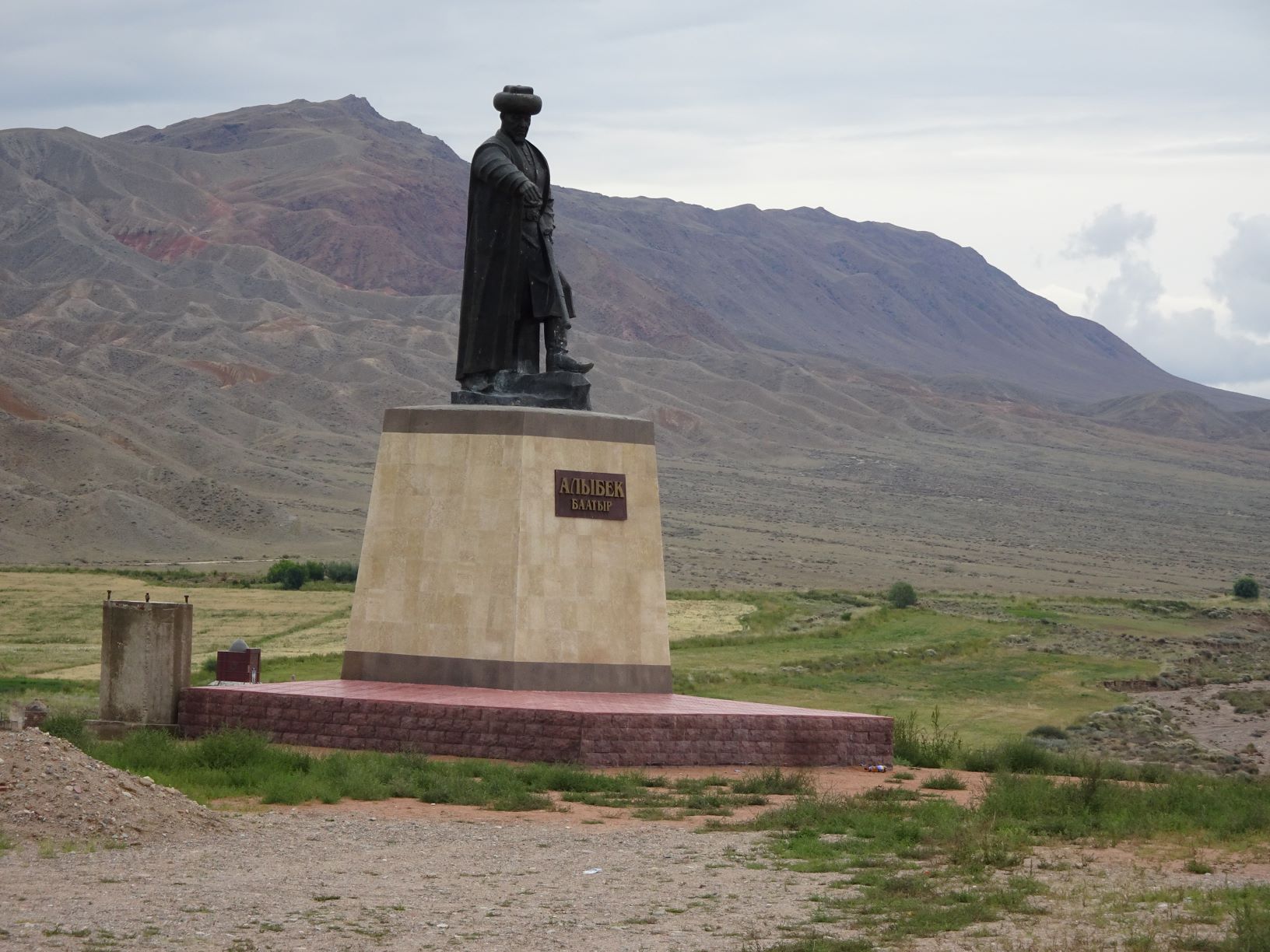
A big statue on a viewpoint along the way. There are so many and most of the time we do not know who they represent. Unique about this one is that the man (of course!) is not on a horse wielding some kind of weapon. There are many famous Kyrgyz people. Men and some women too. We have seen their pictures in the museum in Korakol. Some were politicians, but others were writers, poets and even a very famous heart surgeon of world fame. We do not remember their names and will have to look them up. Two women are on banknotes, well before the Scots put Nan Shepherd on their £5 note. One was again a poet we heard. It is wonderful that artists are recognised here and not just the warlords of the past.
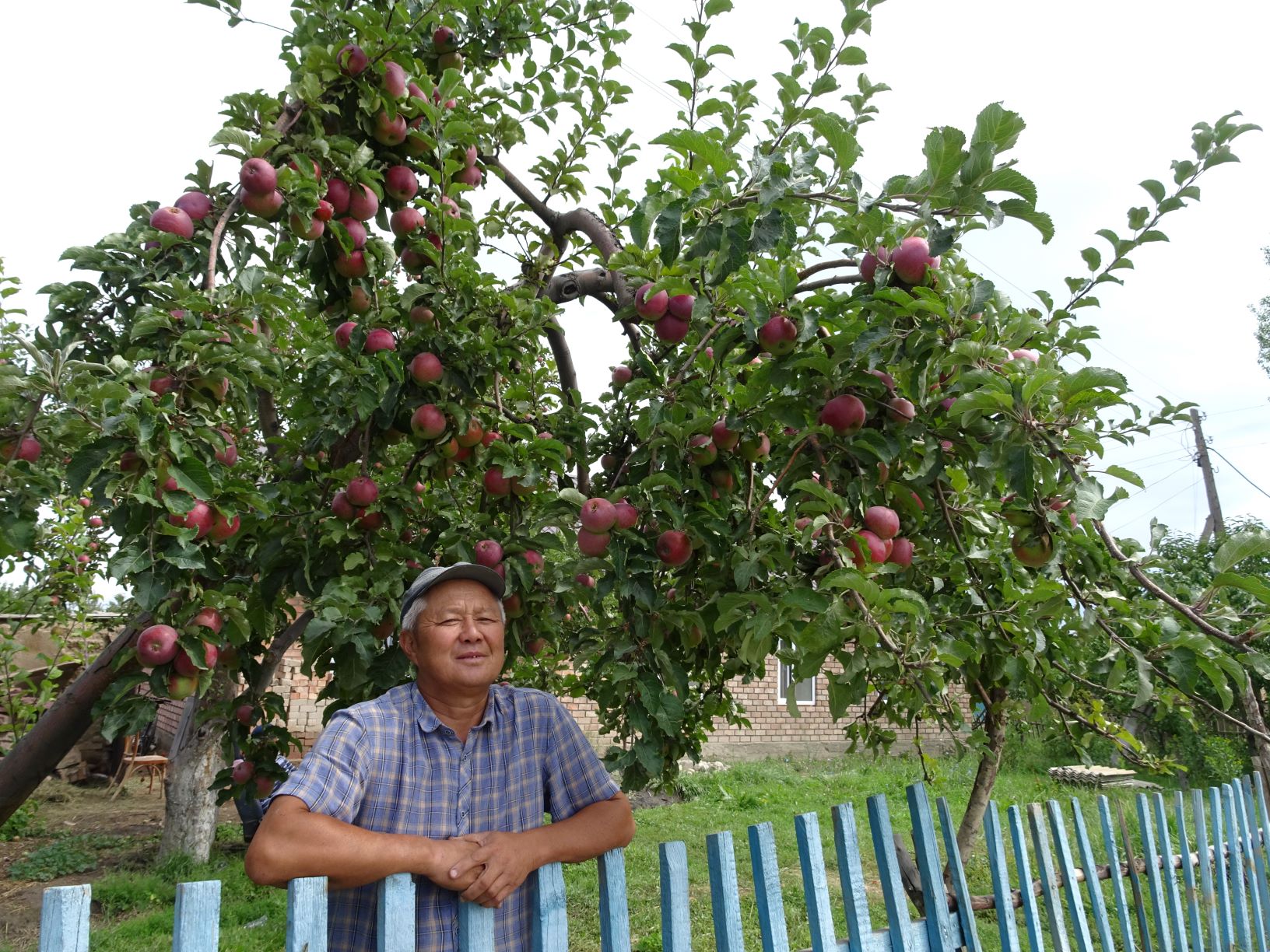
Miep buys apricots on the way; a massive bag to make compote. The seller gives us each an apple of the tree which he is about clear for the next lot of road sales. They look so pretty: so many different kinds of apple trees here. The road stalls are all filled with buckets of fruit and plastic pots, or even bottles with honey. This is the season of jam making. Every restaurant has large bowls of raspberries and other berries cooking away slowly to make the supplies for winter. You cannot serve nan (bread) here without also offering jam.
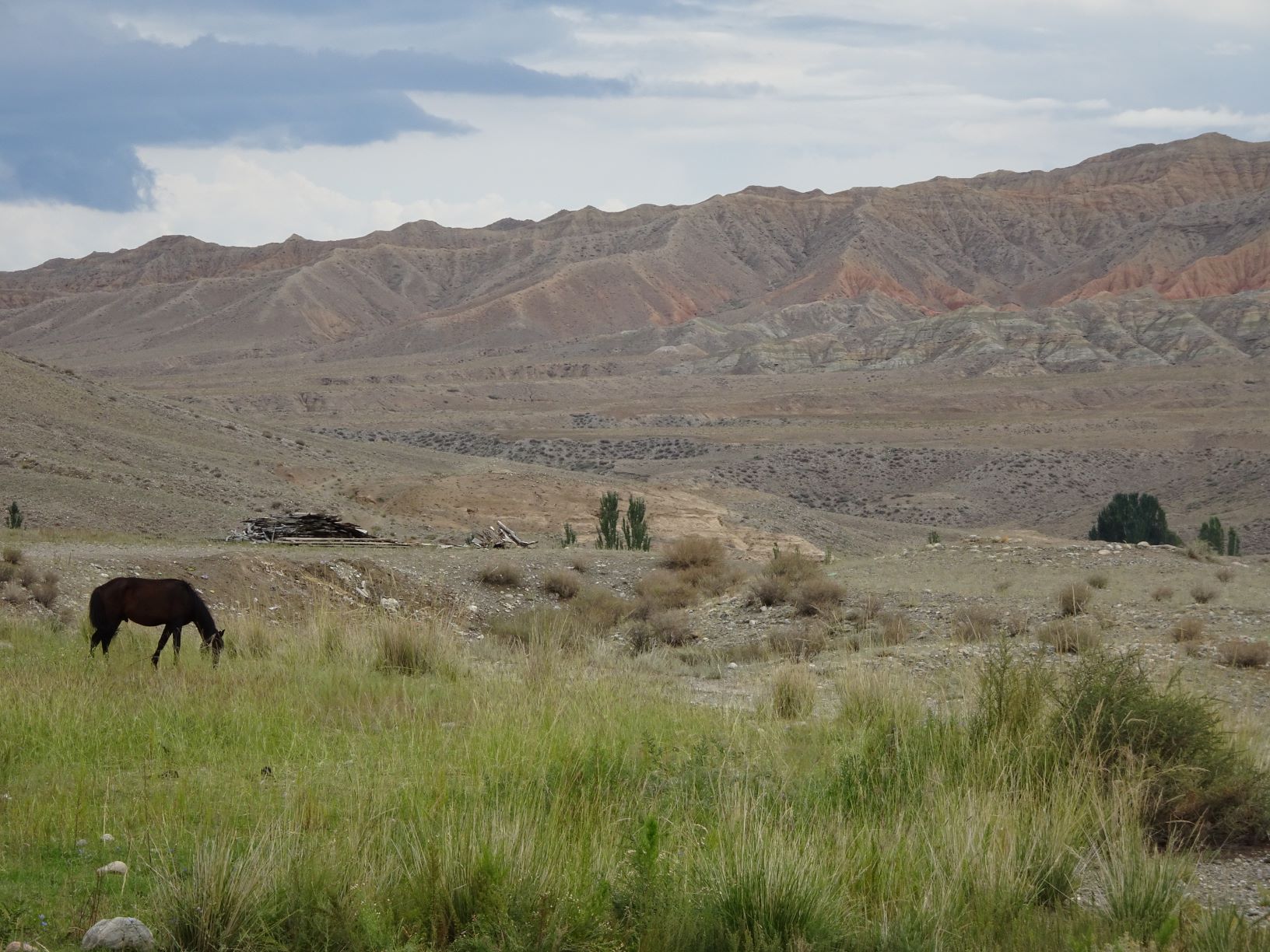
When we reach the end of the massive Issyk-Kul lake (we have now travelled its full length) and turn south the road start to climb a bit and the landscape turns stunningly beautiful. The barren hills and the pastel colours remind us of our trips to Iceland.
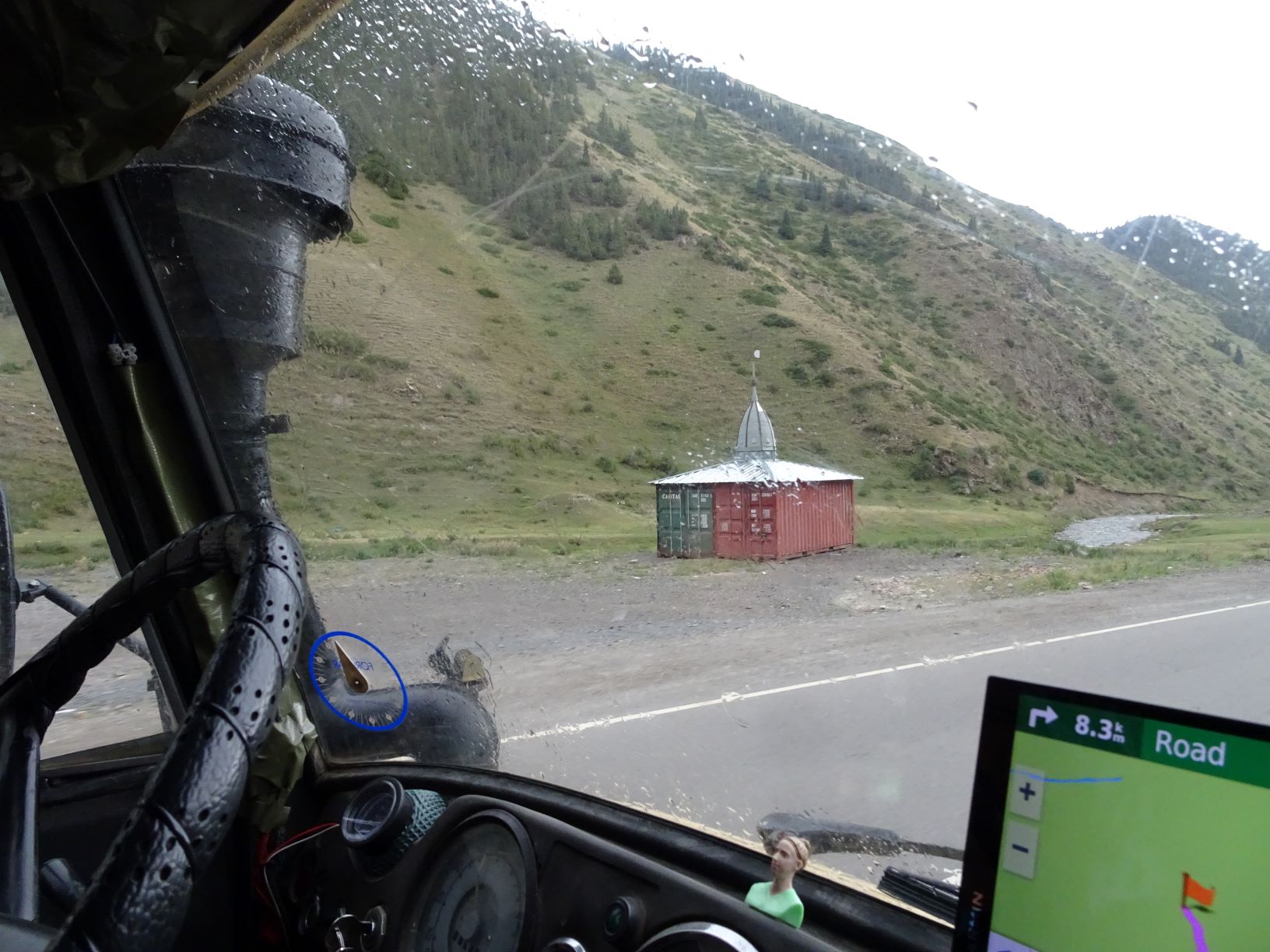
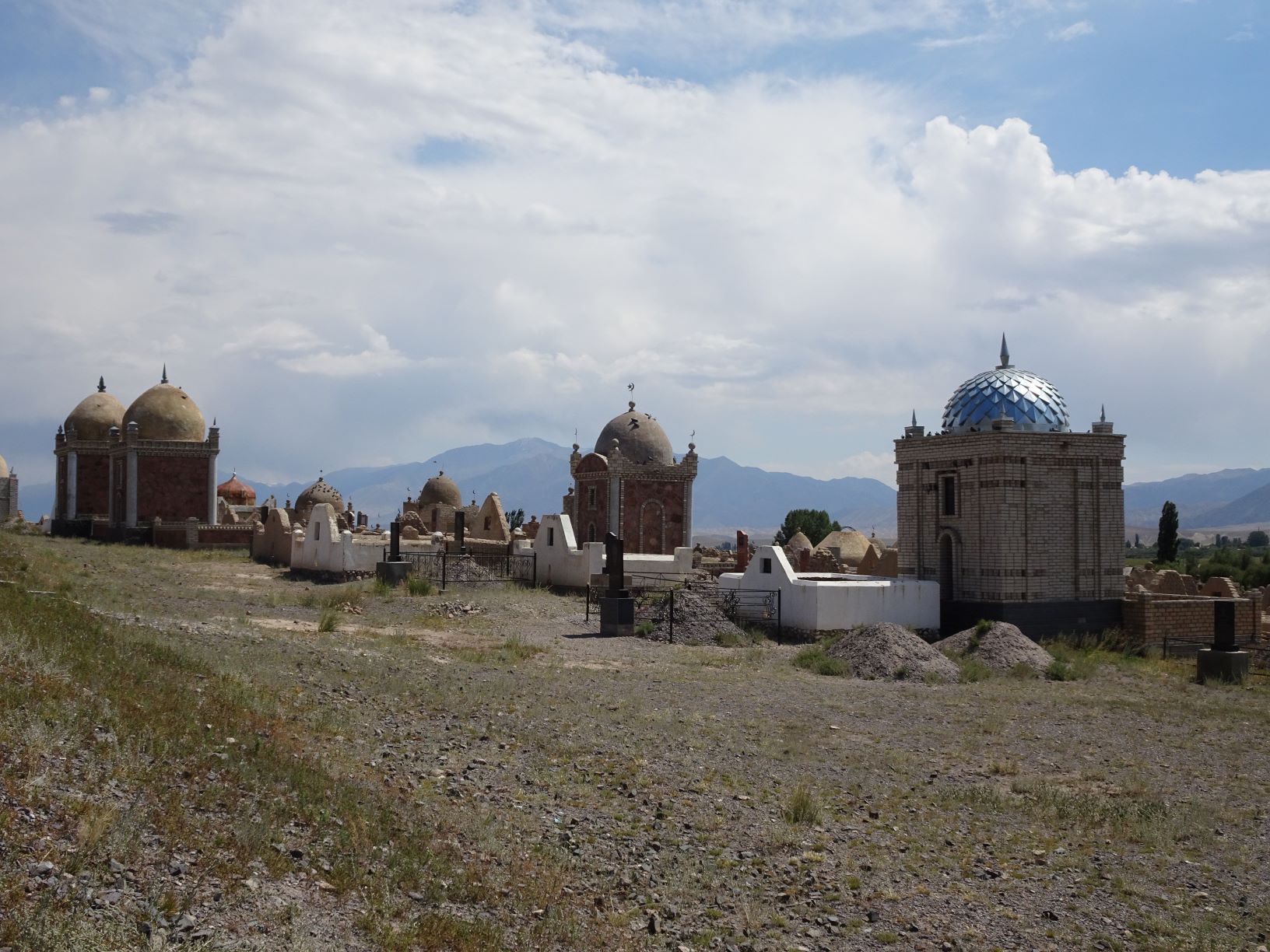
Kyrgyzstan is mainly Muslim and on the whole very poor; places of worship are sometimes a product of improvisation.
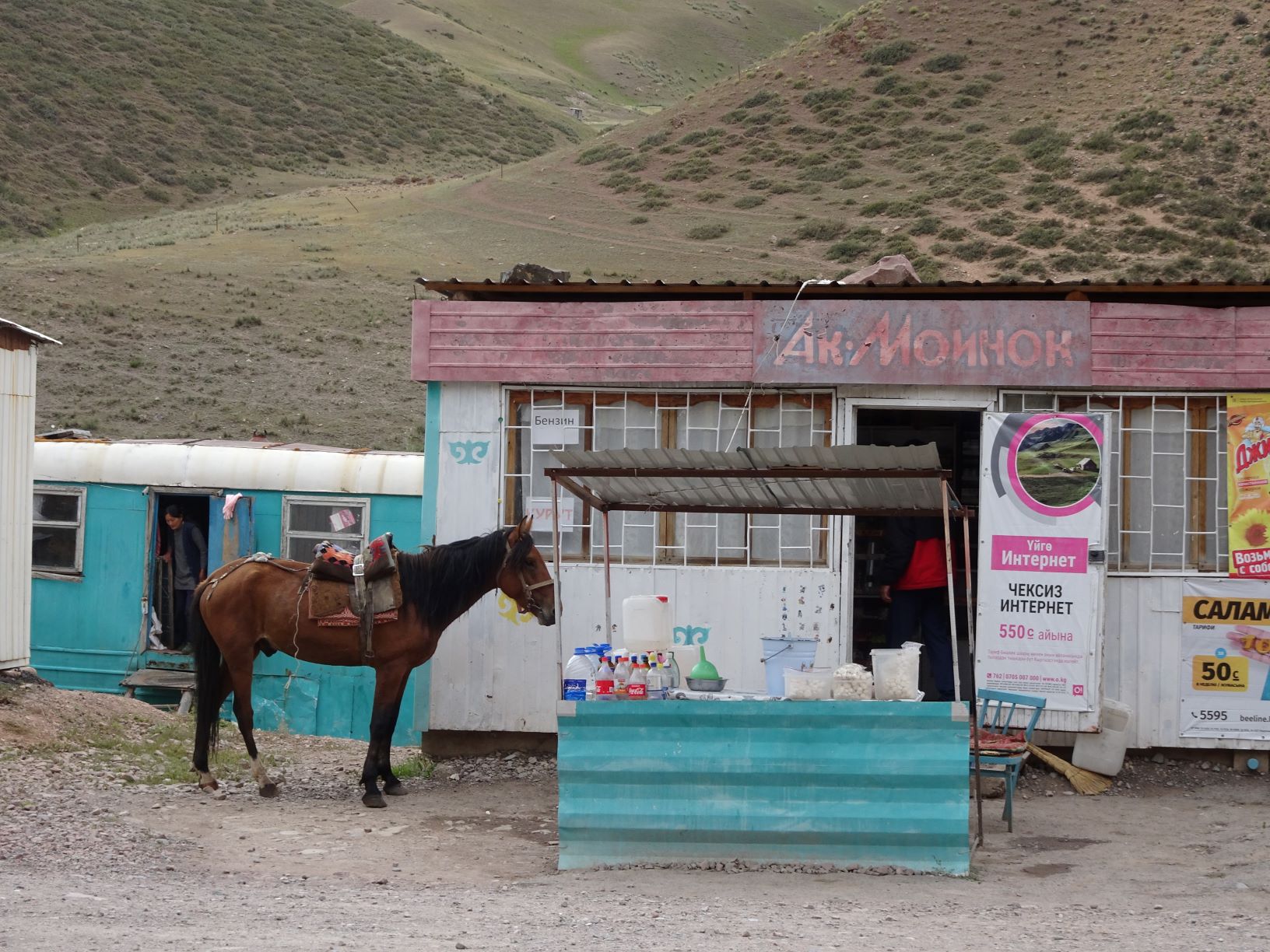
Also the yurts are often supplemented by light blue wagons. People live in them and have roadside restaurants there. This one has a stall outside selling a kind of salty ‘sweet’ made of mare milk. We buy some but find them unpalatable. The local children love them though.
We complete our first real mountain pass on the good tarmac road to the South, towards Naryn. This one is just over 3000 meters and the Mog copes well up to 20 meters below the summit. A short stop to cool off and we make it. From there we go down a little, turn off the main road and find a place to camp.
August 21
What a morning, and what a place to wake up! The moon is still in the sky and it has frozen a few degrees overnight. The air is crisp and clean.
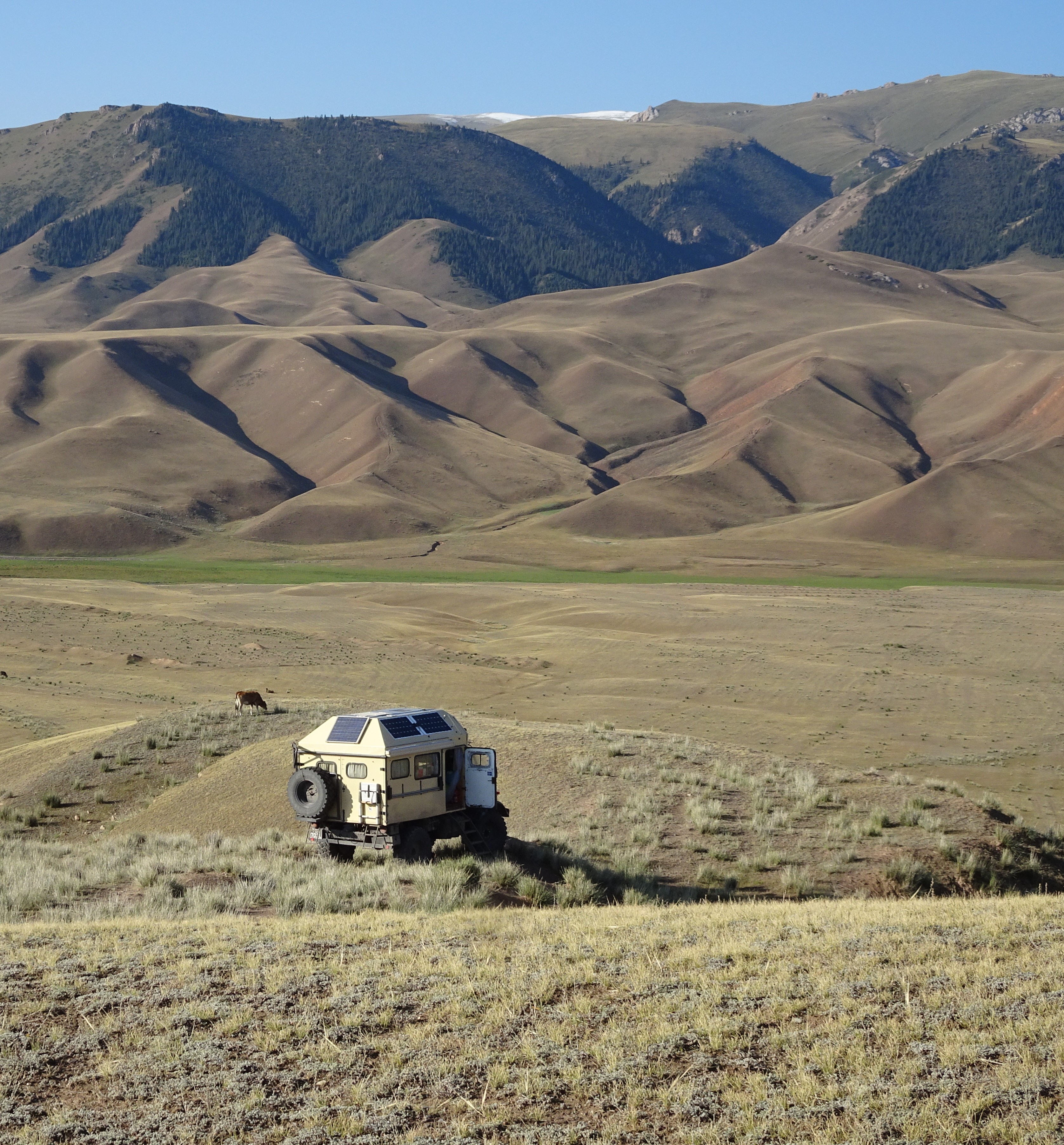
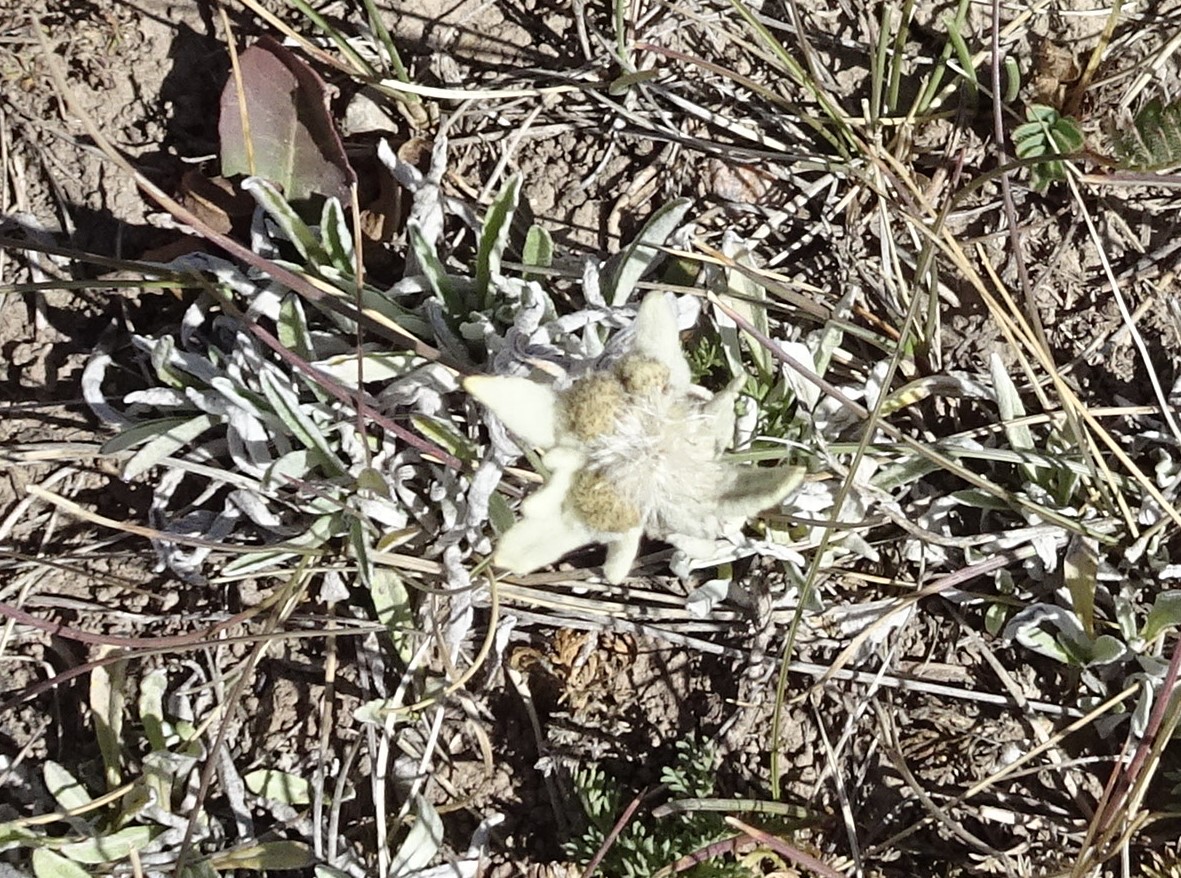
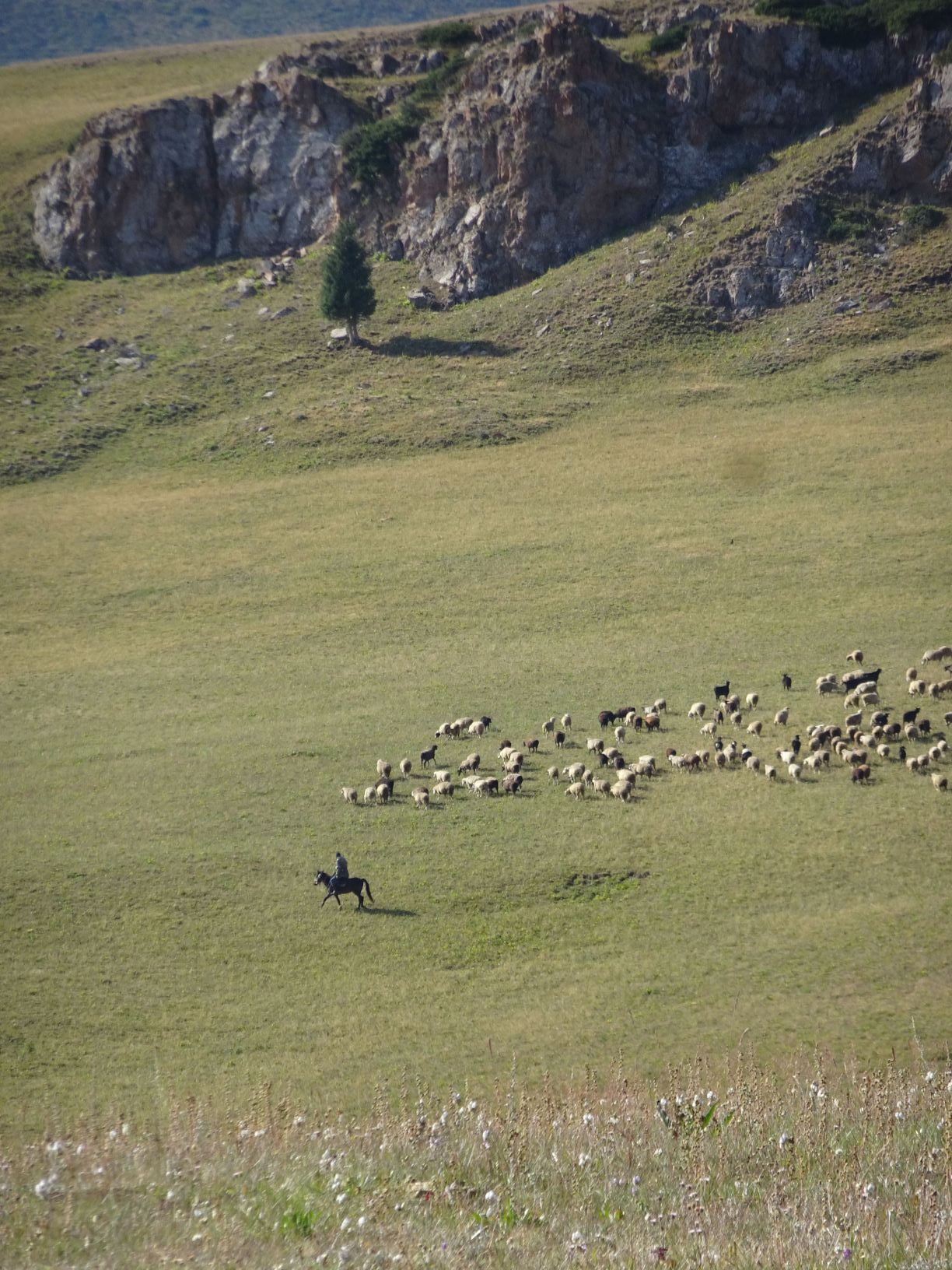
We get on our way to Song-Kul. The road is a narrow dirt track. The weather is great. Nomadic life style is still in full swing here. Mounted shepherds are everywhere herding cattle, sheep, goats or horses. The animals are sometimes in mixed groups together, but more often they are apart by ‘kind’, with only goats and sheep mixed. We often see the shepherds separating out the various animals. We are amazed there is enough food in this dry landscape, but when we walk over the vegetation we smell all kinds of wonderful aromas. These animals feed on high alpine herbal food. Some plants we recognise, such as gentian, thyme and a kind of camomile. There are also flowers without stems looking like plants you would find in a desert and there are lots of different thistles. One is identical to our Scottish thistle and another one is the same but with almost white flowers. There are also thorny bushes with long straight stems that from a distance look like cacti. it is a very arid landscape after all. Most plants have stopped flowering and the beehives have gone from here and are further down in the valleys now. It must be some sight in early spring when the snow has gone. This whole landscape will be full of colour. We also see a flower that reminds us of edelweiss. Is that why one of the yurt camps is called ‘Hotel Edelweiss’?
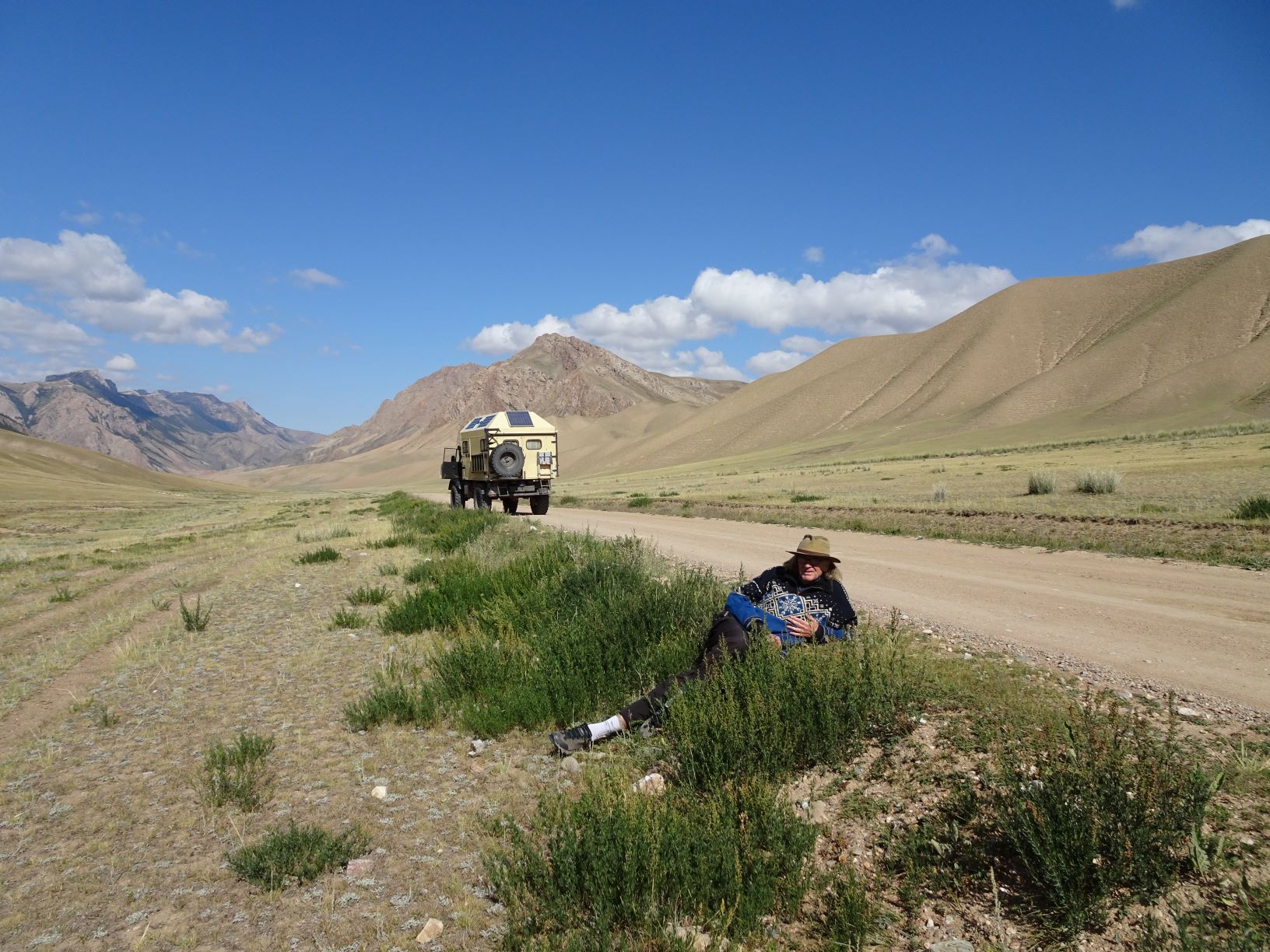
As the lands scape becomes ever more mountainous frequent stops to take in the fresh mountain air should help the recovery from Roelf’s illness and will help the Mog to deal with the gradients. Nothing beats having a lie down in this pristine environment.
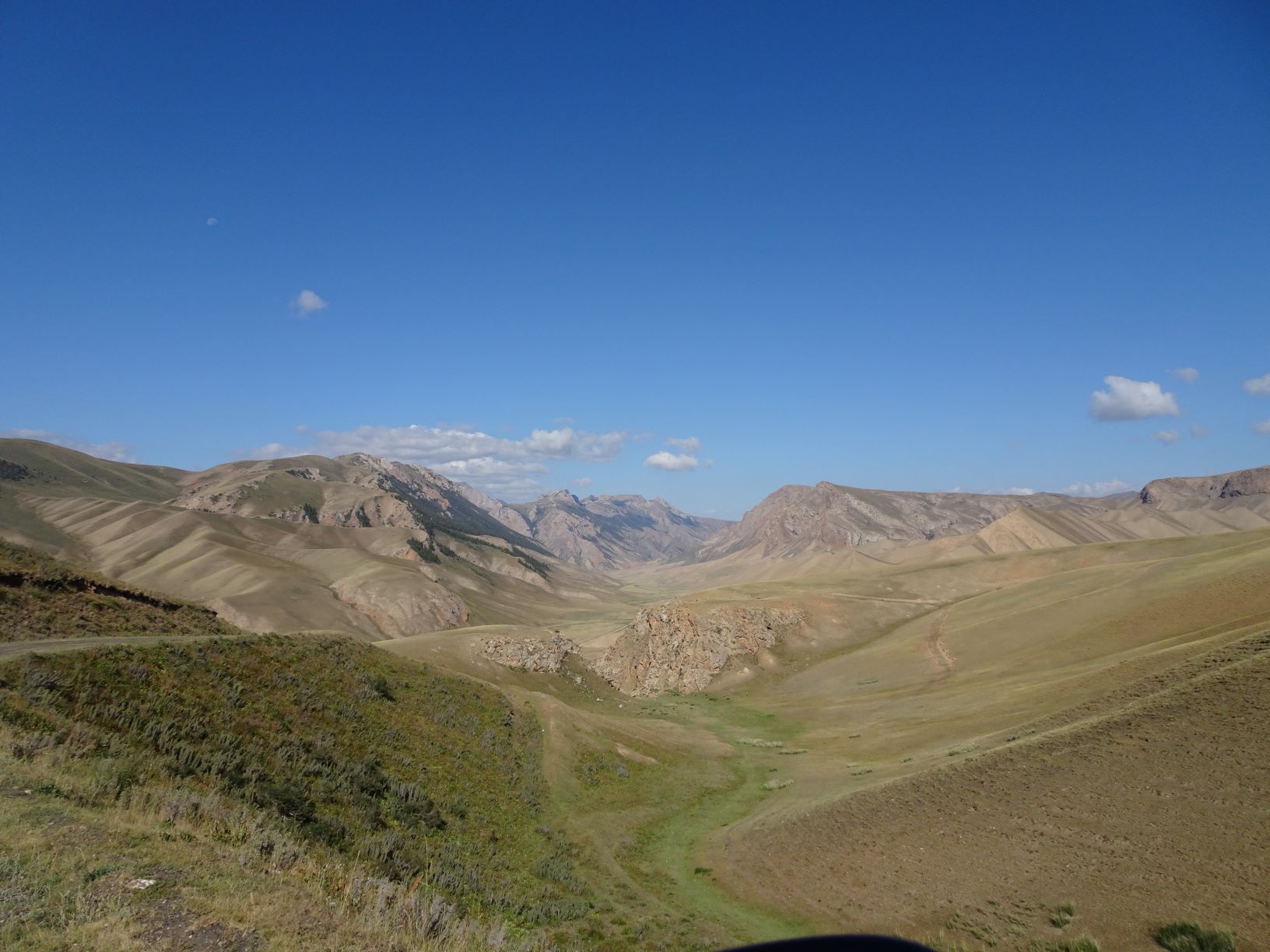
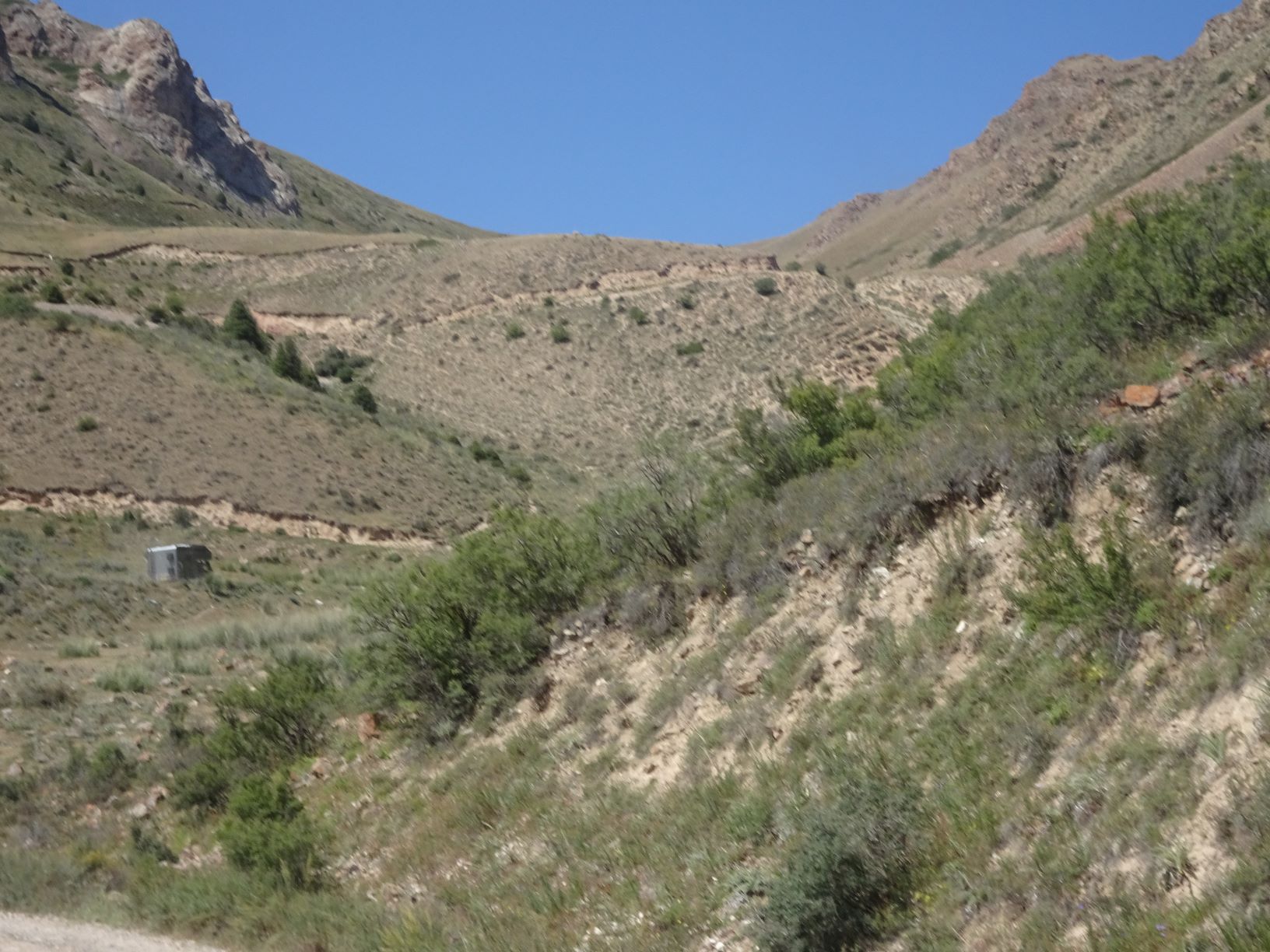
Having already negotiated two passes of more than 3000 metres since we started the journey to the lake we suddenly see ahead of us the third, very high mountain pass. Tiny hairpins and gradients up to 20%. There is little traffic on this road and we realise why. This is a serious bit of climbing, or descending. We see a cyclist coming down and also two motorbikes. Not something we would enjoy. The gravel is loose and the gradient unrelenting. Just a couple of cars take this route, but this is the one, the glorious road recommended by a local guide.
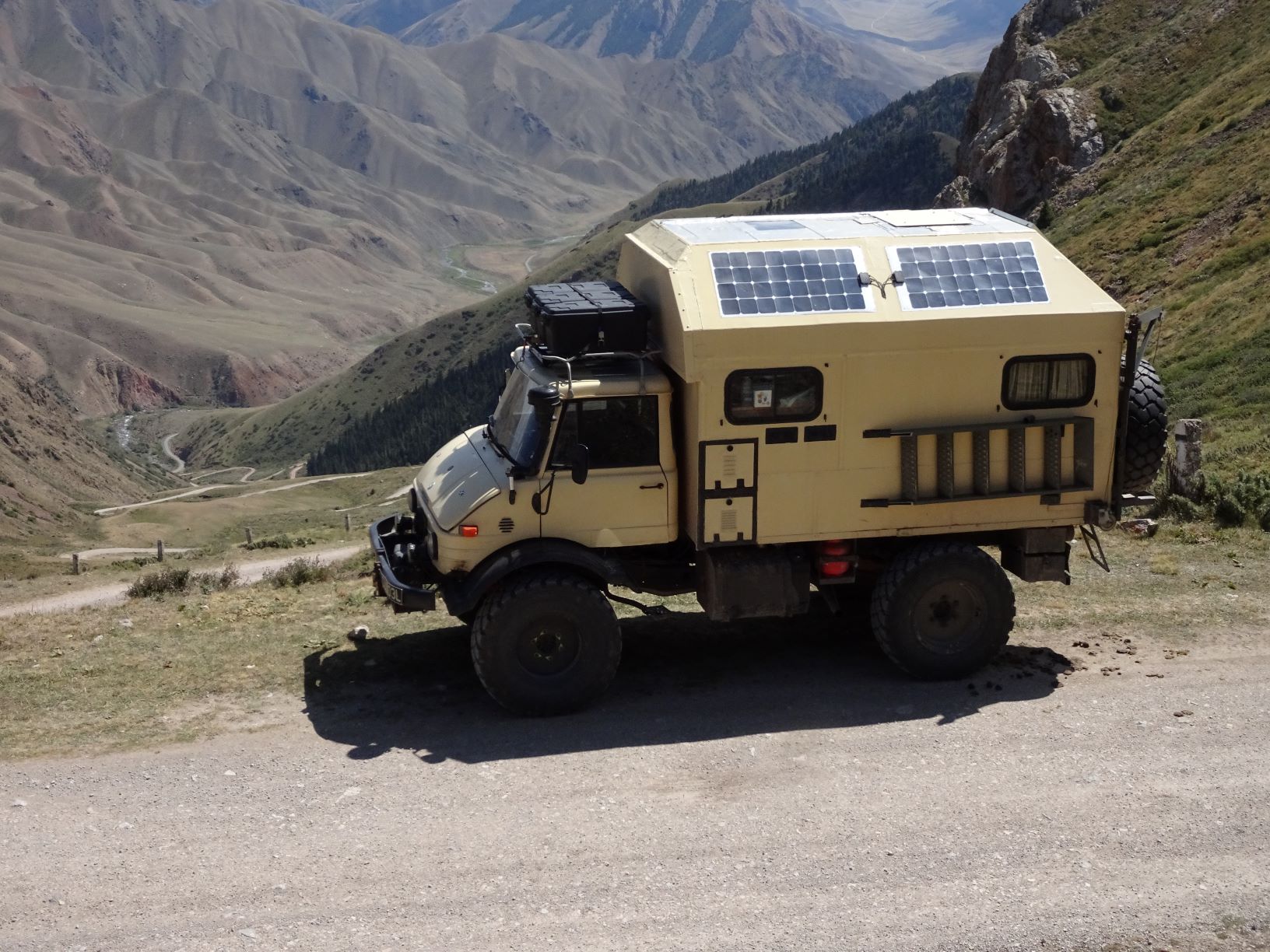
The Mog is brilliant. We have it in crawler gear and can comfortably move up the hill at speeds between 7 and 12 km/hr without engine overheating and without us shaking to bits. We think we have finally cracked it!
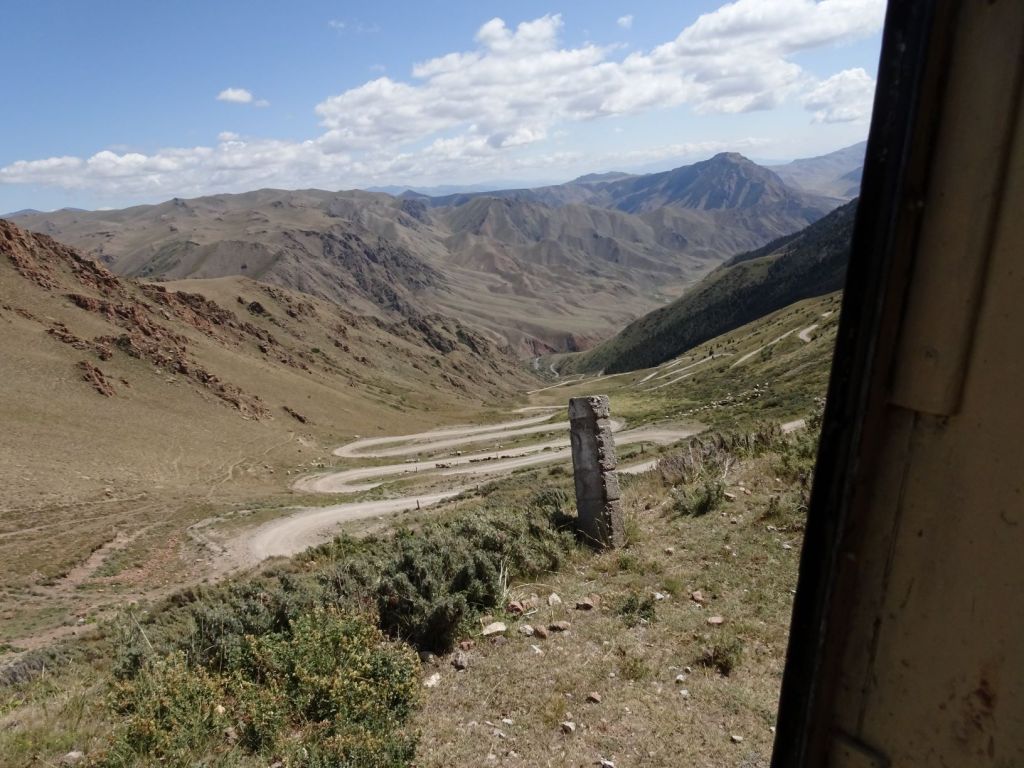
At the top (3250m) we look back with a degree of satisfaction!
Then down we go, but not much because Song-Kul lake is at 3000m. We put up camp on the lake shore, a little bit away from the numerous yurt camps. These are here as part of CBT, the community based tourism. It is a kind of Airbnb. You stay with someone in their house and you can take part in the activities they do and share meals. This is a big deal in Kyrgyzstan and it has resulted in yurt camps and yurt hotels springing up in all the beauty spots. We were not sure about it at first, but it does seem to work. It provides additional income for the people living on the alpine meadows, who have little opportunity to earn some hard cash. The problem is, as always with mass tourism (and this is really on a small scale still), that the infrastructure is not sufficiently developed to cope with the increased numbers of people. There are small busses everywhere taking tourists up for short stays in the yurts where they just sleep for the night, or for some, as part of a longer trek on horseback, through the mountains. The gravel roads can barely cope and deep gullies and potholes. Of course the tourist busses (who are always in a hurry to get back and pick up the next load of tourists) then start to drive outside the eroded tracks making more and more scars on the landscape. The rains and meltwater in spring further erode these tracks. We have seen it all before in Scotland and there is nobody looking after proper road behaviour here as we saw in Iceland where there are big fines for leaving the tracks. Another problem is the waste. There are heaps of rubbish everywhere, plastic bottles, netting washed up on the shore and glass on the side of the tracks. ‘Take home your rubbish’ is clearly not practised by the tour operators and the locals have little opportunity to do it for everyone. We hope that the waste will get buried at the end of the season, but are not so sure. We have seen these heaps everywhere in all countries we have visited so far. The one thing that is working well is the long drop loos that are everywhere. Locals are meticulous about using these. We have not seen any human excrement anywhere or people urinating in public.
August 22
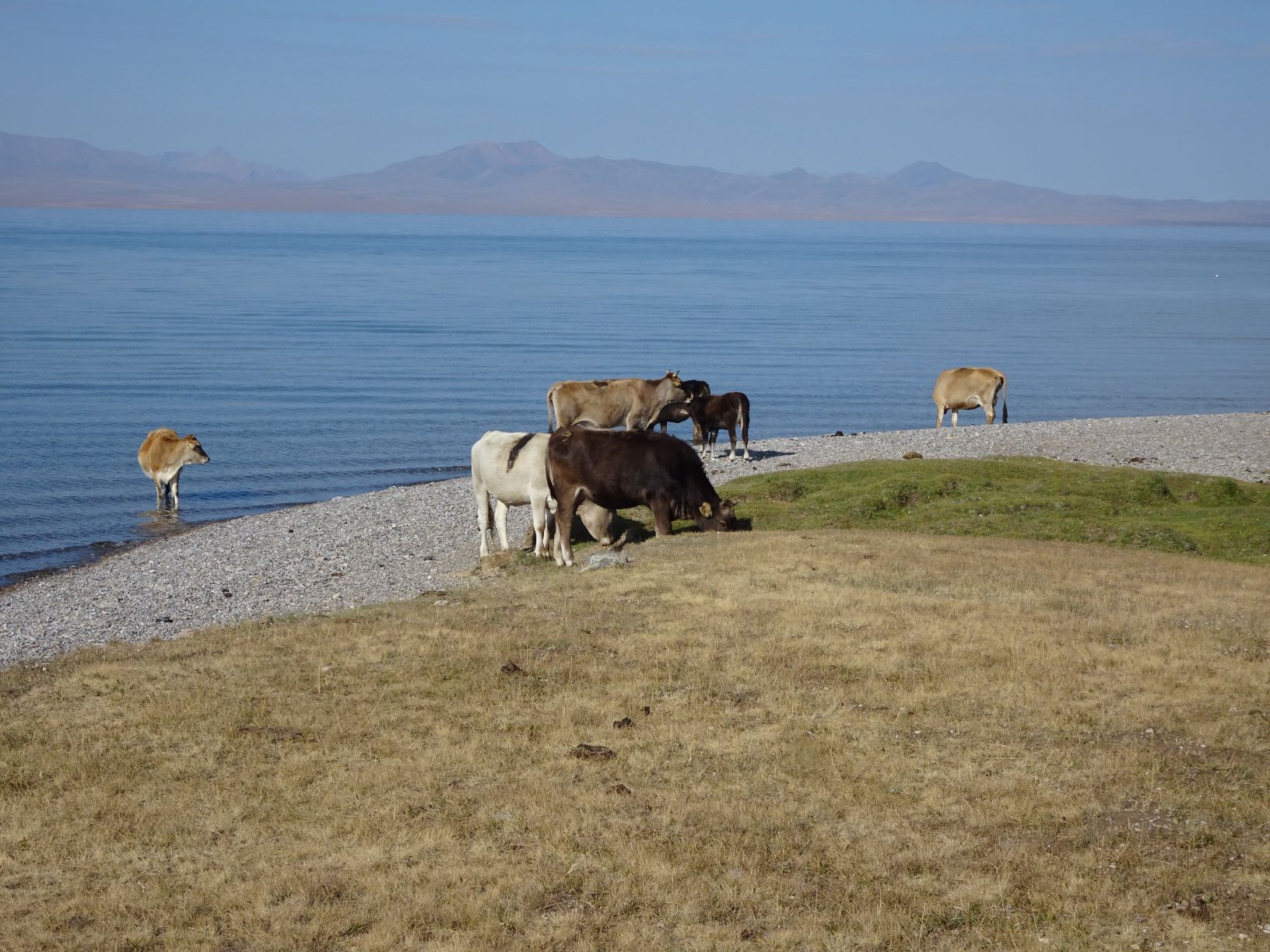
We wake up to another glorious day. It has frozen overnight and the cows and horses come to our campers to have a nosy and to drink from the lake. We had initially thought to stay another day, but Roelf has not recovered as we had hoped and we decide we need to be a bit closer to medical help and to telephone reception in case he needs this. Reluctantly we leave the lake and head over another pass, this one just over 3400 metres (!!) to get back to the main road. We are passed by many tourist busses this time. This pass is closer to Kochkor, the local centre from which the expeditions are organised and the tourists without their own transport unfortunately miss out on the more scenic pass to the south we took. Still, it is a great view from the pass and all the way down.
In Kochkor we buy some Ranitidine as Roelf has bad indigestion. The first two tablets work a miracle right from the start! Gone are the pains in the back and in the epigastrium; gone are the burping and the acid reflux. We celebrate with a large bowl of spaghetti at ‘Cosy Corner’.
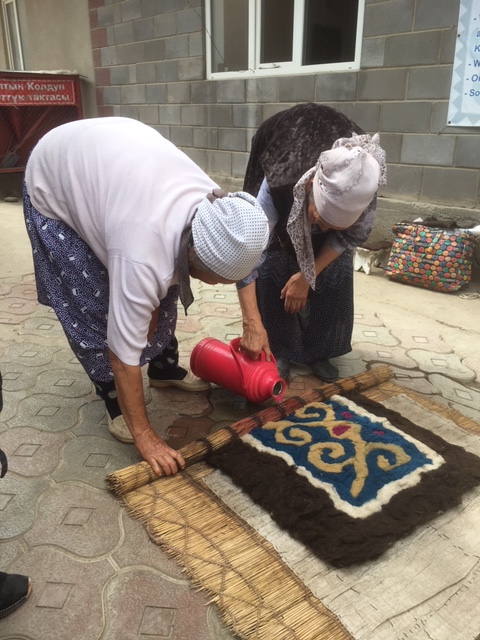
Being back in Kochkor also gives Miep another chance to visit the felt making place. This is run for tourists to see the process, but it also has a great shop that sells all kinds of felt products, made by hand by local women. It is a kind of cooperative where 70% of the revenue goes back to those who make the products. Their main product is the Shyrdak, the carpet make from different colours of felt, cut out in patterns that are inspired by the landscape and animals, for example, the rivers and the dogs tail. These shapes are then sewn together and coloured band is added to accentuate the patterns. They are beautiful, but we are happy with our wall hanging, made by the same process, and buy some small felt animals and a beautiful felted shawl instead.
We move west of Kochkor to find a place to camp. On the way we pass one of these strange Muslim cemeteries. They don’t have headstones but complete buildings over the graves. These buildings are of much better quality than most of the dwelling houses we come across.
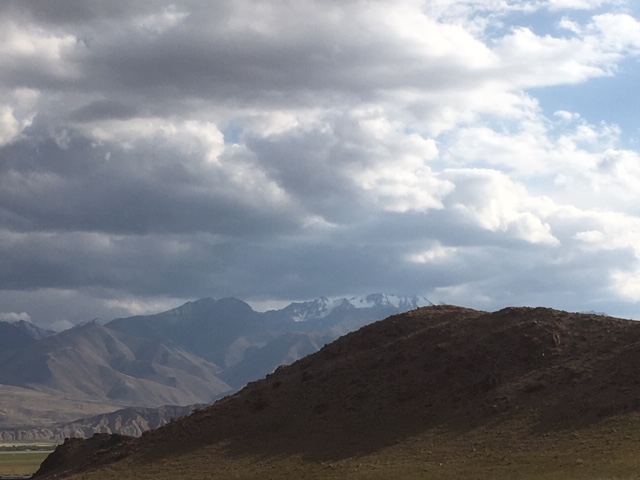
We camp at a deserted farm; the view is spectacular again.
August 23
We move very slowly westwards from Kochkor in the direction of Kyzyl Oy where we hope to meet up again with some members of the group. We go over another mountain pass 2750m where we buy smoked trout. The road is poor with many roadworks. The Mog swings and shudders. We are struck by the endless row of lorries laden with coal that head the other way. The large trucks crawl up the hill bellowing out massive amounts of black smoke. If it is not a coal lorry then it is a lorry carrying sand for the road. They go on day and night and any day of the week. Apparently the road works are paid for in part by a private Italian company that owns the coal mine. The coal is transported to the end of Lake Issyl-Kul, to Balychy, where it is loaded on train wagons to be transported to Bishkek. We presume it is used for generation of electricity. It is remarkable how every village is connected up to electricity here. We assume that many of the villagers, if not working in agriculture, are recruited to be drivers for the coal mine and for the road works. In the middle of nowhere there is a newly built petrol station and we see rows of small houses presumably for the road workers. But we are unsure where they sleep now and where they eat. We have not seen a single restaurant.
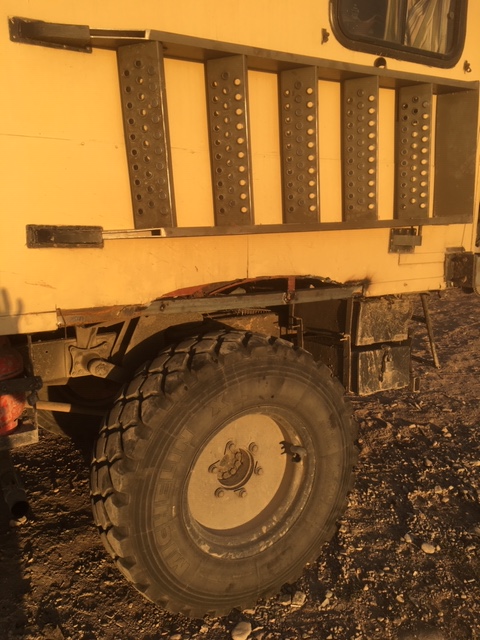
During a short stop we notice a problem with the Mog. She is tilting at the back towards the drivers side. In fact, the living cabin there is so low above the back wheel that the underside has hit the tyre, leaving black streaks of rubber on the underside of the cabin. Closer inspection shows that the rear carrier of the cabin, one of the three that come off the chassis to carry the cabin, has crumpled to cause the tilt to the side.
We take out the grinder to cut away some of the steel of the cabin wall so that we get a better view. As always, help soon arrives. We take the Mog to a “Hotel” where there are welding facilities. A big steel beam is introduced on the side of the cabin and the crumpled carrier beam is beaten partially back in to shape and reinforced with a flat piece of iron welded on to it. It does not look neat and we are not sure if it will all work. However, the cabin is more or less level again and we will give it a go.
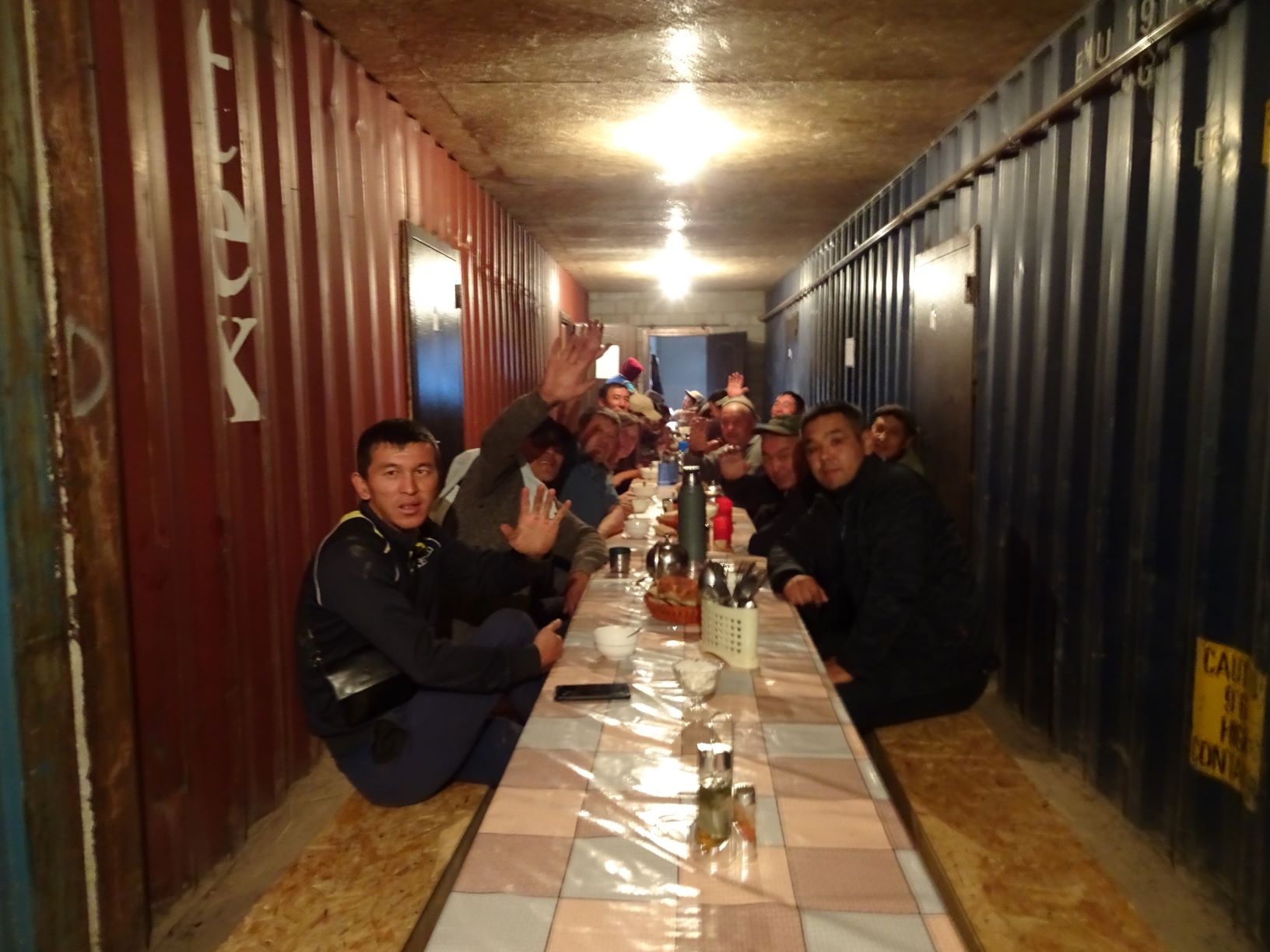
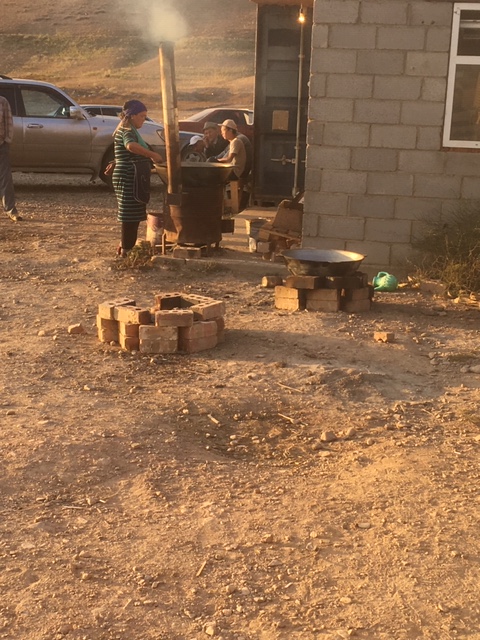
We have a meal in the “hotel” which consists of a row of containers. Now we know where workers eat and sleep. There is a long table on one side and the rooms for the gueats come off on the other side. The guests are the workers who are doing the roadworks. The come in in the evening and we all have some wonderful soup and very nice bread all prepared in big ovens and pots on fires outside. The road workers seem cheery enough, but we are taken aback to hear that they only have two days off per month between half March and half November.
August 24
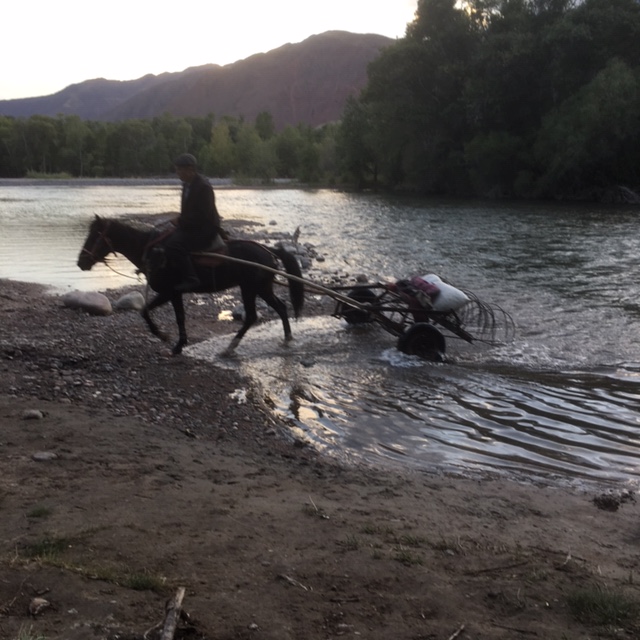
After a good night’s sleep just off the main road we continue our journey slowly. The roadworks continue up to the point where a side road bends into the mountains. This is where the coal mines will be. But then we later on still see lorries with coal. Perhaps there are multiple mines. We will have to find out another time, we have not found people who can tell us. We pass the busiest village/town in this region, called Chaek. There is a park with statues. Two young girls in the shop where we buy some beers tell us they are war heroes of the last century. Indeed they all lived and died in the nineteen hundreds. There are two women amongst the many men. We stop at the point where two rivers meet, the Jungal and the Kukomeren. There is shade and an extended family is having a pinic there. We are kindly welcomed and are given some of their delicious shaslik. Expertly marinated. They get a shot at Roelf’s angling gear in return, but no fish are caught today. We enjoy being free to stay put and watch the world go by. As evening falls several people on horseback cross the river. One horse pulls haymaking equipment!
When it gets dark the family leaves. To our horror they leave all their rubbish behind in a large mount. We cannot understand why this is. This seemed such an educated family. Everywhere we go in Kyrgyzstan the place is littered with rubbish and plastic bottles. We wish we had brought a spade to bury it where we camp. We cannot even find places for our own waste also and the common way to dispose of it is in a hole in the ground that, we hope, will get filled back with earth eventually as in our western rubbish dumps. We find places where the rubbish in the holes has been burned, so this must be the way it is done. It does make us think about the vast amount of packaging, plastic bottles and cans we all use.
August 25
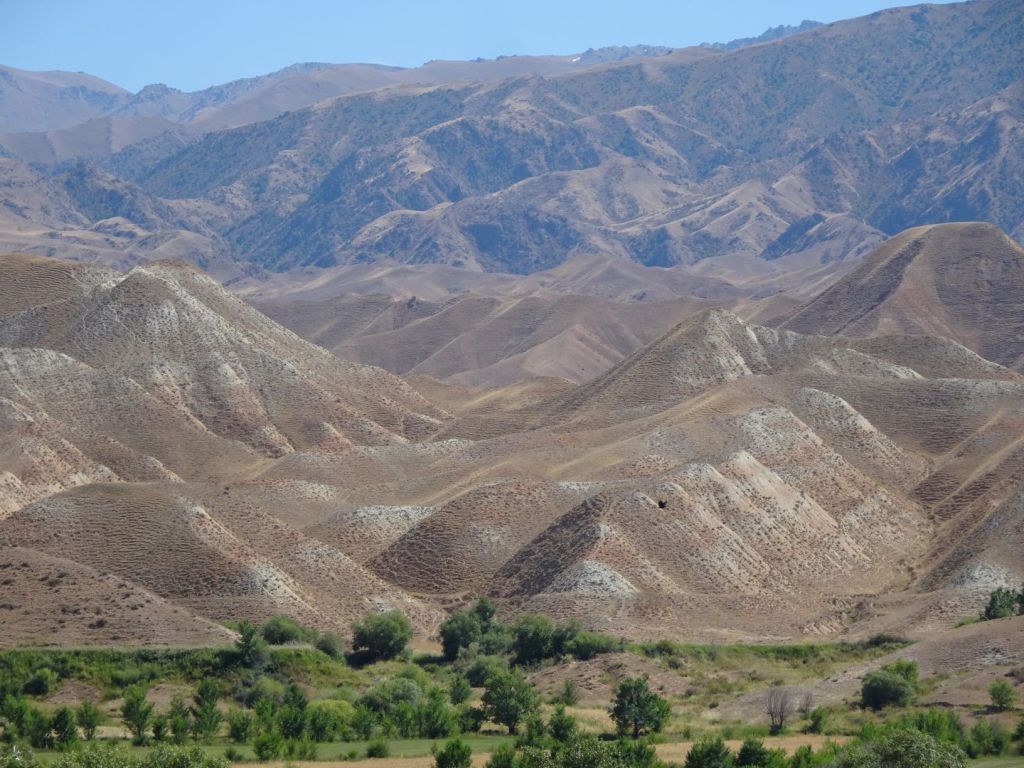
Today we drive on to Kyzyl Oi where we will meet with 2 other couples. This village is part of the official travel route but most equipes have chosen not to go there as access is via a dirt road of 50 km. We enter from the East over the A367 while the others travel from the other direction. The route is absolutely gorgeous albeit quite steep in places. The mountains appear velvety with their dry regular vegetation. Sometimes there is a very light colour, sometimes the hills are red. The colour changes when the sun hits the rock. The Kukomeren River is wild and rocky. this is proper mountain terrain.
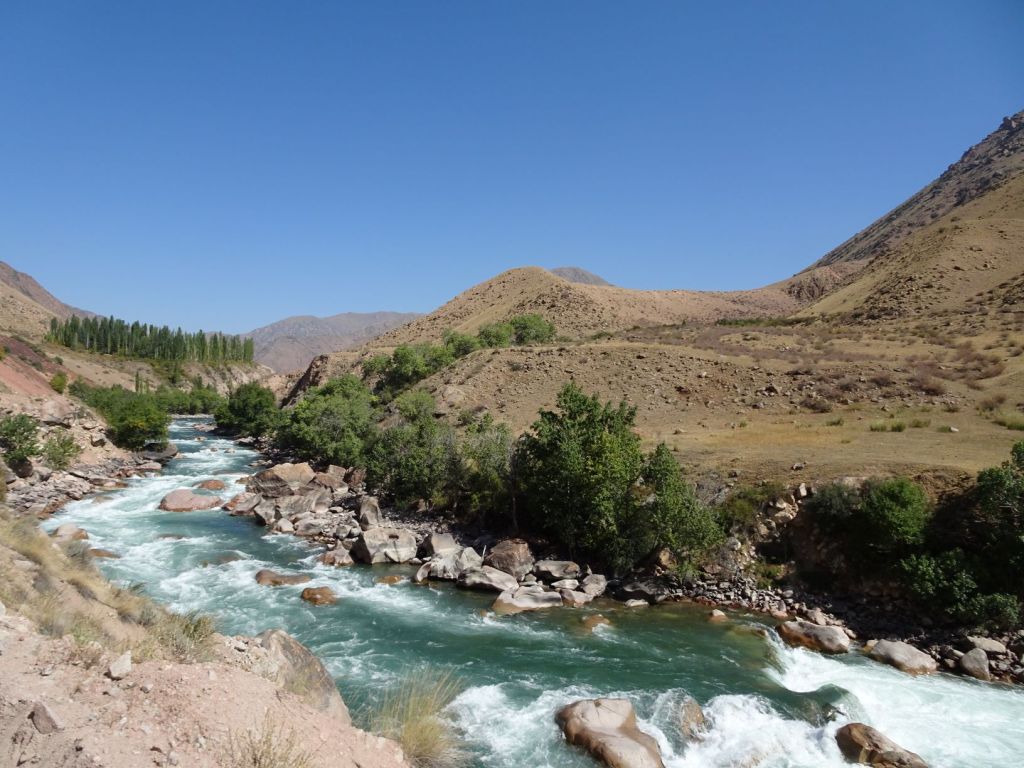
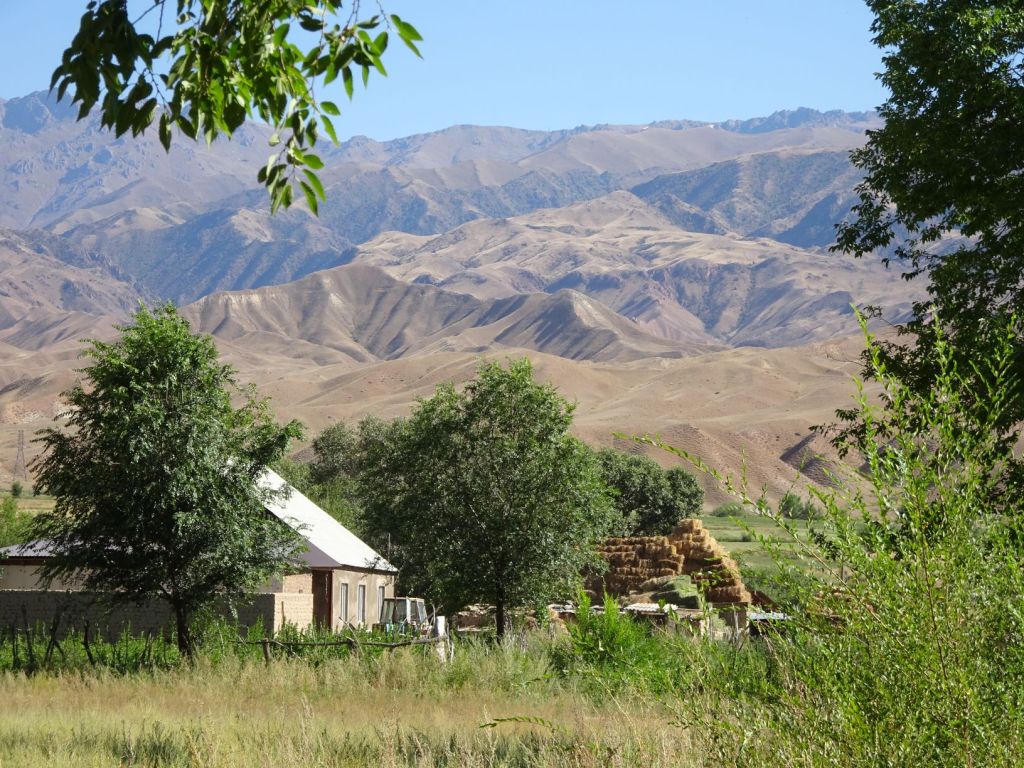
When we come to Kyzyl Oi, the others have just arrived and found our camping spot on the bank of the river. We share this with a herd of cows who come to drink and graze and several group of children who come to swim. It is a great spot. We come to this village to observe village life ‘as few tourist come to this place’ (says our travel guide), so we are quite surprised to find a local office of community based tourism, two busses with Austrian tourists and a list of prices for every thing you may want to see or do in the village (parking car for the day, horse riding, walking with a guide, seeing the children in traditional costume and so on). All good for the village of course and we see quite a lot of well-kept houses and courtyards. The whole village seems to be engaged in bringing in the hay for winter. Make hay while the sun shines! The way they stack the bales is quite unusual but beautiful. We feel we are no longer watching poverty, here we think we see progress because of tourism.
August 26
We spend a hot day in Kyzyl Oi. Just lazying around and for Roelf the first day where he feels recovered. He is doing exercises again and goes on a walk through the village. The others, including Miep go up a hill to a good viewpoint to see the mountains. This has been a good day and we all feel refreshed and ready to re-join the group tomorrow.
August 27
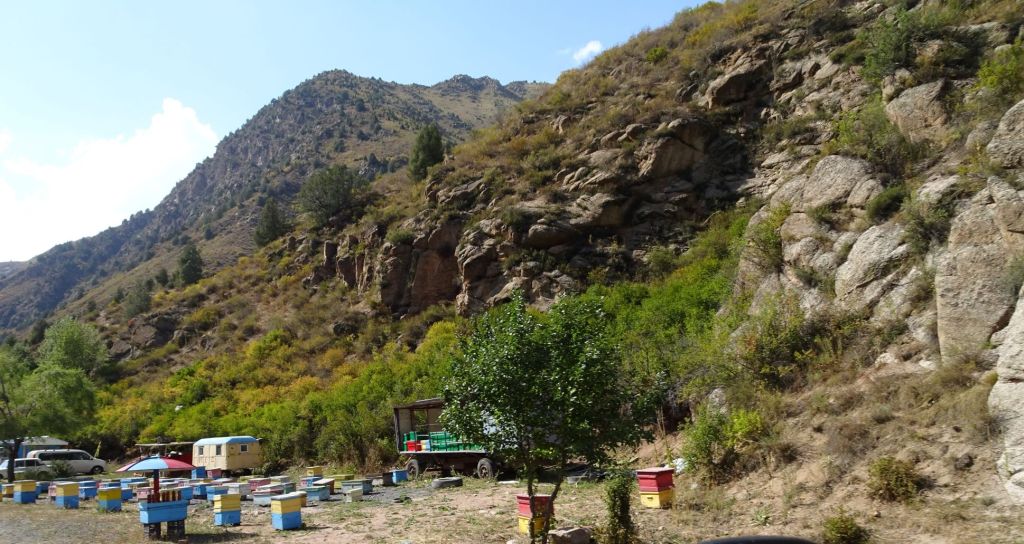
This turns out to be a very difficult day. Not because of the landscape, all that is stunningly beautiful, but because of the endless issues we have with the car. It starts when we depart and the car won’t start. The battery is flat and we end up starting it with another battery, not normally connected to the starter motor. Pulling it wont’t work as the handbreak won’t come loose. All good, we can leave, but we have not identified the problem. At the end of the dirt road 50 km onwards Kees and Lida wait for us and we foolishly switch off the engine. The battery has charged up but the car won’t start again! We let them leave because they have put up with our delays long enough. We think we know what to do. We can roll the car down the hill and start it that way, now that the handbreak is off. We do so with two guys who stop to help us, but things go wrong and the car nearly goes off the bank the wrong way. In the end they pull us with their van and the Mog starts. We can go. But 100 metres on it overheats we forgot to check the water at the end of our rough drive from Kyzyl Oi slightly uphill! We have to stop at a high point before we can switch off the engine and refill the radiator. Then we are finally on our way. We go over a very high pass, some 3200 metres, very slowly to avoid overheating and then descend more than 2000 meters. The Mog loves this and purrs along. The landscape is stunning: yurts, horses, sheep, road stalls with dairy products on the way up and coming down below 2000 metres the honey and beehives reappear. This is where the flowers are still present, especially wild lavender. But then a big bang and we realise the bonnet has come off and is in the middle of the road. Thankfully nobody was directly behind and we can pick it up and it still fits albeit scratched and bent.
We don’t have lights because of the problems with the starter motor and we have switched on our large light bank on top of the cabin. But this does not please the policeman who stops us. We are shown the fixed penalty of 5000 som. Again, we play dumb and are let off. We did not have that money on us anyway. Later we learn that giving 1000 som for most ‘offences’ is customary as the police is woefully underpaid. We will keep a note of that amount ready should we be stopped again. We are finally on the last stretch to our camping spot, but now the hills start again around lake Toktogul. We go 14 km/hr on the steep to void overheating and we finally get there. What a day, but what a great spot to recover. The lake is relatively warm and great for swimming. Surely we will sort the problems tomorrow?
August 28
We wake up early after a good sleep and Roelf immediately gets to work trying to find the fault with the Mog. It is not straightforward as everything gets power from the battery, but there is perhaps an issue in the ignition keyhole. More people come to help think things through but it is getting more complicated all the while. surely this should be something simple? There was no indication the ignition keyhole would be faulty or indeed that the starter motor was not functional, or that the battery was on its last legs. We want to roll the car down the hill to start the engine, but have forgotten in the tiredness after our late arrival the night before, to take of the handbrake and now it is again difficult to dislodge the peg. With help from others we finally get it out, but now the steel rod we used to hammer it out is stuck. The others need to leave, we have along day of driving ahead of us. They go and we decide to give it one last go before calling in heavy duty help. We saw off the rod and thankfully it falls out. Now we can get the car going and Roelf starts reconnecting all the wiring he had checked and measured. A small Mercedes van stops alongside and Miep asks where there may be a garage to check over our starter motor. The guy does not understand what we mean and to help him Roelf points to the ignition and then pushes the ignition button. The car jumps forward!! The problem was fixed by reconnecting everything properly and having cleaned all connections. So it was really simple after all. We jump around for joy and thank the driver who is now even more perplexed. All he did was stop, Roelf calls him a magician.
We deserve a quick swim in the lake before we finally depart at 1.30. We know we will never make the rendezvous in Osh but we will go as far as we can. The drive is very beautiful along the turquoise lake Toktogul, a huge reservoir filled with water from the Naryn river. A big surprise are the fishfarms we see in the lake. We had thought that the many signs of trout outside restaurants were an indication there was good fishing to be had, but perhaps the trout we had for lunch was a farmed trout? Then we get to the end and see the town Toktogul that was built for the workers and managers of the hydroelectric dam. There are soviet style buildings here but also more modern buildings. It is a sprawling city, much larger than we had imagined. The air pollution is striking; heavy traffic compounded by domestic fires and cooking along the road side.
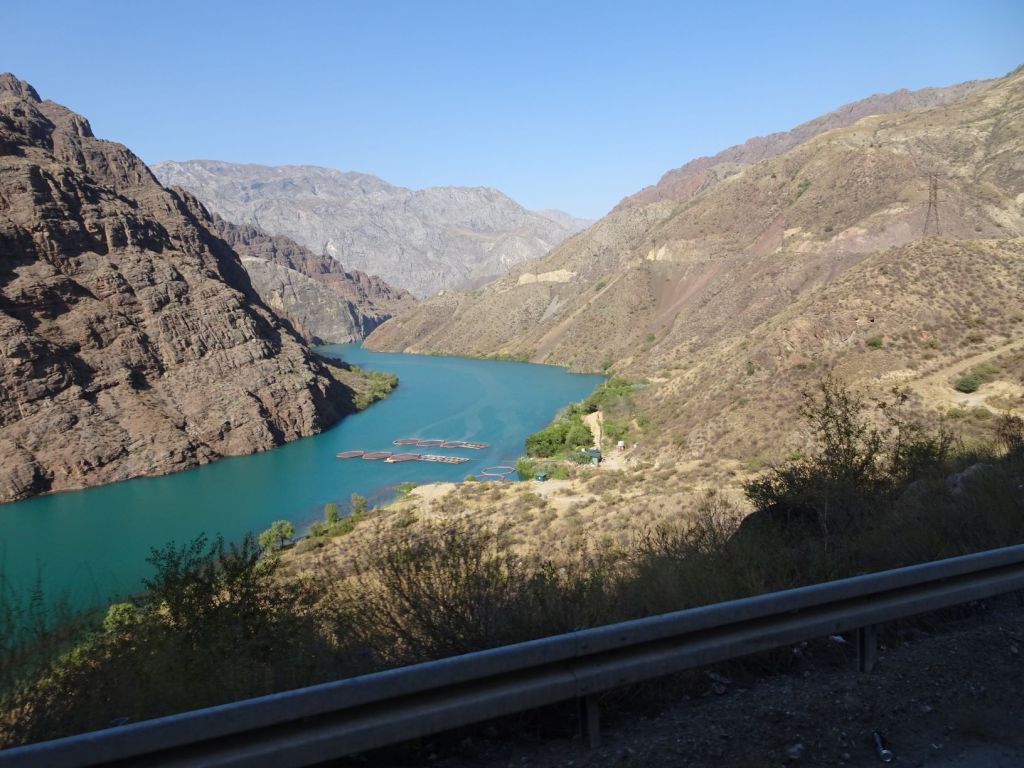
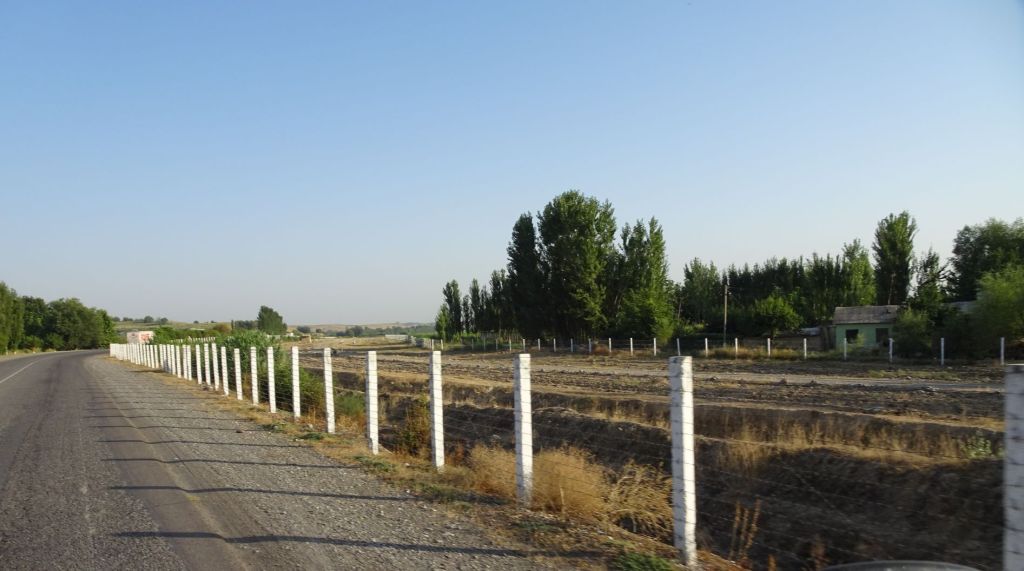
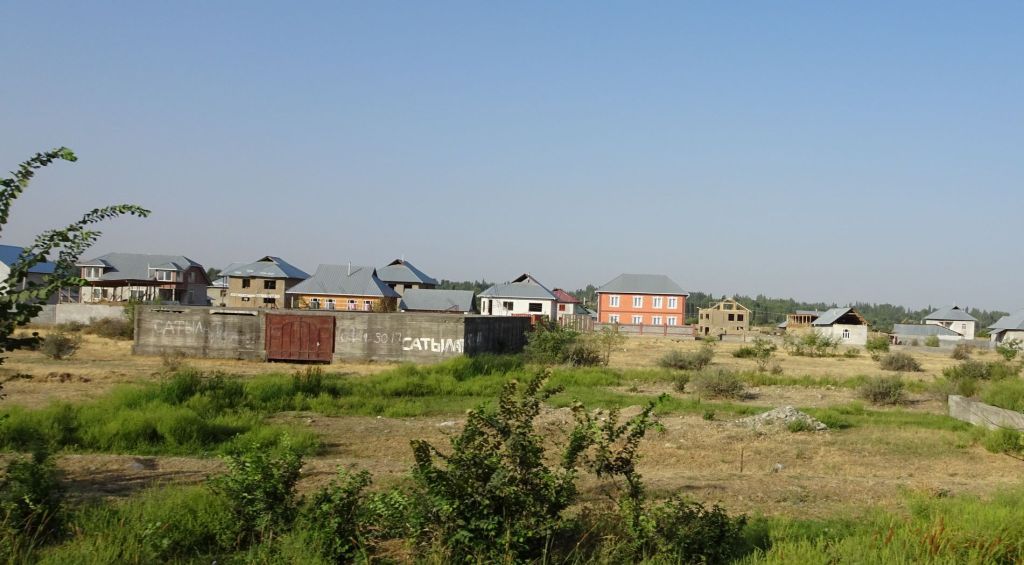
We drive along the poor road which is lined with houses of poor quality alternating with newly built houses that are unfinished, until it is completely dark and we can no longer avoid the potholes in the road. Part of the way we drive alongside the border with Uzbekistan. It is a double fence with border guards keeping watch inside. Visions of East Germany….We camp on a wasteland behind a shop for the night. Within two minutes a police car appears to ask us what we are doing there. As always, their motivation is curiosity and it does not take long to get their blessing for our overnight stay. We sleep remarkably well.
August 29
We make an early start and are on the road again 6am. We make a short stop in Uzgen, a very old city where historical buildings mix with the bustling life of a big market town. It is packed with traders as it has been for centuries. We visit one ausoleum and see another one in the process of being renovated. It is remarkable how much is being restored, especially in the context of new building being of such poor quality. But it is good that the past is remembered, we just hope that all the craft and skills that clearly are present are also used for modern buildings. We don’t dwell long as we want to catch up with the group. We pass their camping place before most of them have left. The aim is to be at the border 12am. We make it alright, but it soon appears that there is a problem with our car documents. Unbeknown to us Russia is in a customs union with Kazachstan and Kyrgyzstan and our date of export of the car from Russia is therefore the date it leaves Kyrgyzstan. On our forms we had given the date we left Russia as the export date which had of course passed by the time we left Kyrgyzstan. Great drama! We were all summoned to the customs office to write some kind of confession to explain our bad behaviour. We also have to pay a fine of some ten euros. The whole thing takes about 6 hours, and in total it takes us twelve hours to cross the border.
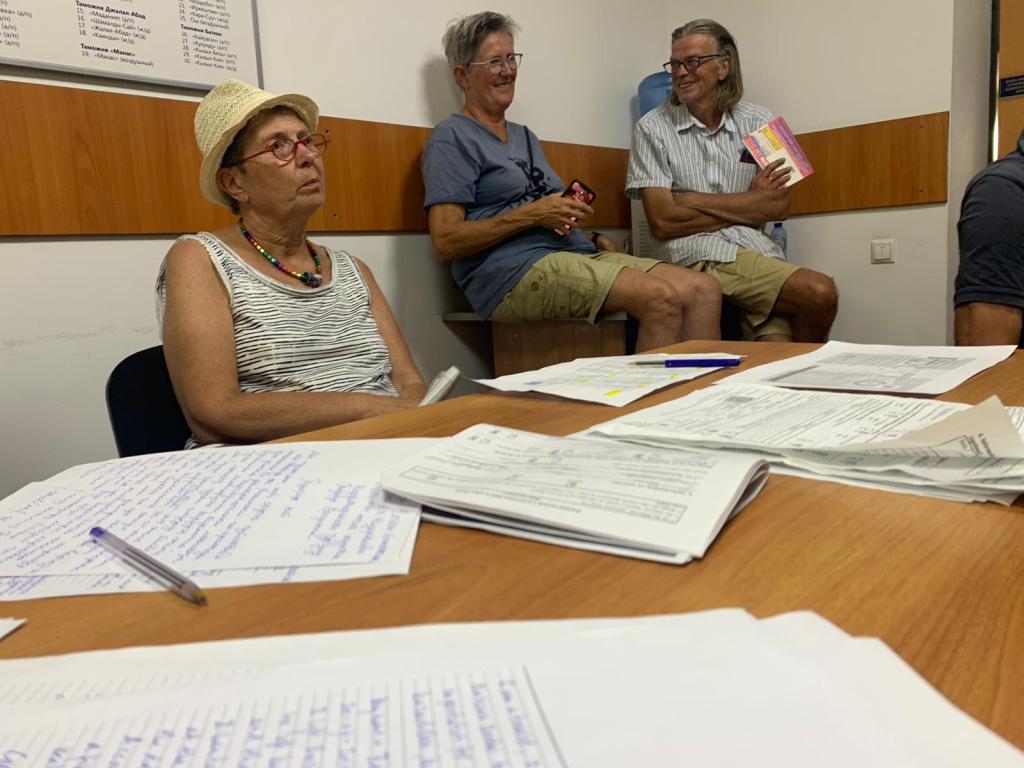
So we leave Kyrgyzstan at midnight and camp straight after the border on the parking lot for taxis. Nobody cares anymore, we are exhausted from the waiting, the incomprehensible form filling, the pushing and shoving we have witnessed all day for the many women who traffic simple goods across the border. We eventually had to get into that crush ourselves and were saved by someone shouting ‘tourists’ leading to us being given preferential treatment.
What a country! We have seen the true nomadic lifestyle, and the change over to a fossil fuel driven economy. The change from a nomadic lifestyle to a sedentary one with dwelling houses is very messy; build quality is extremely poor, often the houses are made of old shipping containers. There is little or no regulation. Apart from police checking the roads for petty traffic offences, the state is completely invisible.
All bets are off for the future of this very poor country. Impossible to predict which way it is going and where it will end up in twenty years time.

 Central Asia Roadtrip
Wat een avonturen. Goed nieuws dat Soene intussen opgeknapt is. Vast lekker om even een paar dagen los van de groep te reizen. De Mog in z’n element, ook als het gaat om de onverwachte troubles. Problemen met elektra zijn vaak moeilijk te achterhalen, niks voor niks ‘ prince of darkness’ . Ongekend hoe gastvrij jullie overal ontvangen worden. We kijken elke dag uit naar nieuwe belevenissen en reports van Lida en jullie. Groeten, Gerard & Aukje.
LikeLike